For Your Consideration #2: The Purge: Anarchy (dir by James DeMonaco)


The_Purge_–_Anarchy_Poster

Yes, I know what you’re saying.

“Seriously, Lisa!?  We should give awards consideration to The Purge: Anarchy!?  Are you serious!?”

Yes, actually I am quite serious.  Notice that I didn’t say that we should necessarily give The Purge: Anarchy any awards or that we should even nominate it.  I just said consideration.  For whatever flaws that The Purge: Anarchy may have, it’s actually one of the better and, in its way, one of the more thought-provoking mainstream American films released this year.  Working within the guise of being a simple genre film, The Purge: Anarchy is one of the few films to give serious consideration to the politics and culture that could both lead to and result from dystopia.

What I’m saying is that — despite what the critics may have said last summer — The Purge: Anarchy is actually one of the most subversive and intellectually curious films released this year.  You just have to be willing to look past all of the action conventions and instead focus on the film’s subtext.

The Purge: Anarchy takes place one year after the end of the first Purge film.  America is still led by the New Founding Fathers and every year, for one night, all crime is legal.  As the national media constantly assures everyone, the Purge is responsible for every good thing about America.  And even though there are a few rebels who claim that the Purge is not necessarily a good thing, most people chose to believe that — as long as it’s government-sanctioned — it’s for the best.

Whereas the first Purge film took place solely inside one family’s house and focused on the domestic melodrama within, The Purge: Anarchy focuses on what goes on outside of the gated sanctuaries of the rich.  As quickly becomes apparent, the Purge is less about purging negative feelings and more about keeping the non-rich, non-white population under control.  While the poor kill each other in the streets, the rich pay for the privilege to kill poverty-stricken “volunteers” in the safety of their own homes.  (Some of the volunteers agree to die out of the hope that their family will be sent some money.  Most are just rounded up on the streets, killed, and forgotten.)

Perhaps even more so than the first film, The Purge: Anarchy works because it feels so plausible.  We live in a society where we are continually told that moral rights and wrongs can be determined by man-made laws.  When a man is filmed being literally choked to death by a pack of police officers, we’re told that it was the man’s fault because he was failing to respect authority and many choose to believe it because “the law is the law.”  (Never mind, of course, whether the law is being fairly applied or makes any sense to begin with.)  If a man in uniform is murdered, it’s rightfully called a crime.  If a man in uniform commits a murder, we’re told it’s simply a part of the job.

And so, that’s why I suggest that The Purge: Anarchy deserves greater consideration than it’s been given.  Yes, it is a genre film and yes, it is an installment in an action franchise.  However, it’s also far closer to the truth than many people are willing to acknowledge.
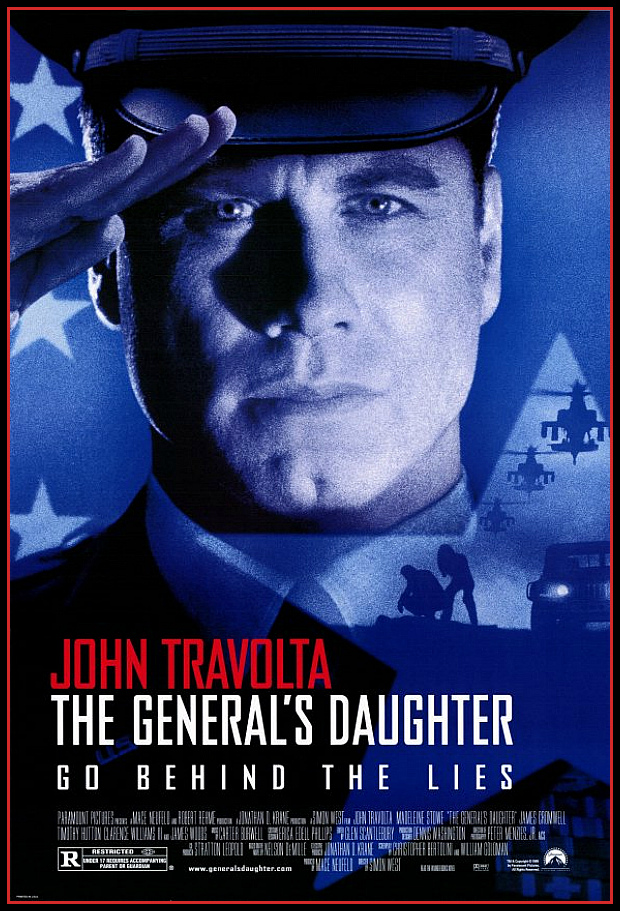
Quickie Review: The General’s Daughter (dir. by Simon West)


The time around the late 1990’s saw a slew of filmmakers who seemed to have been influenced by the filmmaking style of one Michael Bay. In 1998 one such film which had a certain Michael Bay look to it was the crime thriller The General’s Daughter by filmmaker Simon West (fresh off his success from the previous year’s Con-Air). This film adaptation of the Nelson DeMille novel of the same name starred John Travolta when he was still enjoying the second renaissance of his career brought on by his role in Pulp Fiction.

The General’s Daughter was pretty much a crime procedural wrapped around the secretive and insular world of military life. It has Chief Warrant Officer Paul Brenner (played by Travolta) of the Army’s CID investigating what seems to be the apparent rape and murder of a female officer who also happens to be the daughter of the base’s commandant and political-minded general. Brenner’s soon joined by another CID agent, Sara Sunhill (Madeleine Stowe), who must now navigate the insular world which makes up the officer ranks of the military. They find suspects cropping up faster than they could handle and the one prime suspect in base psychologist Col. Moore (James Wood in an over-the-top performance) has secrets about the victim that could jeopardize the lives and career of not just most of the officers on the base but the victim’s own father. This set-up and the basic understanding of the plot should make for a great thriller, but the by-the-numbers direction by Simon West and the over-the-top performances by too many of the characters in the film sinks The General’s Daughter before it could soar.

The story in of itself really has nothing to drag down the film. From the beginning the screenplay does a great job in tossing red herrings to keep the true murderer secret until the very end. It’s these red herrings which manages to bring out the ultimate reason as to the death of Capt. Elisabeth Campbell (Leslie Stefanson) and how a traumatic event in her past became the one major link which would lead to her death early in the film. It’s how these events were acted out which brings down the script. It’s been said that great performances could raise a mediocre script, but the same could be said for the opposite. Very average to bad performances could drag down a great script.

Travolta’s performance was good enough most of the time. He’s especially good when pouring on the Southern charm to try and gain an advantage over those he’s interacting with, but when he suddenly switches over to tough Army investigator that he goes from just beyond campy to over the line into full-blown camp. The same could be said for pretty much everyone in the film from Stowe’s character who manages to just stand around doing nothing but act as a sort of “gal Friday” for Travolta’s character until the very end when she suddenly becomes a crack investigator to help move the plot along. Clarence Williams III really hams it up as the base general’s right-hand man and one would wonder if he realized he wasn’t actually in a grindhouse or exploitation film when it was time to act.

Despite the performances dragging the film down I must admit that The General’s Daughter was quite watchable and entertaining to a certain level. It’s the film’s inadequacies which also makes it quite a disposable fare that should’ve been more. One wonders how the film would be done today with a different set of actors and a filmmaker who knew the nuances of how to navigate around a thriller. Until the inevitable remake from Hollywood gets greenlit (the way things get remade now it’s bound to happen) it’s this version of The General’s Daughter that’d be on record and it’s a film that has too many bad performances for a great screenplay to overcome. A film that ultimately remains mildly entertaining but forgettable in the end.