Horror Film Review: The Walking Dead (dir by Michael Curtiz)


In this 1936 film (which has absolutely no relation to the AMC zombie show), Boris Karloff plays John Ellman.  John Ellman is perhaps one of the unluckiest guys ever.  Seriously check this out:

John Ellman was once an acclaimed concert pianist.  However, he was wrongly convicted of killing his wife and spent ten years in prison.  Now that he’s finally been paroled, he can’t get anyone to hire him.  Meanwhile, the judge who originally sent him to prison is in the news for having defied the mob and sentenced a well-known gangster to prison.  The mob is out for revenge but, rather than take the fall themselves, they’d rather frame a patsy.  And who could be a better patsy than a man who everyone already knows has a grudge against the judge?

Nolan (Ricardo Cortez), a crooked lawyer, arranges for Ellman to be given a job.  Ellman is told that he simply has to spy on the judge for a few nights to determine whether the judge is having an extramarital affair.  Ellman agrees and soon finds himself being set up.  The gangsters kill the judge and plant the body in Ellman’s car.  Ellman is arrested and sentenced to die.  It doesn’t matter that there are witnesses who know that Ellman’s innocent.  No one is willing to cross the mafia.

Ellman is convicted and promptly executed but his story isn’t over.  A scientist named Dr. Beaumont (Edmund Gwenn, who later played the man who might be Santa Claus in Miracle on 34th Street) knows that Ellman is innocent.  He takes Ellman’s body and, through an artificial heart and a bunch of other science-y things, he manages to revive Ellman.  John Ellman lives again!  Of course, he’s a bit of a zombie now and he doesn’t have any memory of his former life.  And yet, he instinctively knows who set him up to be executed and he sets out for revenge.

What’s interesting is that Ellman doesn’t kill anyone.  Even after he’s revived and presumably has no concept of right and wrong, John Ellman remains a rather passive zombie.  For the most part, the racketeers die because of how they react to the sight of the previously dead Ellman coming towards them.  For that matter, Beaumont isn’t the typical mad scientist that you might expect to turn up in a film like this.  He’s a benevolent man who was simply doing what he thought was the right thing.  Though the film ends with a warning about playing God, one can’t hep but get the feeling that, unlike Frankenstein, the film is overall very supportive of the idea of reviving the dead.

Directed by Michael Curtiz (who also did Casablanca, Mildred Pierce, The Adventures of Robin Hood, and countless other classic films), The Walking Dead is a combination horror/gangster film.  The film’s plot is a bit too convoluted for its own good but, overall, The Walking Dead works because of Boris Karloff’s performance.  He’s poignantly pathetic as the living John Ellman and then rather chilling as the vengeance-driven, recently revived Ellman.  The film’s most effective scenes are the ones where he just stares at his enemies, fixing them with a gaze that takes no prisoners and offers no hope.  It’s a great performance that elevates an otherwise uneven film.
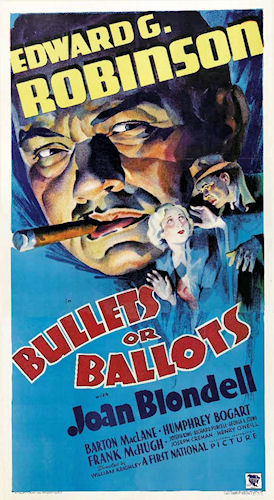
A Movie A Day #180: Bullets or Ballots (1936, directed by William Keighley)


Johnny Blake (Edward G. Robinson) was one of the toughest cops in New York City, until he punched out his new captain (Joe King) and was kicked off the force.  That punch was witnessed by racketeer Al Kruger (Barton McLane).  Kruger has long wanted to get Blake to join his organization and, with Blake now out of work, Kruger makes an offer.  Blake goes to work for Kruger, much to the consternation of Kruger’s second-in-command, Bugs Fenner (Humphrey Bogart).  Bugs says that anyone who was once a cop will always be a cop.  Bugs is right.  Blake is working undercover, trying to expose and take down the mob from the inside.

Bullets or Ballots is an entertaining if predictable gangster film from the 1930s.  After making his career playing bad guys, Robinson makes the transition to the side of law and order without losing any of his trademark attitude.  Bogart plays one of the many remorseless killers that he played before Casablanca reinvented him as a hero.  Bullets or Ballots may be predictable but it’s impossible not to enjoy watching Robinson and Bogart snarl hard-boiled insults at each other.

Second-billed Joan Blondell does not have much screen time but her role is still an interesting one, as a tough businesswoman who runs a numbers racket with her former maid (played by Louise Beavers).  I would have enjoyed seeing a full movie just about Blondell’s character but she mostly takes a back seat to Robinson and Bogart.

Unfortunately, unlike Little Caesar, The Public Enemy, and Scarface, Bullets or Ballots was made after Hollywood started to enforce the infamous Production Code and, as a result, Bullets or Ballots never reaches the gritty, violent heights of those earlier films.  Still, fans of Robinson, Bogart, and Blondell will find much to enjoy here.

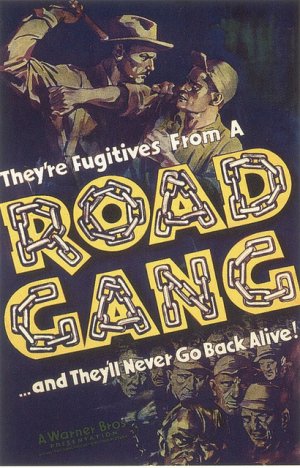
Lisa Cleans Out The DVR: Road Gang (dir by Louis King)


I was going to start this review with a quote from Gandhi: “A nation’s greatness is measured by how it treats its prisoners.”  That was something that I first heard from a perpetually stoned ex-seminarian who used to live in a trailer park in Lake Dallas.  I always figured that, being as stoned as he usually was, he probably knew what he was talking about but, upon doing research for this review, I have discovered that Gandhi actually didn’t say that.  What Gandhi said was, “A nation’s greatness is measured by how it treats its weakest members.”  Fortunately, it’s the same basic idea and, regardless of how you phrase it, it’s a quote that perfectly encapsulates the message of the 1936 film, Road Gang.

Road Gang tells the story of Jim (Donald Woods) and Bob (Carlyle Moore, Jr.).  Bob is fun-loving.  Jim is more serious and engaged to marry heiress Barbara Winston (Kay Linaker).  Jim and Bob live in an unnamed Southern state (though I’m going to assume that the state is supposed to be Georgia, just because).  Jim has just written an article that exposes the corruption of political boss, J.W. Moett (Joe King).  The article is so good that both Jim and Bob have been offered jobs in Chicago!  There’s a lot of corrupt political figures who can be exposed in Chicago!

However, while driving up north, Jim and Bob are arrested on trumped-up charges.  At first, Jim and Bob laugh off Moett’s desperation but, unfortunately, another criminal happens to be breaking out of jail at the same time that Jim and Bob arrives for booking.  That criminal kills the arresting officer and then forces Jim and Bob to drive him across the state.  Eventually, the police recapture the three of them.  However, the escaping criminal is killed and Jim and Bob are arrested as accessories.  Under the advice of their lawyer, Mr. Dudley (Edward Van Sloan), they plead guilty and accept a deal.  What they don’t know is that Dudley works for Moett and that, as a result of pleading guilty, they are going to be sentenced to five years in a prison camp.

Okay, so the film gets off to a pretty melodramatic start.  And, to be honest, the entire film is extremely melodramatic.  A lot of time is devoted to Barbara trying find evidence that Jim and Bob were set up, something that is made difficult by the fact that Barbara’s father, like Mr. Dudley, works for Moett.  Fast-paced and not-always-logical, this is a B-movie, in every sense of the term.

And yet, as melodramatic as it is, Road Gang is deadly serious when it comes to portraying the brutality of the prison camp.  From the minute that Bob and Jim arrive, they find themselves at the mercy of the corrupt warden and his sadistic guards.  The prisoners are largely used as slave labor and subjected to punishments that are often arbitrary and extreme.

Road Gang doesn’t flinch when it comes to portraying why prison often not only fails to rehabilitate but also helps to transform minor offenders into hardened criminals.  There’s a disturbing scene in which Jim, Bob, and the other prisoners are forced to listen as another prisoner is whipped.  The crack of the whip and his howls of agony explode across the soundtrack in a symphony of pain and sadism.  Jim and Bob have two very different reactions to being in prison.  One survives.  One allows himself to be killed rather than take one more day in confinement.

Road Gang is often compared to I Am A Fugitive From A Chain Gang.  Actually, beyond the theme of a fatally compromised justice system, there is no comparison.  The angry and fact-based I Am A Fugitive From A Chain Gang is a hundred times better and, quite frankly, Donald Woods was no Paul Muni.  However, Road Gang still has its moments of power.  Decades after it was made, the issues it raises continue to be relevant.  Do we send people to prison to rehabilitate them or to punish them and are the two goals mutually exclusive?  And how can we say that someone has “paid his debt to society” when, even after a prisoner serves his time, the stigma of having been imprisoned closes and locks most doors of opportunity?

Road Gang shows up occasionally on TCM.  There’s where I recorded it on January 23rd of this year.