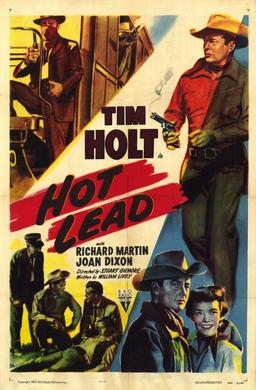
Hot Lead (1951, directed by Stuart Gilmore)


In this B-western programmer, Dave Collins (Ross Elliott) has just been released from prison.  Because he knows how to operate a telegraph, outlaw Turk Thorne (John Dehner) tries to force Dave to get a job at a local telegraph office so that Turk can use his skills to rob a train.

Despite wanting to go straight, Dave also doesn’t want to get full of hot lead.  He rides into town and gets a job at the ranch owned by Gail Martin (Joan Dixon).  He is befriended by Gail’s two ranchhands, serious cowboy Tim Holt (played, believe it or not, by Tim Holt) and his comedy relief sidekick, Chito Rafferty (Richard Martin).  Tim and Chito want revenge on Turk for killing one of their friends during a previous train robbery.  Working with Dave, they set a trap for Turk and his gang.  Meanwhile, Dave falls in love with Gail.

Hot Lead was one of the last of the 46 B-westerns that Tim Holt made for RKO Pictures.  Holt started out playing the type of prototypical happy, go-lucky cowboys who were popular in the 1930s.  At that time, he was unique as one of the few western stars to not play a continuing character who was named after him.  While the studios promoted other western stars as essentially playing themselves, Tim Holt was promoted as being a serious actor.  Holt’s films were popular with audiences but his career was put on hold while he served in World War II.  Post-war, Holt played characters who were far more world-weary than his earlier cowboys and he also started to play characters who were specifically named “Tim Holt.”

Even though most of Holt’s later films were uneven in quality, Hot Lead is one of the better examples of the genre.  Whether happy or serious, Tim Holt was always a convincing cowboy and he brings his natural gravitas to the role, playing his character as being the type of serious and no-nonsense cowboy that anyone would want in their corner.  John Dehner was always a good villain and Ross Elliott is equally good as the man struggling not to go back to his old ways.  The action scenes and the gunfights are well-directed and the story even carries an important message about giving people second chances.  Not bad for a B-western!
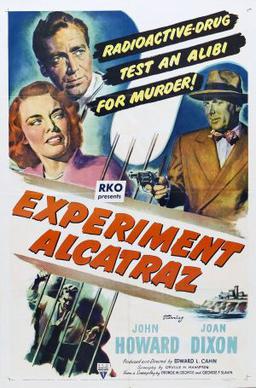
Experiment Alcatraz (1950, directed by Edward L. Cahn)


Dr. Ross Williams (John Howard) has a theory that injecting patients with a radioactive isotope can be used to treat a serious blood disease.  However, he needs people on which to test his theory and, since it involves radiation, volunteers aren’t exactly lining up.  Finally, five prisoners at Alcatraz agree to be used as test subjects in return for early parole.  The prisoners are whisked off to a military where Williams and nurse Joan McKenna (Joan Dixon) oversee the experiment.  Joan has her own reasons for hoping that Williams’s treatment is a success.  Her own brother is currently dying of the disease.

Unfortunately, things go terribly wrong when one of the convicts, Barry Morgan (Robert Shayne), grabs a pair of scissors and stabs another prisoner to death.  Morgan claims that he was driven mad by the treatment and, as a result, the experiments are canceled.  Both Joan and Dr. Williams are convinced that Morgan had another reason for killing the prisoner.  With Morgan and his cronies now free, Williams launches his own investigation into what happened.

Experiment Alcatraz starts out with an intriguing premise but then settles into being a typical B-crime film.  Robert Shayne does a good job playing the viscous criminal but Morgan’s motives for committing the murder turn out to be fairly predictable and the story’s conclusion won’t take anyone by surprise.  Howard and Dixon are competent leads but both are playing dull characters and too much of the film’s story depends on getting the audience to believe that a potentially revolutionary medical treatment would be tested in a thoroughly haphazard manner.  Worst of all, despite the title, there’s very little Alcatraz to be found in Experiment Alcatraz.  The prisoner leaves the prison early and never look back.

Experiment Alcatraz is one of the many films to be directed by the incredibly prolific and fast-working Edward L. Cahn.  Between 1931 and 1962, Cahn is credited as having directed 127 movies.  In 1961 alone, he directed 11 feature films!  1950 was actually a slow year for Cahn.  Including Experiment Alcatraz, he only directed 5 films that year.  As you can guess with that many movies, Cahn’s output was uneven.  For every Experiment Alcatraz, there was an It!  The Terror From Beyond Space.  Despite a promising premise, Experiment Alcatraz is one of Cahn’s more forgettable films.

30 More Days Of Noir #1: Bunco Squad (dir by Herbert I. Leeds)


Welcome to Noirvember!

Yeah, yeah, I know.  That sounds kinda silly, doesn’t it?  However, November is traditionally the month that classic film bloggers tend to concentrate on writing about film noir.  It provides a bit of grit and cynicism in between the horror fun of October and the holiday schmaltz of December.

I have to admit that I’m a little bit torn when it comes to taking part in Noirvember.  On the one hand, I love a good film noir and there’s quite a few obscure and underrated ones available on YouTube right now.  On the other hand, as a natural-born contrarian, I don’t like the idea of hopping on any bandwagons.

In the end, my love of film noir won out.  So, welcome to my first entry in 30 More Days of Noir.

The 1950 film, Bunco Squad, tells the story of Tony Weldon (Ricardo Cortez), a con man who specializes in using a phony psychic routine to swindle rich people out of their money.  He runs a fake enlightenment center and he claims that he can speak to the dead.  His latest target is the wealthy Jessica Royce (Elisabeth Risdon).  After he finds out that her son was killed during the invasion of Normandy, he and his associates go out of their way to trick her into believing that Tony can contact her son and that her son wants her to leave all of her money to Tony’s organization.  It’s actually kind of interesting watching as Tony and his gang manage to track down information about Jessica and her son, asking the most mundane of questions to find out things that Jessica believes only her son would know.  Watching Tony operate, I was reminded of those documentaries and news reports that you see about phony faith healers and other people who claim they can speak to the dead but who actually just go on very vague fishing expeditions.  (“I’m sensing something about the letter L.  Does that mean anything to you?”)

Tony is not just a con artist.  He’s also a murderer, one who specializes in cutting brake lines on cars.  If you try to expose Tony, you’re probably going to end up driving off of a cliff.  I guess you can get away with that when you’re a con artist in California.  Myself, I live in North Texas where the land is totally flat.  Someone could cut my brake lines and I would probably just keep going forward until I eventually ran out of gas.  Once that happened, someone would probably pull over and offer to give me a lift to the nearest gas station.  That’s one reason why someone like Tony Weldon could never pull off any of his crimes in my home state.

Fortunately, the detective of the LAPD’s Bunco Squad know what Tony’s doing.  The only problem is that they have to get some proof that Tony is swindling Ms. Royce and they have to manage to do it before Tony gets a chance to tamper with all of their brakes.  Leading the Bunco Squad is Steve Johnson (Robert Sterling) and you better believe that there’s no way someone named Steve Johnson is going to be anything other than honest and upright.  Working with a real-life magician named Dante, Johnson attempts to expose all of Tony’s tricks.

It’s probably open for debate whether or not Bunco Squad is a true noir.  On the one hand, Tony and his schemes are very noirish.  On the other hand, Steve and the members of the Bunco Squad are so upright that there’s none of the ambiguous morality that you find in the best film noirs.  I guess I would call this a half-noir.

The best thing about Bunco Squad is that it’s only 67 minutes long, which is all the time that it needs to tell a compact and occasionally interesting story.  There’s no excessive padding to try to force the story out to an unwieldy 90 minutes.  Instead, Bunco Squad jumps right into its story and it doesn’t let up until things come to an end.  The other good thing about Bunco Squad is that you’ve got Ricardo Cortez, giving a charmingly evil performance as Tony Weldon.  The film’s heroes are a pretty dull bunch but Cortez brings a nice charge of danger to the proceedings.

Bunco Squad is an obscure film but it moves quickly and the story is interesting enough to hold your attention for an hour.  It can be found on YouTube.