Over the past few years, I’ve seen some extremely depressing animated films.
I cried during the first fifteen minutes of Up. I cried during the final ten minutes of Toy Stories 3 and 4. Actually, now that I think about it, I think I’ve sobbed through every single PIXAR film, with the exception of the movies about the talking cars and the one about the good dinosaur. My point is that I’m not one of those people who automatically assumes that, just because a film is animated, it’s necessarily going to make me laugh. I fully understand that not all animated films are for children and that a cartoon can be just as serious and dark as a live action movie.
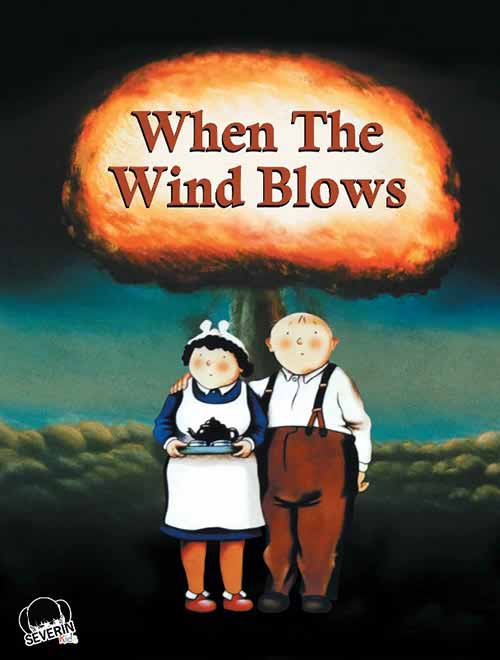
That said, I don’t think anything could have prepared for the 1986 film, When The Wind Blows. To say that When The Wind Blows is bleak would be an understatement. Is When The Wind Blows a depressing film? Yes, you could say that. It’s a film about an elderly couple facing the end of the world with optimism and a never-ending faith that things will turn out okay. This is the most trusting couple in the world and, in the end, they end up crawling into their own separate potato sacks, where they struggle to recite the Lord’s Prayer as they both die a slow and painful death. It’s not just that When The Wind Blows is depressing. It’s also that it’s a film that takes place in a world bereft of hope. It’s a film that has a message but, at the same time, it also seems to be convinced that it’s a message to which no one will bother to listen.
Jim and Hilda Bloggs (voiced by John Mills and Dame Peggy Ashcroft) are a loving couple who own a rather nice cottage in rural England. They’re very content in their life and more than a bit complacent. They have faith that both the milk and the paper will be delivered every morning. Hilda has a nice garden going. Jim regularly takes the bus down to the library, where he reads the newspapers and picks up pamphlets about what to do in case of a nuclear attack. When the news comes over the radio that Britain will probably be attacked in 3 days, Jim industrially sets out to make a shelter for himself and Hilda.
It’s not much of a shelter. In fact, it’s really just two doors leaning against a wall. However, Jim and Hilda are simply following the instructions that they found in a government-printed pamphlet and both of them have a good deal of faith in the “power that be.” As they wait for the war to break out, they remember just how much they enjoyed World War II. Everyone was in it together during World War II! And Jim has faith that everyone will continue to be in it together during this latest war.
The bomb eventually drops. The animation, which previously had the feel of an old school Christmas special, becomes dark and ominous as the world around Jim and Hilda’s house erupts into flames. Jim and Hilda hide in their little shelter. Though the pamphlets say that they shouldn’t leave the shelter for at least two weeks, Jim and Hilda leave within a few hours. They walk around outside and look at the charred remains of the garden. Hilda wonders what fallout looks like. Jim isn’t sure.
And, at this point, we know they’re both as good as dead. (Interestingly enough, it does appear that they survived longer than their neighbors, who perhaps did not hide behind a door.) The rest of the film is essentially watching Jim and Hilda waste away while remaining convinced that someone from the government is going to come and save them. You find yourself wondering if the two of them are really as naive as they seem or if they’re both in a shared denial about what’s happened. It’s probably a combination of the two.
It’s an undeniably effective film. It not only works as an anti-war film but also as an anti-government film. Both the Left and the Right will find things to appreciate in the film’s story. But my God is it ever a depressing movie. It’s a well-made film that I’ll probably never voluntarily watch again.
 19
19


 Through the Shattered Lens