The Fabulous Forties #49: Tulsa (dir by Stuart Heisler)


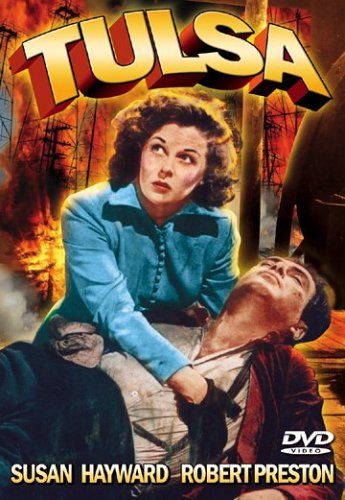
Tulsa_DVD_Cover

The 49th film in Mill Creek’s Fabulous Forties box set was the 1949 “epic” Tulsa!

I put epic in quotation marks because Tulsa is only 90 minutes long and I personally don’t think you can really have an epic unless you also have epic length.  Giant is an epic, whereas Tulsa is an “epic.”  That said, Tulsa does have a goal worthy of an epic.  Tulsa is about oil and the men and women who sacrifice so much to get that oil out of the ground.  Some of them lose their lives, some of them lose their happiness, and some of them make a lot of money.  I know that makes this film sound a lot like There Will Be Blood but it’s really not.  There Will Be Blood is an epic.  Tulsa is an “epic.”

I have to admit that I was intrigued by this film, just because my family lived in Tulsa for a handful of months, way back when I was 9 years old.  That said, I did groan a little bit when the film opened with a folksy guy named Pinky Jimpson (Chill Wills) standing in front of a white fence and staring straight at the camera.  “Howdy, cousins,” Pinky says, before launching into a monologue about how Oklahoma is the greatest place on Earth.  As a Texan, I was legally required to roll my eyes at Pinky’s claims but, to be honest, Oklahoma’s a pretty nice place.  It’s certainly better than Vermont.

(Take that, Vermont!)

Anyway, once the story gets started, we discover that it’s about Cherokee Lansing (Susan Hayward).  After Cherokee’s rancher father is killed when an oil derrick falls over on him, she decides to get her revenge by entering the oil business herself.  At first, everyone is doubtful that a woman — especially a woman whose only apparent friend is a Native American named Jim Redbird (Pedro Armendariz) — can succeed in a man’s world.  But she proves them wrong by befriending eccentric oilman John Brady (Ed Begley).  After Johnny is killed in a bar fight (because Tulsa is a dangerous place), he leaves all of his land and drilling rights to Cherokee.  He also leaves behind a far more sober-minded son, Brad (Robert Preston), who goes into business with Cherokee.

Soon, Cherokee and Jim Redbird are rich and powerful.  But, as often happens, they are in danger of losing sight of why they wanted to become rich and powerful in the first place.  Jim, in particular, turns out to be a big ol’ sellout.  Brad is disgusted with all of them but then, fortunately, there’s a big oil fire which leads to a lot of stuff blowing up and everyone learning an important lesson…

Or, at the very least, Pinky assures us that they all learned a lesson.  He also talks about how everything in the world now runs on oil.  He mentions that you can get oil from other parts of the world but the best oil comes from Tulsa.

(And again, as a Texan, I am contractually obligated to roll my eyes while noting that people from Oklahoma are some of the nicest folks that you’ll ever meet…)

Anyway, as a film, Tulsa never quite works.  90 minutes isn’t enough time to tell the story that it’s trying to tell and some of the acting is rather inconsistent.  However, the fire at the end is still impressive (Tulsa’s special effects received an Oscar nomination.) and I enjoyed watching Susan Hayward go totally over-the-top in role of Cherokee.  Compared to her subtle and kind of depressing performance in Smash-Up, Hayward actually appears to be having fun in Tulsa and good for her!

Tulsa was the 2nd to last film in the Fabulous Forties box set.  In my next review, I will conclude this series by taking a look at Lady of Burlesque!
The Fabulous Forties #46: The Town Went Wild (dir by Ralph Murphy)


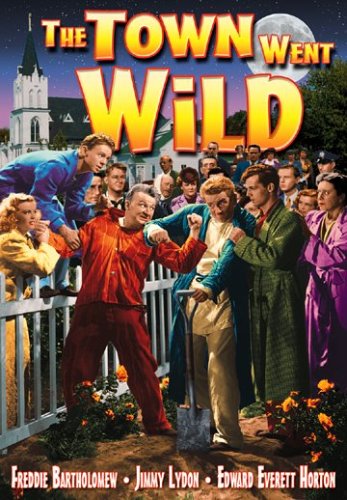
51BRWYTCMZL

The 46th film in Mill Creek’s Fabulous Forties box set was 1946’s The Town Went Wild!  Nice name, huh?

The name is actually a lot nicer than the movie, which is a bit incoherent.  Basically, David (Freddie Bartholomew) is a nice guy who has lived his entire life in the small town.  His best friend is Bob (Jimmy Lydon) and David is also in love with Bob’s sister, Carol (Jill Browning).  David is an engineer who has just been assigned to go work in Alaska.  Before he leaves, he is determined to marry Carol.

Unfortunately, Bob’s father (Edward Everett Horton) and Carol’s father (Tom Tully) hate each other.  They have been feuding for so long that they’re not even sure what they’re feuding about.  However, Carol and David are determined to get married so they decided to elope.  Getting a ride from their friend Mille (Roberta Smith), they go to the next town over and ask the justice of the peace to marry them,

However, before the justice of the peace can marry them, he needs them to publicly post their wedding plans in the local newspaper.  And before David can post those plans, he needs to get his birth certificate from the local registrar.  When David gets his birth certificate, he discovers something shocking.  There was a mix-up at the hosptial!  His Dad went home with the wrong baby.  David is actually … CAROL’S BROTHER!

So, what can they do?  How can David and Carol still get married despite apparently being related?  And will the fathers be able to set aside their feud long enough to help their children out?  The entire town wants to know!

I have to admit that I’m struggling a bit to come up with anything to say about The Town Went Wild.  The movie is a mess and David and Carol are such boring characters that they even make incest look dull.  Unfortunately, the version I saw of The Town Went Wild suffered from one of those infamously cheap Mill Creek transfers, complete with grainy picture, inconsistent sound, abrupt cuts, and the sneaky suspicion that certain scenes did not make the transfer from film to video.

With all that in mind, it’s hard to fairly judge The Town Went Wild but I can say that at least it provided good roles for Edward Everett Horton and Tom Tully.  If nothing else, these two character actors appeared to enjoy playing loud and frequently stupid rivals.  Otherwise, The Town Went Wild is one of those poverty row films that can safely be forgotten.

The Fabulous Forties #43: The Sin of Harold Diddlebock (dir by Preston Sturges)


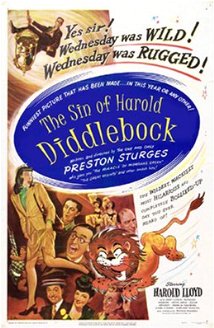
Film1947-TheSinOfHaroldDiddlebock

The 42nd film in Mill Creek’s Fabulous Forties box set was a 1947 comedy called The Sin of Harold Diddlebock.

As a classic film lover, I really wish that The Sin of Harold Diddlebock was better than it actually is.  The film was a collaboration between two of the biggest names in cinematic comedy history: director/writer Preston Sturges and legendary actor Harold Lloyd.  In fact, this was the first film that Sturges directed after leaving the studio system so that he could make bring his unique brand of satire to life without having to deal with interference.  He managed to convince Harold Lloyd to come out of retirement to star in the movie and the film even works as a quasi-sequel to one of Lloyd’s most beloved silent comedies, The Freshman.  In a perfect world, The Sin of Harold Diddlebock would have been a comedy masterpiece that would have perfectly shown off the talents of both men.

Unfortunately, that’s really not the case.  The Sin of Harold Diddlebock is consistently amusing but it’s never quite as funny as you want it to be.  This is one of those films that sounds like it should be hilarious but, when you actually watch it, you see that the film is oddly paced and Lloyd never seems to be fully invested in his role.  I suppose the natural inclination would be to blame this on interference from the notoriously eccentric Howard Hughes, who co-produced the film with Sturges.  After Harold Diddlebock failed at the box office, Hughes withdrew it and spent three years personally reediting the film before re-releasing it under the title Mad Wednesday.  However, by most reports, Hughes wasn’t really the problem.  If Wikipedia is to be believed (and God do I hate starting any sentence with that phrase), Lloyd and Sturges did not have a good working relationship.  As sad as that is, it’s also understandable.  Geniuses rarely work well together.

The Sin of Harold Diddlebock does get off to a good start, seamlessly incorporating the last reel of The Freshmen with footage shot for Harold Diddlebock.  (Somewhat sweetly, the film starts with a title card informing us that the what we are about to see was taken from The Freshman.)  After college freshman Harold Diddlebock scores the winning touchdown in a football game, impressed advertising executive J.E. Waggleberry (Raymond Walburn) offers Harold a job.  However, Harold wants to finish college so Waggleberry tells Harold to look him up in four years.

Four years later, recently graduated Harold goes to Waggleberry for a job and discovers that J.E. Waggleberry has totally forgotten him.  Harold ends up working in the mailroom but is told that, as long as he is ambitious and smart, he will easily move up in the company.  22 years later, Harold is still working in the mailroom.  He is secretly in love with Miss Otis (Frances Ramsden).  Of course, he was also in love with each of Miss Otis’s six older sisters, all of whom worked at the company before the current Miss Otis.  Harold bought an engagement ring when the oldest Otis sister was with company.  Years later, he’s still carrying it with him and dreams of giving it to the current Miss Otis.

However, that might be difficult because Harold has just been fired.  J.E. Waggleberry feels that Harold’s unambitious attitude is setting a bad example.  As severance, Harold is given a watch and $2,946.12.

The normally quiet and reserved Harold reacts to losing his job by doing something very unusual for him.  He goes to a bar and, with the help of a con man (Jimmy Conlin) and a bartender (Edgar Kennedy), he gets drunk.  The bartender even creates a special drink called the Diddlebock.  Harold drinks it and wakes up two days later, wearing a huge cowboy hat and owning a bankrupt circus…

And it only gets stranger from there….

While The Sin of Harold Diddlebock doesn’t quite work, I appreciated the fact that it not only created its own surreal world but that it just kept getting stranger and stranger as the film progressed.  It was Harold Lloyd’s final film and there’s even a scene where he and a lion end up on the edge of a skyscraper that’s almost as good as the famous comedic set pieces from his silent classics.  It’s a pity that the film doesn’t really come together but I’d still recommend seeing it just for history’s sake.

The Fabulous Forties #2: Second Chorus (dir by H.C. Potter)


I’m currently in the process of watching and reviewing all 50 of the films in Mill Creek’s Fabulous Forties DVD box set.  Yesterday, I got things started by reviewing Port of New York.  Today, I’m looking at the set’s 2nd film, 1940’s Second Chorus.

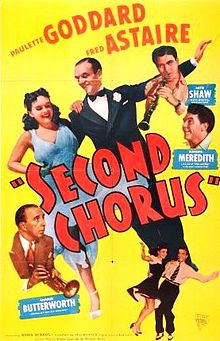
Second_Chorus_poster

As much as I love all of my Mill Creek box sets, watching Second Chorus reminded me of one of the drawbacks of watching a Mill Creek release.  Since Mill Creek specializes in films that have fallen into the public domain, a lot of their DVDs are more than a little rough.  The Mill Creek version was obviously transferred from a seriously deteriorated print.  As a result, the picture is often dark or blurry while the sound is occasionally iffy at best.  That’s a shame because Second Chorus is an entertaining little film.

In Second Chorus, Fred Astaire and Burgess Meredith both play college students.  (Burgess is the wacky one while Fred is … well, he’s Fred Astaire.  He’s confident, he’s suave, and he’s always ready to perform.)  Fred appears to be in his late 30s while Burgess looks closer to 50 but, fortunately, their age is meant to be a part of the joke.  Fred and Burgess have intentionally failed their final exams for seven years so that they can stay in school and continue to lead the college jazz band.  They are perennial college students and who hasn’t known a few of them?  (Apparently, in 1940, there was no such thing as academic suspension.)

When a debt collector comes looking for them (apparently, Burgess bought a set of encyclopedias that he never paid for), Fred manages to charm the collector’s secretary (Paulette Goddard) away from him.  Paulette agrees to serve as Fred and Burgess’s manager and even manages to get them a job with real-life band director Artie Shaw.  (Shaw plays himself and seems to be perpetually annoyed whenever he’s on screen.)  Will Fred finally accept some responsibility, act maturely, hold down a job, and maybe win the heart of Paulette Goddard?

Now, I should point out that, while I enjoyed Second Chorus, Fred Astaire apparently considered Second Chorus to be the worst film that he ever made.  While Second Chorus is definitely no Top Hat, I think that Fred Astaire was being a little too harsh in his assessment. The music is good, the dancing is fun to watch, and the plot … well, who really cares about the plot? It’s undoubtedly a silly film that has very little going on underneath the surface but Astaire and Meredith make for a surprisingly effective comedy team.

And while nondancer Paulette Goddard may not have had as effective a chemistry with Fred as Ginger Rogers (but then again, who did?), I still loved watching them perform the I Ain’t Hep To That Step But I’ll Dig It number.  This entire number was reportedly filmed in one take.  Goddard had little dance experience but it didn’t matter because her partner was Fred Astaire and Fred was so good that he could make anyone look like a natural.

Second Chorus is an entertaining little movie.  Just avoid the Mill Creek transfer.