Retro Television Review: Homicide: Life On The Street 4.16 “Stakeout”


Welcome to Retro Television Reviews, a feature where we review some of our favorite and least favorite shows of the past!  On Sundays, I will be reviewing Homicide: Life On The Street, which aired from 1993 to 1999, on NBC!  It  can be viewed on Peacock.
This week, the detectives take over someone else’s house.

Episode 4.16 “Stakeout”

(Dir by John McNaughton, originally aired on March 15th, 1996)

When a young man confesses to helping an older man carry out a series of murders, the Homicide Squad stakes out the older man’s house.  Jim True-Frost and Kate Walsh play the owners of the home that the squad takes over.  The husband is out of work.  The wife has a habit of oversharing.  While they try to adjust to having cops hanging out in their living room, the detectives adjust to the idea that Bayliss may be leaving them.

Once again, Bayliss is thinking about leaving Homicide.  This has been a recurring theme with Bayliss, ever since he failed to close the Adena Watson case.  (In this episode, he mentions that his number one suspect — Risley Tucker — has recently died.)  Bayliss’s complaint is that he still feels like he barely knows the other detectives.  He mentions that he’s never even been to Pembleton’s house.  Pembleton asks if Bayliss is really that surprised that Pembleton might want time to himself when he’s not on the clock.  Bayliss talks about how the Vice Squad regularly has barbecues.  He talks about the comradery that he felt when he was on the Governor’s security detail.  But Homicide tends to attract the misanthropes and the eccentrics.

Of course, Bayliss doesn’t leave Homicide.  At the end of the episode, he takes one look at the board and sees that he still has one open case.  “I can’t leave until the Lambert case is closed,” Bayliss says while Pembleton smiles.

Giardello, meanwhile, is struggling with the knowledge that his daughter is getting married to a man that he’s never even met.  Giardello has been invited to the wedding in San Francisco but he keeps finding excuses not to go.  Pembleton finally convinces Giardello that he needs to go to his daughter’s wedding.  Unfortunately, when Giardello arrives at the airport, he’s told that all flights have been grounded due to the weather.  So, Giardello misses the wedding regardless.

Eventually, the killer returns to his home.  He’s a stout man who looks like he should be selling insurance.  Bayliss and Pembleton arrest him and the stakeout ends.  The husband, who has been out looking for a job, pulls up just as Bayliss and Pembleton are leaving.  Life goes on for everyone but the dead.

This episode was okay.  I appreciated that it was a return to the character-driven drama of the earlier seasons.  The snowy imagery brought a lot of atmosphere to the episode and director John McNaughton (of Henry: Portrait of a Serial Killer fame) did a good job framing scenes that could have come across as being excessively talky in lesser hands.  That said, the husband and the wife were not that interesting and I never really bought the idea that they would pour out all of their marital woes to a bunch of strangers in their living room.

This is my final Homicide review for 2025.  Retro Television Reviews is taking a break for the holidays!  Homicide will return on January 11th, 2026.
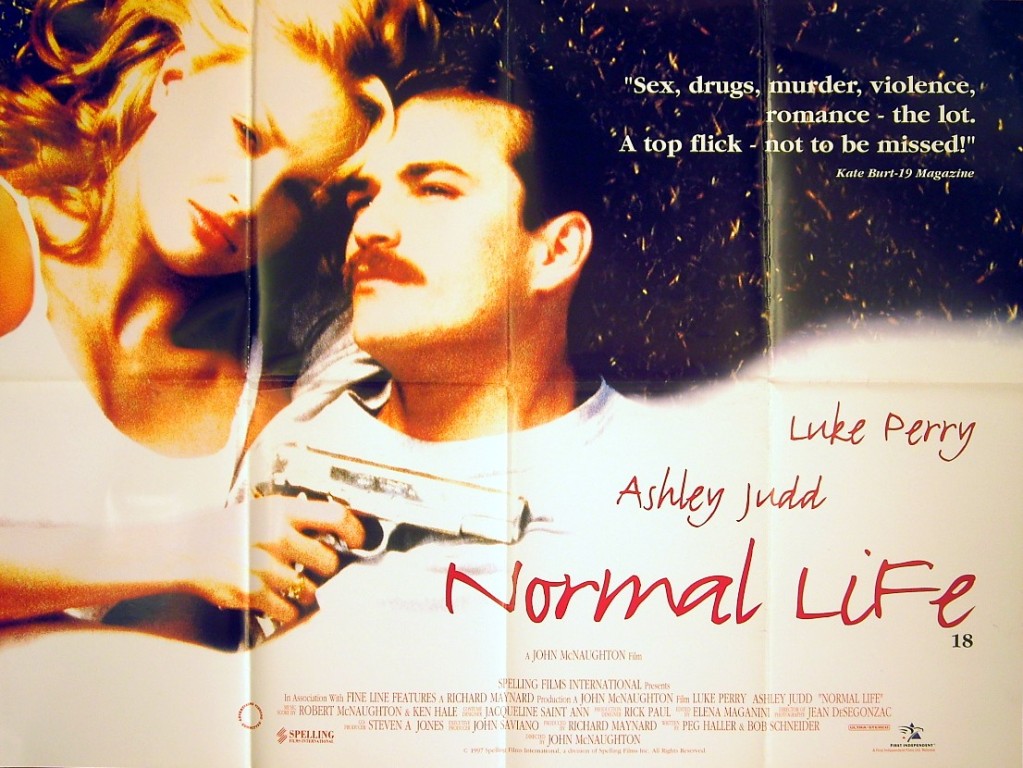
Embracing the Melodrama #44: Normal Life (dir by John McNaughton)


Digital StillCamera

Out of all the sin-in-the-suburbs films that I’ve watched recently, 1996’s Normal Life is one of the best.  Judging from the lack of reviews of this film online, it also appears to be one of the least known.  So, allow me to rectify that by telling you a little about Normal Life.

In Normal Life, Luke Perry plays Chris Anderson, a seemingly naive police officer.  From the minute that we first see Chris, it’s obvious that he’s a cop.  With his thinning hair, his anonymous mustache, and his deliberately calm and controlled manner, there’s no way that Chris could be anything else.

One night, Chris goes out to a bar and sees Pam (Ashley Judd) getting into a fight with her date and cutting her hand.  Chris, playing the hero, bandages it and then asks her for a dance.  For him, it’s love at first sight.  Soon, Chris is taking Pam on dates to the shooting range and, before you know it, they’re married.  Pam, it soon becomes obvious, is emotionally unstable.  She deals with disagreements by threatening to kill herself and trashing the apartment that she shares with Chris.  She makes little secret of how little respect she has for Chris’s family and she often goes out of her way to embarrass him.  However, Chris will never leave her because he’s in love with the idea of being the only one who can save her.  And, even though Pam may not admit it, she wants to be saved.  Chris gives her stability while Pam gives Chris a taste of excitement that his life would otherwise lack.

Unfortunately, even after Chris loses his job, Pam continues to spend money extravagantly.  Soon, in order to support his wife, Chris starts to utilize his law enforcement experience by robbing banks.  Now that they finally have money, they are able to move to a perfect house in the suburbs and Chris is able to pursue his lifelong dream of opening and running a small used bookstore.

However, Pam eventually discovers that Chris is a bank robber and soon decides that she wants to rob a bank with him.  Chris knows that it’s a mistake to involve the unpredictable Pam but, as the film makes clear, he will always chose her happiness over everything else…

Normal Life was directed by John McNaughton, who also directed the seminal serial killer film Henry: Portrait of a Serial Killer.  And while Normal Life is a far less disturbing film than Henry, it does utilize a similar technique of emphasizing just how banal Chris’s suburban lifestyle really is.  When Chris isn’t robbing banks or dealing with his suicidal wife, he’s essentially a rather boring guy who is perfectly happy to spend his days running his little bookstore.  The best scenes in the film are the ones where Chris simply walks to the doorway of his house, the placid calmness of the suburbs providing a strong contrast to what we know is going on inside that house and inside Chris’s head.

Of the two lead performers, Ashley Judd has the showier role and she does give a fantastically brave performance, providing an honest and sympathetic portrayal as a character who is not always pleasant to watch.  Luke Perry, however, is even better.  Whereas Judd is playing a character who is literally incapable of hiding her emotions, Perry has to play a character who keeps all of his emotions hidden.  Judd’s performance is almost totally external while Perry’s performance is largely internal and, when those two techniques come together, it tells us all we need to know about why Chris and Pam are fated to be together.

Normal Life is a film that you need to see.  And you can watch it below!