4 Shots From 4 Films is just what it says it is, 4 shots from 4 of our favorite films. As opposed to the reviews and recaps that we usually post, 4 Shots From 4 Films is all about letting the visuals do the talking.
Let’s hop in the cinematic time machine and take a trip to the distant past with these 4 shots from 4 independent films!
One of the more surprising things about the 1987 film, The Big Easy, is that there aren’t any big Mardi Gras scenes.
Don’t get me wrong. Several characters in the film mention Mardi Gras, usually in a semi-mocking way. And there is a scene in a warehouse where Ellen Barkin and Ned Beatty walk past some fearsome looking floats which Beatty says are being stored there until Mardi Gras. But that’s pretty much it.
Despite not having any huge Mardi Gras scenes, The Big Easy is essentially a cinematic love letter to New Orleans. (In fact, one could probably argue that the film is so in love with New Orleans that, by not including any big Mardi Gras scenes, the film is saying, “There’s more to this wonderful city than just beads, boobs, and people throwing up i the streets!”) While the film does have a plot — technically, it’s both a romantic comedy and a crime drama — the plot is ultimately less important than the city where it takes place. The Big Easy was shot on location in New Orleans and the camera loves every single street, building, and bridge to be found in the Crescent City. The Big Easy loves the distinctive music and dialect of New Orleans. Even more importantly, The Big Easy loves the attitude of New Orleans. This is perhaps one of the most laid back and nonjudgmental crime films to have ever been made.
Dennis Quaid plays Remy McSwain, a Cajun police detective with a nonstop grin and a cheerfully corrupt nature. Today, we tend to associate Dennis Quaid with playing grim-faced authority figures and serving as the commercial spokesman for Esurance so it’s interesting to see him here, playing a lovable, charismatic, and undeniably sexy rogue. Remy may be corrupt but he doesn’t mean any harm. For the most part, he just takes the occasional bribe and sometimes looks the other way when it comes to certain crimes. He used at least some of the money to put his younger brother through college so really, how can you hold his lack of ethics against him?
Ellen Barkin plays Anne Osborne, a state district attorney who has been sent to New Orleans to investigate allegations of police corruption. Anne is serious about doing her job and exposing corruption. At the same time, she also finds herself falling for Remy, even when she has to prosecute him on charges of taking bribes. It doesn’t take them long to become lovers.
Together, they have great sex and solve crimes!
Actually, in this case, they really do. The film opens with the murder of a local mafia boss. (“We call them wise guys,” Remy says, at one point.) When more drug dealers start to turn up dead, Remy’s boss, Captain Kellom (Ned Beatty), suspects that a gang war has broken out. (Two of the drug dealers are found with their hearts missing from their bodies, which leads to a lot of talk about how one of the city’s biggest drug kingpins is into voodoo. It’s not a New Orleans films without a little voodoo.) Remy, however, has reason to believe that the murderers could be cops!
As I said before, the film’s plot is less important than the city where it takes place and the people who live in that city. Director Jim McBride and screenwriter Daniel Petrie, Jr. do a good enough job with the crime plot but it’s obvious that they’re most interested in taking Remy and Anne and surrounding them with a host of eccentric, identifiable New Orleans characters. As a result, the film is full of memorable performances from character performers like Ned Beatty, John Goodman, Lisa Jane Persky, and Grace Zabriskie. Even Jim Garrison, the former New Orleans district attorney whose attempt to frame an innocent man for the murder of John F. Kennedy inspired Oliver Stone’s JFK, makes an appearance as himself.
Even without any big Mardi Gras scenes, The Big Easy is an entertainingly laid back tribute to New Orleans.
In the 1950s, Jerry Lee Lewis (Dennis Quaid) plays what his cousin, Jimmy Swaggart (Alec Baldwin), calls the devil’s music. After signing a contract with Sam Phillips (Trey Wilson), Jerry becomes a star with his wild man persona and crazed piano playing. When Elvis is drafted, it appears that Jerry is destined to take over as the new King of Rock and Roll. But, then, while touring England, the press discovers that Jerry is married to his 13 year-old cousin, Myra (Winona Ryder). When Jerry refuses to apologize for his private life, his career falls apart.
The real Jerry Lew Lewis has stated many times that he hates this musical biopic and that it has very little in common with his actual life. Jerry has a point. Great Balls of Fire is a highly stylized film, one that greatly sanitizes both the life of Jerry Lee Lewis and the early days of rock and roll. In the film, there’s no struggle or even hard work on the road to becoming a star. Jerry just drops off a recording of himself playing piano and viola! He’s a star! Soon, teenagers are dancing around his convertible, both civil rights protestors and white Southern cops start dancing whenever they see him driving down the street, the local radio DJ waves whenever he sees them, and Jerry’s sneaking into Mississippi so that he can marry his thirteen year-old cousin.
Great Balls of Fire! takes a superficially mater of fact approach to Jerry’s marriage to Myra, neither condemning nor excusing, though it does cheat by casting the 18 year-old Winona Ryder as the 13 year-old Myra. (If the film had cast an actress who was closer to Myra’s actual age, Great Balls of Fire! would never have been released.) Fortunately, history helped the movie out by making Jimmy Swaggart into Jerry’s main critic. Alec Baldwin’s performance as Jimmy Swaggart makes his interpretation of Donald Trump look subtle, nuanced, and award-worthy.
Dennis Quaid, at the height of his 80s stardom, is ideally cast as Jerry Lee Lewis, giving a good if broad performance and doing a convincing job lip-syncing to the music. Quaid has said that he was struggling with an addiction to cocaine while filming Great Balls of Fire! and that might have made him the perfect actor to play the always conflicted and always wild Jerry Lee Lewis. The best thing about the film is that Jerry Lee Lewis provided the music, re-recording his best known songs. While the movie may not tell the true story of Jerry Lee Lewis, it does feature enough of his music that it is obvious why Jerry Lee Lewis nearly became the king of rock and roll.
4 Shots From 4 Films is just what it says it is, 4 shots from 4 of our favorite films. As opposed to the reviews and recaps that we usually post, 4 Shots From 4 Films is all about letting the visuals do the talking.
Let’s hop in the cinematic time machine and take a trip to the distant past with these 4 shots from 4 independent films!


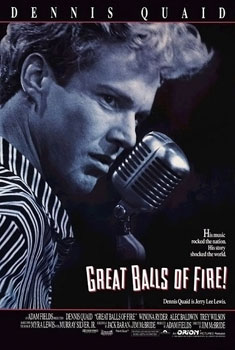 In the 1950s, Jerry Lee Lewis (Dennis Quaid) plays what his cousin, Jimmy Swaggart (Alec Baldwin), calls the devil’s music. After signing a contract with Sam Phillips (Trey Wilson), Jerry becomes a star with his wild man persona and crazed piano playing. When Elvis is drafted, it appears that Jerry is destined to take over as the new King of Rock and Roll. But, then, while touring England, the press discovers that Jerry is married to his 13 year-old cousin, Myra (Winona Ryder). When Jerry refuses to apologize for his private life, his career falls apart.
 Through the Shattered Lens