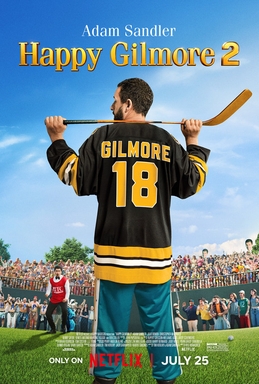
I love 1996’s Happy Gilmore and, over the past few months, I have very much been looking forward to the release of the long-delayed sequel, Happy Gilmore 2. Still, I was a bit concerned when I opened the film on Netflix and discovered that the sequel had a nearly two-hour running time. (The original clocked in at an efficient and fast-paced 90 minutes.) Comedy is all about timing and, in general, shorter is funnier. I know that Judd Apatow and Adam McKay might disagree with me on that but let’s be honest. For all of the acclaim that it was met with, when was the last time you actually felt any desire to rewatch The King of Staten Island? For that matter, if you have to pick between Anchorman or Anchorman 2, which are you going to pick? The 90 minute original or the sequel that takes more than two hours to tell essentially the same story?
Having now watched the film, I can say that Happy Gilmore 2 does run a bit too long. There are a few sequences that could have been trimmed without hurting the film. I can also say that I thoroughly enjoyed the film. I laughed more often than not. It’s a funny film but it’s also a surprisingly touching one.
Taking place 29 years after the first film, Happy Gilmore 2 features an older and slightly more mature Happy. It also features an older and slightly more mature Adam Sandler and, to its credit, the film acknowledges that. It doesn’t try to convince us that Sandler and Gilmore are still the young hell-raisers that they once were. (Happy’s Happy Place has changed considerably.) I’ve often written that there are two Adam Sandlers. There’s the youngish Sandler who made silly and often stupid films where he basically just hung out with his friends and didn’t seem to put much effort into anything. That’s the Sandler who has won multiple Razzie awards. And then there’s the older and wiser Adam Sandler, the sad-eyed character actor who gives sensitive performances as world-weary characters. This is the Adam Sandler who seems to be overdue for an Oscar nomination. If an alien came to Earth and only watched Adam Sandler’s serious films, they would probably think he was one our most-honored actors. While Happy Gilmore 2 is definitely a comedy, it still features quite a bit more of the serious Sandler than I was expecting.
At the start of the movie, Happy is not in a happy place. His grandmother has passed away. His wife, Virginia, was killed by an errant tee shot. He has four rambunctious sons and a daughter, Vienna (played by Sunny Sandler, who was so good in You Are So Not Invited To My Bat Mitzvah). After Virginia’s death, Happy gave up golf. He lost his money. He lost his grandmother’s house. Now, he’s working in a grocery store and he’s an almost forgotten figure. He’s also an alcoholic, keeping bottles of liquor hidden around the house. (A tiny liquor bottle is hidden in the cuckoo clock.) And while this film is certainly not Uncut Gems or even The Meyerowitz Stories, Sandler still does a good job of capturing the reality of Happy’s depression. There’s a true sense of melancholy running through the film’s first hour, as Happy returns to golf to try to make enough money to pay for Vienna to attend a prestigious dance academy. The second hour, in which Happy leads a team of pro golfers against a team of “extreme” athletes is far more goofier but Happy’s love for his family is a theme that runs through the entire film.
Aging is the other theme that runs through the film. Forced to play with three younger players (including Eric Andre and Margaret Qualley) at a local golf course, the rusty Happy grimaces when he hears one of them say, “Is he trying to do the Happy Gilmore swing?” When Happy rejoins the PGA, he discovers that all of the younger players now hit the ball as hard as he used to. An obnoxious tech bro (Benny Safdie) wants to start a new, extreme golf league, one that will “continue the revolution” that Happy started. Happy finds himself defending traditional golf and it’s an acknowledgement that both Gilmore and Adam Sandler have grown up and have come to appreciate that not everything needs to change. Sometimes, you just want to play a nice round of golf on a pretty course without having to deal with the sensory overload of the 2020s.
It’s a funny movie. Even when he’s playing it straight, Sandler still knows how to deliver a funny line. Ben Stiller returns as Hal L., who is now an addiction recovery specialist. (His techniques include ordering people to wash his car.) Christopher McDonald also returns as Shooter McGavin, having escaped from a mental asylum and now fighting, alongside Happy, to save the game that they both love. As someone who always felt that Shooter kind of had every right to be upset during the first film, I was happy to see him get a bit of redemption. Several professional golfers appear as themselves. A running joke about Scottie Scheffler getting arrested and then forcing all of his cellmates to watch golf made me laugh a lot more than I was expecting it too.
The sequel is full of shout-outs to the first film. A fight in a cemetery reveals that everyone who died during and after the first film just happens to have a gravestone and it was actually kind of a nice tribute. (Even the “Get Me Out Of Here” Lady gets a headstone.) It’s a sequel that truly appreciates and values the legacy and the fans of the first film. It’s also a sequel that seems to truly love the game of golf, which is not necessarily something that could be said about the first film.
Happy Gilmore 2 is a worthy sequel, even if it is a bit long. It made me laugh but, at the same time, it was hard not to be touched by the obvious love that Happy had for his family and that they had for him. (It didn’t hurt that Happy’s daughter was played by Sandler’s daughter.) In the first film, Happy played golf for his grandmother. In the second film, he returns to the game for his daughter. It’s all about family, as Adam Sandler’s unexpectedly heartfelt performance makes clear.
 Through the Shattered Lens