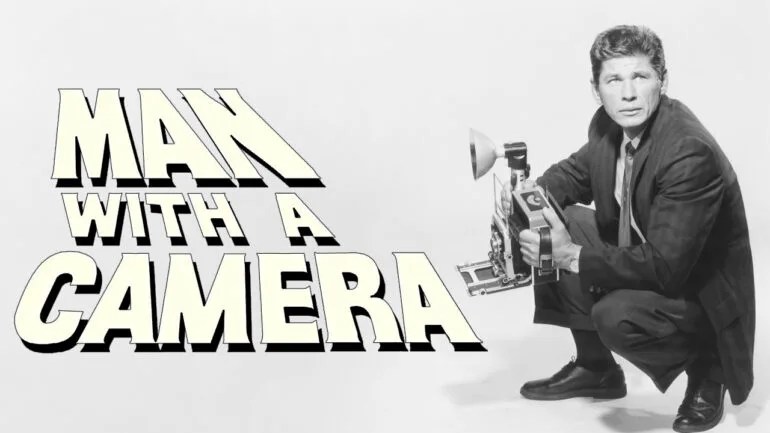
Originally airing on November 28th, 1958, “Another Barrier” opens with free-lance photographer, Mike Kovac (Charles Bronson), in the middle of the California desert working on a photo layout of Major Sandy Dickson (Grant Williams), a hotshot U.S. Air Force pilot who’s in the process of testing the latest X-2 plane. Kovac wants to follow Sandy around for a couple of days leading up the next big test flight, which means he also gets to meet Sandy’s fiancé, Liz (Norma Crane). While having dinner with the couple, Kovac sees just how scared and worried she is about her lover’s dangerous job. Sandy later confides to Mike that Liz has had bad luck with the “men in her life,” in this case being her father and her brother, who both died tragically years earlier. It seems she thinks her love is a curse, and now she’s afraid she’s going to pass it on to Sandy. Maybe she has a point, because on Sandy’s next test flight, his X-2 goes down, losing contact with the control tower ninety-four seconds after being released from its mothership B-50. With the rescue teams looking for Sandy, and with his survival chances being somewhere between slim and none, Kovac tells Liz what happened, and then takes her back to her apartment. Believing it’s her fault that Sandy’s plane went down, as soon as she gets her chance, Liz crawls out on the balcony of the top floor of her multi-story apartment complex. Kovac begins to try his best to convince her not to jump, to at least find out for sure if Sandy is dead or alive. But will anything work on a woman who’s convinced she’s a curse?!
This review may surprise some of my readers, but I didn’t really enjoy this episode at all. I didn’t like its entire concept. I enjoy episodes of the series where Kovac’s pictures help solve crimes, or he’s getting to mix it up with bullies and bad guys. This episode is just melodrama, and boring melodrama at that. Okay, so Sandy loves his job and Liz, and he wants Liz to accept the danger of his job, but she just seems to be a scared and anxious ball of emotions waiting around for him to die. And all Kovac does is take some pictures, listen to Sandy go on and on about Liz, and then beg Liz not to jump once everyone thinks he’s as dead as a doornail. Boring! About the only mildly amusing thing that happens is when Kovac convinces Sandy that a picture of a pilot in his long johns is just what the layout really needs. Boring AND kinda creepy! And I know that Norma Crane is a fine actress, having recently reviewed her episode of ALFRED HITHCOCK PRESENTS: “There Was an Old Woman,” where she also works with Bronson. They were good together in that episode, but neither have anything to work with when it comes to this story. She’s sad and wants to die, and he’s worried and doesn’t want her to jump. The characters barely know each other, having only met the day before, and the drama does not play out convincingly at all. Grant Williams is likewise boring as the “hot shot” Sandy Jackson. If the Air Force wanted to feature a pilot, they should have probably found one with at least a little bit of personality. I’ve always said that I love Bronson so much that I’d pay to watch him read the phone book. Good Lord willing, this episode is the closest I’ll ever get to seeing that happen.
There was one interesting thing that I noted while watching “Another Barrier,” and that’s the connection that its plot shares with a movie that Charles Bronson would star in a few years later, X-15 (1961), the theatrical debut of director Richard Donner. In X-15, which includes narration by the legendary James Stewart, Bronson plays an Air Force pilot with the dangerous job of testing X-planes, and Patricia Owens is his wife who’s worried about him back at home. It’s not one of Bronson’s best, and frankly, it’s kind of boring too. There may be a great movie or show about X-plane test pilots out there. I just know they don’t star Charles Bronson!
 Through the Shattered Lens