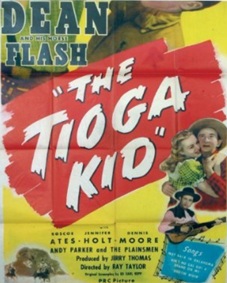
 Singing Ranger Eddie Dean (played by the same-named Eddie Dean) and his sidekick, Soapy Jones (Roscoe Ates), are sent to track down the Tioga Kid, an outlaw who happens to look just like Eddie. Soapy suggests that The Tioga Kid could be a long lost twin brother. Eddie isn’t sure because his parents were killed in an Indian ambush when he was just a baby. This seemed to be the backstory for many of Poverty Row’s favorite western heroes.
Dean plays both Eddie and the Tioga Kid. You can tell them apart because the Tioga Kid doesn’t sing and always dresses in black while Eddie dresses in white and won’t stop singing. Twin rivals were another big thing when it came to B-westerns. Thanks to then revolutionary split-screen technology, matinee audiences could enjoy the sight of their favorite heroes shooting at themselves. Eddie Dean was usually cast as a mild-mannered hero so he really seems to enjoy the chance to be bad as the Tioga Kid.
The Tioga Kid is a film that will be appreciated by those who are already fans of B-westerns. The Tioga Kid was made late in the B-western cycle and there are a lot signs that it was made in a hurry. There’s a scene involving a stunt man where he’s not even wearing the same shirt as the person he’s standing in for. Matinee audiences probably didn’t mind. They were too busy watching Eddie Dean shoot at himself and cheering him on during the movie’s big fist fight scene. Eddie Dean may not have been a great actor but he could throw a punch with the best of them.
 When a federal surveyor disappears while checking out the ghost town of Waterhole, the U.S. Marshall sends Cheyenne Davis (Lash La Rue) and Fuzzy Jones (Al “Fuzzy” St. John) to investigate. It turns out that gold has been discovered around Waterhole, on land owned by the Trent Family. Bad guy Vance Sharpe (Jack Ingram) is trying to kill the last remaining Trents — Rodney (Steve Frost) and his daughter, Diane (Jennifer Holt) — so that he can claim the land as his own. As Cheyenne and Fuzzy investigate, there are plenty of shootouts, fist fights, and an out of control stagecoach. Since this is a Lash LaRue film, there is also a lot of exciting bullwhip action.
 Through the Shattered Lens