 Quick story before the review. If you’d like to skip this, just scroll down a bit.
About a month before The Social Network came out, I was able to catch a special sneak preview of the film in Manhattan. The preview was special because after the film, Sony planned to have a Q&A session with some of the stars. While waiting on line and listening to some of the conversations, one person pointed out that they were waiting to see Aaron Sorkin.
“Excuse me, who?” I asked. The name didn’t ring any kind of bells with me. No Ratattouille – light in front of my eyes or anything.
“Sorkin. The West Wing.” She said.
“Ah, I’ve heard of that, but never saw it.” I said.
“A Few Good Men?” she added.
“Ah, I see!” I exclaimed, smiling. My sister and I loved that movie. She actually memorized the “You can’t Handle the Truth” speech, we liked it so much. Okay, I had a handle who this was.
When the movie ended, we were presented with Armie Hammer, Andrew Garfield, Jesse Eisenberg, Olivia Munn, and Aaron Sorkin, seated in front of the audience. Being in the third row, they were all in hitting distance of my soda. The Q&A lasted for about a half hour or so. Walking out of there, my thoughts were that Aaron Sorkin was just a writer. By the time I got home and hit the internet, I found out that opinions on him, however, were polarized. It’s kind of interesting when all you have to do is throw out a person’s last name to start anyone talking. His work was either really revered or spat upon like a leper. I hadn’t seen anything like it since Joss Whedon, who’s writing I never knew of during the Roseanne years, absolutely could not stand during the Buffy years, and who finally won me over after seeing early morning episodes of Angel on TNT as the show was ending its main run.
So, that’s where I stand with Sorkin. He’s not a “Writer That Can Do No Wrong”, but I’ll admit that I like the conversational style he uses for characters. It’s almost similar to David E. Kelley’s work in a way. It’s not always required and can sometimes hinder things – Matthew Weiner is a good example of someone who does just fine without the tommy gun speeches – but it does work when it needs to.
My Thoughts (Where the Review actually begins…):
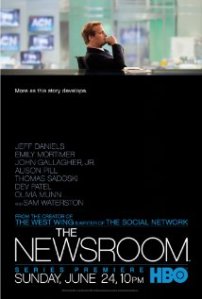
The Newsroom starts out with a televised interview where a number of people are arguing politics back and forth. Seated between them is Will McAvoy (Jeff Daniels), who doesn’t have much to say, but listens. As he does so, he has a moment where he kind of zones out when he notices a woman up in the stands. This gives us a hint to the vertigo issues he supposedly has. When asked why he thinks that America is the greatest country in the world, he notices the same girl who holds up a notepad reading “It’s not, but it could be.” Will chooses to give an even keel answer, but when forced to give ‘a human reaction’, he admits to not feeling that America’s all that. He loses it, stating that even though we proclaim ourselves to be the only free country in the world, there are tons out there. “Canada has freedom! Japan has Freedom. Belgium has freedom!”, he rattles off. He points out that the only thing America really is good at is having a high incarceration rate, for the most part. He then goes on to add the good things the country did over the years. Once the interview ends and he leaves, he turns to his colleagues and asks “What did I say out there?!”
And that was all before the opening credits. I thought that was a good way to start. Definitely a hook, though the responses overall to the scene could be interesting.
Will returns into work the following morning to find most of his staff missing. After a conversation with Maggie (Allison Pill), he finds out he needs to speak with his superior, Charlie (Sam Waterston). I like Allison Pill as an actress. She was great in The Pillars of the Earth, but here is where Sorkin kind of stumbles. Granted, her character is handling being newly promoted to a position she isn’t ready for, but she’s almost too jittery. She’s almost a ball of nerves. It’s the Winifred Burkle / Lexi Grey / Ally McBeal archetype of the “New Girl with a Lot on her Plate”. Before you start in on me, take a look at the first season of Weiner’s Mad Men and you’ll see an example in Elizabeth Moss that’s handled stronger than Pill’s character is here. It’s almost the same situation, but where Moss’ character finds small ways to stand on her own, Maggie’s just a little lost. I’m hoping that in future episodes, she’s able to shake that and come into her own.
We’re also introduced to some of the other characters that run the Newsroom. You have Don (Thomas Sadoski), Will’s former Associate Producer and Neal (Dev Patel), who is the resident tech analyst. We find that Charlie has brought on Mackenzie MacHale (Emily Mortimer) on as the Executive Producer, who Will has a serious problem with. Most of the episode is spent in Will’s office, arguing over how we can do better, and how he has the opportunity to make the news show stronger than what it was. Personally, I felt there were more interesting things going on outside of Will’s office then in it. At one point, a news blip comes in (courtesy of an iNews like program, which was nice), which touches on the start of the oil spill in Louisiana in 2010. It’s then that we’re told this is the time period we’re in. The show begins to accelerate and by the time that Will is actually on air, we get the notion of what the show could be if they rubbed out a little of conversations in between. That was very cool, like watching a submarine crew at work. The newscast scene is actually the strongest part of the episode overall, and Sorkin’s machine gun style dialogue helps there a lot, I felt. Dialog, he can do.
The only problem is for me is that we’re locked to this one location. It’s like watching a play unfold. You’re in one location, and all of this information comes in. It’s discussed and action’s taken, but I didn’t get the feeling that the characters were growing or had room to. Let me put it this way. The star of the show isn’t any one person. It’s the News desk. The most important part of the show happened at the News desk, and while that was great, I’m thinking that for the characters involved, where are the subtle changes?
Here’s the thing (and I go to back to Mad Men, which I’ve also started watching from the beginning). By the end of the first episode of that show, you come to find that it’s main character, Don Draper, changes. You’re shown details that shape his attitude and come to find that he’s not the picture perfect fellow you may have thought he was. I didn’t get any of that with this episode of The Newsroom. I’m eager to see where it goes, because I like what’s being said, but I haven’t hit a point where any one of these people – even Will – is someone I feel I could hook on to. There’s always at least one character that stands out in a show for me – whether it’s Aaron Paul’s Jesse Pinkman in Breaking Bad or Andrew Lincoln’s Rick Grimes in The Walking Dead. I’m hoping that something changes here to help me find that. The only hint of growth or personal reflection seemed to come at the last few minutes between Mac and Will, when he discusses the conversation he had with her father. That, I would love to see more of.
Overall, the Newsroom isn’t a bad show. It kind of moves like a pilot should, a one shot that has to hit the audience with it’s strongest punch to make sure they’re hooked, while at the same time trying to plant seeds for future episodes. It does what it tries to – give the news – but I walked away feeling like I visited this business, watched what went on and then promptly left with only the mildest of introductions to the staff. I don’t really know anyone here.
It can definitely be improved upon, and it’s all the start of something. I’m just not exactly sure I know what that is.

 Through the Shattered Lens