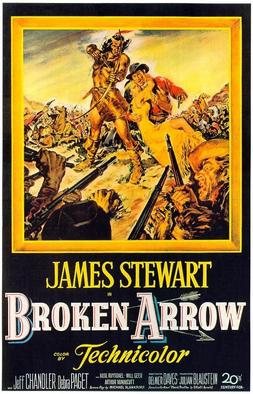
Film Review: Broken Arrow (dir by Delmer Daves)


The 1950 film, Broken Arrow, takes place in the years following the Civil War.

Having survived the war, frontier scout Tom Jeffords (James Stewart) just wants to get away from his fellow countrymen for a while.  During the Civil War, Jeffords saw the worst that humanity had to offer and the experience has left him cynical about the idea of bringing civilization to the American frontier.  Tom just wants to be left alone.  Still, when he comes across a 14 year-old Apache who has been shot in the back, Tom stops to help.  Though wounded, the Apache still tries to attack him.  He’s learned not to trust the white man.  Broken Arrow is a film that suggests that he has good reason not to.  Indeed, Broken Arrow was one of the first major Hollywood productions to attempt to treat the American Indians with sympathy and fairness.

Tom saves the Apache’s life and reunites him with his tribe.  When the Apaches attack and kill a group of nearby gold prospectors, they allow Tom to live but they warn him to stay out of their territory.  However, circumstances make it impossible for Tom to do that.  When Tom arrives in Tucson, the citizens are incredulous that he allowed the Apache child to live.  When Tom learns the Apache language and customs and marries an Apache woman named Sonseeahry (Debra Paget), it causes the other whites to distrust him even more.  However, it is Tom’s eventual friendship with the Apache chief Cochise (Jeff Chandler) that eventually lands Tom in the middle of the conflict between the Apaches who want to preserve their way of life and the white men who want their land.

Broken Arrow is a well-intentioned film, in the way that mildly liberal films from the 50s tended to be.  The U.S. government and its citizens are criticized for breaking their promises and their treaties to the Apache but the film’s ultimate message is one of compromise and understanding.  The bigoted whites may be the villains but then again, so is Geronimo (Jay Silverheels) for refusing to accept Cochise’s desire for peace.  Cochise is the film’s hero specifically because he calls for setting aside differences and living in peace with the white man, despite his own distrust of their leaders.  The majority of the extras were Apache, though Neither Jeff Chandler nor Debra Paget were of Native descent.  Both of them give good performances that largely avoid the stereotypes of the time.  Chandler received his only Oscar nomination, for Best Supporting Actor, for his performance in this film.

That said, the unnominated Jimmy Stewart dominates the film and that’s not really surprising.  (It should be noted that, while Stewart was not nominated for this film, he was nominated for his performance in Harvey, that same year.)  Stewart may have first found fame as the happy and go-lucky face of Middle America but his experiences in World War II left a definite mark on him.  He returned from the war a much more serious figure and every character that he played (even the lovable Elwood in Harvey) had more than a hint of melancholy to him.  Stewart plays Tom as being a troubled soul, someone who is still struggling to come to terms with the destruction and cruelty that he saw during the Civil War.  There’s an authenticity to Stewart’s performance, leaving little doubt that he understood exactly what Tom was going through.  Broken Arrow ends on a note of compromise and racial harmony but it’s a sad film because we know what waits in the future for Cochise and his people.  Tom Jeffords fights to bring peace to the frontier but it’s a peace that won’t last.  And, as played by Stewart, Tom seems to understand that better than anyone.

30 Days of Noir #29: Johnny O’Clock (dir by Robert Rossen)


The 1947 film, Johnny O’Clock, invites us to take a behind-the-scenes look at the sleazy and sordid world of casino management.  If that doesn’t intrigue you, just consider that the man character is named Johnny O’Clock.

Seriously, that’s a really kickass name.  I have to admit that, if my last name was O’Clock, I would be tempted to name my child Four Twenty.  But, that said, Johnny is a pretty good name too.  On the one hand, he’s got an all-American name like Johnny but he’s also got a last name — O’Clock — that promises mystery and danger.  Johnny O’Clock is also played by Dick Powell, who was always good at playing tough guys who had a heart of gold.  (Along with appearing in several noir films, Dick Powell was also the first actor to ever play the famed detective, Philip Marlowe.)

Johnny O’Clock is a partner in a casino with Guido Marchettis (Thomas Gomez).  Johnny and Guido are longtime business partners who find the future of their casino threatened when a hat-check girl named Harriet Hobson (Nina Foch) dies under mysterious circumstances.  Even though the crime scene was clearly set up to make it appear as if Harriet committed suicide, it doesn’t take Inspector Koch (Lee J. Cobb) long to figure out that Harriet was actually murdered.

Who killed Harriet?

Was it her boyfriend, Chuck Blayden (Jim Bannon)?  Chuck is a corrupt cop who has been trying to convince Guido to force Johnny out of the casino and instead hire Chuck instead.

Or is the murderer Guido’s wife, Nellie (Ellen Drew)?  Nellie used to be Johnny’s girlfriend and, as soon becomes obvious, she still has feelings for him.  When she attempted to give Johnny a romantic present, Johnny’s response was to give it to Harriet so that Harriet could return it.  Did Johnny’s rejection of Nellie push her over the edge and did she take her anger out on Harriet?

Or maybe the murderer was Guido.  Guido, after all, is a rather shady sort.  Maybe Harriet discovered something that she shouldn’t have.

Then again, you could also say the same thing about Johnny O’Clock….

Inspector Koch isn’t the only person determined to get to the truth!  Harriet’s sister, Nancy (Evelyn Keyes), also shows up and starts to investigate on her own.  Soon, she and Johnny are falling in love but Johnny knows that the situation is too dangerous for either him or Nancy to stick around the casino.  He starts to make plans to flee with her to South America but he’s got just a few things to do before they can leave….

Johnny O’Clock was the first film to be directed by Robert Rossen, who is often credited as being one of the most important filmmaers in development of American film noir.  A year after Johnny O’Clock was released, Rossen’s All The King’s Men would win best picture.  Rossen’s career was derailed when he was accused of being a communist and blacklisted in the 50s.  Like Elia Kazan, Rossen initially took the fifth but he later relented and “named names” to the House UnAmerican Activities Committee.  Though Rossen would later direct the Oscar-nominated The Hustler in 1962, it can be argued that Rossen’s career never recovered from either being blacklisted or from naming names.

Clocking in at 93 minutes, Johnny O’Clock is probably about 20 minutes too long and the murder mystery is never really as intriguing as you might hope it would be.  On the positive side, the casino is stylish and the cast is full of noir talent.  Dick Powell is a likable, if occasionally bull-headed, protagonist and Lee J. Cobb is well-cast as Inspector Koch.  (The film has some fun contrasting the glitz of the casino with the shabbiness of Koch.)  Burnett Guffey’s black-and-white cinematography gives the film a properly noirish look and, while the pace may be slow, the occasional bursts of action are well-handled.  The scene where Johnny is nearly the victim of a drive-by shooting is particularly exciting.  Johnny O’Clock is a flawed noir but the cast is good enough to hold the interest of fans of the genre.

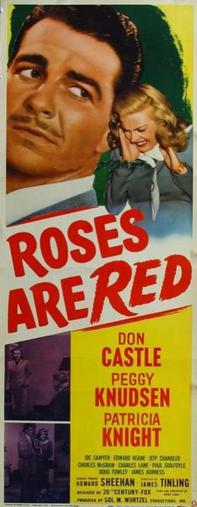
30 Days of Noir #10: Roses are Red (dir by James Tinling)


As the 1947 film, Roses Are Red, begins, Robert A. Thorne (Don Castle) has just been elected to the office of district attorney.

Now, being the horror fan that I am, the thing that I immediately noticed was that the new district attorney had the exact same name as the character played by Gregory Peck in The Omen.  However, Roses Are Red has nothing to do with the son of Satan or the end of the world.  Instead, it’s just a briskly paced tale of swapped identity.

Robert A. Thorne is not just a brilliant lawyer.  He’s also an example of that rare breed, an honest politician.  He ran on a platform of reform and that’s what he’s intending to pursue now that he’s been elected.  As he tells his girlfriend, journalist Martha McCormick (Peggy Knudsen), cleaning up this country isn’t going to be easy but he’s determined to do it.  And the first step is going to be taking down the local mob boss, Jim Locke (Edward Keane).

The wheelchair-bound Jim Locke is a man who prefers to stay in the safety of his penthouse, where he can feed his fish and give orders to his subordinates, all of whom have names like Duke (Charles McGraw), Knuckle (Jeff Chandler), Buster (Paul Guilfoyle), and Ace (Douglas Fowley).  However, his man on the police force, Lt. Rocky Wall (Joe Sawyer), has warned him that this new district attorney might not respond to usual combination of bribes and intimidation.  That’s not good news because there are men who might be willing to testify against Locke in return for a shorter prison sentence.

However, things start to look up when none other than Robert A. Thorne shows up at Locke’s penthouse and says that the honesty bit was all a sham and that he wants to be on Locke’s payroll.  However, Locke soon figures out that he’s not talking to Thorne.  Instead, he’s talking to Don Carney (also played by Don Castle), a career criminal who has recently been released from prison and who just happens to look exactly like Robert Thorne!

Locke and Don come up with a plan that seems foolproof.  What if Knuckle kidnaps Thorne and holds him hostage for a few days?  During that time, Don can study Thorne and learn how to perfectly imitate all of his movements and expressions.  Once the two men are absolutely indistinguishable, Knuckle will murder Thorne and then Don will take his place.

Knuckle manages to kidnap Thorne with absolutely no trouble.  The police, under the prodding of Lt. Wall, announce that Thorne has obviously run off to avoid dealing with the local gangsters.  Don starts the process of studying Thorne but it turns out that the district attorney has a few tricks of his own….

With a running time of only 67 minutes, Roses are Red doesn’t waste any time jumping into its somewhat implausible plot.  Fortunately, the film is so short and quickly paced that most viewers won’t really have time to worry about whether or not the film’s plot actually makes any sense.  This is an entertaining, low-budget film noir, featuring a host of memorable performances and all of the hard-boiled dialogue that you could hope for.  Don Castle does a good job playing both the sleazy Don Carney and the upright Robert A. Thorne.  History nerds like me will immediately notice that, with his mustache and his slicked back hair, Castle bears a distinct resemblance to former Manhattan D.A. and two-time presidential candidate, Thomas E. Dewey.

All in all, Roses are Red is an enjoyable film for fans of old school gangster noir.  Check it out below: