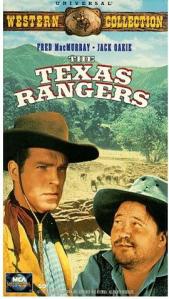
A Movie A Day #223: The Texas Rangers (1936, directed by King Vidor)


Sam (Lloyd Nolan), Jim (Fred MacMurray), and Wahoo (Jack Oakie) are three outlaws in the old west.  Wahoo works as a stagecoach driver and always lets Sam and Jim know which coaches will be worth holding up.  It’s a pretty good scam until the authorities get wise to their scheme and set out after the three of them.  Sam abandons his two partners while Jim and Wahoo eventually end up in Texas.  At first, Jim and Wahoo are planning to keep on robbing stagecoaches but then they realize that they can make even more money as Texas Rangers.

At first, Jim and Wahoo are just planning on sticking around long enough to make some cash and then split.  However, both of them discover that they prefer to be on the right side of the law.  After they save a boy named David from Indians, Jim and Wahoo decide to stay in Texas and protect its settlers.

The only problem is that their old friend Sam has returned and his still on the wrong side of the law.

Made to commemorate the Texas centenary (though it was filmed in New Mexico), The Texas Rangers is a good example of what’s known as an oater, a low-budget but entertaining portrayal of life on the frontier.   King Vidor does a good job with the action scenes and Fred MacMuarry and Jack Oakie are a likable onscreen team.  The best performance comes from Lloyd Nolan, as the ruthless and calculating Sam.  Sam can be funny and even likable but when he’s bad, he’s really bad.

Jack Oakie was better known as a comedian and The Texas Rangers provides him with a rare dramatic role.  Four years after appearing in The Texas Rangers, Oakie would appear in his most famous role, playing a parody of Benito Mussolini in Charlie Chaplin’s The Great Dictator.
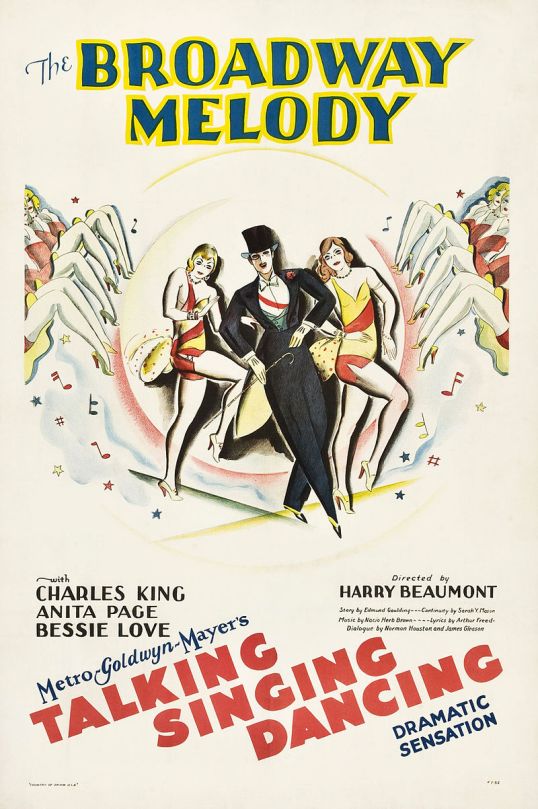
Lisa Reviews An Oscar Winner: The Broadway Melody (dir by Harry Beaumont)


broadway_melody_poster

Oh, The Broadway Melody.

Where to begin?

First released way back in 1929, The Broadway Melody is a historically significant film.  You really can’t talk about the development of film — especially sound film — without taking at least a few minutes to acknowledge The Broadway Melody.  It was the 2nd film to ever win the Oscar for Best Picture (or Best Production, as it was called back then) and it was the first sound film to win the Oscar.  (In fact, it would be 83 years before another silent film won Best Picture and it’s debatable whether or not The Artist can really be considered a silent film in the same way that Wings was silent film.)  It was also the first musical to win best picture and some people consider it to be the first true musical to have ever been produced.  It was such a huge box office success that it could be argued that The Broadway Melody is responsible for nearly every musical that followed it.

To say that The Broadway Melody tells a familiar story would be an understatement.  I’ve read a few reviews that have suggested that the clichés in this film really weren’t clichés until after The Broadway Melody was released but I’ve seen enough silent films to know that this is not the case.  It tells the story of two sisters who want to be stars.  After spending years working in vaudeville, they’ve been invited to perform in a revue that’s being produced by Francis Zanfield (Eddie Kane).

(I assume that Zanfield was meant to be a stand-in for Florence Ziegfeld, himself the subject of a later Best Picture winner, The Great Ziegfeld.)

The sisters are Hank (Bessie Love) and Queenie (Anita Page).  Hank is the driven one.  Hank is the one with the raw talent and she’s also the one who best understands how the business of entertainment works.  Her younger sister, Queenie (Anita Page), may not have Hank’s drive or quite the same level of talent but she does have beauty.  Guess who finds the most success?

Songwriter Eddie Kearns (Charles King) is engaged to marry Hank but soon, both he and Queenie find themselves falling in love.  Not wanting to hurt her sister, Queenie instead runs off with a notorious playboy named Jock Warner (Kenneth Thomson).

As I stated previously, The Broadway Melody has not aged well.  The fact that it’s one of the first sound films just allows contemporary viewers to hear the creakiness of the plot.  As impressive as sound film was to audiences in 1929, it’s obvious today that the cast and crew of The Broadway Melody were still struggling to figure out how to work with the new technology.  As a result the performances are still a bit too broad, which only serves to make the film seem even more melodramatic than it actually is.  As for the songs, they’re not particularly memorable.  I always enjoy backstage musicals but Broadway Melody is no 42nd Street.

I did appreciate the relationship between Bessie Love and Anita Page.  That was one of the few things about the film that felt real to me, perhaps because I have three older sisters.  Interestingly enough, when Anita Page died in 2008, she was the last surviving attendee of the first Academy Awards ceremony.

The Broadway Melody was named the Best Picture of 1929.  This was the year that the winners were selected by a committee and there were no official nominations.  Though the notes from the meeting indicate that there was some consideration given to awarding the Best Actress Oscar to Bessie Love, Best Picture was the only Oscar that The Broadway Melody received.

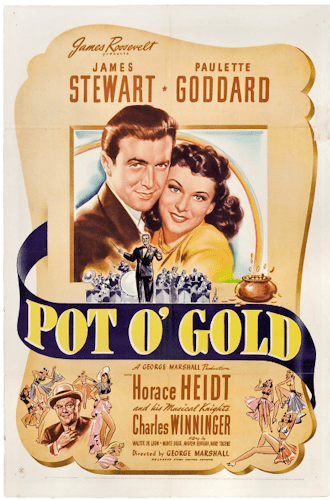
The Fabulous Forties #48: Pot O’ Gold (dir by George Marshall)


Pot_o_Gold-_1941-_Poster

The 48th film in Mill Creek’s Fabulous Forties box set was 1941’s Pot O’ Gold.  At first, I was really excited about watching Pot O’ Gold because it starred James Stewart, one of my favorite of the Golden Age stars.  “Wow,” I thought, “James Stewart never made a bad movie!  This is going to be great!”  However, before watching the film, I looked Pot O’ Gold up on Wikipedia and I discovered that apparently, James Stewart considered Pot O’ Gold to be the worst film that he ever made.

After having watched the film, I think that Jimmy may very well have been correct in his assessment.

Pot O’ Gold is a musical comedy.  Stewart plays Jimmy Haskell, the owner of a music store.  Jimmy loves music but he’s a terrible businessman.  Despite the fact that his store always seems to be full of quirky characters playing musical instruments, it still goes out of business.  Jimmy is forced to go to work for his uncle, C.J. Haskell (Charles Winninger).  C.J. not only owns a health food company but he also produces a radio show.

And, on top of all that, C.J. hates music!

Unfortunately, considering how much C.J. hates music, he lives right next door to the McCorkles, a family of Irish musicians.  The McCorkles are constantly practicing in front of C.J.’s store and, as a result, C.J. is constantly forced to call the cops to make them go away.

When Jimmy first arrives at the store, he befriends the McCorkles.  He even falls in love with Molly McCorkle (Paulette Goddard).  Unfortunately, none of the McCorkles know that he is C.J.’s nephew and C.J. doesn’t know that his nephew secretly continues to love music.  Meanwhile, C.J. is trying to catch the mysterious person who threw a tomato at him.  What he doesn’t realize is that the tomato was thrown by … JIMMY!

And it just keeps going on and on from there.  C.J. conspires to get rid of the McCorkles.  Jimmy tries to bring peace between the two sided without the Molly discovering that he’s related to C.J. and without C.J. realizing that Jimmy threw that tomato.  Jimmy eventually goes on C.J.’s radio show and soon, he’s using the show as a way to give away money to the needy.  Meanwhile, he struggles to forge peace between the McCorkles and C.J. without Molly discovering his true identity and without C.J. finding out he threw that tomato.  Will C.J. ever learn to love music and will it ever occur to anyone that this whole mess could easily be resolved by everyone making an effort not to randomly break out into song every time C.J. happens to be walking down the street?

Pot O’ Gold is an amazingly silly movie and I don’t mean silly in a good way.  This is one of those films where every issue could be resolved if people just showed a little intelligence.  It’s also a movie where everyone breaks into song every few minutes.  The key to a successful musical is that the songs have to feel like the grow organically out of the action.  The songs in Pot O’ Gold feel like they’re just there to be there.

Personally, I think James Stewart is one of those actors who can make any movie worth seeing.  He is his normal, likable self in this film but Pot O’ Gold never seems worthy of his famous persona.

Incidentally, Pot O’ Gold’s credited producer was James Roosevelt, FDR’s wastrel son.  I don’t know how much he had to do with the actual production but I’ve always wanted an excuse to use the word “wastrel” in a review.