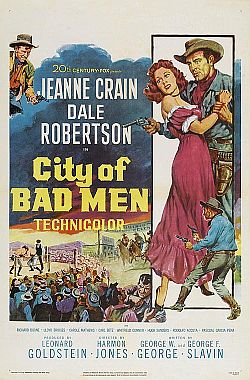
City of Bad Men (1953, directed by Harmon Jones)


In the year 1897, an outlaw gang led by brothers Brett (Dale Robertson) and Gar (Lloyd Bridges) ride into the frontier town of Carson City, Nevada.  Brett and Gar remember Carson City as being a sleepy town where not much happens but, when they arrive, they discover that a carnival-like atmosphere has broken out in the streets.  A heavyweight fight between “Gentleman Jim” Corbett and Bob Fitzsimmons is scheduled to take place in Carson City and the once sleepy little town has become the center of the old west.

Sheriff Bill Gifford (Hugh Sanders) already knows that he’s going to have his hands full with all of the people coming to town for the fight so he’s not happy to see that Brett and Gar have returned.  When the notorious outlaw Johnny Ringo (Richard Boone) also shows up for the fight, Gifford realizes that he’s going to have to do something unheard of.  He deputizes the three outlaws, assigning them to keep the peace.

Even as deputies, the outlaws scheme to steal the money that’s raised by the fight.  However, Brett is actually more interested in getting back together with his former girlfriend, Linda (Jeanne Crain).  When Gar and Ringo realize that Brett might be backing away from the plan, it leads to a climatic showdown in Carson City.

This B-western tells a semi-true story.  Corbett and Fitzsimmons did fight a match in Carson City in 1897.  The fight lasted for over 90 minutes and ended with an upset victory for Fitzsimmons.  It was the first boxing match to be filmed and it was later released into cinemas as The Corbett-Fitzsimmons Fight.  It was the first film to last over an hour and it is considered to be the first feature film.  It’s also considered to be the first pay-per-view event because the film of the fight made the boxers more money than the fight itself.  The rest of the film is pure fiction.  (The infamous outlaw Johnny Ringo had been dead for five years by the time of the Corbett/Fitzsimmons fight.)  But even if there wasn’t an attempt to rob the Corbett/Fitzsimmons Fight, the use of the actual fight and the publicity surrounding it serves to remind the audience that the modern world is coming to the frontier.

For most, the main appeal of this film will be to see Dale Robertson, Richard Boone, and Lloyd Bridges acting opposite each other.  All three are well known to western fans.  Boone would later star in Have Gun Will Travel while Robertson appeared in Tales of Wells Fargo, Iron Horse, and Death Valley Days.  Lloyd Bridges previously played the resentful deputy in High Noon.  The three of them are in top form in City of Bad Men, with Bridges especially making an impression as the less honest of the two outlaw brothers.  The three of them play outlaws who know that the era of the lawless west is coming to an end and all three of them have to decide whether they want to go straight or if they want to go out with a bang (some more literally than others).  With the fast-paced script and a dedicated cast, City of Bad Men is a film that will be appreciated by anyone who likes a good western tale.

Embracing the Melodrama Part II #18: A Letter To Three Wives (dir by Joseph L. Mankiewicz)


220px-A_letter_to_three_wives_movie_poster

Last week, I started a little series that I call Embracing The Melodrama, Part II.  Over the next three weeks, I will be reviewing, in chronological order, 128 cinematic melodramas.  I started this series with the 1927 silent film Sunrise and now, we have reached our 18th film, the 1949 best picture nominee, A Letter To Three Wives!

Now, I’m going to start this review by pointing out something that will probably scare off some of our readers.  So, before you read the next paragraph, understand that A Letter To Three Wives is a great film that’s full of great performances and witty dialogue and you really should watch it the next time that it’s on TCM.  Got all that?  Okay.  Good.  Moving on…

A Letter To Three Wives feels a lot like a 1949 version of Desperate Housewives.  Now, before you freak out, I’m talking about early Desperate Housewives as opposed to later Desperate Housewives.  The similarities are actually pretty striking.  Both A Letter To Three Wives and Desperate Housewives take place in an upper class suburb.  Both of them deal with women who appear to have happy marriages but who are all actually dissatisfied with how their lives have turned out.  Both of them are satires disguised as mystery stories.  (The mystery in Desperate Housewives involved murder.  The one in A Letter To Three Wives involves adultery.)  Perhaps most significantly, both Desperate Housewives and A Letter To Three Wives are narrated by a snarky woman who exists largely off screen.

The narrator in A Letter To Three Wives is named Addie Ross and voiced by Celeste Holm.  We never actually see Addie but we hear a lot from her and a lot about her.  Apparently, every man in town has, at some point, been in love with Addie.  Every woman is jealous of her.  And Addie, amazingly enough, seems to have the power to know exactly what’s happening in everyone else’s marriage.  At the start of A Letter To Three Wives, Addie has sent … well, a letter to three wives.  In the letter, Addie explains that she’s run off with one of their husbands but she declines to reveal which husband.  Each one of the wives thinks back on her marriage and wonders if her husband is the one.

Deborah (Jeanne Crain), for instance, is a country girl who met and married Bradford “Brad” Bishop (Jeffrey Lynn) during World War II.  Deborah is insecure about the fact that Brad comes from an upper class background and that he was apparently engaged to marry Addie before he met Deborah.

(Here’s an interesting piece of trivia for those of you who, like me, are into true crime stories.  Along with the movie character, there’s also a real-life murderer named Bradford “Brad” Bishop.  Like the character in the movie, he came from an upper class background.  Unlike the film character, the real Brad Bishop ended up murdering his wife, his children, and his mother and then fled to Europe.  He’s been a fugitive for close to 40 years and is believed to still be alive.  He’s currently on the FBI’s most wanted list.)

And then there’s Rita (Ann Sothern), who is an old friend of Brad’s.  Rita is married to George.  George is a quiet and intellectual English professor who is insecure over the fact that Rita, working as a soap opera writer, makes more money than he does.  George is played by Kirk Douglas and, admittedly, it does take a while to get used to the idea of Kirk Douglas playing an introverted intellectual.  But, once you get over the initial shock, Kirk Douglas gives a pretty good performance.  Kirk may be miscast but that actually works to the film’s advantage.  In a world where surface appearances hide the unexpected truth, it only makes sense that a mild college professor would look like Kirk Douglas.

My favorite wife was Lorna Mae (Linda Darnell), who grew up next to the train tracks and who pursues and eventually married a wealthy, older man (Paul Douglas).  It was impossible for me not to relate to and even admire Lorna Mae.  Much like me, Lorna Mae was determined to get what she wanted.  Perhaps my favorite scene with Lorna Mae was when she blatantly did everything possible to get stuffy old Paul Douglas to look at her legs, largely because I’ve done the exact same thing on occasion.

A Letter To Three Wives is an entertaining and witty film that still holds up today.  Director Joseph L. Mankiewicz deservedly won the Best Director Oscar for his work here.  The film itself was nominated for best picture but lost to All The King’s Men.  I actually happen to like All The King’s Men but, if I had been an Academy voter in 1949, my vote would have totally gone to A Letter To Three Wives.