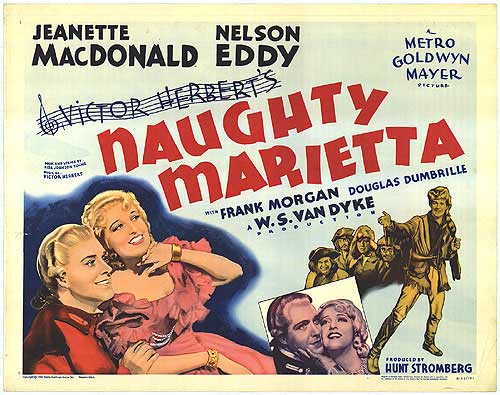
Cleaning Out The DVR, Again #12: Naughty Marietta (dir by W.S. Van Dyke)


b70-4632

Continuing the process of cleaning out my DVR, I watched the 1935 film, Naughty Marietta.  I recorded Naughty Marietta off of TCM on April 3rd.  Like many of the films that I record off of TCM, Naughty Marietta was nominated for Best Picture.  In fact, if not for that Oscar nomination long ago, Naughty Marietta would probably be totally forgotten.

Instead, it’s only partially forgotten.

Based on an operetta and containing at least one song that I’ve sung while drunk (that song, incidentally, would be Ah!  Sweet Mystery of Life), Naughty Marietta tells the story of Princess Marie (Jeanette MacDonald).  A Spanish princess, Marie is engaged (against her will) to the elderly Don Carlos (Walter Kingsford).  In order to escape a life of forced marriage, Marie pretends to be a servant girl named Marietta and stows away on a boat to New Orleans.  The boat is carrying women to the new world so that they marry French colonists.  The other women on board are shocked when Marietta announces that she plans to never marry.

However, they are even more shocked when the boat is taken over by pirates!  The pirates kill the crew and take the women prisoner.  The pirates take the women to Louisiana where, fortunately, a group of mercenaries led by Captain Richard Warrington (Nelson Eddy) show up and rescue the women.

Marie negotiates for Warrington to take the women to New Orleans and it’s obvious from the start that Marie and Warrington are attracted to each other.  However, Warrington claims that, much like Marie, he plans to never marry!  Oh my God, could it be that these two are meant to get together!?

It has all the potential for being a good musical and Jeannette MacDonald gives a good performance as Marie.  But, unfortunately, Nelson Eddy is a lot less charismatic in the role of Warrington.  Even his singing voice is a bit blah.  Oddly, Naughty Marietta was one of many romantic musicals that Jeanette MacDonald and Nelson Eddy made together.  The reason I use the term “odd,” is because — judging from this film — they didn’t appear to have much onscreen chemistry.  Whereas MacDonald is personable and relatable, Nelson Eddy seems to hold the audience at a distance.  Watching a film like this, you can’t help but regret that Jeanette MacDonald didn’t have someone like Fred Astaire for a co-star.

As for Naughty Marietta‘s best picture nomination — well, it was a big production and it was also an adaptation of a popular operetta.  At a time when 10 films were nominated every year and the studios pretty much controlled which one of their films was nominated for best picture, Naughty Marietta got a nomination.  However, the Oscar went to Mutiny on the Bounty.
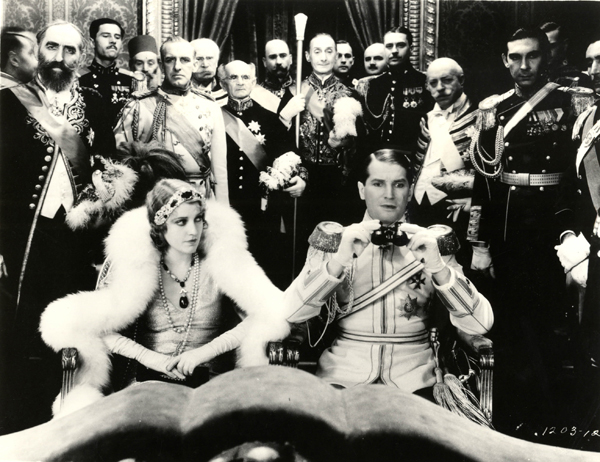
Lisa Reviews An Oscar Nominee: The Love Parade (dir by Ernst Lubitsch)


Love_Parade

Recently, as a part of TCM’s 31 Days of Oscar, I watched the 1929 musical The Love Parade.

Now, I have to admit that this was one of those movies that I started watching with a lot of pre-conceived notions.  While I happen to enjoy movies from all eras, I sometimes have a hard time adjusting to the style of the films that were made in the early days of the sound era.  Often times, it’s obvious that these films were made by directors and actors who were still struggling to make the transition from silent to sound cinema.  As a result, it’s not uncommon for films of this era to come across as being stiff and stagey.

But I needn’t have worried.  While The Love Parade does have its occasionally stagey moments, it actually holds up remarkably well.  For a film that was made 89 years ago, The Love Parade is still a lot of fun and surprisingly entertaining.  It helps, of course, that The Love Parade was made before the adoption of the infamous Production Code and, as such, it’s allowed to show off a racy sense of humor that keeps the film from feeling too dated.

As for the film itself, it deals with Queen Louise (Jeanette MacDonald), the young ruler of the European kingdom of Sylvania.  Despite the fact that Louise is a capable ruler, her subjects worry that she has yet to get married.  When her advisors inform her that she is running the risk of never marrying, Louise dismisses their concerns in a very Pre-Code way.  She lifts up her skirt, shows off her left leg, and says that there’s only one other leg as perfect as her left leg.  She then extends her right leg.  Since I basically do the same thing every single day, that was the moment when I realized that she might be the Queen and I might just be an outspoken redhead but I could still totally relate to Louise.

After showing off her legs, Louise deals with the issue of Count Alfred (Maurice Chevalier), a diplomat at Sylvania’s Paris embassy.  Apparently, Alfred ended up having an affair with every woman at the embassy (including the ambassador’s wife) and he has been recalled to Sylvania.  After reading the details of his sexual exploits, Louise decided that she has to meet Alfred for herself.

(And again, we’re reminded that this is a Pre-Code film.)

Alfred and Louise meet, fall in love, and marry.  However, Alfred has a hard time dealing with the fact that, as Queen, Louise has all the power in their marriage.  Even his attempts to draw up an economic plan are dismissed by the Queen’s advisors.  Feeling emasculated, Alfred sings a song called Nobody’s Using It Now.

Three guess what “it” is.

Can this marriage be saved?  Louise’s maid (Lillian Roth) and Alfred’s servant (Lupino Lane) are determined to make sure that it can be!

If the plot description and my review of The Love Parade sounds in any way similar to my review of The Smiling Lieutenant, that’s because both films were directed by Ernst Lubitsch.  In fact, The Love Parade was Lubitsch’s first sound film and, in many ways, his assured direction here played a huge role in helping Hollywood make the transition from the silents to the talkies.  Both Jeanette MacDonald and Maurice Chevalier give assured (and sexy) performances that hold up well today and the film’s opulent sets and costumes remain a visual delight.  The end result feels like a wonderfully entertaining fairy tale.

The Love Parade was nominated for best picture but it lost to the far more grim All Quiet On The Western Front.  But, regardless of what awards it won or did not win, The Love Parade is a delightful little film that works both as a historical document and a terrifically entertaining musical comedy.

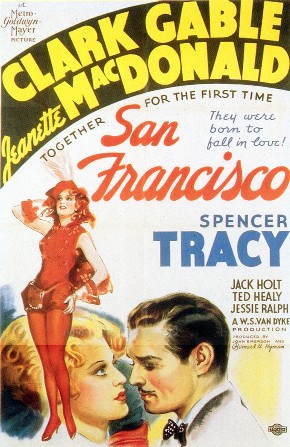
Lisa Watches An Oscar Nominee: San Francisco (dir by W.S. Van Dyke)


San_Francisco_(film)_poster

As I sit here writing this, I’m snowed in, my asthma’s acting up, and our cat is quickly losing patience with me.  On the plus side, however, this weather has given me an opportunity to watch some more of the old best picture nominees that I had saved up on my DVR.

For instance, I just finished watching the 1936 best picture nominee, San Francisco.

San Francisco was one of the first disaster films, a film that follows a group of characters as they attempt to survive the 1906 earthquake that destroyed the town of San Francisco.  And it has to be said that, nearly 80 years after the film was first released, the climatic earthquake remains effective and scary.  San Francisco, of course, was made long before there was any such thing as CGI.  Many of the film’s sets were built on special platforms that were designed to shake back and forth, just like in an actual earthquake.  When you see walls and buildings collapsing in San Francisco, you know that those walls are breaking apart and collapsing for real and the extras running for their life are literally doing just that.  After the earthquake, Clark Gable, as the film’s hero, walks through the ruins of San Francisco with the haunted look of a true survivor.  Gable was such a confident actor that it’s still jarring to see him looking overwhelmed.

Unfortunately, before you get to that spectacular earthquake, you have to sit through the rest of the film.  It’s a massive understatement to say that the pre-earthquake portion of San Francisco drags.  Clark Gable is Blackie Norton, a notorious gambler and saloon keeper.  Blackie may be a rogue but he’s a rogue with a heart of gold.  His childhood friend, Father Tim (Spencer Tracy), wants Blackie to run for the board of supervisors.  Blackie, however, is more interested in Mary Blake (Jeanette MacDonald), the newest singer at his club.

From the minute she first appears to the very end of the film, Jeanette MacDonald is singing.  Even when she’s not at the center of the scene, you can often hear her singing in the background.  And, after a little while, you just want her to stop singing.  But, whenever that happens, she tries to act and you realize that the only thing more boring than Jeanette MacDonald singing is Jeanette MacDonald acting.

Anyway, the film goes through all of the expected melodrama.  Blackie wants to reform.  Blackie decides not to reform.  Father Tim believes that there’s good in Blackie.  Father Tim gives up on Blackie.  Father Tim decides to give Blackie another chance.  Mary loves Blackie.  Mary fears Blackie.  Mary leaves Blackie.  Mary comes back to Blackie.  Mary leaves Blackie again.  Mary sings.  And sings and sings and sings…

But then, just when you’re about to fall asleep, the city starts to shake and all is forgotten in the wake of a natural disaster.  Even earthquakes serve a purpose…

San Francisco was a huge box office success.  It was nominated for best picture.  Somehow, Spencer Tracy received a nomination for best actor, despite the fact that he’s really not that impressive in the film. (His role is primarily a supporting one and he’s consistently overshadowed by Gable.)  The only Oscar that San Francisco won was for best sound recording and it must be said that, after all these years, the earthquake still sounds terrifying.

As for the film itself, I’d suggest skipping ahead to the earthquake.  That, after all, is the main reason anyone would be watching the film and, by skipping ahead, you’re spared having to sit through an hour and a half of Jeanette MacDonald singing.