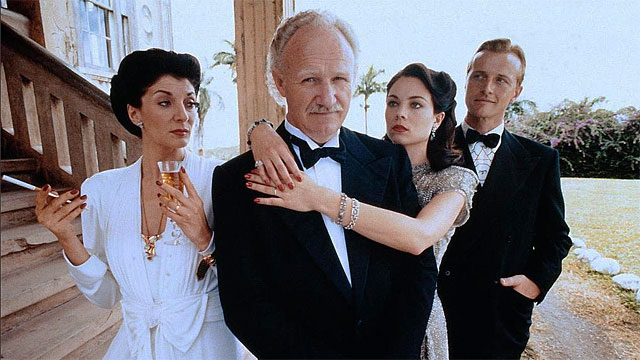
EUREKA (1983) – Gene Hackman strikes gold and tries to strike Rutger Hauer with a meat cleaver in the same move!


I’ve been thinking a lot about Gene Hackman as he recently celebrated his 95th birthday. He’s an incredible actor who has been a part of my life since I first really discovered my love of movies beginning in the mid-80’s. I’ve also been writing about Rutger Hauer every Sunday here on the Shattered Lens. Hackman and Hauer made a movie together back in 1983 called EUREKA, and to be honest, I almost forgot about it. It’s a movie I watched a long time ago and hadn’t watched again until today. It seemed like the perfect time for a revisit.

EUREKA opens with a stunning aerial shot that descends upon obsessed gold prospector Jack McCann (Gene Hackman) who’s fighting with a man on a snow-covered mountain in the Yukon territory. The man has asked Jack to partner with him in their search for gold, and Jack makes it clear that he will never “make a nickel on another man’s sweat.” Next, we see Jack as he’s walking through a nearly deserted town. In another unforgettable shot, Jack watches a man, who’s clearly gone mad, commit suicide just outside of the local “Claims office.” Before watching again today, that was the only scene that I could remember from my initial viewings of the film so many years ago. Next, we see Jack lying down below a tree at night, in windy, frigid temperatures, just about to freeze to death. Three hungry wolves have even approached ready for dinner. And this is where things get strange. Out of the blue, this clairvoyant madam (Helena Kallianiotes) from a local brothel sees him in her crystal ball, as a mysterious stone falls right next to him, starting a fire that warms him and drives away the wolves. He goes to see the madam at the brothel where she tells him that he will strike gold, but he “will be alone now.” Jack leaves the next morning and finds gold, rivers of gold. It’s another stunning sequence showing the obsessed man, who’s been searching for gold for 15 long and hard years, finally finding the object of his obsession. 

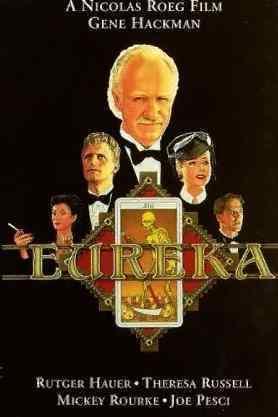
Cut to 20 years in the future, where Jack is now the richest man on earth, living on his own Caribbean island. It also appears he may also be the unhappiest man on earth. He has all the money in the world, but there is no peace in his heart or soul. His wife Helen (Jane Lapotaire), who he was once deeply in love with, is now detached and addicted to alcohol. His daughter Tracy (Theresa Russell) has fallen in love and married Claude Maillot Van Horn (Rutger Hauer). Jack cannot stand Claude as he suspects that he seduced and married Tracy so he could get to his money. His best friend Charles (Ed Lauter) has somehow gotten mixed in with Miami mobsters, led by a guy named Mayakofsky (Joe Pesci) and his lawyer Aurelio D’Amato (Mickey Rourke), who want to force Jack to sell them land on his island so they can build a casino. Jack feels like everybody just wants a piece of him and his money. He has lost the joy in his life. The rest of the film plays out against this backdrop as Jack tries to separate Tracy from Claude, and as the mobsters try to force Jack to sell to them by any means necessary.
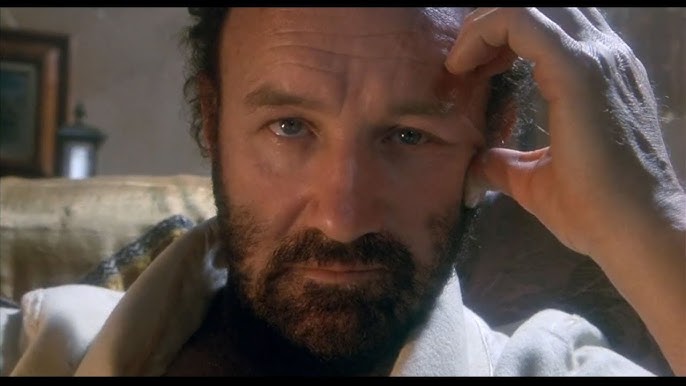
EUREKA is not a film that everyone will love, but I enjoyed watching it again after so many years. Director Nicolas Roeg, who also directed PERFORMANCE (1970), DON’T LOOK NOW (1973) and FULL BODY MASSAGE (1995), creates some truly amazing and brutal images that once seen are not easily forgotten. The scene where Jack McCann finds his huge vein of gold is so beautiful, but there are alternatively horrific scenes of brutal violence that play out almost to the point of overkill. The movie also takes some surprising twists and turns in the third act that you may not see coming. I always like it when a movie surprises me. It’s a melodramatic film that doesn’t have a lot of likable characters, but with a cast this good, I’m willing to go along with the filmmakers. In addition to the excellent work of Gene Hackman and Rutger Hauer, Theresa Russell has the important role as the daughter stuck between the man she loves and the dad who adores her. Her acting style exemplifies the melodrama of Roeg’s vision, so it works well in the context of this film. Jane Lapotaire has a couple of strong moments as Hackman’s alcoholic wife who yearns for days long gone when they were so in love. We were quite spoiled in the early 80’s when a movie could round out its already impressive cast with actors like Joe Pesci, Mickey Rourke, Ed Lauter, Corin Redgrave and Joe Spinell.

Nicolas Roeg appears to be trying to make deep statements about the meaning of life in EUREKA. I’m not a person who generally consumes films for deep meaning, but I thought it might be fun to at least take a surface-level view of some of the items I noticed while watching the movie. Jack spouts a lot of profound things throughout the movie, things that he feels describe him as a person. I mentioned one earlier when Jack tells the competing prospector prior to finding gold that, “I’ll never make a nickel off of another man’s sweat.” He will continue to use this saying throughout the film, even after he’s a rich, jaded, older man. The truth is that he would not have found the gold without the help of the clairvoyant madam, with her even passing away right after he hits the jackpot. In another scene at an extremely awkward dinner party, Jack tells his guests that the only rule that matters is the Golden Rule, “Do unto others as you would have them do unto you.” While I agree with the importance of this rule, Jack does not seem to follow the Golden Rule in any way that helps others or gives him any sense of peace or connection. Jack does not seem to understand the contradictions in his use of these phrases as played out in his own life, but I also think that his lack of understanding helps to illustrate a truth that plays out at times in many of our own lives. So often we’ll claim certain beliefs and values, but our lives as lived will be much more complex and often hypocritical. We can see them in Jack, but can we always see them in ourselves?

EUREKA also seems to be a movie that’s open to different interpretations based on who’s viewing the movie and where they are in life at that specific time. In a moment of clarity with his wife, Jack seems to recognize the hypocrisy in his life when he tells her “I once had it all… now I just have everything.” Jack is finally reflecting on the important things in his life, rather than dwelling on his current distrust of everyone around him. This final quote got me to thinking about my own life and just how different I am as a man in my early 50’s compared that naïve 20-year-old who first watched this film. I didn’t know what it was like to chase my dreams, catch them, and then try to figure out how to keep striving with a purpose. I didn’t know what it was like to be married with the responsibility of loving my wife and genuinely caring about her needs, through both the good times and the bad times. I didn’t know what it was like to be a dad who wanted nothing but true happiness for his children. Jack has lived through these specific opportunities in life, and we can see how he’s dealt with them. Each of these things have now played out in my own life. There have been times that I’ve failed, and there have been times that I’ve succeeded. I just keep reminding myself to try to focus on the things that matter and not get distracted by the things that don’t. Even now, it’s not always easy to do.    

I’ve included the trailer for EUREKA below:
Horror Film Review: The Asphyx (dir by Peter Newbrook)


The Asphyx, a 1972 horror film from the UK, opens in what would have been the film’s modern day.  A horrific accident occurs when two cars collide.  The drivers are both dead, with one of the them rather grotesquely hanging out of a shattered windshield.  And yet somehow, an elderly pedestrian who was trapped underneath the two cars is still alive and able to shuffle away from the accident.

The film then jumps back to the Victorian-era.  Sir Hugo Cunningham (Robert Stephens) is a scientist who is studying what happens at the exact moment of death.  Taking a look of several pictures that were taken of people as they died, he spots a dark smudge that seems to be hovering near the subject of each photograph.  Later, while making a home movie with an amazing new device called a motion picture camera, Sir Hugo can only watch in horror as his son Clive (Ralph Arliss) and Clive’s fiancee, Anna (Fiona Walker), both drown in a boating accident.  When Sir Hugo later looks at the film, he notices a ghostly blue light that seems to be hovering over both his son and Anna.

Sir Hugo speculates that the light could be what the ancient Greek called the Asphyx, a force that comes for everyone’s life in the moment right before death.  Hugo theorizes that everyone has their own individual Asphyx and he also comes to believe that if one were to capture their own Asphyx before it takes away their life, the result would be immortality.  Working with his reluctant adopted son, Giles (Robert Powell), Hugo sets out to capture an Asphyx.  Unfortunately, to do so means that someone has to be on the verge of death so that their Asphyx will show up.  Giles is not happy about the idea of strapping Hugo into an electric chair or of sitting in a gas chamber himself but he agrees to do so in return for Hugo’s permission to marry Hugo’s daughter, Christina (Jane Lapotaire).

(Before we all say, “Ewwww!,” let us remember that Clive is only adopted.  Still, it does feel a bit strange.)

The experiments lead to both tragedy and success.  Heads roll, literally.  And while Giles’s doubts continue to grow, Hugo finds himself more and more obsessed with the idea of living forever.

The Asphyx is a rather low-key horror film.  No one is going to mistake this for one of Hammer’s bloody and flamboyant films.  The horror is less in what is seen and more in what is implied.  That said, the premise is an intriguing one, the film’s plot unfolds with a good deal of intelligence, and both Robert Powell and Robert Stephens overact so grandly during the film’s final few minutes that those who are just looking for a campy British horror film will be satisfied.  Robert Stephens gives a very good performance as Sir Hugo, a scientist who claims that he’s just tying to make the world a better place but who is actually motivated by his own megalomania.  (He reasons that he deserves to be immortal because he’s a scientist and his contributions are too important to be ended by a mere death.)  Robert Powell’s somewhat wooden acting style actually makes him ideal for the role of Giles, who is written to be, at least in the beginning, a somewhat boring person.  The film’s best performance comes from Jane Lapotaire, whose reaction to discovering how far her father is willing to go to capture an Asphyx is simply heart-breaking to watch.

The Asphyx is a great pick if you’re looking for an off-beat and intelligent horror film this scary season.

Spring Breakdown: Eureka (dir by Nicolas Roeg)


In this 1983 film, Gene Hackman plays Jack McCann, a prospector who is determined to either get rich or freeze to death as he wanders around Alaska in the 1920s.  When he’s not having sex and philosophical discussions with the local witch, Freida (Helena Kallianiotes), Jack desperately searches for gold.  Jack is convinced that gold is all that he needs to be happy, though Freida counsels him that it’s also important to pursue more Earthly delights.  Everywhere Jack looks, he sees people dying in the snow.  In fact, Jack nearly dies himself until he stumbles across a mountain full of gold.  As gold dust pours down on him, he celebrates while having flashbacks to Freida writhing in ecstasy.  It’s just that type of film.  When Jack tells Freida about his claim, he asks what’s going to happen next.  Freida tells him that it’s both the end and the beginning.  Once again, it’s just that type of film.

At this point, Eureka jumps ahead 20 years.  The year is 1945.  World War II is coming to an end.  Jack is no longer freezing and starving to death in Alaska.  Now, he is one of the world’s richest men.  He even owns his own island in the Caribbean.  Jack has a huge house, a beautiful view of the ocean, and all the money in the world.  One could even say that his life has become an exclusive beach vacation, an eternal Spring Break, if you will.  And yet, even with all of his money, Jack has fallen victim to ennui.  He was happier when he was poor and starving and seeking warmth from Freida.  Now, he’s got an alcoholic wife (Jane LaPotaire) and his daughter, Tracy (Theresa Russell), is in love with a dissolute aristocrat named Claude (Rutger Hauer), to whom Jack takes an instant dislike.  Claude claims that Jack has stolen his wealth from the Earth.  Claude is the type who eats gold and then promises to return it to Jack as soon as he can.  That’s something that actually happens.  It’s kind of silly but Rutger Hauer is such a charmer that he nearly pulls it off.

Claude and Tracy aren’t the only thing that Jack has to worry about.  An American gangster named Mayakofsky (Joe Pesci) wants to take over Jack’s island so that he can build a casino on it.  However, despite the best efforts of Mayakofsky’s attorney (Mickey Rourke), Jack is still not willing to sell.  When hitman Joe Spinell shows up outside the estate, are Jack’s days of ennui numbered?

Of course, they are!  That’s not really a spoiler.  Eureka is (loosely) based on the real-life murder of Sir Harry Oakes, an American-born prospector who was thought to be one of the world’s richest men when he was brutally murdered in the 40s.  Jack is, of course, a stand-in for Oakes while Mayakofsky is based on Meyer Lansky, the mobster who many people suspect ordered Oakes’s murder.  Lansky was never charged with the crime.  Instead, Oakes’s son-in-law, Count Alfred de Marigny, was arrested and charged with the crime.  After a trial that made international news and was described as being “the trial of the century,” de Marigny was acquitted and the murder of Harry Oakes remains officially unsolved.

It’s an interesting story and it seems like one that should perfectly translate to film.  Surprisingly though, Eureka doesn’t really do it justice.  The film was directed by one of the masters of cinematic surrealism, Nicolas Roeg.  Roeg, of course, is probably best remembered for films like Performance, Don’t Look Now, Walkabout, and The Man Who Fell To Earth.  As one might expect from a Roeg film, Eureka is visually stunning but, as a director, Roeg can’t seem to decide whether he’s more interested in Jack’s ennui or in all the soapy melodrama surrounding Jack’s murder.  As such, neither element of the film gets explored with any particular depth and the resulting film, while always watchable, still feels rather shallow and disjointed.  (After taking forever to reach the end of Jack’s story, Eureka then turns into a rather conventional courtroom drama.  Theresa Russell does get to utter the immortal line, “Did you cut off my father’s head?” but otherwise, it’s kind of dry.)  The film is at its strongest when Jack is just a prospector in Alaska.  The harsh landscape and the crazed dialogue is perfect for Roeg’s dream-like style.  Once the film moves to the Caribbean, it suffers the same fate that befell Jack when he become rich.  It loses its spark.

That said, Eureka has its moments.  Any film that features Gene Hackman, Mickey Rourke, Joe Pesci, Rutger Hauer, and Joe Spinell all acting opposite of each other is going to have at least a few scenes worth watching.  I particularly liked Pesci’s surprisingly subdued performance as Mayakofsky.  With everyone else in the film chewing every piece of scenery on the island, Pesci wisely underplays and is all the more menacing for it.  While Eureka ultimately doesn’t add up too much, it’s worth watching at least once for the cast.

Finally, my personal theory is that Harry Oakes’s murder had more to do with the Duke and Duchess of Windsor (formerly King Edward VIII and Wallis Simpson) than it did with Meyer Lansky.  (The Duke was the governor of the Bahamas at the time of Oakes’s murder.)  But that’s just my opinion.