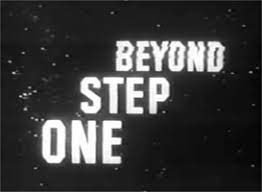
Tonight’s episode of One Step Beyond features host John Newland listening as a drunk (Sean McClory) at a bar tells the story of his former life as a gigolo and how a cursed necklace drove him mad. This episode is interesting if just because it takes the show’s “Did this story really happen?” premise to its logical conclusion. Apparently, John Newland couldn’t leave his house without someone telling him a story about the paranormal!
This episode originally aired on October 27th, 1959.
Yes, it’s true. Long before the creator of The Marvelous Mrs. Maisel was even born, Lenny Bruce was a real comedian who was challenging the status quo and going to jail for using words in his routine that were, at the time, considered to be so obscene that they couldn’t even be uttered in public. Today, of course, we hear those words and they’re so commonplace that we barely even notice. But, in the 50s and the early 60s, it was not uncommon for Lenny Bruce to get arrested in the middle of his act. Club owners could literally be fined for allowing Lenny Bruce to perform on their stage. At the height of his fame, it was a struggle for Lenny to find anyone willing to even consider booking him.
Whether it was his intention or not, Lenny Bruce became one of the first great warriors for the 1st amendment. It made him famous and a hero to many. Many people also believe that the pressure of being under constant legal threat led to his death from a drug overdose in 1966. Lenny Bruce was only 40 years old when he died but he inspired generations of comedians who came after him. It can be argued that modern comedy started with Lenny Bruce.
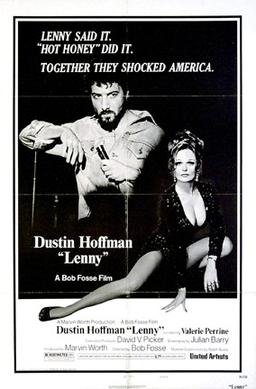
Directed by Bob Fosse and based on a play by Julian Barry, 1974’s Lenny takes a look at Lenny Bruce’s life, comedy, legal battles, and eventual death. As he would later do in the thematically similar Star 80, Fosse takes a mockumentary approach to telling his story. Clips of Lenny Bruce (played by Dustin Hoffman) performing are mixed in with “interviews” with actors playing the people who knew him while he was alive. Because the story is told out of chronological order, scenes of a young and enthusiastic Lenny are often immediately followed by scenes of a burned-out and bitter Lenny reading from the transcripts of his trial during his stand-up. Fosse never forgets to show us the audience listening as Lenny does his act. Most of them laugh at Bruce’s increasingly outrageous comments but, to his credit, Fosse never hesitates to show us the people who aren’t laughing. Lenny Bruce, the film tells us, was too honest to ever be universally embraced.
The film doesn’t hesitate to portray Lenny Bruce’s dark side. For much of the film, Lenny is not exactly a likable character. Even before his first arrest, Lenny comes across as being a narcissist who is cruelly manipulative of his first wife, stripper Honey Harlow (Valerine Perrine). As opposed to the somewhat dashing Lenny of The Marvelous Mrs. Maisel, Dustin Hoffman’s Lenny Bruce comes across as someone who you would not necessarily want to be left alone with. The film’s Lenny is a hero on stage and frequently a hypocrite in his private life but that seems to be the point of the movie. Lenny argues that one of the reasons why Lenny Bruce could so perfectly call out society for being fucked up was because he was pretty fucked up himself.
As with all of his films, Lenny is as much about Bob Fosse as it is about Lenny Bruce. As a director, Fosse often seems to be more interested in Bruce’s early days, when he was performing in low-rent strip clubs and trying to impress aging vaudevillians, than in Bruce’s later days as a celebrity. (The world in which the young Lenny Bruce struggled was a world that Fosse knew well and its aesthetic was one to which he frequently returned in his films and stage productions.) It’s also easy to see parallels between Lenny’s uneasy relationship with Honey and Bob Fosse’s own legendary partnership with Gwen Verdon. The film’s grainy black-and-white cinematography captures not only the rough edges of Lenny’s life but also perhaps Fosse’s as well. Just as Lenny Bruce performed confessional stand-up comedy, Lenny feels like confessional filmmaking.
Of course, it’s not always a pleasant film to watch. Dustin Hoffman does a very good job of capturing Lenny Bruce’s drive but he doesn’t really have the natural comedic timing necessary to be totally convincing as a stand-up comedian. (The film sometimes seems to forget that, as much as Lenny Bruce was admired for his first amendment activism, he was also considered to be a very funny stand-up.) Still, it’s a valuable film to watch. It’s a document of history, a reminder of a time when you actually could get arrested for saying the “wrong” thing. Some people would say that we’re returning to those times and it’s easy to imagine that the real Lenny Bruce (as opposed to the idealized version of him) would not be welcome to perform on most college campuses today. One can only imagine how modern audiences would react to a part of Lenny’s stand-up where he repeats several racial slurs over and over again. (If Lenny Bruce had lived to get a twitter account, he would be getting cancelled every week.) Lenny‘s vehement celebration of freedom of speech is probably more relevant in 2020 than it was in even 1974.
Lenny received several Oscar nominations, including best picture. However, 1974 was also the year of both The Godfather, Part II and Chinatown so Lenny failed to win a single Oscar.
(Interestingly enough, Fosse’s previous film, Cabaret, was also prevented from winning the award for best picture by the first Godfather, though Fosse did win best director over Francis Ford Coppola. Five years after the release of Lenny, Fosse would make All That Jazz, which was partially based on his own health struggles that he suffered with during the filming Lenny. In All That Jazz, Cliff Gorman — who starred in the stage production of Lenny — is frequently heard reciting a Lenny Bruce-style monologue about death. Fosse’s All That Jazz would again compete with a Francis Ford Coppola production at the Oscars. However, Kramer vs Kramer — starring Lenny‘s Dustin Hoffman — defeated both All That Jazz and Apocalypse Now for the big prize. 22 years later, Chicago, which was based on Fosse’s legendary stage production and which featuring the song that gave All That Jazz it’s name — would itself win best picture.)
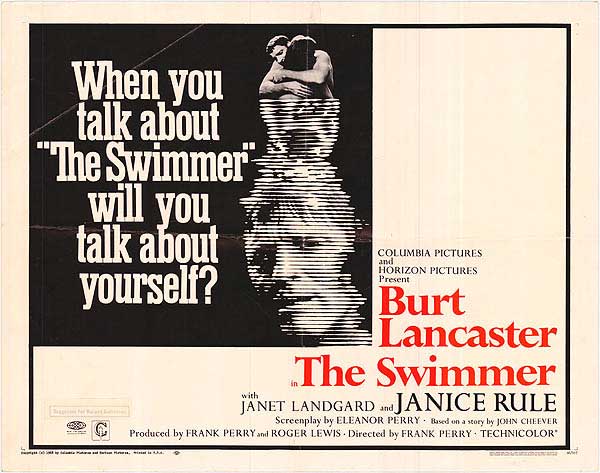
The 1968 film The Swimmer opens with Ned Merrill (Burt Lancaster) emerging from the woods that surround an affluent Connecticut suburb. He’s a tanned, middle-aged man and, because he spends the entire film wearing only a bathing suit, we can tell that he’s still in good shape for a man in his 50s. When Ned speaks, it’s with the nonstop optimism of a man who has found and claimed his part of the American Dream. In short, Ned appears to be ideal American male, living in the ideal American community.
However, it gradually starts to become apparent that all is not well with Ned. When he mysteriously shows up at a pool party being held by a group of his friends, they all seem to be shocked to see him, commenting that it’s been a while since Ned has been around. Ned, however, acts as if there’s nothing wrong and instead talks about how beautiful the day is and says that he’s heading back to his home. He’s figured out that all of his neighbor’s swimming pools form a “river” to his house and Ned’s plan is to swim home.
And that’s exactly what Ned proceeds to do, going from neighbor to neighbor and swimming through their pools. As he does so, he meets and talk to his neighbors and it becomes more and more obvious that there are secrets hidden behind his constant smile and friendly manner. As Ned gets closer and closer to his actual home, the neighbors are far less happy to see him.
At one house, he runs into Julie (Janet Landgard) who used to babysit for his daughter. Julie agrees to swim with Ned and eventually confesses that she once had a crush on him. When Ned reacts by promising to always protect and love her, Julie gets scared and runs away.
At another house, Ned comes across another pool party. A woman named Joan (played by a youngish Joan Rivers) talks to him before a friend of her warns her to stay away from Ned.
When Ned reaches the house of actress Shirley (Janice Rule), it becomes obvious that Shirley was once Ned’s mistress. They discuss their relationship and it quickly becomes apparent that Ned’s memories are totally different from Shirley’s.
And, through it all, Ned keeps swimming. Even when he’s offered a ride to his house, Ned replies that he has to swim home.
The Swimmer is a film that I had wanted to see ever since I first saw the trailer on the DVD for I Drink Your Blood. (That’s an interesting combination, no? I Drink Your Blood and The Swimmer.) I finally saw the film when it showed up on TCM one night and, when I first watched it, I have to admit that I was a little disappointed. Stylistically, the film itself is such a product of the 1960s that, even though suburban ennui and financial instability are still very relevant topics, The Swimmer felt rather dated. I mean, I love a good zoom shot as much as anyone but, often times during the 60s, they seemed to be used more for the sake of technique than the sake of story telling.
However, the second time I sat through The Swimmer, I appreciated the film a bit more. I was able to look past the stylistic flourishes of the direction and I could focus more on Burt Lancaster’s excellent lead performance. Lancaster plays Ned as the epitome of the American ideal and, as a result, his eventual collapse also mirror the collapse of that same ideal. The Swimmer is based on a short story by John Cheever and, quite honestly, the film’s story is a bit too much of a literary conceit to really work on film. That said, The Swimmer — much like the character of Ned Merrill — is an interesting failure, which is certainly more than can be said of most failures.
 Through the Shattered Lens