
The 1960 gangster film, The Purple Gang, really took me by surprise.
The film opens with U.S. Rep. James Roosevelt standing in front of his desk. James Roosevelt was the son of President Franklin D. Roosevelt. He was a notoriously shady businessman who, before entering politics, dabbled a bit in Hollywood. That probably explains how he eventually came to be standing in his congressional office, filming the introduction for a low-budget B-movie about Detroit gangsters. Roosevelt tells us that he’s already watched the movie that we’re about to see and that he can assure us that it is an accurate portrayal of not just the history of The Purple Gang but also of how 1920s bootlegging led to a host of other crimes. Roosevelt goes on to compare bootleggers to modern day drug pushers. The most interesting thing about the speech is that it almost sounds like a defense of prohibition, the law that FDR famously opposed.
To use a term from the film’s era, it’s kind of a square opening. James Roosevelt comes across as being so vacuously earnest that it’s almost as if Beto O’Rourke got his hands on a time machine and went back to 1960. At the same time, there’s something oddly charming about how awkward it is. One can only imagine how audiences would react if a film today opened with a speech from a congressperson. I guess some parts of the country would love it. Down here in Texas, the theater would probably get set on fire.
Now, based on that less than edgy opening, you might be justified in expecting that The Purple Gang will just be your standard 1960s crime thriller but it most definitely is not. The Purple Gang is a tough and violet movie, one that is full of shadowy and sometimes disturbing imagery. A very young Robert Blake plays Honeyboy Willard, a teenage hoodlum who, through pure sociopathic ruthlessness, takes over the rackets in Detroit. Barry Sullivan is Lt. Harley, the police detective whose quest to bring down the Purple Gang leads to him losing almost everything that was important to him.
Our first impression of Lt. Harley comes when he skeptically listens to a liberal social worker, Joan McNamara (Jody Lawrance), explain that criminals are not born but are instead made by their circumstances. Harley obviously doesn’t agree. Later, while Joan is walking around Detroit at night, she is attacked, rape,d and then murdered by the same criminals that she was earlier defending. With the city outraged over Joan’s murder, Lt. Harley steps up his efforts to bring down the gang so Honeyboy murders Harley’s pregnant wife.
While Harley seeks revenge, Honeyboy is busy making deals with Canadian liquor distributors and building the Purple Gang into the biggest criminal enterprise in the northern midwest. When a group of distraught businessmen, upset at being extorted by the Purple Gang, turns to the Mafia for help, Honeyboy declares war….
Of course, despite James Roosevelt’s assurance at the start of the film and the semi-documentary approach that director Frank McDonald takes to the material, the truth is far different from the movie. In real life, The Purple Gang was predominantly made up of the children of recent immigrants from Russia and Poland. It was run not by Honeyboy Willard but by the four Bernstein brothers. The Purple Gang did not go to war with the Mafia but instead, they were allied with Lucky Luciano and Meyer Lansky in their attempts to create a national crime syndicate. They were also closely allied with Al Capone, to the extent that it’s been suggested that Capone used Purple Gang gunmen to carry out the St. Valentine’s Day Massacre. The Purple Gang eventually fell apart due to infighting and the end of prohibition, with the majority of the members who weren’t in jail simply joining other gangs.
So, no, The Purple Gang is not historically accurate but it’s still an effective and surprisingly brutal gangster film. The noirish photography makes certain scenes seem almost as if they’ve been lifted straight out of a nightmare and, historically accurate or not, the film does do a good job of showing how organized crime came to exist in the United States. It’s a quick-paced and energetic film and it features a great performance from Robert Blake as the chillingly sociopathic Honeyboy. The Purple Gang is a low-budget B-movie that packs a punch.
Plus, James Roosevelt did ask you to watch. Are you going to say no to James Roosevelt?
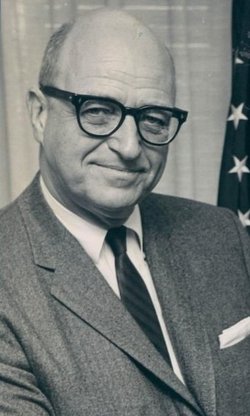
James Roosevelt, film critic
Previous Offers You Can’t Refuse:
 Through the Shattered Lens