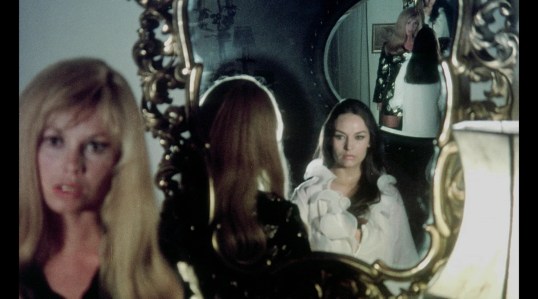
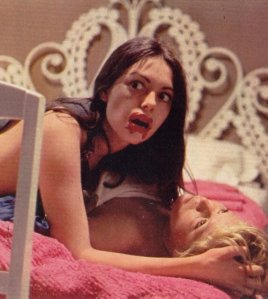
International Horror Film Review: Pieces (dir by J. Piquer Simon)


It’s a strange world out there.

This 1982 Spanish-produced slasher film was advertised, at least in the United States, with the brilliant tag line: “You don’t have to go to Texas for a chainsaw massacre.”  And indeed, Pieces takes place in Boston, Massachusetts.  And yet, it’s a Boston that has little relation to the Boston of the real world.  (Some of that may be because, while a few scenes were filmed in Boston, the majority of the film was shot in Spain.)  Indeed, one can argue that Pieces takes place in an alternate reality, one that was created with bits of giallo suspense, slasher gore, and scenes randomly borrowed from every other exploitation film ever made.

In the 1950s, a little boy wears a bowtie and plays with a pornographic jigsaw puzzle.  His mother takes the puzzle away from him, which he doesn’t appreciate at all.  It leads, as things usually do, to an axe murder.

In the 1980s, a college student tries to roller skate down a sidewalk, just to suddenly lose control.  As she helplessly rolls down the street, two workman carrying a sheet of glass just happen to step out in front of her.  Pieces of blood-stained glass fly everywhere.  As is typical of Pieces, this actually has nothing to do with the larger plot of the film.  We never learn the girl’s name.  We never hear learn if she survived nor do we hear much else about the accident.  Instead, it’s just a random incident, tossed in to illustrate that the world is going mad.

On campus, a chainsaw killer is killing students and teachers.  He’s the boy with the bowtie, all grown up.  He takes body parts home with him so that he can stitch them together, recreating the jigsaw puzzle that was stolen from him years before.  Oddly enough, he never makes much of an effort to hide his chainsaw.  He casually gets on an elevator with one of his victims.  She notices that he’s carrying a chainsaw but she doesn’t say anything about it until he actually turns it on.

Dean Foley (played by Eurohorror veteran Edmund Purdom) is upset that students keep getting dismembered on campus, as well he should be.  Lt. Bracken (Christopher George, barking out his lines with the same annoyed energy that he brought to Graduation Day) is also upset because he’s supposed to arrest criminals and stuff.  Unfortunately, all of Bracken’s cops are incredibly incompetent.  Bracken is forced to rely on the help of Kendall James (Ian Sera).  Despite being kind of scrawny and unappealing, Kendall is the most popular student on campus.  Kendall also knows every victim and discovers the majority of them.  You would think that Kendall would be the obvious suspect but instead, Kendall somehow ends up directing the entire investigation.  Kendall’s not a cop but he’s soon ordering around the veteran detectives and everyone’s okay with that.  (One detective even mentions that Kendall might as well be a part of the force.)

Lt. Backen decides that the best way to solve the case is to send in Mary Riggs (Linda Day George), who is not only an undercover cop but also a top-ranked tennis player!  There’s a lot of tennis in Pieces, as Mary works on her game in between working with Kendall to solve the murders.  Kendall and Mary aren’t very effective though.  After discovering that one victim was chopped in half in the showers while Kendall and Mary were trying to find the source of some loud marching band music, Mary lets the killer know exactly what she thinks of him.

But who is the killer?  Because Pieces was as inspired by the giallo genre as the slasher genre, there are several suspects.  Kendall seems like the obvious one but, for whatever reason, no one makes that connection.  Instead, we’re left to wonder if maybe it could be the Dean.  Or how about Prof. Brown (Jack Taylor), the somewhat odd professor who seems to be a bit repressed?  Or maybe it’s the handyman, Willard (Paul L. Smith)?  Willard is creepy and he works with a chainsaw!  There are a lot of suspects and helpfully, after a murder at the pool, every single one of them shows up at the scene of the crime.  At one point, they all even gather in the same corner and look straight at the camera.  You half expect Kendall to announce, “Well, I can’t possibly solve this one!  Can you?”
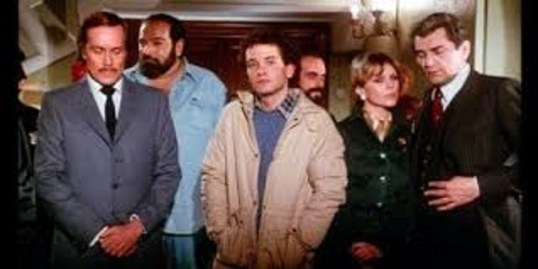
But that’s not all!  When Kendall and Mary aren’t solving murders, they’re having to deal with all of the other weird things that happen on campus.  At one point, Mary is randomly attacked by the school’s karate instructor.  After Kendall shows up and explains who the man in, they all laugh it off as being the result of “bad chop suey.”  Later, Kendall walks Mary back to her place and, after she rejects his attempts at romance, Kendall turns around to be confronted by another student who taunts him by yelling, “Casanova!”  Meanwhile, other students are still walking around campus in the middle of the night and making plans to meet up in a room that contain the height of campus luxury, a waterbed!

(Yes, a murder does occur on the waterbed.  Yes, water goes everywhere.  It’s Chekhov’s waterbed. You can’t introduce it without including a scene where it gets punctured.)

Many things happen, none of which make sense.  The entire film is so over-the-top in its combination of gore, overacting, and general absurdity that it becomes strangely fascinating.  From today’s perspective, it’s easy to imagine that the film was actually meant to be a parody but director J. Piquer Simon has said that it was meant to be viewed as a serious thriller, regardless of how the film was subsequently advertised in the United States.  Even the film’s ending, in which someone who is not the killer is randomly castrated just because, was meant to be taken seriously.  Every weird moment was included to give the audience what they wanted.  Audiences loved Bruce Lee so, of course, a random karate fight was tossed in.  People love chainsaws so, of course …. well, you get the idea.

On the one hand, Pieces is a really heavy-handed and mean-spirited film, one in which the victims are almost exclusively women and where sex and violence are too often connected.  Mary may be an absurd character but you’re happy when she shows up because she’s the one woman in the film not presented as being a passive victim.  On the other hand, Pieces is just so over-the-top and absurd that it’s hard not to watch the film all the way through.  Perhaps the only thing that keeps the film from being incredibly offensive is that, regardless of what the director has claimed, it is so obviously not meant to be taking place in the real world.  When that plate glass was shattered, it obviously opened a vortex that sucked the campus into a world where every slasher and giallo trope has been adapted to the point of absurdity.  This is one of those films that just gets more and more strange with each passing minute.  You watch it and you find yourself continually thinking, “This movie can’t get any weirder” and then it manages to do just that.  Watching the movie is like stepping through a portal into some sort of strange alternate reality.  Just try to look away.
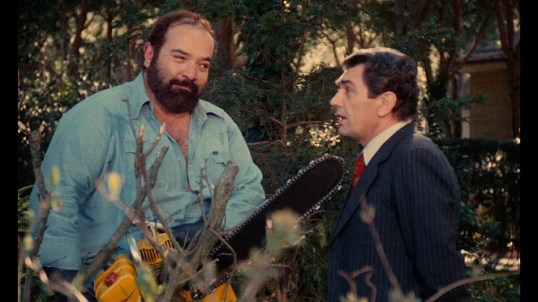
Who could the murderer be?
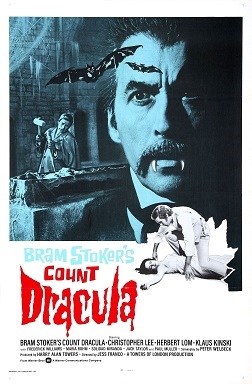
International Horror Review: Count Dracula (dir by Jess Franco)


Christopher Lee played Dracula in seven horror films and he often said that he hated almost every single one of them.

Christopher Lee, you have to understand, was a fan of Bram Stoker’s original novel and he always wanted to play Dracula the way that Stoker wrote him, as a member of the old nobility who got younger each time he drank blood.  As Lee often explained it, he spent years vainly trying to convince Hammer to do a Dracula film that was faithful to Stoker’s novel but Hammer instead preferred to use Dracula as an almost generic villain, one who was frequently plugged into equally generic films.

At some point, in the late 60s, producer Harry Alan Towers approached Christopher Lee and asked him to play Dracula in a non-Hammer film about the world’s most famous vampire.  At first, Lee refused.  If he was bored with playing Dracula for Hammer, why would he want to play him for someone else?  However, Towers then explained that his version of Dracula would be the first Dracula film to actually be faithful to Stoker’s book.  In fact, along with the presence of Christopher Lee, that would be the film’s major selling point!  Hearing this, Lee agreed.

The resulting film was 1970’s Count Dracula, a German-Spanish-British co-production that was directed by none other than Jess Franco.  Jess Franco, of course, is a beloved figure among many fans of Eurohorror and a bit of a controversial filmmaker.  Some people admired him for his ability to direct atmospheric films while spending very little money.  Others complained that Franco’s films were frequently amateurish and narratively incoherent.  When it comes to Franco, both camps can make a compelling argument.  Personally, I tend to come down on the pro-Franco side of things, particularly when it comes to the films that he made with Towers in the 70s.  For his part, Christopher Lee said he enjoyed working with Franco and they would go on to collaborate on several more films together.

So, what type of film is Jess Franco’s Count Dracula?  Well, Towers did not lie to Lee.  For the most part, Count Dracula remains faithful to plot of Bram Stoker’s Dracula.  There’s a few minor differences, of course.  A few characters are combined, which is understandable given that you sometimes need a scorecard to keep up with everyone in the novel.  The ending is a bit more abrupt in the film than it is in the book.  This probably has something to do with the fact that Franco ran out of money before he finished the film.  That was a fairly frequent occurrence on Franco’s films.

That said, film sticks close to the novel.  Jonathan Harker (Frederick Williams) goes to Transylvania and meets Dracula (Christopher Lee, with a mustache), an aging nobleman.  Harker soon finds himself being held prisoner in the castle, a victim of Dracula and his brides.  Though Harker does manage to escape (though not before finding Dracula asleep in his coffin), he ends up at a psychiatric hospital in London.  He meets Dr. Seward (Paul Muller) and Prof. Van Helsing (Herbert Lom).  Eventually, his fiancee Mina (Maria Rohm) and her best friend, Lucy (Soledad Miranda, who was Franco’s muse until he tragic death in a car accident) come to visit him.  Accompanying Lucy is Quincy Morris (Franco regular Jack Taylor), who, in the film, is a combination of two of the novel’s characters, Quincy and Arthur Holmwood.  Meanwhile, a madman named Renfield (Klaus Kinski) babbles about his master and eats bugs.

That said, while the story may stick close to Stoker, this is definitely a Franco film.  The action plays out at its own deliberate pace.  Depending on how much tolerance you have for Franco’s aesthetic, you’ll find this film to be either dream-like or slow.  Personally, I liked the amospheric images and the somewhat ragged editing style.  Whether it was Franco’s intention or not, they gave the film a hallucinatory feel, as if one was watching a nightmare being dreamt by Stoker himself.  At the same time, I can imagine others getting frustrated by the film and I can understand where they’re coming from.  Franco, with his habit of mixing the sensual with a deep sense of ennui, is not for everyone.

Still, it was interesting to see Lee giving a much a different performance as Dracula than he did in the Hammer films.  The Hammer films portrayed Dracula as being animalistic, driven by only his craving for blood.  In Count Dracula, Lee plays with the idea of Dracula being a relic of the old world, someone who has no choice but to watch as civilization changes around him.  While Dracula is undoubtedly evil, Lee plays him with hints of dignity.  Gone is the snarling and growling monster of the Hammer films and instead, this movie features a Dracula who takes an almost Calvinistic approach to his affliction.  He’s accepted his fate.  As he tells Harker, Harker can either choose to enter the castle or not.  In the end, it makes no difference because eventually, someone will enter.  The film also retains the idea of Dracula growing younger in appearance as he drinks blood, which adds a whole other dimension to Dracula’s cravings.  Blood is life and youth, two things that Dracula no longer possesses.

As for the rest of the cast, Klaus Kinski, not surprisingly, throws himself into the role of Renfield.  Reportedly, he ate real bugs for the role.  Herbert Lom seems a bit bored with the role of Van Helsing.  He doesn’t have any of the eccentric energy that we typically associate with the role.  Of course, some of that is due to the fact that, because of scheduling conflicts, Lom and Lee were never on set at the same time.  The scenes where Dracula and Van Helsing confront each other were created through some editing sleight-of-hand.  As is typical with Franco films, sometimes it works and sometimes, it’s extremely obvious that Lom wasn’t actually looking at Lee (or anyone other than the cameraman) when he delivered his lines.

Count Dracula is an interesting take on the story.  It’s a bit uneven, though that’s perhaps not a surprise considering that the production was apparently beset by budgetary problems from the start.  This film is Franco at his least lurid and it’s hard not to miss some Franco’s more sordid impulses.  Watching the film, you get the feeling that Franco was holding back.  But, the visuals are wonderfully dreamy, Kinski is compelling in his insane way, and Lee finally appears to be enjoying the role of Dracula.  It’s actually kind of nice to see.

The TSL’s Daily Horror Grindhouse: The Ghost Galleon (dir by Amando de Ossorio)


gg

The Blind Dead are back and this time, they’re on a boat!

Yes, you read that correctly.  1974’s The Ghost Galleon is the third film in Spanish director Amando de Ossorio’s Blind Dead series.  The decaying and blind Knight Templar are back and they’re just as evil and blood thirsty as they were in both Tombs of the Blind Dead and Return of the Evil Dead.  However, this time, they’re on a boat.  What are they doing on a boat?  Apparently, they’re guarding some sort of Satanic treasure chest and they’re killing and eating anyone who makes the mistake of boarding their boat.

That means that this is the first Blind Dead film to not feature any scenes of the Blind Dead riding their horses in slow motion.  That may not sounds like much but the absence of those horses is definitely felt.  The Blind Dead on horses are a metaphor for everything from political tyranny to religious oppression.  The Blind Dead on a boat are still scary but now they’re also vaguely silly.

And yet, the Blind Dead on a boat is not the silliest part of the film!  The Ghost Galleon starts out with two models lost at sea.  Apparently, they were hired by a businessman and aspiring politician named (in the version released in America, anyway) Howard Tucker (Jack Taylor).  Howard is a boat manufacturer and he felt it would be great publicity if the models took one of his boats out into the ocean and pretended to get stranded.  Apparently, Howard felt that this would convince the public that they could live for weeks in one of his speedboats if they needed to…

No, I’m not making that up.  That’s the plot of the damn film.

ANYWAY — the models get stranded for real but suddenly, here comes a big, dark, old timey galleon.  It’s just floating out in the middle of the ocean and it appears to be surrounded by a very thick fog.  Naturally, the models decide to leave their boat for the galleon because why stay somewhere vaguely safe when you can get on a big, scary, evil looking galleon?

Now the models are missing and Howard needs to get his boat back.  So, he and his evil henchman get yet another model to sail out to the middle of the ocean with them.  Also accompanying them is a historian/scientist guy, who is mostly there because the film will later need him to fill in the backstory of the Blind Dead…

Now, I know that it probably sounds like I’m being supercritical of the third Blind Dead film but actually, it kind of works.  The key is not to worry about logic, consistency, or anything you learned about at that screenwriting workshop.  Instead, simply accept The Ghost Galleon as being the equivalent of a filmed nightmare.  For everything that the film lacks in logic, it makes up for in atmosphere.  (Let’s just say that the fog machine gets quite a workout.)  And while it may not make much sense for them to be on a boat, the Blind Dead are just as scary, evil, and merciless as ever.

Add to that, the film has a great ending.  I won’t spoil it here but I will say that the film’s final shot makes up for a lot of what you have to sit through in order to reach it.

The Ghost Galleon should not be the first Blind Dead film that you see.  (Unfortunately, it can be found in several ultra cheap box sets, complete with a bad transfer and spotty soundtrack.)  But if you’ve seen Tombs of the Blind Dead and Return of the Evil Dead, you should also see The Ghost Galleon.  If nothing else, it proves the de Ossorio could get results with even the most ludicrous of premises.

Embracing the Melodrama Part II #34: Nightmares Come At Night (dir by Jess Franco)


nightmarescome2big For the past two weeks, I’ve been in the process of reviewing 126 cinematic melodramas.  Embracing the Melodrama Part Two started in 1927 with a look at Sunrise and now, 33 reviews later, we’ve finally reached the 70s.  And what else can I say about that other than to exclaim, “Yay!”

Seriously, a lot of good films were released in the 1970s.

We begin the 70s by taking a look at a film from the iconic and (to some people) infamous Spanish director Jess Franco.  Over the course of 54 years, director Jesus Franco Manera was credited with directing 203 films.  In all probability, the workaholic Franco directed a lot more than he’s been credited with.  As I wrote about Franco in my previous review of Female Vampire: “Among critics, Franco is usually either dismissed as a total hack (and/or pervert) or embraced as the living embodiment of the auteur theory.  Though no one’s quite sure how many films Franco has directed, Franco himself has estimated that he’s directed more than 200 films and, for the most part, he has financed and distributed them all on his own.  Franco has worked in every genre from thriller to comedy to hardcore pornography, but he is probably best known for directing low-budget, occasionally atmospheric erotic horror films.”

Now, I have to admit that I feel a little guilty about using a paragraph from an old review in a new review.  (And, as you may have noticed, I reviewed Female Vampire before Franco passed away in 2013.)  But, then again, it feels somewhat appropriate because Franco was famous for and unapologetic about taking bits and pieces of old and unfinished films and inserting them into new films.  That’s certainly the case with his 1970 film Nightmares Come At Night.

Nightmares Come At Night opens with Anna (Diana Lorys) living in an atmospheric mansion with her lover, Cynthia (Colette Giacobine).  Anna is haunted by frequent nightmares where she sees herself killing strange men with a spear.  Cynthia arranges for Anna to talk to an enigmatic doctor (Paul Muller).  Anna tells the doctor about how she was once a famous erotic dancer until she met Cynthia.  At this point, we get several lengthy flashbacks of Anna dancing in an oddly desolate club, all of which adds to the film’s ennui-drenched atmosphere.

Talking to the doctor doesn’t do Anna much good and she continues to have her nightmares except now the nightmares also seem to feature men giving lengthy monologues.  It soon becomes obvious that the neurotic Anna is being held as a virtual prisoner in the house by the dominating Cynthia.

(It’s a bit like a Lifetime movie, except everyone’s naked for 85% of the film’s running time.)

Meanwhile, we occasionally get shots of two people staring out of an unrelated window.  Eventually, we realize that they’re supposed to be Cynthia’s neighbors.  One of them is played by Franco’s frequent muse, Soledad Miranda.  (Miranda would tragically die in an automobile accident in 1970.)  Anyone who is familiar with Franco’s work will immediately notice that Miranda’s look in Nightmares was later duplicated by Lina Romay in Female Vampire.  The neighbors are obsessed with Anna.  As the film progresses, we discover that, when not looking out the window, they spend most of their time lying on a filthy mattress.  At one point, the camera zooms in for a close-up of the graffiti that’s been written on the wall over the mattress.

LIFE IS ALL SHIT, it reads.

To a certain extent, it’s pointless to say that Nightmares Come At Night is a disjointed film because almost all of Franco’s films were disjointed.  That’s actually what gave even the weakest of his films an odd and memorably dreamlike feel.  But Nightmares Come At Night is even more disjointed than usual.  That’s because Nightmares Come At Night was made out of a mix of footage shot for other films.  The scenes with Soledad Miranda were for an earlier, unfinished film.  Those scenes were combined with the footage of Anna, Cynthia, and the doctor.  The end result is a film that doesn’t necessarily much sense but you still have to admire Franco’s refusal to let any footage go to waste.

Ultimately, as with so many Franco films, Nightmares Come At Night is less about plot and all about atmosphere.  This is a film that is full of ennui and existential decadence.  It’s not one of Franco’s best films but, much like last year’s underrated California Scheming, it’s a bit of a minor existential classic when taken on its own terms.

(Please note: the trailer below is mildly NSFW.  Watch at your own risk.)

The Daily Grindhouse (Horror Edition): Female Vampire (dir. by Jess Franco)


My wonderful and loyal readers, I fear that I have failed you.  How is it, with my love of both grindhouse and Eurosleaze cinema, that I have yet to review a Jess Franco film on the site?  Halloween seems to be the perfect time to correct that oversight by taking a look at Franco’s infamous 1973 horror film, Female Vampire.

To truly “appreciate” a film like Female Vampire, it helps to know a little something about Jess Franco.  Working under a variety of pseudonyms, Spanish-born Jesus Franco Manera has been making films for over 60 years.   Among critics, Franco is usually either dismissed as a total hack (and/or pervert) or embraced as the living embodiment of the auteur theory.  Though no one’s quite sure how many films Franco has directed, Franco himself has estimated that he’s directed more than 200 films and, for the most part, he has financed and distributed them all on his own.  Franco has worked in every genre from thriller to comedy to hardcore pornography, but he is probably best known for directing low-budget, occasionally atmospheric erotic horror films like Female Vampire.

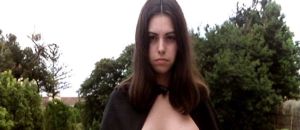
The opening of Female Vampire pretty much epitomizes everything that people love and hate about Jess Franco as a director.  The film begins with a series of ominous shots of a misty forrest.  The forest feels both beautiful and desolate at the same time and Franco’s camera lingers over the fog, building up an atmosphere of both mystery and melancholy.  Suddenly, we see one lone figure walking through the forest.  Irina (played by frequent Franco star Lina Romay) emerges from the fog, naked except for a cape and a belt.  The camera follows Irina as she walks through the mist.  When Irina stops and faces the audience, the camera zooms in to a close-up of her face and her body.  While Franco’s aim here is obviously to cater t0 the sexual fantasies of his predominately male audience, it’s still a remarkably strong scene because Romay faces the camera with such confidence that her nudity feels less like exploitation and more like empowerment.  (Romay was, like me, a self-described exhibitionist.)  Once Franco’s camera zooms away from Irina, she then starts to confidently approach the camera (and the audience as well).  She gets closer and closer to the camera until finally … she accidentally bumps her head on the lens.

That, for lack of a better example, totally sums the aesthetic of Jess Franco.  When you watch a Franco film, you’re left with the impression that Franco simply turned on the camera and recorded whatever happened to happen in front of it.  Occasionally, he managed to capture something unique and dramatic and just as often, he filmed someone bumping into the equipment or staring straight at the camera.  Whether he liked the spontaneity that came from an unexpected mistake or he just didn’t have enough money in his budget to do a second take, Franco would more often than not include these mistakes in his final film.

As for the rest of Female Vampire, it’s eventually established that. along with being a vampire, Irina is a countess and also a mute.  (At one point, we do hear her inner thoughts, a monologue in which she tells us, “I earnestly wish an end would come to this bloody race I am forced to run.”)  Several different cuts of Female Vampire have been released over the years and depending on which version you see, Irina either has to either regularly drink blood or drink semen in order to survive.  (“It was as if his potency was sucked out of him,” as the coroner puts it.)

While Irina spends all of her time wandering around a depressing resort town and seducing various victims, a poet (Jack Taylor) searches for her.  This poet — who spends a lot of time staring off into the distance and delivering inner monologues about walking down this road we call life — is determined that he and Irina are meant to be together.

There are many different version of Female Vampire currently in circulation.  For instance, a heavily-edited version was released in the U.S. as The Bare-Breasted Countess.   While Franco’s director’s cut lasts close to two hours, there are other versions that barely clock in at 70 minutes.  There’s a hard-core version, a soft-core version, and even a version that features close to no sex at all.  The version I saw was the DVD released by Image Entertainment.  That version is reportedly close to Franco’s original.

As is typical for a Franco film, not much happens in Female Vampire and what does happen doesn’t make much sense.  But, oddly enough, that actually worked in the film’s favor.  By ignoring things like plot and logic and by focusing on the film’s visuals, Franco made a film that literally feels like a dream.  Every scene is filled with an atmosphere of pure ennui and, when coupled with charisma of Lina Romay and Jack Taylor,  the end result is a film that’s strangely compelling.