The dream has to end somewhere. Science fiction seems to agree on that. Futuristic technology produces what biology could not: logic-based systems so functional and adept at survival that humanity becomes obsolete. Whether we assimilate into a borg colony or a zerg hive mind, imagination is pretty screwed. Our best bet might be something like The Matrix. Perhaps some utility will compel our robot overlords to spare the sheep who spawned them. Yay!
I cannot say what it must feel like to be enslaved by a post-human species, but I fancy it would sound a lot like the 777 trilogy by Blut Aus Nord. Between 2011 and 2012, these French black metal legends offered up a journey through a world that was beyond dystopian. Discordant melodies and unorthodox rhythms taken to the extreme are usually a recipe for disaster–the tools of technically proficient but creatively deprived math rock and avant-garde musicians I would only listen to under duress. Blut Aus Nord masterfully avoided that pitfall by envisioning a coherent aesthetic framework and driving the music forward as a consistent conceptual progression across 18 tracks. Radical experimentation joins forces with dark industrial grooves to place the listener in a futuristic, post-human world where mechanical gods rule apathetic over mortals bred in gestation crates.
The trilogy does not actually offer any textual insight into what its world is supposed to be. The minimal lyrics are highly esoteric, and Blut Aus Nord ultimately leave it to the instrumentation to tell their tale. You might not experience it as a futuristic world at all, but rather as some bleak corner of hell from which a lost soul digs through the madness and witnesses his overlord. But as far as it speaks to me, the 777 trilogy is the vision of a feckless human slave awakening from his dream into terrifying, incomprehensible world. He slowly comes to understand his master and, perhaps, ultimately assimilates into the hive mind. The final track, “Epitome XVIII”, is a grim, cold trance in which a soulless machine reigns on triumphant.
Pyramids are four seemingly random Joes from Denton, Texas, who have managed to attract some huge names in the world of music, possibly through their completely ridiculous album covers. Well, maybe not that, but the genre-defying oddity known as Pyramids and their associated acts have shown an uncanny knack for recruiting stars to their projects. Originally signed to Aaron Turner’s (Isis, Old Man Gloom) acclaimed Hydra Head Records, they managed a transition to metal’s newest cutting edge label, Profound Lore, as soon as the former went defunct. Their self-titled debut in 2008 scored Colin Marston (Krallice), Vindsval (Blut Aus Nord), and Justin Broadrick (Godflesh, Jesu), among others, to contribute to a remix album, while band leader R. Loren’s White Moth and Sailors with Wax Wings projects have featured David Tibet (Current 93), Alec Empire (Atari Teenage Riot), Jonas Renkse (Katatonia), John Gossard (Weakling), Simon Scott (Slowdive), Hildur Guðnadóttir (múm), and Aaron Stainthorpe (My Dying Bride), to name… a few? The 2009 follow-up, a collaborative album with Nadja, featured Simon Raymonde (Cocteau Twins), and there’s an Ulver remix of it floating around out there. They also lead some cassette tape project with 49 bands I’ve never heard of and This Will Destroy You.
In spite of the absolutely ridiculous, confounding string of names I just threw out, this band remains pretty damn obscure. A Northern Meadow, their first full-length since 2009, may well change all that, with positive reviews on sites like Pitchfork Media ensuring them a moment in the spotlight. Moreover, Colin Marston and Vindsval are active guest musicians this time, with pretty encompassing roles.
track: “In Perfect Stillness, I’ve Only Found Sorrow”
The opening track, “In Perfect Stillness, I’ve Only Found Sorrow”, kicks off with Marston’s quintessential tremolo and Vindsval’s equally iconic drum programming, while R. Loren’s vocals quickly cue us into the fact that this isn’t going to be a straight metal album. Instead, we face a prolonged melancholy that finds its essence in the vocals and never really resolves into anything. This brooding approach carries throughout the album, but as the minutes tick by you can notice a slight sort of development–little hints at a more complex animal below the surface. “The Earth Melts Into Red Gashes Like The Mouths Of Whales” rises out of the plod for thirty seconds of really catchy guitar before dissolving back into bleak noise. “The Substance Of Grief Is Not Imaginary” feels like a Blut Aus Nord song in slow motion, offering all of their accustomed madness with none of the speed or volume, while Loren briefly confounds the mood with a really beautiful but short lived vocal melody. “Indigo Birds” extends the vocal presence, with Loren singing longer with more effects and range. As the song dissolves out into distorted droning and ultimately three minutes of dissonant synth, the album approaches a modest transition in character. The interlude resets the mood, allowing the remainder of the album to take, I think, a slightly more abrasive or confrontational approach.
Track: “I Am So Sorry, Goodbye”
The second half of the album is more distinct, with more drive in the guitar and a faster rate of transition. “I Have Four Sons, All Named For Men We Lost To War” starts off with the most crushing tones on the album, enhanced in their finality by the still slow pace set by Vindsval’s drums. “I Am So Sorry, Goodbye” has a really memorable industrial groove, with some synth tones that invoke for the first time in me a real vision of something… perhaps ancient, a sort of primordial ruin made all the older by Loren’s forlorn, beautiful vocals. Like “Indigo Birds”, the song dissolves out into low-tuned guitar and synth droning, but the feeling is more complete. The substance of the song gives you more to reflect on in the haze of noise that follows.
On “I Am So Sorry, Goodbye” and growing throughout the remainder of the album, Loren’s vocals start to sound subtly reminiscent of Chino Moreno to me–high-pitch meanderings that feel slightly unstable yet always harmonious. It’s an effect he pulls off well, and it makes the album feel rather back-loaded to me. “Consilience” wraps things up with a turn back to the darker side. More chaotic, and with a new touch of pessimism to the vocals, it concludes an already morbid album on a particularly bleak note. Oppressive synth creeps its way in a bit earlier, and a hard stop takes us to fading noise and silence.
A Northern Meadow leaves me with pretty mixed feelings. R. Loren has a clear aural agenda that he sticks to throughout, yet I can’t escape the feeling that the album’s highest points were those most distant from the overarching theme. The beat-down opening of “I Have Four Sons…”, the synth early in “I Am So Sorry, Goodbye”, Marston’s driving 30-second sweep in “The Earth Melts…”, the short-lived vocal burst at the start of “My Father, Tall as Goliath”… I find myself anticipating these finer moments through a lot of the moody grind, rather than just enjoying the ride and taking the highs as they hit me. That grind has a lot of character at times, especially the further into the album I get, but not enough to match the talent Loren was working with here.
I guess I would say that A Northern Meadow is a very unique album, and I love Loren’s dedication to uniting awesome musicians, but I don’t feel very compelled to keep listening to it as the novelty begins to wear off. If its slightly chaotic morbidity strikes a chord with you, you might love it, but if you can’t connect to that feeling it will inevitably grow tedious at times. Marston’s noodling isn’t extensive enough to keep me constantly engaged the way a Krallice album can–a tall order, considering how equally brilliant that band’s other three members are–nor do I think Vindsval’s drum tones hold up in this sort of mono-tempo drag. It doesn’t help that both musicians inevitably play themselves. Like say, Humphrey Bogart or Morgan Freeman, they are so distinctly themselves that you feel like you’re hearing the actors, not the characters they are meant to portray. There is nothing of the instrumental synergy both produce in their main bands. I don’t hear the chemistry of two great musicians working together here. I just hear two great musicians, like some mash-up with Loren mixing vocals and synth into the pot. There may be some truth to that: if I understood Loren’s recent interview with Decibel Magazine correctly, I’m pretty sure Vindsval and Marston had no direct communication while crafting this.
I’m not saying A Northern Meadow is bad. Not at all. But it does leave me wanting something more. I can’t help but wonder what could come out of Loren, Marston, and Vindsval sitting down in a recording studio together, and I suspect it would be something more substantive than this, with a lot more motion and a lot less gloom. But that meeting might be pretty difficult to arrange, and who knows whether they would see eye to eye if Loren had allowed them less freedom to do their own things. I might yet get into this, if I can get over what it isn’t sufficiently to appreciate what it is.
Blut aus Nord generated a lot of waves in the metal scene last April when they released Sect(s), the first installment in their 777 trilogy. The album was a gripping ride through a vivid musical nightmare, merging industrial music and a particularly demented take on black metal to paint its demon-ridden post-apocalyptic landscapes. The Desanctification, released in last November, flew much lower under the radar. Lacking all of Sect(s)’s shock value, it was a more contemplative plod which capitalized on the industrial side of their 777 sound and presented the devastation inflicted first-hand on Sect(s) from a less intimate angle. If the listener was the victim on Sect(s), Desanctification offered the role of witness.
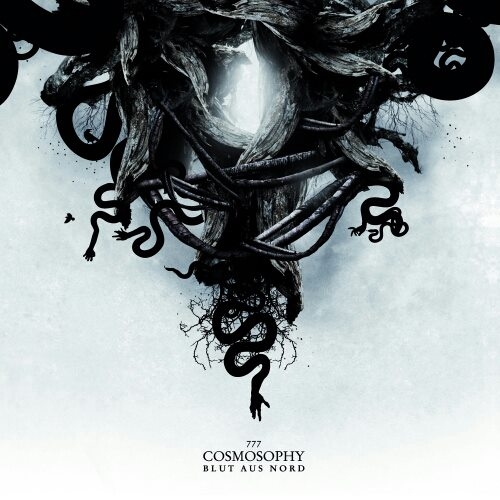
Cosmosophy, the final installment in the 777 trilogy, was released this September, and a lot hinged on it. Sect(s) and The Desanctification were drastically different and yet inseparable, the second naturally flowing from the first. How did Blut aus Nord intend to bring it all to an end?
In the very last way anyone could have ever expected: They repeated the exact same thing they did on The Desanctification. It’s a brooding, visually stunning bird’s-eye view of a cyberpunk holocaust, and as such it’s just as outstanding as its predecessor. But where is it going?
If Blut aus Nord released two albums like this every year they might well become my favorite band. I’ve been dying for this kind of material, and The Desanctification and Cosmosophy both fill that niche with a degree of excellence that surpasses all other attempts I have heard. But I guess for me the 777 series was telling a story, vague though it need necessarily be, and Cosmosophy just kind of waves that off. It’s an outstanding album in its own right, but it does not feel appropriate in the context of the trilogy.
Epitome XVII and XVIII are somewhat of an exception,and they’re the tracks I’ll be sampling here. XVII has a definite sense of conclusion about it. It’s not an optimistic one, especially given the lyrics–“How many seasons beyond this sacred life? How many treasons beyond this clever lie?” But the feeling is one of profound revelation, as if the listener in this nearly wordless narrative has finally come to see the grand vision we were all hoping Cosmosophy would offer. The transition that spans from about 4:20 to 6:20 is pensive, serving to reintroduce the darkness that resolution has by no means abated. As this fades and we reach the final track in the trilogy, you can definitely see the story coming to an end:
Epitome XVIII is one of the finest of those bird’s-eye perspectives on the greater 777 landscape, and in its context it offers something of a new, esoteric light on the devastation below. The outro that begins to fade in after the 7 minute mark is the perfect conclusion and perhaps the darkest moment in the entire trilogy, epic in its silence. Of Cosmosophy’s two concluding tracks I have no complaints. It’s the first three that get us there that leave a lot to be desired.
If you care to revisit The Desanctification, it ends on a completely twisted industrial groove that offers all of the madness of Sect(s) without any of the fear–a sense that the subject (the listener) is breaking down into utter insanity, becoming a part of the surrounding chaos. I desperately wanted Cosmosophy to pick up on this note. I wanted to hear a merging of Sect(s)’s black metal and Desanctification’s industrial that, if you’ll humor my manner of description, merged the victim and the witness into one. I expected a juxtaposition of the sweeping landscapes and the frantic madness that could, in the context of the trilogy, depict a sort of out of body experience in the subject/listener. Epitome XIV and XVI instead feel like unused (though equal) tracks from Desanctification, while XV offers three minutes of obnoxiously spoken French which quite frankly fails to invoke anything but annoyance before plunging into an outstanding but compromised semi-operatic sweep that could have found a place on the album but lacks appropriate context as presented.
Epitome XV is the only track I dislike in the trilogy, while XIV and XVI seem out of order. In the meantime, I feel like an essential step between Desanctification’s XIII and Cosmosophy’s XVII is missing. In short, Cosmosophy does not live up to my ridiculously high expectations. If Blut aus Nord were to come out with a surprise Part 4, I certainly would not deem it overkill. But if we view Cosmosophy as just another 2012 metal album there is hardly room to complain. It is only in light of the standard set by Sect(s) and The Desanctification, and in expectation that the conclusion ought to be the 777 trilogy’s finest hour, that it slightly disappoints.
 Through the Shattered Lens