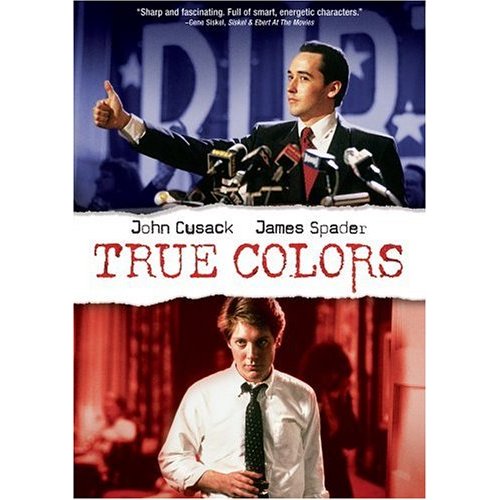
For the past 9 days, I’ve been posting chronological reviews of 54 of the most (and least) memorable melodramas ever filmed. I started with a film from 1916 and yesterday, I completed the 80s. Today, we start in on the 90s with the 1991 political drama True Colors.
True Colors tells the story of two ambitious law students. Tim Gerritty (James Spader) is a wealthy idealist who wants to work at the Justice Department so he can uncover and prosecute political corruption. His roommate and eventual best friend is Peter Burton (John Cusack). Although Peter initially lies about his background, it’s eventually revealed that he comes from a poor family and the result of growing up in poverty has left Peter with an obsessive desire for revenge on everyone who has ever looked down on him. And how is Peter planning on getting that revenge? By marrying the daughter of Sen. James Stiles (Richard Widmark) and eventually running for a seat in the U.S. House. Despite the fact that Tim happens to be in love with Sen. Stiles’s daughter as well, he still supports his friend Peter and even agrees to be his best man. However, as Peter gets closer and closer to achieving his goals, Tim starts to reconsider their friendship….
There’s a scene about halfway through True Colors, in which Peter Burton attempts to blackmail Sen. Stiles into supporting his political career. Stiles agrees but then angrily adds, “God help you when the people find out. They always do, you know.” I was naturally waiting for Peter to come up with a properly sarcastic response but instead, Peter simply looks down at the ground, properly chastened. It’s a jarringly false note and, unfortunately, everything that comes after this scene feels equally false. The film, which starts out as such a strong portrait of what happens with friendship comes into conflict with ambition, ends up turning into a painfully predictable political diatribe, the type of thing that makes the portrait of politics in The Adjustment Bureau seem subtle and nuanced by comparison. When Tim decided to betray Peter, it should be a moment full of moral ambiguity. Instead, we’re expected to ignore their long friendship and just be happy that Tim is willing to do the right thing and protect the integrity of the American political process.
And, who knows? Maybe that’s the way people viewed politics back in the early 90s. But for audiences today, it all feels really naive and simplistic.
But, if you can manage to look past the film’s weak’s script, you can enjoy the acting. John Cusack is wonderfully intense as Peter, making the character compelling even when the screenplay lets him down. Watching him in True Colors is like watching the performance that he should have given in The Butler. James Spader is sympathetic as Tim and, like Cusack, his performance almost allows him to overcome a script that doesn’t seem to realize that Tim is essentially a self-righteous jerk. And finally, there’s Mandy Patikin who has a lot of fun playing the local crime boss who sponsors Peter’s career and who, in one memorable (if out-of-place ) scene beats up a shark that’s jumped up on the desk of his yacht.
Much like High Stakes, True Colors is one of those obscure films that occasionally pops up on cable, usually late at night and usually serving as filler between showings of better-known films. Keep an eye out for it, if just for the chance to enjoy the performances.
 Through the Shattered Lens