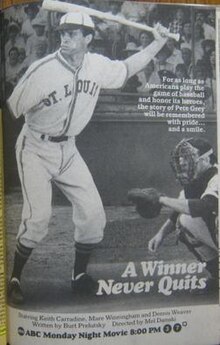
I Watched A Winner Never Quits (1986, dir. by Mel Damski)


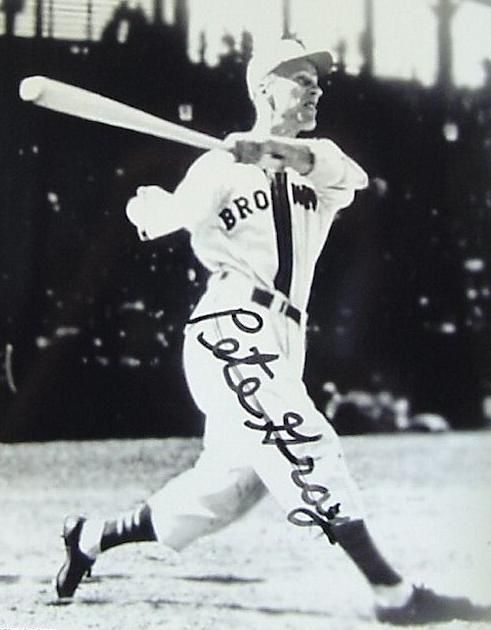
In 1945, Peter Gray made history when he became the first one-armed major league baseball player.  Gray grew up in poverty in Pennsylvania.  His father was a miner and Peter was one of five children.  He was only seven years old when he lost his right arm in a wagon accident but he loved baseball and he wasn’t going to let his disability keep him from playing.  He learned how to bat and catch and throw with his left hand.  He quit school when he was thirteen and worked for a while as waterboy while playing baseball in the local leagues.  Eventually, he made his way up to the minor leagues and, in 1945, he was called up to the majors.  He played one season for the St. Louis Browns.

The media loved the story of the one-armed baseball player but Peter always said that he resented feeling like he was being put on display whenever he took the field.  He was a competitive outfielder who could catch a ball, remove his glove, and then throw the ball to the infield just as quickly as anyone with two hands.  As a hitter, he struggled because pitchers figured out early on that he couldn’t hit the breaking ball.  After the 1945 season, Peter was sent to back to the minors, where he spent the rest of his career.  Though Peter was known for being an angry player who resented anyone pointing out his disability, he still made time to visit amputees in military hospitals to show them that they could still find success and to encourage them to chase after their dreams.

Peter’s story was the basis of A Winner Never Quits, which I watched on YouTube this weekend.  It was a good baseball movie, starring Keith Carradine as Peter.  What I liked is that the movie didn’t make him into a saint.  Carradine played Peter as being angry and with a definite chip on his shoulder.  Peter had every right to be angry and I’m glad the movie acknowledged that.  In both the movie and in real life, Peter was worried that he was just being treated as a sideshow.  In the movie, his attitude improves when he meets a young boy who recently lost his arm and who looks up to Peter.  Peter remained a friend to the boy and his family for the rest of his life.  A Winner Never Quits is about pursuing what you love and never giving up.  That’s what baseball is all about.  A Winner Never Quits is a good and inspiring baseball movie that’s not just for the fans.
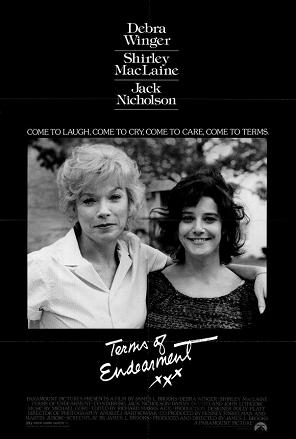
Embracing the Melodrama Part II #72: Terms of Endearment (dir by James L. Brooks)


Terms_of_Endearment,_1983_film

I have to admit that, when I first sat down and watched the 1983 best picture winner Terms of Endearment, I was actually taken by surprise.  Before I actually saw it, I was under the impression that Terms of Endearment was considered to be one of the weaker films to win best picture.  I had read a few reviews online that were rather dismissive of Terms, describing it as being well-made but overrated.

But then, a few weeks ago, I watched Terms of Endearment on Netflix.  The film started with a scene of new mother Aurora Greenwood (Shirley MacClaine) obsessively checking on her daughter, Emma.  Stepping into the bedroom, Aurora is, at first, scared that Emma’s dead.  Without bothering to take off her high heels, Aurora nearly climbs into the crib to check on her.  Fortunately, Emma starts to cry.

And I laughed because I’ve been told about how my mom used to obsessively check in on me when I was a baby.  And, while my mom was never the type to wear high heels around the house, I could still imagine her climbing into a crib to check on me and my sisters.

And then, when Emma (now played by Debra Winger) married Flap Horton (a very young Jeff Daniels) over the objections of her mother, I smiled but I didn’t laugh because, in this case, I was relating to Emma.  Because the fact of the matter is that every girl has known a boy like Flap Horton, the smart and funny guy who is destined to ultimately hurt her.

And when Flap got a job in Des Moines and Emma moved from Houston to Iowa, I knew — as did Aurora — what was going to happen.  I knew that Flap would deal with his insecurity over not being a good provider for his wife and children by cheating on his wife.  And when he did, I wanted to cry with Emma.

But then I wanted to cheer when Emma has an affair of her own.  In the role of Sam, John Lithgow doesn’t have much screen time in Terms of Endearment but he does get the best line.  When a rude cashier claims that she doesn’t feel that she was being rude to Emma, Sam replies, “Then you must be from New York.”

Meanwhile, the widowed Aurora is having an affair of her own.  Jack Nicholson plays Garrett Breedlove, a former astronaut who now has both a drinking problem and a house with a pool.  Garrett gets Aurora to loosen up.  Aurora makes Garrett realize that he actually is capable of being a decent guy.  MacClaine and Nicholson both won Oscars for their performances here and they deserved them.

And then, Emma was diagnosed with cancer.  And I cried and cried because, at this point, I had come to think of Emma and Aurora as being real people.  And when Emma told her friends that she was dying and she spent her final days with her children, I sobbed because it made me think about my mom.  And now I’m sobbing as I write this review.

But it’s a great film, even if it did make me cry.  Because, in the end, you’re glad that you got to know these characters.  And, even through the tears, the film leaves you happy that you got to spend some time with them.

And isn’t that what a great film is supposed to do?

http://www.youtube.com/watch?v=zY0GM9KHU8o