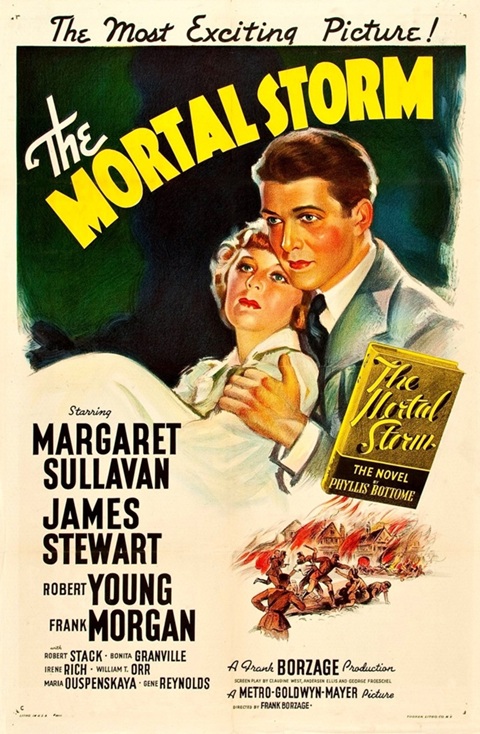
The Unnominated #16: The Mortal Storm (dir by Frank Borzage)


Though the Academy of Motion Picture Arts and Sciences claim that the Oscars honor the best of the year, we all know that there are always worthy films and performances that end up getting overlooked.  Sometimes, it’s because the competition too fierce.  Sometimes, it’s because the film itself was too controversial.  Often, it’s just a case of a film’s quality not being fully recognized until years after its initial released.  This series of reviews takes a look at the films and performances that should have been nominated but were, for whatever reason, overlooked.  These are the Unnominated.

Oh, how this movie made me cry!

Released in 1940, at a time when war was spreading across Europe, Asia, and Africa but the United States was still officially neutral, The Mortal Storm opens on January 30th, 1933.  In the mountains of Germany, near the Austrian border, Professor Viktor Roth (Frank Morgan) is celebrating his 60th birthday.  He starts the day being applauded by his students at the local college.  In the evening, he returns home for a celebration with his family, including wife (Irene Rich), his daughter Freya (Margaret Sullivan), his son Rudi (Gene Reynolds), and his two stepsons, Otto (Robert Stack) and Erich von Rohn (William T. Orr).  Also present are Freya’s fiancé, Fritz (Robert Young) and one of Roth’s students, a pacifist named Martin Breitner (James Stewart).  It’s a joyous occasion and the film takes its time introducing us to Prof. Roth and his extended family.  At first, everyone seems very kind.  They seem like people who most viewers would want to spend time with or live next to….

But then, the family’s maid excitedly enters the room and announces that it’s just been announced that Adolf Hitler is the new chancellor of Germany.  Otto and Erich are overjoyed and head out to celebrate with the other members of the Nazi Youth Leage.  Martin is less happy and excuses himself to return home.  Roth and his wife worry about what this means for people who do not agree with Hitler’s beliefs.  Freya says that they shouldn’t talk politics.  It is jokingly mentioned that Hitler has taken away Roth’s special day but Roth’s young son Rudi says that he’s learned in school that the needs of the individual will never be more important than the needs of the state.  If Hitler wants to take away your day, it’s your duty to give it up or face the consequences.

Based on a 1937 novel, The Mortal Storm was not the first Hollywood production to take a stand against Hitler and the Nazis but it was one of the best.  I say this despite the fact that the film only hints at the fact that Prof. Roth is Jewish, something that was made very clear in the book.  (In the movie, Roth and his wife worry what will happen to “Non-Aryans” and “freethinkers.”)  That said, the film perfectly captures how quickly and insidiously the authoritarian impulse can spread.  The town, which once seemed so friendly, becomes a very dark place as the students at the university put on their swastika armbands and start to hunt down anyone who dissents from the party line.  When Roth says that, as a scientist, he does not believe one race can be genetically superior to another, his students walk out on him.  A local teacher is beaten when he fails to return to the Nazi salute.  When Martin refuses to join the Party, Otto and Erich turn against him despite being lifelong friends.  When Martina and Freya flee for the border, Fritz pursues them.  And even after Prof. Roth is sent to a concentration camp, Otto and Erich continue to follow the orders of Hull (Dan Dailey), the sinister Youth Party Leader.

It’s a powerful film, one that remains just as relevant today as it was when it was first released.  Hull and Erich’s fanaticism would, today, find a welcome home on social media.  The scenes in which the townspeople eagerly threaten to report their former friends and neighbors for failing to salute or show proper enthusiasm for the government have far too many modern day equivalents for me to even begin to list them all.  This film was also the last the James Stewart made with frequent co-star Margaret Sullivan and they both give great performances.  (All-American Jimmy Stewart might seem a strange choice to play a German farmer but he is never less that convincing as Martin, one of the few people in the town not to surrender his principles and beliefs to the crowd.)  The film’s final moments, with the camera panning around the empty Roth home, brought very real tears to my eyes.

Despite being a powerful film, The Mortal Storm was not nominated for a single Oscar.  (Jimmy Stewart did win his only Oscar that year but it was for The Philadelphia Story.)  It’s temping to assume that, at a time when America was still divided about how to react to the war in Europe and when many Americans still remembered the trauma of the first World War, The Mortal Storm was too explicitly political and anti-Nazi to get a nomination but, the same year, The Great Dictator was nominated for Best Picture.  It seems more likely that, in those days when the studios ruled supreme, MGM decided to puts it weight behind The Philadelphia Story rather than The Mortal Storm.

That said, The Mortal Storm was definitely worthy of being nominated, for Picture, Director, Screenplay, Actress (Margaret Sullivan), Actor (Stewart), Supporting Actor (Frank Morgan and Robert Stack), and Supporting Actress (Irene Rich and, in the role of Stewart’s mother, Maria Ouspenskaya).  The film may not have been nominated but it remains a powerful and important work of art.
Previous entries in The Unnominated:
  1. Auto Focus 
  2. Star 80
  3. Monty Python and The Holy Grail
  4. Johnny Got His Gun
  5. Saint Jack
  6. Office Space
  7. Play Misty For Me
  8. The Long Riders
  9. Mean Streets
  10. The Long Goodbye
  11. The General
  12. Tombstone
  13. Heat
  14. Kansas City Bomber
  15. Touch of Evil

A Herman Wouk Double Feature: The Winds of War (1983, directed by Dan Curtis) and War and Remembrance (1988, directed by Dan Curtis)


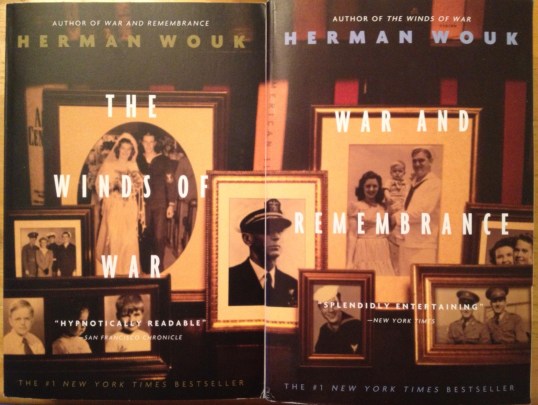
When the great American novelist Herman Wouk passed away earlier this month at the age of 103, he left behind a rich and varied literary legacy.  From 1947, the year that his first novel was published to 2016, the year that he published his memoirs, Wouk wrote about religion, history, science, and even the movies.  However, Wouk will probably always be best remembered for the three novels that he wrote about World War II.

Based on his own Naval service during World War II, The Caine Mutiny was published in 1951 and was later adapted into both a successful stage play and an Oscar-nominated film.  It also won Wouk a Pulitzer Prize and established him as a major American writer.  Nearly 20 years later, Wouk would return to the history of the Second World War with two of his greatest literary works, The Winds of War and War and Remembrance.  (Originally, Wouk was only planning on writing one book about the entire war but when it took him nearly a thousand pages to reach Pearl Harbor, he decided to split the story in two.)  Beginning in 1939 and proceeding all the way through to the end of the war, the two books followed two families, the Henrys and the Jastrows, as they watched the world descend into war. Along the way, the book’s fictional characters rub shoulders with historical characters like Hitler, Churchill, FDR, and even Stalin.  Carefully researched and meticulously detailed, the books were both critically acclaimed and popular with readers and, despite some soapy elements, they both hold up well today.

Given their success, it’s not a surprise that both The Winds of War and War and Remembrance were adapted for television.  Today, HBO would probably give the books the Game of Thrones treatment, with 8 seasons of war, tragedy, romance, and Emmys.  However, this was the 1980s.  This was the age of of the big-budget, all-star cast network miniseries.  Wouk’s epic history of World War II was coming to prime time.

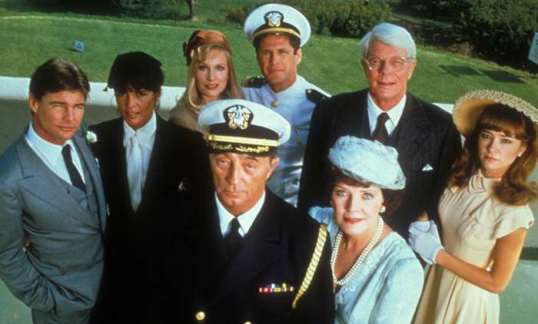
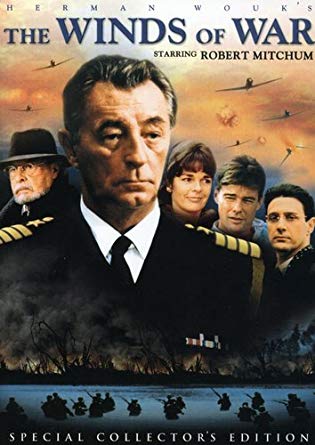
With a total running times of 15 hours, The Winds of War originally aired over seven evenings in 1983.  Produced and directed for ABC by Dan Curtis, The Winds of War had a 962-page script, a 200-day shooting schedule, 285 speaking parts, and a then-record budget of $35,000,000.  It also had Robert Mitchum, starring as Victor “Pug” Henry, an ambitious naval officer who somehow always managed to be in the right place to witness almost all of the events leading up to America’s entry into World War II.  Jan-Michael Vincent played Pug’s son, Byron, while John Houseman took on the pivotal role Aaron Jastrow, a Jewish scholar though whose eyes the home audience would witness the rise of fascism in Europe.  Terribly miscast as Natalie, Aaron’s niece and Byron’s lover, was 44 year-old Ali MacGraw.  Among those playing historical figures were Ralph Bellamy as FDR, Howard Lang as Churchill, and Gunter Meisner as Hitler.

I recently watched The Winds of War on DVD and, despite some glaring flaws that I’ll get to later, it holds up well as both a history of World War II and a tribute to those who battled Hitler’s evil.  Like Wouk’s novels, the miniseries does a good job of breaking down not only how Hitler came to power but also why the rest of the world was often in denial about what was happening.  Watching the entire miniseries in one setting can be overwhelming.  It’s a big production and it is also unmistakably a product of a time when the major networks didn’t have to worry about competition from cable.  It takes its time but, in the end, you’re glad that it did.  All of the little details can get exhausting but they’re important to understanding just how Hitler was able to catch the world off-guard.

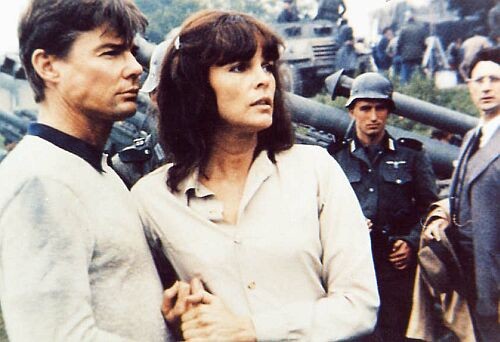
Jan-Michael Vincent and Ali MacGraw in The Winds of War

The miniseries does suffer due to the miscasting of some key roles.  Both Jan-Michael Vincent and Ali MacGraw were far too old for their roles.  Vincent was 38 and MacGraw was 44 when they were cast as naive and idealistic lovers trying to find themselves in Europe.  It’s perhaps less of a problem for Vincent, who had yet to lose his looks to alcoholism and who looked enough like Robert Mitchum that he could pass as Mitchum’s son.  But MacGraw is simply terrible in her role, flatly delivering her lines and looking more like Vincent’s mother than his lover.  It’s particularly jarring when she mockingly calls diplomat Leslie Sloat “Old Sloat,” because Sloat was played by David Dukes, who was six years younger than MacGraw.

67 year-old Robert Mitchum was also much too old to play an ambitious junior officer, one whose main goal in life is still to ultimately become an admiral.  When he ends up having an affair with a younger British journalist played by 30ish Victoria Tennant, the difference in their ages is even more pronounced than in Wouk’s novel.  (Pug was in his 40s in The Winds of War.)  However, Mitchum overcomes his miscasting by virtue of his natural gravitas.  With his weary presence and authoritative voice, Mitchum simply is Pug.

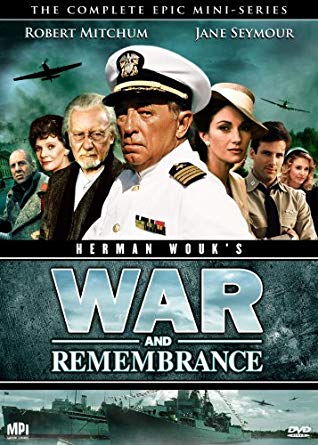
A ratings hit and a multiple Emmy nominee, The Winds of War was followed up five years later by War and Remembrance.  Like its predecessor, War and Remembrance set records.  The script ran 1,492 pages and featured 356 speaking parts.  The production employed 44,000 extras and filming took nearly two years, from January of 1986 to September of 1987.  With a budget of $104 million, it was the most expensive television production to date.  The final miniseries had a 30-hour running time, which was divided over 12 nights.  War and Remembrance not only made history because of its cost and length but also as the first major production to be allowed to film on location at the Auschwitz concentration camp.  For many members of the generation born after the end of World War II, War and Remembrance would serve as their first introduction to the horrors of the Holocaust.

Director Dan Curtis returned and with him came Robert Mitchum, now in his 70s and still playing a junior naval officer.  David Dukes once again played the hapless diplomat, Leslie Sloat.  Ralph Bellamy also returned as FDR as did Victoria Tennant as Mitchum’s lover, Polly Bergen as Mitchum’s wife, and Peter Graves as Bergen’s lover.  However, they were the exception.  The majority of the original cast was replaced for the sequel, in most cases for the better.  With John Houseman too ill to reprise his role, John Gielgud took over the role of Aaron Jastrow while Hart Bochner replaced the famously troubled Jan-Michael Vincent.  Robert Hardy took over the role of Churchill while Hitler was recast with Steven Berkoff.  Best of all, Jane Seymour replaced Ali MacGraw in the role of Natalie and gave the best performance of her career.  Other characters were played by a mix of up-and-comers to tv veterans, with the cast eventually including everyone from Barry Bostwick and Sharon Stone to E.G. Marshall and Ian McShane.

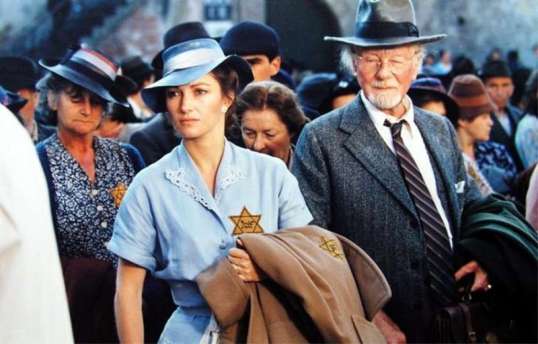
Jane Seymour and John Gielgud

With a stronger cast and (ironically, considering the running length) a more focused storyline, War and Remembrance is superior to The Winds of War in every way.  That doesn’t mean that it’s perfect, of course.  The scenes featuring Barry Bostwick as a submarine commander feel as if they go on forever and Robert Mitchum still seems like he should be preparing for retirement instead of angling for a promotion.  But none of that matters when the miniseries focuses on Aaron and Natalie Jastrow and their struggle to survive life in the Theresienstadt Ghetto and eventually Auschwitz.  At the time that War and Remembrance was initially broadcast, the concentration camp scenes were considered to be highly controversial and many viewers complained that they were so disturbing that they should not have been aired during prime time.  (This was four years before Schindler’s List.)  Seen today, those scenes are the most important part of the film.  Not only do they show why the war had to be fought but they also demand that the world never allow such a thing to happen again.

Though it was considered by a rating disappointment when compared to its predecessor, War and Remembrance was still a multiple-Emmy nominee.  Controversially, it defeated Lonesome Dove for Best Miniseries.  Both Winds of War and War and Remembrance have been released on DVD and, like the books that inspired them, they both hold up well.  They pay tribute to not only those who fought the Nazis but also to the humanistic vision of Herman Wouk.

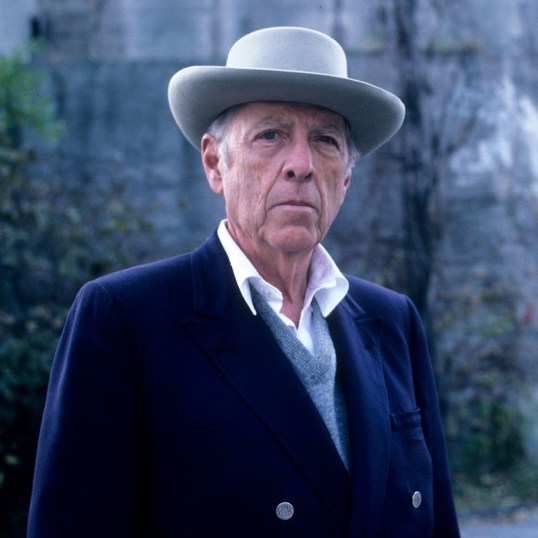
Herman Wouk (1915-2019)