The TSL’s Grindhouse: Parents (dir by Bob Balaban)


An odd little film, 1989’s Parents is.

It takes place in the 50s of the pop cultural imagination, with neatly laid out suburban neighborhoods and perfectly mowed lawns and big cars driving down the street.  Nick (Randy Quaid) and Lily (Mary Beth Hurt) seem like the perfect couple.  Lily stays at home and spends a lot of time in the kitchen.  Nick is an engineer who works for a company called Toxico and who is helping to develop what will become known, during the Vietnam War, as Agent Orange.  Nick and Lily are friendly, well-mannered, and they love to eat meat.  Lily explains, at one point, that she didn’t really love to eat meat until she married Nick and he showed her how wonderful it could be.

Their son, ten year-old Michael (Bryan Madorsky), is a bit less conventional.  He’s a quiet boy who never smiles and who, when asked to draw a picture of his family, freaks out his school’s guidance counselor (played by Sandy Dennis).  Michael has frequent nightmares.  Michael doesn’t like to eat meat and, in fact, it’s hard to think of a single scene in the movie where Michael is seen eating anything.  Michael is haunted by the sight of his parents making love in the living room.  He’s also haunted by a growing suspicion that his parents are cannibals.

Are they?  Perhaps.  It’s hard to say.  The first time you watch the movie, it seems deceptively obvious that Nick and Lily are exactly what Michael says they are.  The second time, you start to notice a few odd things.  For one thing, we never see Michael actually going from one location to another.  Instead, he just seems to magically show up wherever he needs to be to hear something that will confirm his suspicions.  When his teacher and his guidance counselor discuss his home life, Michael just happens to be in a nearby closet.  When his mother is preparing something that looks like it might be a human organ, Michael just happens to be standing in the pantry.  Are we seeing reality or are we just seeing what Michael thinks is reality?  When Nick starts to threaten Michael and later claims that there’s no way Michael is his son, is he really saying that or is Michael just imagining his fatherr confirming all of Michael’s insecurities?  How much of the film is real and how much of it is in Michael’s head?

It’s an odd film, Parents.  It’s also the directorial debut of character actor Bob Balaban.  Balaban has spent the majority of his career playing shy, slightly repressed characters.  Parents, with the withdrawn Michael as the main character, is a film that feels autobiographical.  That’s not to say that Balaban’s parents were cannibals but the scenes where Nick goes from being a loving father to an abusive monster are too intense and suffused with too much pain for them to be anything other than personal.  Balaban’s direction is heavily stylized.  At times, it’s a bit too stylized but ultimately, it works.  The final 30 minutes of the film feel like a nightmare that has somehow been filmed.

A satire of conformity and suburbia, Parents is also a portrait of an alienated child struggling to figure out where he fits into his family.  He’s given the choice of either indulging in his family’s sins or living life alone.  Except, of course, it really isn’t a choice.  Nick expects Michael to do what he’s been told, no matter what.  Randy Quaid and Mary Beth Hurt are both terrifying as the parents but, at the same time, Balaban makes good use of the fact that both of those performers — at least at the time this movie was made — were naturally likable.  You want Nick to be the perfect father that he pretends to be and you share Michael’s anger and disillusionment when he turns out to be something very different.

Parents may be a strange film but it’s not one that you’re going to forget.

Horror on TV: Friday the 13th: The Series 2.14 “Face of Evil” (dir by William Fruet)


Tonight, for our horror on the lens, we have the fourteenth episode of the 2nd season of Friday the 13th: The Series!

In this episode is a sequel to the Vanity’s Mirror episode from season 1. The gold compact is back and this time, an aging model is using its power to maintain her youth. Unfortunately, there’s a price for looking young and that price is …. can you guess it? ….. murder!

This episode originally aired on February 11th, 1989.

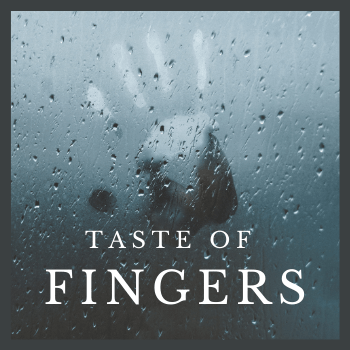
Game Review: Taste of Fingers (2021, V Dobranov)


Taste of Fingers is an entrant in 2021 Interactive Fiction competition.  Browse and experience all of the games by clicking here.

You are in a city that you do not know, a stranger in a strange land. You are hiding behind the counter of a small cafe while, outside, the world comes to an end. Whether it’s due to a plague or just people finally being driven mad by the stress of every day life, going outside is not recommended. The cafe is your only sanctuary. Behind the counter, you experience memories of the way the world was in the days leading up to whatever has happened. When an intruder enters the cafe, it is time for action!

Like a lot of Twine games, Taste of Fingers is more of a short story with choices than an actual game. You really don’t have much control over how the game progresses or how it ends. The main choice you get to make is which memories to explore while you hid behind the counter. It’s not possible to explore every memory over the course of just one play through, which does give this game a high replay value. The descriptions of the cafe and the memories are vivid enough that you’ll want to explore them, even if it would have been nice to have had more options. Realistically, though, there aren’t that many options available when the world is ending around you. Taste of Fingers captures the feel of a world spinning out of control. It’s not a happy game but it does what it does well.

Play Taste of Fingers.

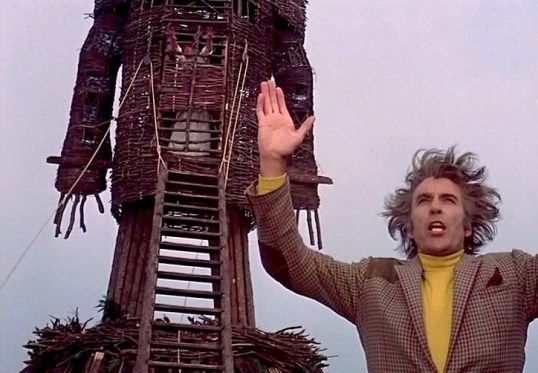
Scenes That I Love: Christopher Lee as Lord Summerisle in The Wicker Man


Over the course of his long career, Christopher Lee often cited his performance as the charismatic but ultimately sinister Lord Summerisle in 1973’s The Wicker Man as one of his personal favorites.  It’s easy to see why.  The role not only showcased Lee’s ability to be menacing but it was also one of the few films that allowed him to be witty as well.  Lord Summerisle may be a pagan who maintains his power by sacrificing virgins but he’s still quite charming.  With his longish hair, sideburns, and turtleneck, Lord Summerisle is the perfectly aristocratic 70s rogue.

Today’s scene that I love comes from the original The Wicker Man.  (Sorry, the Nicole Cage “bees” scene from the remake will have to wait for next year’s horrorthon.)  In this scene, Lord Summerisle expalins the ways of the island to a skeptical police detective.  Little does the detective know that he’s already been selected to be the next sacrifice.  Lee’s avuncular performance holds up wonderully.

Horror Novel Review: Witch by Christopher Pike


First published in 1990, Christopher Pike’s extremely weird YA novel Witch tells the story of Julia Florence and her friend Amy.

Basically, Julia is the latest in a long line of witches.  She has the power to see the future and to heal people, with the only problem being that, when she heals them, she takes their illnesses and injuries into her own body.  So, if she heals someone who is on the verge of death, that means that she’ll be the one who dies.  That’s what happened to Julia’s mother and Julia’s determined not to let the same thing happen to her.  It seems like the simple solution would be to just not heal anyone.

But then her friend Scott gets shot during a convenience store robbery.  Scott is in a coma and is going to die unless he gets some supernatural healing.  Julia can either heal him or she can buy a gun (?), use her abilities to see the future, and go all vigilante in an attempt to take out the robber who shot Scott.  Julia goes for the latter but then Amy discovers that the robber has a weird, kind of out-of-nowhere connection to a girl who was previously healed by Julia’s mother.  And, she also discovers that there’s a coven of witches searching for Julia because …. well, who knows?

Anyway, it all comes down to whether or not Julia will risk her life to save Scott.  Scott is an aspiring director and kind of an annoying guy, to be honest.  But everyone is charmed by how annoying he is and he has a great future ahead of him, unless he dies.

Whatever will Julia do!?

This is a weird one.  Between the witchcraft, the healing, the psychic visions, the high school drama, and the vigilante action scenes, one gets the feeling that Pike just threw random darts at a bunch of story points that he had taped to the wall and he pretty much just went wherever the darts led him.  And don’t get me wrong.  It is a little fun to see just how many different genres and plot elements that Pike could stuff into one book but the story itself is still a bit of a mess.  There’s a lot in here and not all of it really comes together.

Plus, this is yet another Pike novel to end on a downbeat note.  R.L. Stine wrote some pretty morbid books but he always ended with a joke.  Pike’s books, on the other hand, always seem to end with the message that there is no such thing as a completely happy ending.  Normally, I’m all for a book that ends on a down note but this time, after all the messiness that came before the ending, I really could have used a Stine-style one liner.  Sometimes, the best way to deal with an existential crisis is to laugh your way through it.

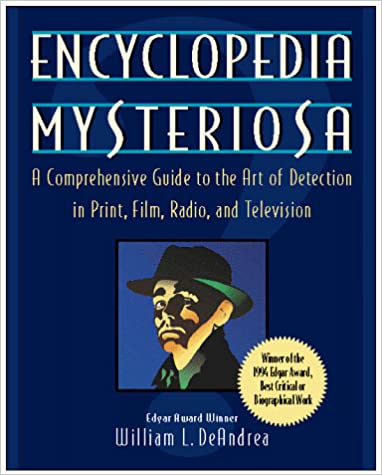
Book Review: Encyclopedia Mysteriosa by William L. DeAndrea


This is a fun book that I came across at Half-Price Books two Decembers ago.  It went right on my Christmas list and, ever since then, it’s a book that I’ve found useful many times.

As you can probably tell, it’s an encyclopedia, one that is devoted to detectives.  You can’t have a good mystery without a good detective and this book proves that, with entries for fictional detectives, their creators, and the TV shows, movies, and books in which they appeared.  It’s all written in a concise and lively manner, which is another way of saying that it’s a fun read.  That’s especially true if you’re a fan of mysteries, as I am.

Now, I should mention that this book was originally published in 1994.  Another edition came out in 1997.  As far as I can tell, that was it.  As such, a lot of the information in the book is a bit of out-of-date.  Authors who have passed or who have retired are still listed as being very much alive and active.  More recent detectives are not mentioned.  (Sorry, Mr. Monk.)  The original Magnum P.I. and Hawaii 5-0 get entries but not the reboots.  There’s no mention of CSI and Thomas Harris’s entry is rather small, with no mention of the post-Silence of the Lamb Lecter films, largely because they hadn’t been made yet.  You get the idea.   But, even with that in mind, this book is still full of useful information, especially if you’re into the older, classic detectives or if you’re a history nerd like I am.  (Trust me, if you have to choose between Wikipedia and reading a book that was actually written during the period in which you’re interested, go with the book every time.)  What it doesn’t contain about recent detectives, it makes up for with information on Poirot, Holmes. Philip Marlowe, Mike Hammer, Sam Spade, and many others.

If nothing else, Encyclopedia Mysteriosa is a good starting point for those looking for a good mystery!  And, if you’re looking for a little inspiration to maybe write a mystery of your own, this book may provie you with exactly the inspiration you need.  There are several copies for sale on Amazon, all reasonably priced.

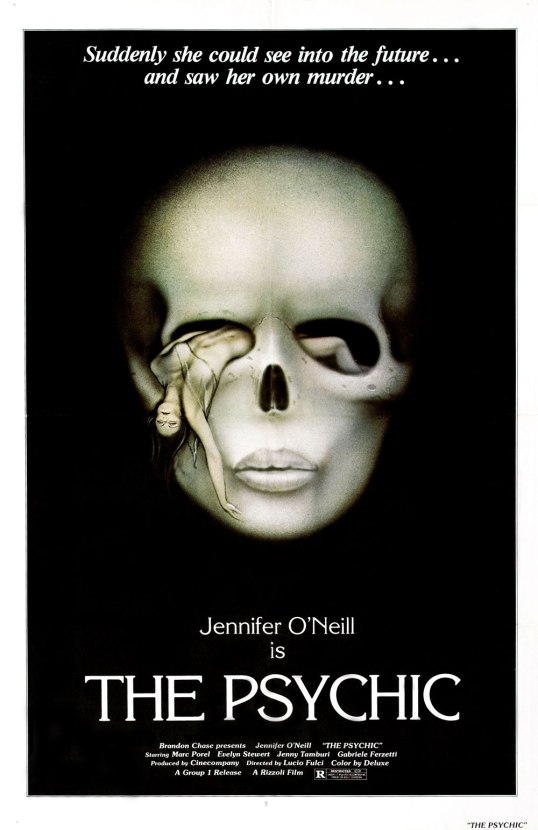
International Horror Film Review: The Psychic (a.k.a. Seven Notes In Black) (dir by Lucio Fulci)


Also known as Seven Notes In Black, The Psychic is an Italian paranormal thriller that was made and released in 1977, shortly before the film’s director, Lucio Fulci, reinvented Italian horror with Zombi 2.

For years, Virginia (Jennier O’Neill) has been haunted by visions.  When she was a child, she saw a vision of her mother jumping off a cliff.  It turned out that, at the same time Virginia had her vision, her mother was doing exactly that.  18 years later, Virginia is living in Rome and she’s married to a wealthy businessman named Francesco Ducci (Gianni Garko, who also starred in several Spaghetti westerns).  Virginia would seem to have the perfect life but she’s still haunted by disturbing visions.  She sees an old woman murdered.  She sees a wall being ripped apart.  She sees a discarded letter.  Is she seeing the past, the present, or the future?  She does not know.  Ducci insists that her visions mean nothing but Virginia is convinced that something is reaching out to her.

While Ducci is away on business, Virginia visits an abandoned house that her husband has recently bought.  Virginia wants to renovate it but, as soon as she sees it, she realizes that the house previously appeared in her visions.  When she investigates, she discovers a skeleton in one of the walls.  With the police now convinced that Ducci is a murderer, Virginia tries to figure out the meaning behind her visions and looks for a way to clear Ducci’s name.  Strangely, Ducci still doesn’t seem to be that concerned about any of it….

Along with Lizard In A Woman’s Skin and Don’t Torture A Duckling, The Psychic is a film that gets a lot of attention as an example of Fulci’s pre-Zombi 2 horror output.  After Zombi 2, Fucli would become best known for making films that were full of gore and that often seemed to be deeply angry with the world.  The fact that Fulci was also a brilliant stylist who created some of the most dream-like images ever to be captured on film would often be overlooked in all the controversy over the often violent content of his movies.  One thing that makes The Psychic interesting is that, visually, it’s clearly a Fulci film.  The cinematography is lush and vibrant.  The visions are surreal and disturbing.  However, there’s very little of the gore that came to define Fulci’s later films.  Instead, the emphasis is on the atmosphere and the mystery.  This is one of the few Fulci films that you could safely show an older relative.

Fulci was often (a bit unfairly, in my opinon) portrayed as being a cinematic misanthrope, as a director who little use for the characters that populated his films.  That’s certainly not the case with The Psychic, though.  Virginia is probably one of the most sympathetic characters to ever appear in a Fulci film and Jennifer O’Neill does a good job in the lead role.  Even more importantly, Fulci seems to like her and, from the start, it’s clear that the film is fully on her side.  The entire story is told through her eyes and she’s a character who you immediately root for.  Like Fulci himself, she’s a visionary whose visions are often underappreciated until it’s too late.  Though the film ends on a characteristically downbeat note (happy endings were rare even in Fulci’s pre-Zombi 2 films), Virginia is still allowed her triumph with one final and rather clever little twist.

The Pyschic is a bit slowly-paced but it’s still a far better film that many Fulci critics seem to be willing to acknowledge.  (One gets the feeling that many critics resent any film that indicates that there was more to Fulci than eye damage and zombies.)  It’s an entertaining and intriguing latter-era giallo and proof that there was more to Fulci than just blood.

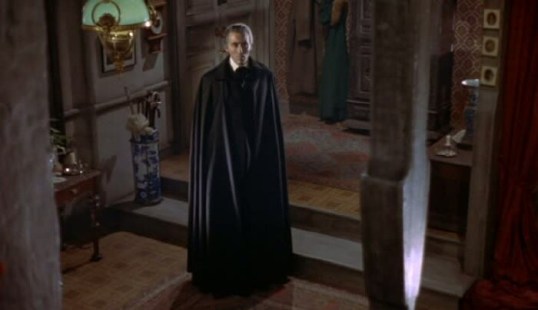
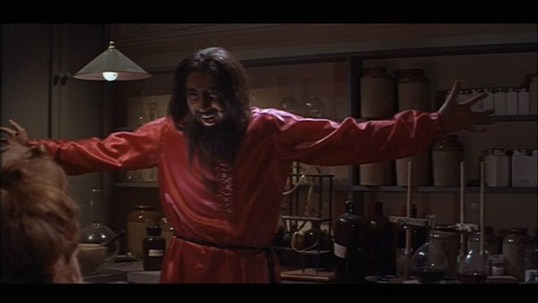
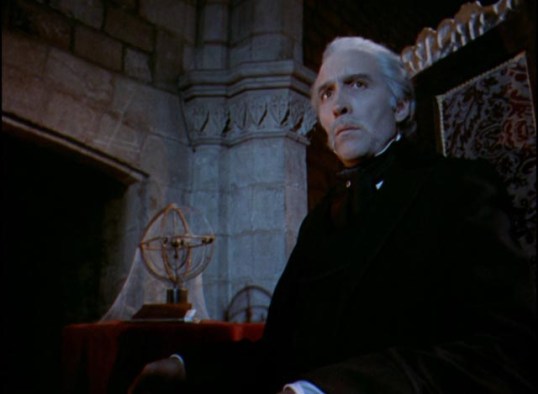
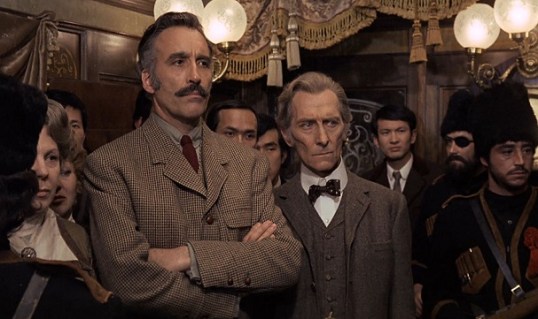
6 Shots From 6 Christopher Lee Films


4 Or More Shots From 4 Or More Films is just what it says it is, 4 shots from 4 of our favorite films. As opposed to the reviews and recaps that we usually post, 4 Shots From 4 Films lets the visuals do the talking!

Today, we honor the legacy of a man who was not just a great horror star but also a great actor. period  Christopher Lee worked with everyone from Laurence Olivier to Steven Spielberg to Peter Jackson to Martin Scorsese.  Though he turned own the chance to play Dr. No, Lee later did go play a Bond villain in The Man with The Golden Gun.  He was one of those actors who was always great, even if the film wasn’t.

That said, it’s for his horror films that Lee is best known.  He was the scariest Dracula and the most imposing Frankenstein’s Monster.  He played mad scientists, decadent aristocrats, and even the occasional hero.  Christopher Lee was an actor who could do it all and today, we honor him with….

6 Shots From 6 Christopher Lee Films

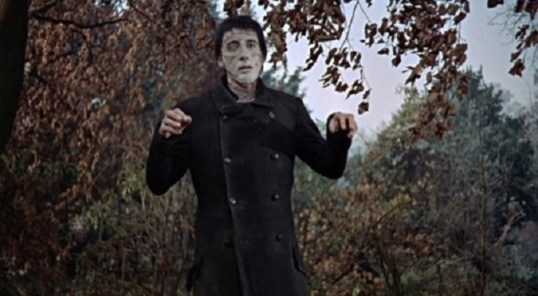
The Curse of Frankenstein (1957, dir by Terence Fisher, DP: Jack Asher)

The Horror of Dracula (1958, dir by Terence Fisher, DP: Jack Asher)

Rasputin The Mad Monk (1966, dir by Don Sharp, DP: Michael Reed)

Count Dracula (1970, dir by Jess Franco, DP: Manuel Merino and Luciano Trasatti)

Horror Express (1972, dir by Eugenio Martin, DP: Alejandro Ulloa)

The Wicker Man (1973, dir by Robert Hardy. DP: Harry Waxman)

Spirits of the Pulp Age


Artist Unknown

Hearing bumps in the night?  Halloween is the favorite holiday of ghosts the world over.  That was as true in the pulp era as today.  Here’s just a few example of the spirits of the pulp age!

by Edward Dalton Stevens

by Edward Dalton Stevens

by Jean Oldham

by Jean Oldham

by Jean Oldham

by Margaret Brundage

by Modest Stein

by Modest Stein

by Rudolph Belarski

Artist Unknown

Unknown Artist


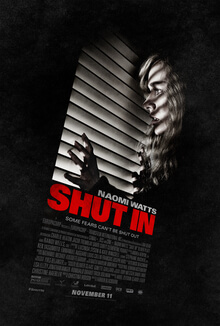
Horror Film Review: Shut In (dir by Farren Blackburn)


The 2016 film, Shut In, is yet another film in which Naomi Watts plays an intelligent woman who is forced to do stupid things because, otherwise, there would be no story.

This time, Watts is cast as Dr. Mary Portman, a psychologist who is taking care of her stepson, Stephen (Charlie Heaton).  Stephen was left in a vegatative state by a tragic accident that not only killed Mary’s husband but which also totaled a brand new SUV.  Mary and Stephen are in an isolated house so there’s no way anything could go wrong, right?

Mary has a lot on her mind.  Not only does she have to take care of Stephen but she’s also starting to date again.  Plus, one of her patients, a child named Tom (Jacob Tremblay), has disappeared.  She’s worried about Tom.  He disappeared near her house and no one has been able to find him.  Mary occasionally thinks that she sees Tom but her psychologist (played by poor Oliver Platt, who looks embarrassed to be there) says that Mary is just seeing what she wants to see.  And when two little hands come out of the darkness to keep Mary from entering a crawlspace, that’s just a coincidence, too.

Right.

Because it’s not like totally obvious, from the freaking start, that Tom is hiding out in her house.

Now, before anyone gets excited, this film does not feature Jacob Tremblay as an evil child who torments Naomi Watts.  (Jacob Tremblay is 15 years old now, just in case you needed an excuse to feel old.)  Instead, it turns out that Mary’s tormenter is….

What?

Spoiler alert?

Really, I have to give a spoiler alert before revealing the most obvious twist of all time?  How is that fair?

Okay, fine.  SPOILER ALERT!  Stop crying, you babies.

Mary is being menaced by Stephen, who it turns out woke up from his coma long ago and is now faking his vegetative state.  That seems like that would be a difficult thing to fake but, whatever.  Anyway, it turns out that Stephen has really enjoyed having Mary all to himself and he’s not really happy about the idea of having to share her with Tom.  So, Stephen’s idea is to trap Tom in the crawlspace and hold Mary hostage.  Or something.  I don’t know.  It doesn’t seem like Stephen’s really thought this out.  Normally, that would be understandable because it takes a lot of planning to trap someone in a crawlspace while pretending to be in a coma.  But Stephen spends all day lying around so he should have used that time to give a little more thought to his plan.

Eventually, Oliver Platt realizes that something strange is happening so he goes up the house to rescue her but — surprise! — Stephen kills him.  Seriously, Oliver — you deserved better than this movie.

For that matter so does Naomi Watts.  Watts is a good actress who can play both comedy and drama and yet, she keeps showing up in these movies where she basically spends the whole movie being held prisoner, either physically or mentally.  She always does a good job in them and, when I first heard that Woman In The Window was being turned into a movie, she was my choice for the role played by Amy Adams but, still, Watts definitely deserves better than a by-the-numbers film like Shut In.  Too often, the film requires Mary to act in a totally illogical, rather stupid manner.  Watts does her best with the character but the script lets her down.

Along with being totally predictable, Shut In moves at a glacial pace.  A lot of time is spent in an attempt to establish mood and atmosphere but again, the big twist is so obvious that no amount of mood and Kubrickian atmosphere is going to save it..  Shut In is a movie that very slowly takes us to exactly where we think it’s going to take us.  Everyone involved deserved better.