Horror Film Review: The Mummy’s Tomb (dir by Harold Young)


1942’s The Mummy’s Tomb picks up 30 years after the end of The Mummy’s Hand.

Archeologist Steve Banning (Dick Foran) is now living a peaceful life in the small town of Mapleton, Massachusetts.  As the film opens, he is telling his guests about the time that he and his friend, Babe Hanson (Wallace Ford), went to Egypt and discovered the tomb of an Egyptian princess.  He tells them how Andoheb (George Zucco) tried to use the ancient mummy, Kharis, to protect the tomb.  Steve assures everyone that Andoheb is now dead and Kharis is no longer a threat to anyone.

The film then travels to Egypt where we discover that Steve was not quite correct.  Adoheb survived being shot at the end of The Mummy’s Hand.  He’s now an old man, dying but still obsessed with getting revenge.  He instructs his disciple, Mehemet Bey (Turhan Bey), to travel to America with Kharis (now played, under a bunch of bandages, by Lon Chaney, Jr.) and to get revenge on the remaining members of the Banning expedition.

Bey and Kharis travel to Massachusetts and soon, the entire town of Mapleton is gripped in fear as Kharis starts to murder people.  Steve Banning is the first victim.  Then Steve’s sister, Jane (Mary Gordon). Kharis even kills Babe Hanson, whose role in the previous film was largely comic relief.  Seriously, not even Frankenstein’s Monster killed the comic relief.  Kharis is a ruthless and unstoppable killer and, in a performance that is totally focused on his hulking physicality, Lon Chaney, Jr. makes for a frightening mummy.  Kharis moves slowly, dragging one foot behind him.  But when he does attack, he’s relentless.  This movie reminded me of why the mummy has, to me, always been the scariest of the old Universal monsters.

Despite the fact that Kharis is leaving bandages and ancient mold all over the place, the authorities are not quite convinced that an ancient mummy has come to their small town.  However, the townspeople have no doubt what’s happening and, since this is a Universal film, they are soon running around with torches and pitchforks.  Meanwhile, Steve’s son, John (John Hubbard), tries to figure out how to destroy the mummy and how to protect his fiancée, Isobel (Elyse Knox).  Bey has decided that he’s in love with Isobel and he orders Kharis to bring her to him.  Even under all the bandages, Kharis’s facial expression still suggests that he knows this isn’t a good idea.

The Mummy’s Tomb suffers from the same problem that afflicted The Mummy’s Hand.  It feels like it takes forever to actually get to the good stuff.  This is only a 60-minute film and ten of those minutes is taken up with a flashback to The Mummy’s Hand.  But no matter!  Once Kharis arrives in America, the pace of the film picks up and it becomes an effective little horror film.  Lon Chaney, Jr. is frightening Kharis.  I wouldn’t want him following me down a dark alley!

Previous Universal Horror Reviews:

  1. Dracula (1931)
  2. Dracula (Spanish Language Version) (1931)
  3. Frankenstein (1931)
  4. Island of Lost Souls (1932)
  5. The Mummy (1932)
  6. The Invisible Man (1933)
  7. The Bride of Frankenstein (1935)
  8. Dracula’s Daughter (1936)
  9. Son of Frankenstein (1939)
  10. Black Friday (1940)
  11. The Invisible Man Returns (1940)
  12. The Mummy’s Hand (1940)
  13. The Wolf Man (1941)
  14. Ghost of Frankenstein (1942)
  15. Invisible Agent (1942)
  16. Frankenstein Meets The Wolf Man (1943)
  17. Son of Dracula (1943)
  18. House of Frankenstein (1944)
  19. The Invisible Man’s Revenge (1944)
  20. House of Dracula (1945) 
  21. Creature From The Black Lagoon (1954)

Horror on the Lens: Robot Monster (dir by Phil Tucker)


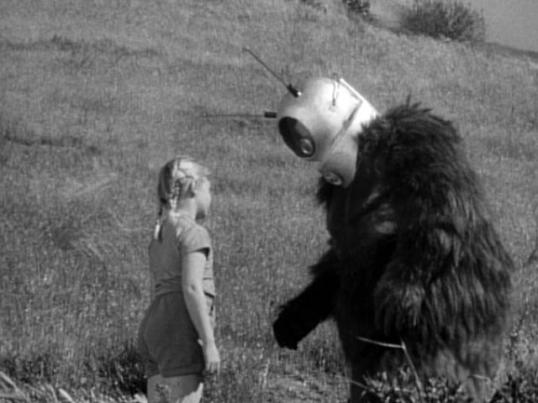
Today’s horror film is a true classic of its kind, the 1953 science fiction epic Robot Monster.

Now, I should admit that this is not the first time that I’ve shared Robot Monster in October.  I share it every year and, every year, YouTube seems to pull the video down in November.  That sucks because Robot Monster is one of those weird films that everyone should see.  So, I’m going to share it again.  And, hopefully, YouTube will let the video stay up for a while.

As for what Robot Monster is about…

What happens with the Earth is attacked by aliens?  Well, first off, dinosaurs come back to life.  All of humanity is killed, except for one annoying family.  Finally, the fearsome Ro-Man is sent down to the planet to make sure that it’s ready for colonization.  (Or something like that.  To be honest, Ro-Man’s exact goal remains a bit vague.)

Why is Ro-Man so fearsome?  Well, he lives in a cave for one thing.  He also owns a bubble machine.  And finally, perhaps most horrifically, he’s a gorilla wearing a diver’s helmet.  However, Ro-Man is not just a one-dimensional bad guy.  No, he actually gets to have a monologue about halfway through the film in which he considers the existential issues inherent in being a gorilla wearing a diver’s helmet.

Can humanity defeat Ro-Man?  Will Ro-Man ever get his intergalactic supervisor to appreciate him?  And finally, why are the dinosaurs there?

Despite the film’s reputation for being borderline incoherent, most of those above questions actually are answered if you pay attention to the first few scenes of Robot Monster.  In fact, one could even argue that Robot Monster is maybe a little bit more clever than it’s often given credit for.  Of course, it’s still a zero-budget mess of a film but it’s also undeniably fun and, in some sections, unexpectedly dark.  If you’ve never seen it before, you owe it to yourself to set aside an hour and two minutes in order to watch it.  You’ve never see anything like it before.

Finally, I should note that Robot Monster’s hero was played by George Nader, who actually did go on to appear in several mainstream films.  Despite his good looks and talent (which may not be obvious in this film but which he did have), George Nader struggled to get starring roles in Hollywood, where he was often dismissed as just being a member of Rock Hudson’s entourage.  (It’s been theorized that Nader struggled because the studios feared that giving him too big of a role would lead to the gossip magazines writing about Nader’s relationship with Hudson, though the two were just friends.  Nader was in a relationship with Hudson’s private secretary, Mark Miller, from 1947 until Nader’s death in 2001.)  Nader finally left Hollywood and went on to have a pretty successful career in Europe.  He was perhaps best known for playing secret agent Jerry Cotton in a series of films in the 60s.

Enjoy Robot Monster!

Music Video of the Day: This Corrosion by The Sisters of Mercy (1987, directed by Stuart Orme)


“It’s about the idiots, full of sound and fury, who stampede around this world signifying nothing. It’s about people who sing about the revolution while selling it short, about people who sing about the corrosion of things while they themselves are falling apart. People who miss the point… It’s also stupidly over-the-top bombastic, but rightly so.”

— Andrew Eldritch, on This Corrosion

Even more specifically, This Corrosion was written as a “take that” to two former members of the Sisters of Mercy who left the band in 1985 to form The Mission.  Eldritch’s feeling was that The Mission was just a corrosive version of Sisters of Mercy.

Director Stuart Orme was one of the directors who worked with literally everyone.  His video here is properly goth in the style of 1987.

Enjoy!

Late Night Retro Television Reviews: Nightmare Café 1.2 “Dying Well Is The Best Revenge”


Welcome to Late Night Retro Television Reviews, a feature where we review some of our favorite and least favorite shows of the past!  On Mondays, I will be reviewing Nightmare Cafe, which ran on NBC from January to April of 1992.  The entire show is currently streaming on YouTube!

This week, Frank and Fay get involved in a case of ghost noir!

Episode 1.2 “Dying Well Is The Best Revenge”

(Dir by Armand Mastroianni, originally aired on March 6th, 1992)

This week’s episode of Nightmare Café begins with Frank and Fay feeling pretty comfortable in their new roles of working at the café under the watchful eye of Blackie.  I guess some time has passed since the pilot, as both Frank and Fay seem to be totally okay with the fact that they’re both dead and destined to spend the rest of their existence working as, respectively, a cook and a waitress.

Don’t get me wrong, of course.  There’s nothing wrong with being a cook or a waitress.  If I was a waitress, I would definitely want to work for Robert Englund and get to wear a cute uniform like Fay does.  I think what is throwing me is that Fay and Frank seem to be so comfortable with the idea of being dead.  It would take me a bit longer to accept that.

As for tonight’s episode, the action starts when a sultry woman named Angela (Beth Toussaint) enters the café and asks for a cup of coffee.  Frank immediately starts flirting with her and Angela flirts back in typical film noir fashion.  All of the flirting ends, though, when Angela’s husband, Edward (Justin Deas), stumbles into the café, his face bloodied from apparently being attacked outside while he was waiting for Angela.  Angela and Edward leave but Angela later returns so that she can talk to Frank.

Angela claims that Edward is abusive.  Frank leaves the café so that he can visit Angela at home and eventually sleep with her.  (Fay and Blackie watch on the television.)  Fay doesn’t trust Angela, especially after her previous lover — a country club tennis pro (Andrew Airlie) — is mysteriously run over by a hit-and-run-driver.  As Fay puts it, she thinks that Frank could be putting his life at risk.  But, the thing with that is that Frank and Fay are already dead.  That was established in the pilot.  So, if Frank is already dead, how is he putting his life at risk?  For that matter, if Frank and Fay are dead and the Nightmare Café is basically a dimensional portal, how are they both able to casually leave the café and walk around town?  I mean, are they dead and in purgatory or not?  Seriously, what are the rules of the Nightmare Café?

Eventually, Edward confronts Frank and Angela and Frank …. SHOOTS HIM!  Well, I guess since Frank is dead, he can be a murderer.  Except, in a clever twist, it turns out that Edward was already dead and the Nightmare Café gave him a second chance to prove that Angela was the one who set up his murder.  When Angela tries to put Edward in the trunk of her car, Edward suddenly gets out of the trunk and Angela shoots him several times.  Edward pretends to die once again, allowing the police to arrest Angela for murder.  The episode ends with Angela in prison, with Edward as her ghostly companion.

So, as I said earlier, I’m still not sure what the rules of the Nightmare Café are supposed to be and, in this episode, it felt like Frank and Fay could basically just do whatever was convenient to the plot.  That’s a bit of a problem because, when there are no rules, there aren’t any stakes either.  That said, this episode was helped immensely by the friendly charm of Robert Englund.  Blackie didn’t really get involved in the storyline but he did break the fourth wall and talk directly to the audience a few times and Englund delivered the lines with just the right amount of cheery sarcasm.  Robert Englund definitely kept things entertaining!

Horror on TV: The Hitchhiker 5.2 “In Living Color” (dir by John Laing)


On tonight’s episode of The Hitchhiker, the title character (Page Fletcher) continues to come across the worst people on the planet.

This time, that person is Eric Coleman (Ray Sharkey), a once great photographer who now makes a disreputable living taking pictures of celebrities and tragedies.  When Eric has a chance to stop a woman’s suicide, he instead decides to take pictures.  His new assistant goes out of her way to make Eric feel the error of his ways.

This episode features a convincingly sleazy performance from Ray Sharkey.  Eric Coleman is a character who you will definitely want to see receive his comeuppance.

This episode originally aired on April 29th, 1989.

October Hacks: X-Ray (dir by Boaz Davidson)


The 1982 film X-Ray (also known was Hospital Massacre) opens in the early 60s.  A nerdy kid named Harold gives a Valentine’s Day card to a popular girl named Susan.  Susan takes one look at the card and laughs.  Harold responds by taking Susan’s friend, David, and hanging him from a coat rack.  Yikes!

The film then jumps forward by 19 years.  Susan (Barbi Benton) is an upper class, divorced mom who has just received a promotion at work.  As a part of the promotion, she was required to get a medical exam for insurance purposes.  On Valentine’s Day, she heads to the hospital so that she can get the results of that exam.  It should be a routine thing that only takes a few minutes.  Susan may be a  chain smoker but, otherwise, she’s in good health.

Unfortunately, Harold is now working at the hospital and he finally sees his chance to give Susan “a piece of my heart.”  Harold fakes Susan’s test results and then murders her doctor.  Susan finds herself being checked into the hospital, pretty much against her will.  Since Harold didn’t do a very good job at faking her results, the doctors are all confused by Susan’s results.  Some of them want to operate.  Some of them just want to hold her for observation.  Susan desperately wants to leave, especially when she comes to realize that Harold is killing people in the ward.  As the doctors and nurses strap Susan down to her bed and prepare to operate, Harold goes on a rampage….

Produced by Cannon Films and directed by Boaz Davidson, X-Ray is an effectively frightening slasher film.  While the film’s plot doesn’t always hang together (for instance, Susan is remarkably untraumatized by the fact that, when she was a child, her best friend was hung from a coat rack), the hospital itself is a thoroughly creepy location and the supporting characters are all either extremely strange or extremely callous.  This is a slasher film that works less because of the blood that’s spilled but instead because it captures the dread that everyone feels at the prospect of having to spend any time at the hospital.  Even the doctors who aren’t trying to kill Susan come across as being cold and unfeeling.  The scene where Susan finds herself being ordered to undress so that she can be examined by a brusque doctor who she only met a few minutes before is, quite frankly, just as nightmarish as anything that we see Harold doing to any of his victims.  The fact that no one is willing to tell Susan what’s wrong and that everyone refuses to listen to her when she gets upset over the way she’s being treated is something to which many viewers will immediately relate.  And, of course, it’s not just that Susan has a madman stalking her through the hospital.  It’s also that all of the other patients seem to be so strange, from the guy who wanders around with his flask of bourbon to the three old women who share a hospital room with her and who talk about how, while Susan is beautiful on the outside, the inside of her body is slowly decaying.

Violent but quirky, X-Ray plays out like a filmed nightmare and it’s one of the most effective slasher films over the early 80s.

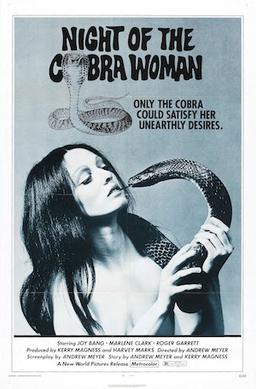
The TSL Horror Grindhouse: Night of the Cobra Woman (dir by Andrew Meyer)


The 1972 film, Night of the Cobra Woman, tells the story of Lena (Marlene Clark).

During World War II, Lena was a nurse assigned to the Philippines.  When she and a friend were attacked in the jungle by a Japanese soldier, Lena’s friend was raped while Lena was bitten by a cobra named Movini.  As the result of being raised by a snake cult, Movini’s super-powered venom conferred eternal youth, beauty, and sexual energy.  It also gave Lena the power to turn into a snake.  After subduing the Japanese soldier and turning him into her slave, Lena made a life for herself in the jungle.  Worshipped by the locals, Lena became known for never aging.

Years later, a young UNICEF worker named Joanna (Joy Bang) is working at a laboratory in the Philippines.  Having heard about Lena’s special snake venom, Joanna heads out to Lena’s compound to ask her how the venom works.  However, Joanna is chased off by Lena’s mute man-servant (Vic Diaz).  Later, Joanna’s boyfriend, Duff (Roger Garrett), decides to head out to the compound himself and see what’s going on.

When Duff doesn’t return, Joanna heads out to the compound a second time.  This time, she brings along Duff’s pet eagle.  Joanna is confronted by Lena, who claims that Duff has been bitten by a cobra and has been recovering at the compound.  After Movini hisses at Joanna, Joanna released the eagle.  The eagle promptly kills Movini.

Now, this sets up a bit of a problem.  Lena needed Movini because it was Movini’s venom that was keeping her young and preventing her from turning into a snake and then not being able to change back.  Now that Movini is dead, Lena has to head into Manila and find men to seduce so that she can live off of their life force.  Helping her out is Duff, who has apparently been brainwashed by Lena and will now do anything to help her, including setting her up with an American serviceman (who is played by an actor named, I kid you not, Slash Marks.)  Duff himself starts to rapidly age and turn into a snake.  Can Joanna save him and, more importantly, why would she want to?  Seriously, Duff left her for another woman.  Joanna doesn’t owe him anything!

Night of the Cobra Woman is a thoroughly incoherent movie, one that feels as if it was made up on the spot while filming was taking place.  Duff’s decision to go to Lena’s compound on his own never makes sense, nor does it really make much sense that Joanna doesn’t seem to be that upset by the fact that he basically just abandoned her to live with the Cobra Woman.  That said, Night of the Cobra Woman does have a cult following because it’s one of the eight films that Joy Bang made during her career.  Bang (and that was her real name, as her husband was named Paul Bang) specialized in playing flighty hippies and, as a result, she’s not exactly believable as an expert in snake venom.  But the fact that she is so miscast adds to the film’s charm.  She has pretty much the same freaked-out reaction to seeing a cobra that I would have, making her a character to whom I could at least relate.

Anyway, Night of the Cobra Woman is not that good but Joy Bang completists will definitely want to check it out.

Blood Sisters of Lesbian Sin (1997, directed by Greg Griffin)


Johnny Blake (Justin Gorence) is a demon slayer and vampire hunter who is so pure of heart and intention that he is known as The Monk.  However, when Sister Avarice (Lara Daans) puts a hex on him, the Monk finds himself being tempted as never before.  Sister Avarice wants the Monk to track down her two older sisters and take their pieces of the fabled demon stone from them.  Once the three pieces of the demon stone are put together, the demon Asmodeus will return to the world of the living.  Because of the hex, the Monk and his secretary, Karen (Heather Lea McIntyre) have no choice but to do find the other stones.  Will the Monk and Karen be able to resist Sister Avarice’s final temptation?

This is pretty dumb but I think most people will guess that as soon as the words “Torma Presents” appears on the screen.  It turns out that Sister Anger (Alisa Christensen) owns a gym and Sister Lust (Jenna Johns) owns a brothel.  Sister Anger tries to seduce Karen while Sister Lust tries to seduce the Monk.  There’s a lot of talk about bringing The Monk and Karen over to the dark side and revealing their true nature but it’s mostly just an excuse to have nearly every woman in the film go topless at some point.  (Admittedly, 14 year-old me would have thought this was the best movie ever made.)  There is one good fight scene between The Monk and a group of muggers who come across him while he’s spying on Sister Anger making out with Karen.  Otherwise, Sisters of Sin get boring pretty quickly.

The film is also known as Sisters of Sin, which make much more sense than Blood Sisters of Lesbian Sin, as only one of the sisters is a lesbian.  But Troma had Troma had a film to sell and I guess Blood Sisters of Lesbian Sin tested better than just plain Sisters of Sin.

Horror Scenes That I Love: Andrew Divoff in Wishmaster


Andrew Divoff is a talented character actor who has been making films since 1986.  He’s been played a countless number of different characters, some of whom are villainous and some of whom are sympathetic.  On Lost, he was the most menacing of the Others.  That said, for a certain generation of horror fans, Andrew Divoff will always be known for starring as the tricky Djinn in the Wishmaster films.

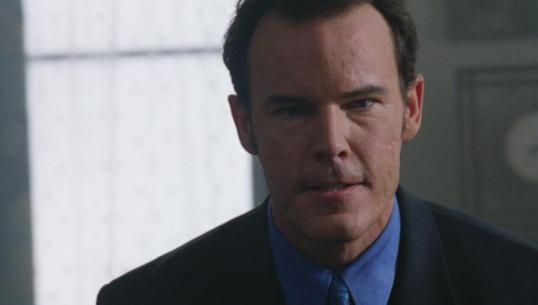
In this scene, from 1997’s Wishmaster, The Djinn finally confronts Alexandra (Tammy Lauren) and grants her wish to see the Djinn as he truly is.  In the hands of Andrew Divoff, the Djinn becomes a truly classic horror movie villain.  Who can ever forget the gleam in his eye when he asks, “Is this something that might interest you?”