Phantom Ranger (1938, directed by Sam Newfield)


Treasury agent Pat Doyle (John St. Polis) is sent to investigate a counterfeiting ring in Wyoming but ends up getting kidnapped by gang leader Sharpe (Karl Hackett) instead.  With Doyle’s daughter, Joan (Suzanne Kaaren), demanding that the government rescue her father and generating all sorts of bad publicity for the Secret Service, the decision is made to send in Tim Hayes (Tim McCoy).  Hayes, who will be working undercover, is selected because he’s not a “city boy.”  He’s a cowboy, through and through.  If you want to tame the west, you have to send a cowboy.

Phantom Ranger is a low-budget, 56-minute western from Monogram Pictures.  The plot is nothing special but the film itself still interesting because it’s a western that takes place in the 1930s.  Tim Hayes may ride a horse and wear a cowboy hat but he also works in a Washington D.C. office building and he interacts with a woman dressed like a flapper.  In this movie, the frontier has not caught up with the modern world but the modern world has also forgotten what life is like away from civilization.

The movie has the usual collection of B-western stalwarts.  Karl Hackett, John Merton, Charles King, Frank Ellis, Herman Hack, and Horace B. Carpenter are all present and accounted for.  Tim McCoy, a former rodeo performer and army officer, plays the hero and brings a lot of natural authority to the role.  McCoy was not only one of the first western heroes but he was also one of the best.

There’s no phantoms to be found in Phantom Ranger.  It’s still a good western.

Gun Lords of Stirrup Basin (1937, directed by Sam Newfield)


On the frontier, crooked lawyer Gabe Bowdre (Karl Hackett) is trying to secure all of the local water rights for himself and that means running off both the homesteaders and the ranchers.  Bowdre and his men try to start a range war between the ranching Stocktown family and the homesteading Dawsons.  Meanwhile, Dan Stockton (Bob Steele) has fallen in love with Gail Dawson (Louise Stanley) and marries her mere minutes before someone shoots his father in the back.

Gun Lords of Stirrup Basin has all the common elements that usually come with a B-western.  I have lost track of how many times I have watched Karl Hackett play a crooked businessman who tries to start a range war to win either the water rights or the property deeds.  Bob Steele spent a good deal of his career beating up Karl Hackett on screen.

What sets Gun Lords of Stirrup Basin apart is the Romeo and Juliet angle.  While it’s predictable, the love story between Dan and Gail still adds more emotional depth than is usually found in these movies.  The scene where all of the ranchers glare daggers at Dan’s new wife is powerful.

Bob Steele’s as good a hero as usual and Karl Hackett is a dastardly villain.  Gun Lords of Stirrup Basin runs a little less than an hour, making it a good western for an afternoon break.

Riders of the Desert (1932, directed by Robert N. Bradbury)


In the closing days of the frontier, a group of Rangers in New Mexico receive a telegram telling them that it is time to disband and to turn law enforcement duties over to the local sheriff.  However, there’s a viscous outlaw named Hashknife (George “Gabby” Hayes) on the loose so Bob Houston (Bob Steele) and Slim (Al St. John) pretend that they never received the telegram so that they can arrest him.  Hashknife kidnaps Bob’s girl (Gertie Messenger) and that makes thing personal.

Riders of the Desert is an appropriate name for this film because the majority of its 50-minute running time really was just taken up with footage of men riding their horses from one location to another.  Even though the film was less than an hour long, the story sill needed some filler.

Riders of the Desert is still a pretty good western, though.  It’s definitely better than the average Poverty Row western.  As always, Bob Steele look authentic riding a horse and Al St. John provides good support as Fuzzy.  The disbanding of the Rangers gives the first half of the film an elegiac feel that would later show up in several of the westerns made during and after the 1960s.  The old west is coming to an end and there’s less need for the Rangers.  The second half of the film is almost all action and George “Gabby” Hayes is a surprisingly effective villain.  Of course, this movie was made before he became Gabby.

As with most Poverty Row westerns, this is not the film to watch if you’re not already a fan of the genre.  But for those who like westerns, Riders of the Desert is a good one.

The Apache Kid’s Escape (1930, directed by Robert J. Horner)


In the old west, the Apache Kid (Jack Perrin) has decided to go straight because his own mother refuses to accept the stolen money that he sends home.  Unfortunately, other outlaws, like Buck Harris (Bud Osborne), continue to break the law while wearing the Apache Kid’s trademark checkered scarf so the Apache Kid still has a posse after him.

Using the alias Jim, the Kid gets a job working at a local ranch.  Ranch hand Ted Conway (Fred Church) is looking forward to marrying Jane Wilson (Josephine Hill), the daughter of the ranch’s owner.  Ted’s father, Frank (Henry Roquemore), wants Jane for himself so he reveals that Ted is actually adopted and no one knows who his real parents are.  Jane’s father (Horace B. Carpenter) announces that the wedding is canceled.  So, Ted decides to take on the identity of the Apache Kid and rob a stagecoach.  After Ted is arrested, Jim has to return to his old ways to help Ted get out of jail.

The Apache Kid’s Escape is a 47-minute poverty row western that is remembered for being one of the first westerns to feature recorded sound.  Unfortunately, the movie sounds terrible, with a steady hum in the background and all of the actors speaking slowly, loudly, and very precisely while awkwardly trying not to look straight at the camera.  Everyone noticeably hesitates before speaking, as if waiting for the director to give them the signal to go.  With all of the humans struggling to speak, the film’s best performance comes from Starlight the Horse, who is a natural star.  Jack Perrin went on to have an active career in B-westerns so maybe he learned how to handle acting with sound.

This was the only film to feature Perrin as the Apache Kid and it’s easy to see why.  The plot doesn’t even try to make sense.  If Jim wants to escape being the Apache Kid, he should be happy that so many other people are willing to take over the role for him.  Perrin is also stuck wearing a really big hat, which makes him look more like a Blazing Saddles extra than a cowboy star.

There were a lot of bad westerns made during the early days of the sound era.  The Apache Kid’s Escape might be the worst.

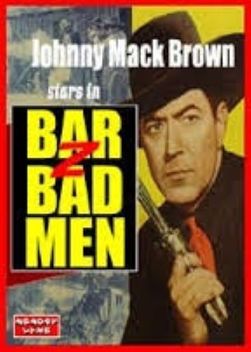
Bar-Z Bad Men (1937, directed by Sam Newfield)


After getting kicked out of town for shooting the place up during a night of friendly fun, cowboy Jim Waters (Johnny Mack Brown) drops in on his old friend, rancher Ed Parks (Jack Rothwell).  Ed has got a strange problem.  There are cattle rustlers about but instead of stealing Ed’s cattle, they’re adding cattle to Ed’s herd.  It’s an obvious scheme to try to create a feud between Ed and his neighbor, rancher Hamp Harvey (Frank LaRue).  Before Jim and Ed can solve the problem, Ed is gunned down.  Harvey is the number one suspect but Jim figures out the truth, that Harvey has been betrayed by one of his own employees and that all of this is a part of a scheme by Sig Bostell (Tom London) to take control of both ranches.

Bar-Z Bad Man is a B-western with a notably twisty plot as Bostell plays both sides against each other for his own benefit.  As usual, Johnny Mack Brown makes for a good and convincing western hero.  Whether he’s chasing someone on his horse or drawing his guns, Brown is always a convincing cowboy.  What makes this film interesting is that it opens with Johnny Mack Brown engaging in the type of behavior that most B-western heroes would never think of doing.  Shooting up the town and then getting exiled for his actions adds an element of redemption to Jim’s efforts to get to the bottom of Bostell’s schemes.  Or it would if Jim ever really seemed to feel bad about shooting the town up.  His excuse is that he was just having a good time.  Try to get away with that in the real old west, Jim!

Bar-Z Bad Men is a good B-western for those who like the genre.  The story is solid and Johnny Mack Brown is as convincing saving the west as he was shooting it up.