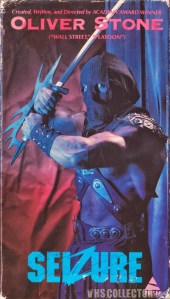
Everyone had to start somewhere and, long before he became one of the leading political provocateurs of American cinema, Oliver Stone was just another struggling film school grad who was looking for a chance to make a name for himself. Like many aspiring filmmakers, Stone made his directorial debut with a low-budget horror film.
Filmed in Quebec and featuring an eclectic cast that included a soap opera star, a former Warhol superstar, a faded teen idol, a past Bond girl, and a future Bond villain, Seizure stars Jonathan Frid (of Dark Shadows fame) as Edmund Blackstone. Edmund is a horror novelist who is described as being “a modern-day Edgar Allan Poe.” When Edmund’s rich friends get together for the weekend, they are terrorized by three maniacs: the Queen of Evil (Martine Beswick), a mute giant called the Jackal (Henry Judd Baker), and a psychotic dwarf named The Spider (Hervé Villechaize).
All of Edmund’s guests face the inevitability of death in a different way. Playboy Mark Frost (Troy Donahue) is too concerned with pursuing pleasure to realize that he’s in danger. Businessman Charlie Hughes (Joseph Sirola) gets out his wallet and tries to buy his way out of trouble. Mikki (Mary Woronov), Charlie’s much younger wife, strips down to her underwear and runs away. Eunice Kahn (Anne Meachem) jumps out of a window after the Spider ticks her into using an aging cream. Eunice’s husband, philosopher Serge (Roger de Koven), faces death with stoicism. Edmund’s brother-in-law, Gerald (Richard Cox), is a long-haired hippie who accidentally gets shot in the head by Edmund and dies saying, “You bastard!” Edmund’s wife (Christina Pickles) tries to protect her son (Timothy Ousey) and Edmund reveals himself to be the first of the many flawed father figures who would appear in Stone’s films.
If not for the identity of its director, Seizure would be a forgotten film. In fact, it seems to be a film that Stone wishes was forgotten. He rarely mentions it in interviews and usually describes Seizure as being a “learning experience” and there’s really nothing about Seizure that would make you think the director would go on to win three Oscars. It’s a slow and talky movie that is just occasionally weird enough to be interesting. Seizure‘s philosophical digressions are pure Stone but otherwise, it’s hard to see any sign of the director that Stone would become in Seizure.
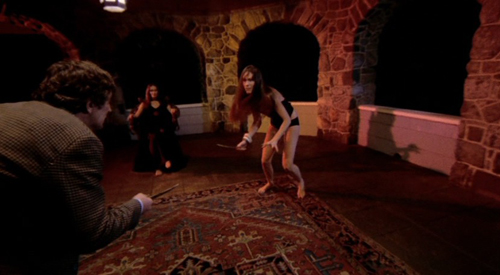
Still, what other movie features Jonathan Frid and Mary Woronov having a knife fight while Martine Beswick and Hervé Villechaize watch?
If you ever find yourself on the campus of the University of North Texas and you need to kill some time, stop by the UNT Library, go up to the second floor, find the biographies, and track down a copy of Peter Manso’s Mailer: His Life and Times.
Back in December of 2007, at a time when I really should have been studying for my finals, I spent an entire afternoon in the library reading Manso’s book. I didn’t know much about Norman Mailer, the Pulitzer prize-winning writer and occasional political candidate, beyond the fact that he died that previous November and that a lot of older people who I respected apparently thought highly of his work. Though Manso’s book had been written 20 years earlier, it still provided an interesting portrait of the controversial author. It was largely an oral history, full of interviews with people who had known Mailer over the years. As I skimmed the book, it quickly became apparent that, among other things, Mailer was a larger-than-life figure.
For me, the book was at its most interesting when it dealt with Mailer’s attempts to be a filmmaker. In the 1960s, Mailer directed three movies. All three of them also starred Norman Mailer and featured his friends in supporting roles. All three of them were largely improvised. And, when released into theaters, all three of them were greeted with derision.
Maidstone, Mailer’s 3rd film, was filmed in 1970. In the film, Mailer played Norman Kingsley, an avante garde film director who is running for President. Over the course of one weekend, while also working on a movie about a brothel, Norman meets with potential supporters and debates the issues. And, of course, shadowy figures plot to assassinate Norman, not so much because they don’t want him to be President as much as they want him to be a martyr for their vaguely defined cause.
Just based on what I read in Manso’s book, it’s hard not to feel that the making of Maidstone could itself be the basis of a good movie. Mailer essentially invited all of his friends to his estate and they spent 5 days filming, with no script. It was five days of drinking, drugs, and bad feelings.
At one point, actor and painter Herve Villechaize (who would later play Knick Knack in The Man With The Golden Gun) got so drunk and obnoxious that he was picked up by actor Rip Torn and literally tossed over a fence. The unconscious Villechaize ended up floating face down in a neighbor’s pool. After fishing Villechaize out of the pool, the neighbor tossed him back over the fence and shouted, “Norman, come get your dwarf!”
Eventually, after five days, filming fell apart. Some members of the cast were okay with that. And one most definitely was not..
Fortunately, Maidstone is currently available on YouTube so I watched it last night. Unfortunately, the film itself is never as interesting as the stories about what went on behind the cameras. Maidstone is essentially scene after scene of people talking and the effectiveness of each scene depends on who is in it. For instance, Norman’s half-brother is played by Rip Torn, a professional actor with a big personality. The scenes with Torn are interesting to watch because Rip Torn is always interesting to watch. However, other scenes feature people who were clearly cast because they happened to be visiting the set on that particular day. And these scenes are boring because, quite frankly, most people are boring.
And then you’ve got Norman Mailer himself. For an acclaimed writer who was apparently quite a celebrity back in the day, it’s amazing just how little screen presence Norman Mailer had as an actor. Preening for the camera, standing around shirtless and showing off his hairy back along with his middle-aged man boobs, Mailer comes across as being more than a little pathetic. He’s at his worst whenever he tries to talk to a woman, giving off a vibe that’s somewhere between creepy uncle and super veiny soccer dad having a midlife crisis.
It’s an uneven film but, for the first half or so, it’s at least interesting as a time capsule. For those of us who want to know what rich intellectuals were like in the late 60s, Maidstone provides a service. However, during the second half of the film, it becomes obvious that Mailer got bored. Suddenly, all pretense towards telling an actual story are abandoned and the film becomes about Mailer asking his cast for their opinion about what they’ve filmed so far.
And then, during the final 15 minutes of the film, Norman Mailer decides to have the cameramen film him as he plays with his wife and children. This is apparently too much for Rip Torn who, after spending an eternity glaring at Mailer and undoubtedly thinking about everything he could have been doing during those five day if he hadn’t been filming Maidstone, walks up to Mailer, says, “You must die, Kingsley,” and then hits Mailer on the head with a hammer.
This, of course, leads to a long wrestling match between Mailer and Torn and, as the cameras roll, blood is spilled and insults are exchanged. There’s a lot of differing opinions about whether this final fight was spontaneous or staged. Having seen the footage, I get the impression that Mailer was caught off guard but that Torn probably let the cameraman know what he was going to do ahead of time.
Regardless, it’s hard to deny that the pride of Temple, Texas, Elmore “Rip” Torn, appears to be the one who came out on top. After the fight, Mailer and Torn have a lengthy argument that amounts to Rip saying that he had to do it because it was the only way that the film would make sense while Mailer replies with some of the least imaginative insults ever lobbed by a Pulitzer winner.
(So basically, Rip Torn won both the physical and the verbal rounds of the fight.)
Anyway, you can watch the entire Rip Torn/Norman Mailer confrontation below.
Now, while the fight is really the only must-see part of Maidstone, it still has considerable value as a time capsule of the time when it was made. You can watch it below!
Hi there! The name’s Bowman. Lisa Marie Bowman. Yes, I’ve made that joke a few times over the past two weeks but so what? Let me have my fun! And speaking of fun, we’ve been reviewing the entire James Bond franchise here at the Shattered Lens. Today, we’re going to take a look at 1974’s The Man With The Golden Gun, the 9th “official” James Bond film and the second Bond film to feature Roger Moore in the lead role.
The Man With The Golden Gun is Francisco Scaramanga (Christopher Lee), the world’s most feared assassin. Living on his own private island, Scaramanga is waited on hand-and-foot by a murderous dwarf named Nick Nack (Herve Villechaize) and his mistress Andrea Anders (played by Maud Adams, who, like me, is a member of the red-headed 2%). Every few days or so, Nick Nack arranges for a different gangster or spy to come to the island and fight a duel with Scaramanga. Much to Nick Nack’s disappointment, Scaramanga always manages to win each duel. However, Scaramanga remains a frustrated assassin because he’s never had the chance to take on (and kill) his hero, James Bond.
Just how obsessed is Scaramanga with Bond? Scaramanga has his own private funhouse set up on the island and the star exhibit at that funhouse is a wax figure of Bond that Scaramanga enjoys firing golden bullets at.
Meanwhile, in London, MI6 receives one of those golden bullets with “007” etched into the surface. M (Bernard Lee), not wishing to see his best agent killed, immediately relieves Bond from his current mission. Bond, along with a painfully dizzy British agent named Mary Goodnight (played by Britt Ekland), responds by setting off to track down Scaramanga on his own.
Bond eventually tracks Scaramanga down to Bangkok where Scaramanga is busy scheming to steal something called a Solex agitator which, depending on who is using it, can either be the key to solving the energy crisis or it can be a deadly, solar-powered weapon. Bond also discovers that the bullet wasn’t sent by Scaramanga but was instead sent by Andrea who wants Scaramanga dead.
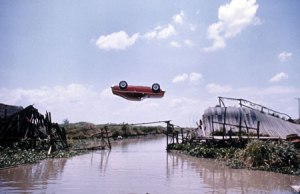
Not surprisingly, this all leads to what you would expect — an elaborate car chase, a Bond girl in a bikini, and a final duel between Bond and Scaramanga.
When The Man With The Golden Gun was first released way back in 1974, the film received some of the worst reviews in the Bond franchise’s history. A typical review came from Time Magazine’s Jay Cocks who complained that Moore “lacks all Connery’s strengths and has several deep deficiencies”, whilst Lee was “an unusually unimpressive villain.” In a complaint that would be made about the majority of the post-Connery, pre-Craig Bond films, Cocks also criticized the film’s plot for being too dependent on both Bond and Scaramanga using implausible gadgets.
While most of the Bond films were treated dismissively by critics when they were first released, the majority of them have also come to be seen in a more positive light as the years have passed. The Man With The Golden Gun, however, is an exception to that rule. Nearly four decades after first being released, The Man With The Golden Gun still has a reputation for being a disappointment. While Christopher Lee has rightly come to be recognized as one of the best Bond villains, the film itself is still regularly dismissed as one of the worst of the Bond films.
The Man With The Golden Gun‘s flaws are pretty obvious.
As played by Britt Ekland, Mary Goodnight is perhaps one of the most useless Bond girls ever and pretty much confirms every accusation of sexism that’s ever been made against the Bond films. It’s hard not to wish that the role of Goodnight had been played by Maud Adams who, as Andrea Anders, proves to be one of the best of the Bond femme fatales.
Redneck Sheriff J. W. Pepper (Clifton James) was an acquired taste when he first showed up in Live and Let Die and those who were annoyed by his character the first time will probably not be happy when he implausibly pops up in this film, vacationing in Bangkok and somehow getting involved in yet another car chase.
Finally, while Roger Moore’s performance as James Bond has always been rather underrated, it’s hard to deny that he looks a bit ill-at-ease in this film. As opposed to Live and Let Die (which was clearly written to match Moore’s interpretation of the role), The Man With The Golden Gun feels like it was written for Sean Connery’s more ruthless interpretation of the role. There’s a rather ugly scene where Bond roughly slaps Andrea to get her to tell him about Scaramanga. It’s the type of thing that you could imagine Connery doing without a second thought but Moore seems uncomfortable with it. His Bond simply doesn’t have the sadistic streak that hid underneath the surface of Connery’s interpretation.
That said, The Man With The Golden Gun is something of a guilty pleasure of mine. The Man With The Golden Gun is one of the Bond films that I always make a point to catch whenever it shows up on television and I certainly had a better time rewatching it than I did when I rewatched You Only Live Twice. The film moves along quickly enough, the car chases are a lot of fun, and Scaramanga’s funhouse is one of the best of the Bond sets.
For all of its flaws, The Man With The Golden Gun is saved by its trio of villains. Maud Adams, Herve Villechaize, and especially Christopher Lee give three of the most memorably eccentric performances in the history of the Bond franchise. They’re so much fun to watch that, if spending time with them also means spending time with Mary Goodnight and Sheriff Pepper, it’s a sacrifice that I’m willing to make.
The strength of Christopher Lee’s performance as Scaramanga cannot be understated. There’s something oddly touching in the contrast between Scaramanga the steely assassin with the golden gun and Scaramanga, the insecure killer who is apparently always comparing his accomplishments to the accomplishments of James Bond. Lee’s Scaramanga is such a compelling character that you almost regret that he can’t, in some way, be allowed to achieve some sort of victory at the end of the film.
But, of course, if that happened then it would no longer be a James Bond film.
As always, regardless of what the critics may have wished, James Bond would return. Ironically, Moore would follow-up a what many considered to be the worst James Bond adventure with a film that many consider to be one of the best. We’ll be taking a look at The Spy Who Loved Me tomorrow.
Until then, let’s enjoy one of the most underrated theme songs in the history of the Bond franchise.
 Everyone had to start somewhere and, long before he became one of the leading political provocateurs of American cinema, Oliver Stone was just another struggling film school grad who was looking for a chance to make a name for himself. Like many aspiring filmmakers, Stone made his directorial debut with a low-budget horror film.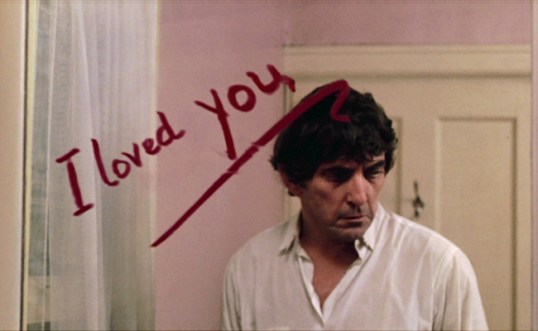




 Through the Shattered Lens