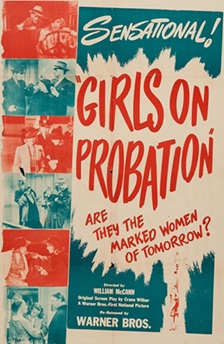
Eager to get away from her abusive father (Sig Ruman), Connie Heath (Jane Bryan) keeps making the mistake of hanging out with the ultimate bad friend, Hilda Engstrom (Sheila Bromley). Hilda steals a dress from where they work and when the dress is torn, Hilda lets Connie take the blame. When the dress’s owner (Susan Hayward, making her film debut) insists on pressing charges, insurance investigator Neil Dillon (Ronald Reagan) helps Connie get off the hook and out of jail.
Having not learned her lesson, Connie continues to hang out with Hilda and her new boyfriend, Tony Rand (Anthony Averill). This time, Connie gets caught up in a bank robbery. Will Neil be able to get her out of another jam?
63-minutes long, Girl on Probation is a Warner Bros. B-movie. Ronald Reagan is surprisingly mellow as someone falling in love with a woman who keeps getting framed for his crimes she didn’t commit. Sheila Bromley steals the show as the out-of-control dangerous blonde who tells a priest, “I’m about to meet your boss.” The main problem with the film is that Connie is incredibly stupid. How many times can one person be framed? Jane Bryan, who played Connie, ended her acting career when she got married but she and her millionaire husband later helped to bankroll Reagan’s first political campaign and both of them were members of his unofficial “kitchen cabinet” when he was governor of California.
The movie has never been released on DVD and is hard to find. It plays on TCM occasionally, which is where I saw it. Online, the only place it appears to be streaming, ironically enough, is on a Russian site.
Gangster William Kroner (Bernard Nedell) and his henchman Martino (Eduardo Ciannelli) frame teenager Gabe Ryan (Frankie Thomas) for setting several buildings on fire. Because Gabe has just gotten out of reform school and is a member of a local neighborhood gang, they know that no one will believe him or his sister, Joy (Ann Sheridan).
What Kroner and Martino did not count on were the Dead End Kids (Billy Halop, Bobby Jordan, Leo Gorcey, Gabriel Dell, Huntz Hall, and Benard Punsley). They’re not going to sit by while the adults send their friend to jail. Plus, one of their friends was killed in one of the fires. The kids are out for revenge and sympathetic district attorney Pat Remsen (Ronald Reagan) is on their side.
As a publicity stunt, the city is holding an election for “Kid Mayor.” The Kid Mayor gets to run the city for a week. What could go wrong? Billy Halop decides to run for Kid Mayor so that he can order the arrest of Kroner and then beat a confession out of him.
Angels Wash Their Faces was one of the last of the studio-made Dead End Kid films. After this one, they would be sent down to Poverty Row and their films would be more obviously comedic. Angels Wash Their Faces starts out as a juvenile delinquent drama, with Gabe struggling to rebuild his life and keep on the right track. Then it becomes a goofy comedy, with Billy Halop running for mayor and unleashing vigilante justice on the bad guys. I’m not sure that any city would actually give the “kid mayor” the power to lock people up. Whoever came up with the idea of a kid mayor should be run out of politics.
On the positive side, Ann Sheridan is beautiful. Future president Reagan is his usual friendly self. On the negative side, the movie, overall, lacks the edge that made the first few Dead End Kids films memorable and the Dead End Kids themselves seem to be pretty much interchangeable. Huntz Hall would have made a better mayor.
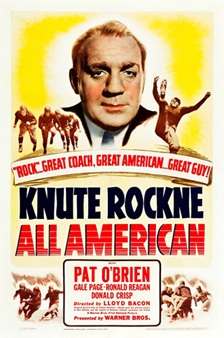
The son of a Norwegian carriage builder who immigrated to the United States in 1892, Knute Rockne (Pat O’Brien) attends Notre Dame, revolutionizes football as both a player and a coach, and leads Notre Dame to upset victory after upset victory. Other coaches look to Rockne and see how to build and inspire a team and learn the importance of taking chances when the game is on the line.
This rah-rah biopic of real-life coach Knute Rockne elevates the character to near sainthood. I was surprised that he didn’t heal any sick children or single-handedly end World War I. Pat O’Brien is just the right age to play Rockne as an aging, veteran coach but the movie also has him playing Rockne as a college student. It’s strange to see Rockne telling his father that he’s decided to go into coaching and that he hopes he won’t be a disappointment to his family when both the father and the son appear to be the same age.
If there is one thing about this movie that really works, it’s the performance of future President Ronald Reagan as George Gipp, a college baseball player who is recruited to the football team after Rockne sees how far and how high he can kick the ball. Gipp becomes a surrogate son to Rockne and Ronald Reagan’s innate likability is put to good use. As an actor in forgettable B-movie, Reagan could seem stiff and uncomfortable but, as George Gipp, he seems surprisingly relaxed and natural. It’s easy to see why this film temporarily made him a star. The scene when George Gipp, on his death bed, tells Knute to tell the team to “win one for the Gipper” is a classic tear-jerker moment and Reagan’s image as being the selfless Gipper, the man who was all about inspiring the team at even the worst of moments, served him well when he went into politics.
(It also served the makers of Airplane! well when Leslie Nielsen needed to give Robert Hays an inspiring speech to get Hays back into the cockpit of that plane. Win one for the Zipper!)
Ronald Reagan’s performance is the only thing about Knute Rockne, All American that has aged well. The movie made me want to win one for the Gipper.
The Life of Emile Zola, the winner of the 1936 Oscar for Best Picture of the Year, opens with two French artists living in a drafty apartment.
Emile Zola (Paul Muni) is destined to become one of France’s most popular and important writers. Paul Cezanne (Vladimir Sokoloff) will eventually become one of the most important artists of the post-impressionist movement. But for now, they’re just two struggling artists who have sworn that they will never sell out their principles. They are poor but they’re happy. That changes for Zola after he meets a prostitute named Nana (Erin O’Brien-Moore) and he uses her life story as the inspiration for a novel. The book is controversial and its frank content scandalizes France. The public censor comes close to banning it. But it also becomes a best seller. It’s the book everyone secretly owns but claims to have never read.
Zola writes several more books, all about the conditions of the working class in France. Eventually, he becomes what he claimed he would never be, a wealthy man living in a mansion and having little contact with the poor and oppressed. Cezanne sees Zola one last time, calling him out for having sold his talent for money. Cezanne explains that, on general principle, he can no longer be Zola’s friend.
Meanwhile, a quiet and rather meek family man named Captain Alfred Dreyfus (Joseph Schildkraut) has been arrested and accused of being a spy for Germany. There’s little evidence that Dreyfus is a spy. Indeed, most of the evidence seems to point to a Major Walsin-Esterhazy (Robert Barrat). But, because Dreyfus is considered to be an outsider, he is convicted in a show trial and exiled to Devil’s Island.
(In real life, it’s generally agreed that Dreyfus was a victim of anti-Semitism. As the only Jewish member of the army’s General Staff, Dreyfus was viewed with suspicion by his colleagues even before anyone knew that there was a German spy. The Life of Emile Zola doesn’t specifically state that Dreyfus was a victim of anti-Semitism, with the exception of a brief moment when one of his accusers looks at his personnel file and says, “He’s not one of us,” while pointing at the word “Jew.” Otherwise, the fact that Dreyfuss was Jewish is never mentioned in the film. It’s as if the film is going out of its way to avoid offending the very people that the movie is criticizing.)
After speaking to Dreyfus’s wife (played by Gale Sondergaard, who would later become the victim of a show trial herself when she was blacklisted as a suspected communist), Zola decides to take up Dreyfus’s case. He publishes an open letter — J’Accuse — in which he states that Dreyfus was not given a fair trial and that Dreyfus is innocent of the charges against him. Zola finds himself in court, accused of libel. Zola uses his trial to give Dreyfus the hearing that he never received. While the army boos his every utterance, the people of France rally to his side.
The Life of Emile Zola is an early example of the type of prestige production that today is often referred to as being an “Oscar picture.” It tells a true story. As a film that condemns the treatment of Alfred Dreyfus but avoids stating the obvious reason why Dreyfus was targeted in the first place, it’s political without being radical. And it features a performance from the most acclaimed actor of the era, Paul Muni. Muni gives a powerful performance as Zola, holding the viewer’s attention even during the lengthy trial scenes that take up most the second half of the film. That said, the true star of the film is Joseph Schildkraut, who plays Dreyfus as being a kind and trusting soul who finds himself caught up in a Kafkaesque nightmare. At one point, Dreyfus is given a gun and told that there’s one way that he can avoid being put on trial for treason. Schildkraut played the scene so well that I wanted to cheer when he refused to surrender.
The Life of Emile Zola is a big and, at times, self-consciously important production. It was clearly designed to win a bunch of Oscars and it certainly managed to do that. Compared to some of the other films nominated that year — The Awful Truth,Dead End, A Star is Born, Lost Horizon, Stage Door, In Old Chicago — The Life of Emile Zola can seem a bit stodgy. However, the performances of Muni and Schildkraut continue to make the film worth watching.
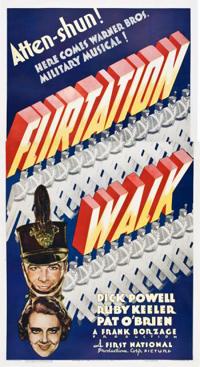
In the 1934 Best Picture nominee, Flirtation Walk, Dick Powell plays a soldier who is constantly trying to go AWOL.
It’s not that Richard “Dick” Palmer Grant Dorcy Jr. dislikes the army. In fact, he’s actually getting a pretty good deal out of his enlistment. He’s been stationed in Hawaii, where he gets to go to luaus and hang out on the beach. He has a wonderful friend and mentor in the person of Sgt. Scrapper Thornhill (Pat O’Brien). Since this film was made in 1934, he’s not going to have to worry about going to war for another 7 years. He’s known as The Canary because he loves to whistle and sing. Everyone like Pvt. Dick Dorcy and that includes Kit Fitts (Ruby Keeler).
Unfortunately, Kit’s father is General Fitts (Henry O’Neill) and he’s none too amused about his daughter having a romance with an irresponsible enlisted man. He would much rather that Kit marry his aide, Lt. Biddle (John Eldredge). After he’s told to stay away from Kitt, Dick makes plans to desert so he can run off with her. Fortunately, Scrapper finds out what Dick is planning and he goes to Kit and warns her that Dick’s about to throw away his life for her. Not wanting him to get into trouble, Kit pretends that she never felt anything for Dick. When a broken-hearted Dick wonders why Kit rejected him, Biddle smugly informs him that he’s neither “an officer nor a gentleman.”
Stung, Dick decides to fix that problem. In order to become an officer, he applies for admission to West Point and gets in. Dick leaves Hawaii for the mainland and he does very well at West Point. He’s even put in charge of producing, writing, and directing West Point’s annual theatrical production. However, things get complicated with Gen. Fitts arrives to serve as superintendent. Coming with Gen. Fitts are both Kit and Lt. Biddle.
Deciding to express his angst through art, Dick writes a show about a female general. Since Kit is the only female at West Point, guess who gets the lead role? Though Kit is still in love with Dick, she can’t get him to listen to her explanation for why she rejected him. Will a stroll along West Point’s famed Flirtation Walk help fix things?
Well, it is a Dick Powell musical….
Flirtation Walk is a pleasant but forgettable movie. Dick Powell and Ruby Keeler make for a cute couple but neither one of them gives a particularly interesting performance and the bland songs don’t make much of an impression either. Those who are into military history might enjoy the fact that the film was actually filmed on location at West Point but, for the rest of us, this is a nice but not particularly memorable musical romance. For me, the most interesting part of the film was that it didn’t even attempt to be realistic when it came to Dick’s theatrical production. It’s a huge production, if never coming close to being as much fun as the one from 42nd Street.
Why was Flirtation Walk nominated for Best Picture? I imagine it was because it was a hit at the box office. It only received one other nomination, for Best Sound Recording. Regardless of why it was nominated, it lost to the far more memorable It Happened One Night.
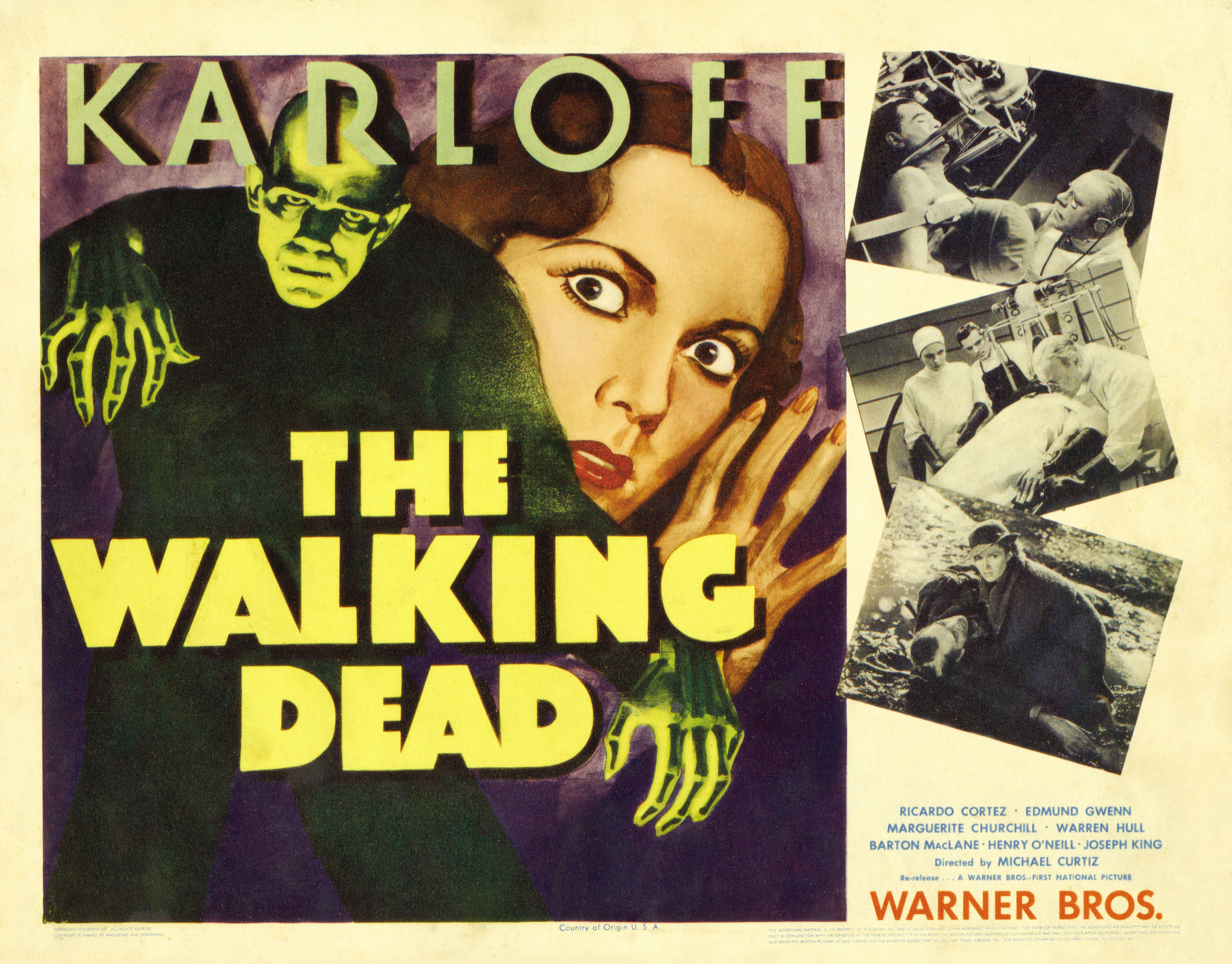
In this 1936 film (which has absolutely no relation to the AMC zombie show), Boris Karloff plays John Ellman. John Ellman is perhaps one of the unluckiest guys ever. Seriously check this out:
John Ellman was once an acclaimed concert pianist. However, he was wrongly convicted of killing his wife and spent ten years in prison. Now that he’s finally been paroled, he can’t get anyone to hire him. Meanwhile, the judge who originally sent him to prison is in the news for having defied the mob and sentenced a well-known gangster to prison. The mob is out for revenge but, rather than take the fall themselves, they’d rather frame a patsy. And who could be a better patsy than a man who everyone already knows has a grudge against the judge?
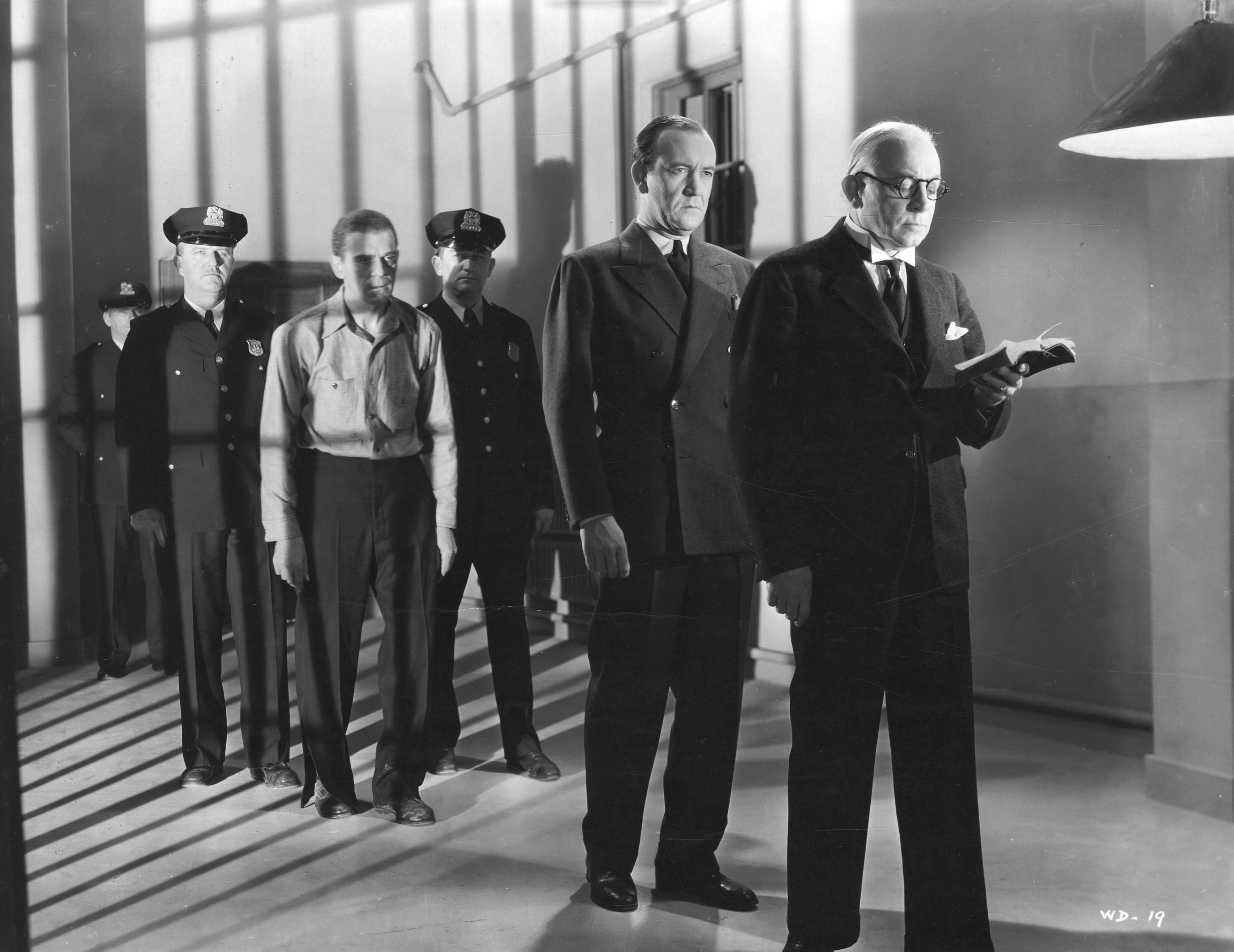
Nolan (Ricardo Cortez), a crooked lawyer, arranges for Ellman to be given a job. Ellman is told that he simply has to spy on the judge for a few nights to determine whether the judge is having an extramarital affair. Ellman agrees and soon finds himself being set up. The gangsters kill the judge and plant the body in Ellman’s car. Ellman is arrested and sentenced to die. It doesn’t matter that there are witnesses who know that Ellman’s innocent. No one is willing to cross the mafia.
Ellman is convicted and promptly executed but his story isn’t over. A scientist named Dr. Beaumont (Edmund Gwenn, who later played the man who might be Santa Claus in Miracle on 34th Street) knows that Ellman is innocent. He takes Ellman’s body and, through an artificial heart and a bunch of other science-y things, he manages to revive Ellman. John Ellman lives again! Of course, he’s a bit of a zombie now and he doesn’t have any memory of his former life. And yet, he instinctively knows who set him up to be executed and he sets out for revenge.
What’s interesting is that Ellman doesn’t kill anyone. Even after he’s revived and presumably has no concept of right and wrong, John Ellman remains a rather passive zombie. For the most part, the racketeers die because of how they react to the sight of the previously dead Ellman coming towards them. For that matter, Beaumont isn’t the typical mad scientist that you might expect to turn up in a film like this. He’s a benevolent man who was simply doing what he thought was the right thing. Though the film ends with a warning about playing God, one can’t hep but get the feeling that, unlike Frankenstein, the film is overall very supportive of the idea of reviving the dead.
Directed by Michael Curtiz (who also did Casablanca, Mildred Pierce, The Adventures of Robin Hood, and countless other classic films), The Walking Dead is a combination horror/gangster film. The film’s plot is a bit too convoluted for its own good but, overall, The Walking Dead works because of Boris Karloff’s performance. He’s poignantly pathetic as the living John Ellman and then rather chilling as the vengeance-driven, recently revived Ellman. The film’s most effective scenes are the ones where he just stares at his enemies, fixing them with a gaze that takes no prisoners and offers no hope. It’s a great performance that elevates an otherwise uneven film.
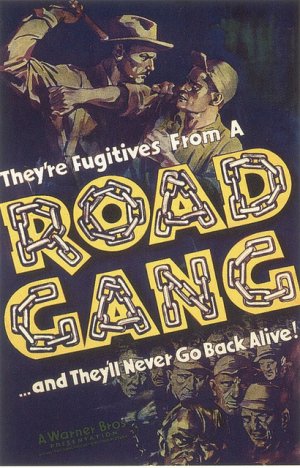
I was going to start this review with a quote from Gandhi: “A nation’s greatness is measured by how it treats its prisoners.” That was something that I first heard from a perpetually stoned ex-seminarian who used to live in a trailer park in Lake Dallas. I always figured that, being as stoned as he usually was, he probably knew what he was talking about but, upon doing research for this review, I have discovered that Gandhi actually didn’t say that. What Gandhi said was, “A nation’s greatness is measured by how it treats its weakest members.” Fortunately, it’s the same basic idea and, regardless of how you phrase it, it’s a quote that perfectly encapsulates the message of the 1936 film, Road Gang.
Road Gang tells the story of Jim (Donald Woods) and Bob (Carlyle Moore, Jr.). Bob is fun-loving. Jim is more serious and engaged to marry heiress Barbara Winston (Kay Linaker). Jim and Bob live in an unnamed Southern state (though I’m going to assume that the state is supposed to be Georgia, just because). Jim has just written an article that exposes the corruption of political boss, J.W. Moett (Joe King). The article is so good that both Jim and Bob have been offered jobs in Chicago! There’s a lot of corrupt political figures who can be exposed in Chicago!
However, while driving up north, Jim and Bob are arrested on trumped-up charges. At first, Jim and Bob laugh off Moett’s desperation but, unfortunately, another criminal happens to be breaking out of jail at the same time that Jim and Bob arrives for booking. That criminal kills the arresting officer and then forces Jim and Bob to drive him across the state. Eventually, the police recapture the three of them. However, the escaping criminal is killed and Jim and Bob are arrested as accessories. Under the advice of their lawyer, Mr. Dudley (Edward Van Sloan), they plead guilty and accept a deal. What they don’t know is that Dudley works for Moett and that, as a result of pleading guilty, they are going to be sentenced to five years in a prison camp.
Okay, so the film gets off to a pretty melodramatic start. And, to be honest, the entire film is extremely melodramatic. A lot of time is devoted to Barbara trying find evidence that Jim and Bob were set up, something that is made difficult by the fact that Barbara’s father, like Mr. Dudley, works for Moett. Fast-paced and not-always-logical, this is a B-movie, in every sense of the term.
And yet, as melodramatic as it is, Road Gang is deadly serious when it comes to portraying the brutality of the prison camp. From the minute that Bob and Jim arrive, they find themselves at the mercy of the corrupt warden and his sadistic guards. The prisoners are largely used as slave labor and subjected to punishments that are often arbitrary and extreme.
Road Gang doesn’t flinch when it comes to portraying why prison often not only fails to rehabilitate but also helps to transform minor offenders into hardened criminals. There’s a disturbing scene in which Jim, Bob, and the other prisoners are forced to listen as another prisoner is whipped. The crack of the whip and his howls of agony explode across the soundtrack in a symphony of pain and sadism. Jim and Bob have two very different reactions to being in prison. One survives. One allows himself to be killed rather than take one more day in confinement.
Road Gang is often compared to I Am A Fugitive From A Chain Gang. Actually, beyond the theme of a fatally compromised justice system, there is no comparison. The angry and fact-based I Am A Fugitive From A Chain Gang is a hundred times better and, quite frankly, Donald Woods was no Paul Muni. However, Road Gang still has its moments of power. Decades after it was made, the issues it raises continue to be relevant. Do we send people to prison to rehabilitate them or to punish them and are the two goals mutually exclusive? And how can we say that someone has “paid his debt to society” when, even after a prisoner serves his time, the stigma of having been imprisoned closes and locks most doors of opportunity?
Road Gang shows up occasionally on TCM. There’s where I recorded it on January 23rd of this year.
1936’s THE WALKING DEAD has absolutely nothing to do with the wildly popular AMC TV series. This WALKING DEAD stars Boris Karloff , making the first of a five-picture deal he signed with Warners, an interesting hybrid of the gangster and horror genres about an unjustly executed man who’s revived by science exacting vengeance on those who set him up. The result was a fast paced (clocked at 66 minutes) entry in the first horror cycle, and one of the last horror films made until their 1939 revival (more about that later).
Boris stars as John Ellman, newly released from a stretch in prison. A gangland cartel, looking to get rid of a law-and-order judge, set Ellman up as a patsy, hiring him to stake out the judge’s home, murdering the guy, and dumping the body in Ellman’s car. He goes on trial, defended by crooked lawyer Nolan, and sentenced to death…
(For those following at home, Lisa is attempting to clean out her DVR by watching and reviewing 38 films by the end of today!!!!! Will she make it? Keep following the site to find out!)
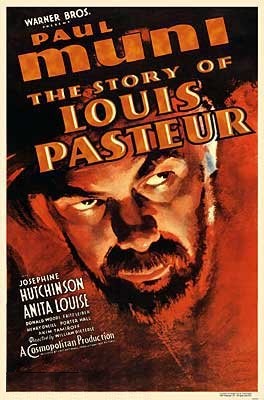
OH MY GOD, LOUIS PASTEUR WAS THE DEVIL!
Okay, maybe not but that’s certainly the impression that you might get from looking at the one sheet for the 1936 film, The Story of Louis Pasteur. Seriously, Louis looks quite sinister!
As the movie starts, that’s certainly the view of the 19th century French medical establishment. A doctor has been murdered by a grieving husband and it’s believed that the murder was inspired by one of Pasteur’s incendiary flyers. What does the flyer demand? That doctors should wash their hands and sterilize their instruments before operating.
That’s right! Washing your hands before plunging them into a human body was once considered to be a controversial notion. Pasteur is put on trial, accused of inciting violence with his quackery. Even though Pasteur is acquitted, he finds himself a pariah. The autocratic and close-minded Dr. Charbonnet (Fritz Leiber) declares Pasteur to be guilty of great quackery and even the ducks are offended. That’s how hated Pasteur has become.
But, of course, we the audience know that Pasteur is not a quack. Not only do we know that he is responsible for discovering the process of pasteurization but he’s also apparently important enough to have his own 1930s Warner Bros. biopic. And he’s played by Paul Muni, who made a career out of playing great men in 1930s biopics.
The film follows Pasteur as he discovers cures for anthrax and rabies. Along the way, he yells at a lot of people and he gives a lot of speeches. This film might as well have been called The Paul Muni Show and … well, his performance is okay. It’s not great. If you’ve seen the very first version of Scarface, you know that Paul Muni was capable of giving a far better performance than he gives here. But then again, as written, all Louis does is bellow against everyone who disagrees with him. (And cure rabies, we shouldn’t overlook that.)
The Story of Louis Pasteur is one of those old-fashioned biopics that feels a bit creaky and stiff today. As I watched it, I kept thinking that it felt like something you might across on PBS at three in the morning. However, 1936 audiences disagreed with me. The Story of Louis Pasteur did quite well at the box office and was nominated for best picture, though it lost to another biopic, The Great Ziegfeld.
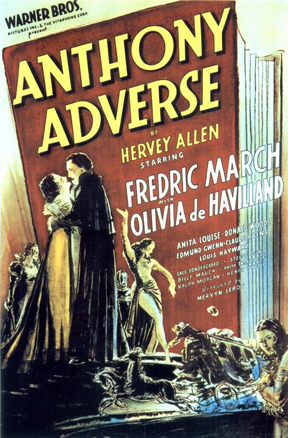
Late last night, I continued to clean out my DVR by watching the 1936 film, Anthony Adverse.
I recorded Anthony Adverse off of TCM, where it was being shown as a part of that channel’s 31 Days of Oscars. Anthony Adverse was aired because it was nominated for Best Picture of 1936. That’s significant because, if not for that nomination, I doubt that anyone would ever have a reason to watch Anthony Adverse. It’s certainly one of the more obscure best picture nominees. Despite a prestigious cast and being directed by the respectable Mervyn LeRoy, Anthony Adverse only has a handful of reviews over at the imdb. And most of those reviews were written by Oscar fanatics like me.
Anthony Adverse is an epic historical film, one that tells the story of Anthony Adverse (Frederic March). Anthony is the illegitimate son of Denis Moore (Louis Hayward) and Maria (Anita Louise), the wife of evil Spanish nobleman, Don Luis (Claude Rains, convincing as a nobleman but not as someone from Spain). Luis murdered Denis and Maria died giving birth so Luis abandons the baby at an Italian convent. Anthony is raised by nuns and priests and then, 10 years later, is apprenticed to an English merchant named John Bonnyfeather (Edmund Gwenn). Bonnyfeather just happens to be Anthony’s grandfather! Though Luis told him that Anthony died as soon as he was born, Bonnyfeather quickly figures out that Anthony is his grandson. However, Bonnyfeather doesn’t share that information with Anthony and instead, he gives Anthony the surname “Adverse.”
Bonnyfeather raises Anthony as his own son. Anthony grows up to be Frederic March and ends up falling in love with and marrying the beautiful Angela (Olivia De Havilland). However, Anthony is suddenly called away on business to Havana, Cuba. He doesn’t even have a chance to tell Angela that he’s leaving. He does leave her a note but it blows away. Assuming that she’s been abandoned, Angela goes to France, becomes an opera singer, and is soon the mistress of Napoleon.
Meanwhile, in Cuba, Anthony becomes convinced that Angela has intentionally abandoned him. Consumed by grief, he ends up running a slave trading post in Africa. He takes one of the slaves, Neleta (Steffi Duna), as his mistress and becomes known for his cruelty. However, he eventually meets Brother Francois (Pedro de Cordoba) and starts to reconsider his ways.
(The film’s treatment of the slave trade is …. well, it’s awkward to watch. The film is undoubtedly critical of slavery but, at the same time, it’s hard not to notice that the only slave with a prominent part in the film is played by a Hungarian actress. Anthony may eventually reject cruelty but it’s left ambiguous as to whether or not he rejects the slave trade as a business. If Anthony Adverse were made today, one imagines that this section of the film would be handled much differently.)
Meanwhile, back in Europe, Bonnyfeather is dying and his housekeeper, Faith (Gale Sondergaard, who won the first ever Oscar awarded for Best Supporting Actress for her performance here), plots to claim his fortune.
After I watched the movie but before I started this review, I did some research and I discovered that Anthony Adverse was based on a 1,222-page best seller that came out in 1933. I’m going to guess that the film’s long and ponderous story may have worked better on the page than it does on the screen. As a film, Anthony Adverse clocks in at 141 minute and it feels even longer. Despite the impressive cast, the film just never clicks. It’s never that interesting.
At the same time, I can understand why it was nominated for best picture. It’s a big movie, full of characters and extravagant sets and ornate costumes. You can tell it was an expensive movie to make and there’s enough philosophical dialogue that you can pretend there’s something going on underneath the surface. In the 1936, Anthony Adverse may have been quite impressive but seen today, it’s forgettable.
Anthony Adverse lost best picture to another overproduced extravaganza, The Great Ziegfield. Personally, I would have given the award to the unnominated My Man Godfrey.
 Eager to get away from her abusive father (Sig Ruman), Connie Heath (Jane Bryan) keeps making the mistake of hanging out with the ultimate bad friend, Hilda Engstrom (Sheila Bromley). Hilda steals a dress from where they work and when the dress is torn, Hilda lets Connie take the blame. When the dress’s owner (Susan Hayward, making her film debut) insists on pressing charges, insurance investigator Neil Dillon (Ronald Reagan) helps Connie get off the hook and out of jail.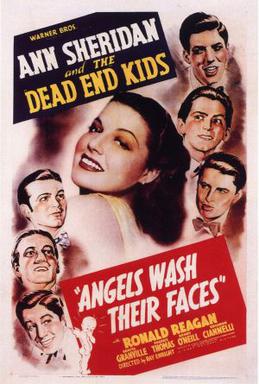


 Through the Shattered Lens