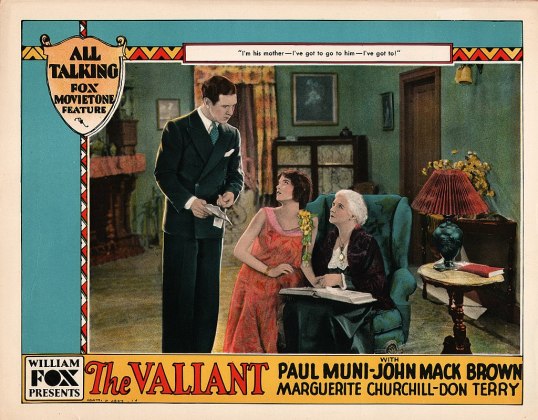
Film Review: The Valiant (dir by William K. Howard)


In the days after World War I, a man (Paul Muni) stumbles out of an apartment building and then walks down to the local police station.  He informs the officer on duty that he just shot a man.  He refuses to explain why he shot the man and, when asked for his name, he identifies himself as James Dyke.  The office notices a poster for “Dyke & Co.” on the wall and realizes that the man made up his name.  The man is convicted and sentenced to be executed.

The years pass as the man waits for his execution date.  He is a model prisoner, working hard in the garden and writing editorials for the newspapers in which he warns young readers about pursuing a life of crime.  The money he makes, he puts into Liberty Bonds.  He continues to refuse to tell anyone his first name.

In a small town, an old woman (Edith Yorke) sits in her rocking chair and has visions of all the men who went to war and never returned.  When the woman sees a picture of James Dyke in a newspaper, she thinks that he looks like her son, Joe, who long ago went missing.  The woman’s daughter, Mary (Marguerite Churhill), realizes that her mother is planning to make the trip to the prison to see him before he is executed.  Mary decides to go herself.  She tells her fiancé (John Mack Brown) that she could never get married if it turned out her brother was a murderer.  Meanwhile, the old woman continues to have visions of soldiers marching to war.

At the prison, James Dyke tells Mary that he has no family and he has no past.  But he did serve in World War I and during that time, he met her brother and he saw him die heroically in battle.  Dyke tells her to write to the army for the details of her brother’s death but to be aware that they might not even know whether or not he actually served because the war was such a confusing time that “they don’t know what happened to half the men out there.”  Dyke and Mary continue to talk as the hour of execution draws near….

An adaptation of a one-act play, The Valiant was released in 1929, at a time when America was still coming to terms with the horror of the Great War and Hollywood was still trying to adjust to the arrival of sound.  Though many had assumed that sound films would just be a fad, it turned out that audiences really did like to hear the dialogue as opposed to just reading it.  The Valiant is the type of melodrama that was popular during the silent era and the film does feature title cards that appear between scenes.  “A city street — where laughter and tragedy rub elbows,” one card reads.  Another one announces, “Civilization demands its toll.”  At the same time, it is a sound picture.  The first five minutes of the film are just the Man walking through the city and listening to the sound of cars honking and people talking.  Like many of the early sounds films, it’s obvious that the majority of the cast was not quite sure how they should handle delivering their dialogue.  Some people talk too loudly.  Some talk too softly.  Quite a few deliver their dialogue stiffly and without emotion.  Others use way too much emotion.

The only actor who seems to be fully confident in his ability to perform with sound is Paul Muni, making his screen debut in the lead role.  Muni gives a strong and empathetic performance, one that makes even the most melodramatic of dialogue feel naturalistic.  Muni shows an instinctive knowledge of how to deliver his lines with emotion without going over the top, which was a skill that many of the actors who tried to make the transition to sounds films never learned.  Paul Muni was the first great actor of the sound era, as well as one of the first screen actors to use what would eventually become known as the Method.  Among the actors who were directly inspired by Muni were John Garfield, Montgomery Clift, and Marlon Brando.  Much of modern acting owes a huge debt to the work of Paul Muni.

Seen today, the contrast between Paul Muni’s performance and the film’s staginess can make The Valiant seem like a rather surreal film.  While Muni captures the screen and confidently delivers his lines, everyone else seems hesitant and unsure of how to reply.  The end result is that, to modern audiences, The Valiant can almost seem like a filmed dream.  From the shot of Muni walking down the noisy city street to the sudden appearance of a swing band playing in the prison cafeteria, the film can seem almost Lynchian in its oddness.

The Valiant was a box office success and, according to the notes in the Academy archives, Paul Muni was among the actors considered for the second Best Actor Oscar.  (That year, there were no official nominations and only the winners were announced.)  The Oscar went to Warner Baxter for In Old Arizona but Muni would go on to have an amazing career.
Lisa Reviews An Oscar Nominee: Romeo and Juliet (dir by George Cukor)


http://www.youtube.com/watch?v=IoAgB_sbDOE

You know the story that’s told in this 1936 film already, don’t you?

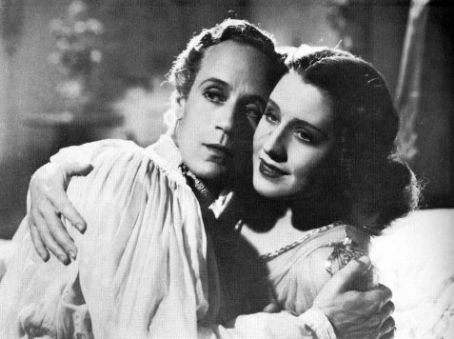
In the city of Verona, Romeo Montague (Leslie Howard) has fallen in love with Juliet Capulet (Norma Shearer).  Normally, this would be cause for celebration because, as we all know, love is a wonderful thing.  However, the House of Capulet and the House of Montague have long been rivals.  When we first meet them all, they’re in the process of having a brawl in the middle of the street.  There’s no way that Lord Capulet (C. Aubrey Smith) will ever accept the idea of Juliet marrying a Montague, especially when he’s already decided that she is to marry Paris (Ralph Forbes).  Things get even more complicated with Juliet’s cousin, Tybalt (Basil Rathbone), kills Romeo’s best friend, Mercutio (John Barrymore).  Romeo then kills Tybalt and things only grow more tragic from there.

It’s hard to keep track of the number of films that have been made out of William Shakespeare’s tale of star-crossed lovers and tragedy.  The plot is so universally known that “Romeo and Juliet” has become shorthand for any story of lovers who come from different social sects.  Personally, I’ve always felt that Romeo and Juliet was less about love and more about how the rivalry between the Montagues and the Capulets forces the young lovers into making hasty decisions.  If not for Lord Capulet throwing a fit over his daughter’s new boyfriend, she and Romeo probably would have split up after a month or two.  Seriously, I’ve lost track of how many losers I went out with in high school just because my family told me that I shouldn’t.

Producer Irving Thalberg spent five years trying to get MGM’s Louis B. Mayer to agree to greenlight a film version of Romeo and Juliet.  Mayer thought that most audiences felt that Shakespeare was above them and that they wouldn’t spend money to see an adaptation of one of his plays.  Thalberg, on the other hand, thought that the story would be a perfect opportunity to highlight the talents of his wife, Norma Shearer.  It was only after Warner Bros. produced a financially successful version of A Midsummer Night’s Dream that Mayer gave Romeo and Juliet the go ahead.

Of course, by the time the film went into production, Norma Shearer was 34 years old and a little bit too mature to be playing one of the most famous teenagers in literary history.  Perhaps seeking to make Shearer seem younger, Thalberg cast 43 year-old Leslie Howard as Romeo, 44 year-old Basil Rathbone as Tybalt, and 54 year-old John Barrymore as Mercutio,  (In Barrymore’s defense, to me, Mercutio always has come across as being Verona’s equivalent of the guy who goes to college for ten years and then keeps hanging out on the campus even after dropping out.)

In short, this is the middle-aged Romeo and Juliet and, despite all of the good actors in the cast, it’s impossible not to notice.  There were few Golden Age actors who fell in love with the authenticity of Leslie Howard and Basil Rathbone is a wonderfully arrogant and sinister Tybalt.  Norma Shearer occasionally struggles with some of the Shakespearean dialogue but, for the most part, she does a good job of making Juliet’s emotions feel credible.  As for Barrymore — well, he’s John Barrymore.  He’s flamboyant, theatrical, and a lot of fun to watch if not always totally convincing as anything other than a veteran stage actor hamming it up.  The film is gorgeous to look at and George Cukor embraces the melodrama without going overboard.  But, everyone in the movie is just too old and it does prove to be a bit distracting.  A heart-broken teenager screaming out, “I am fortune’s fool!” is emotionally powerful.  A 43 year-old man doing the same thing is just not as effective.

Despite being a box office failure (it turned out that Mayer was right about Depression-era audiences considering Shakespeare to be too “arty”), Romeo and Juliet was nominated for Best Picture of the year, the second Shakespearean adaptation to be so honored.  However, the award that year went to another big production, The Great Ziegfeld.

Cleaning Out The DVR: Let Us Live! (dir by John Brahm)


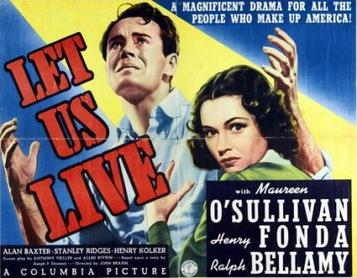
In the 1939 film, Let Us Live!, Henry Fonda plays Brick Tennant.  Brick is a poor but honest taxi driver who has always lived a law-abiding life and who is looking forward to marrying waitress named Mary Roberts (Maureen O’Sullivan).  However, when a taxi is used as a getaway car in a violent robbery that leaves a policeman dead, Brick finds that he’s a suspect.

At first, Brick isn’t too worried.  It turns out that every taxi driver in Boston is apparently being considered a suspect.  Brick is just 1 out of 120.  However, when the police bring Brick in to take part in a lineup, one of the witnesses insists that Brick and his friend, Joe Linden (Alan Baxter), were involved in the robbery.  Despite the fact that Brick and Mary were at a church, planning their wedding, during the robbery, Brick and Joe are arrested and put on trial for murder.  Despite Brick’s initial faith in the system, he and Joe are convicted and sentenced to die.

On death row, Brick faces the inhumane reality of American justice.  He watches as other prisoners slowly lose their mind as a result of neglect and abuse.  He watches as another prisoner drops dead in front of him, to the indifference of the guards.  Even when Mary tells him that she’s still looking for evidence that will exonerate him, Brick says that he no longer cares.  The state of Massachusetts is determined to kill him and he doesn’t believe that there’s any way stop them.  As Mary puts it, Brick is now dead inside.

Still, Mary continued to investigate.  Helping her is a police detective named Everett (Ralph Bellamy).  Everett comes to realize that two innocent men are sitting on Death Row but will he and Mary be able to find the real culprits before the state executes Brick and Joe?

While watching Let Us Live, I found it impossible not to compare the film to The Wrong Man, another film in which Henry Fonda played an innocent man being railroaded by the system.  Both The Wrong Man and Let Us Live were based on a true stories, though Let Us Live takes considerably more liberty with its source material than The Wong Man does.  Whereas The Wrong Man is a docudrama that’s full of moody atmosphere courtesy of director Alfred Hitchcock, Let Us Live is much more of a fast-paced, melodramatic B-move.

That said, Let Us Live! is still a definitely effective look at how an innocent man can be railroaded by a system that’s often more concerned with getting a quick conviction than actually searching for the truth.  Sadly, the issues that Let Us Live deals with are just as relevant today as they were in 1939.  The film’s power comes from Henry Fonda’s performance as Brick.  It’s truly heart-breaking to watch Brick go from being a cheerful optimist to a man who has been so broken down by American justice that he can’t even bring himself to celebrate the news that he might be released.  The film ends on a grim note, a reminder that some damage cannot be undone.

Let Us Live! is another good but obscure film that I discovered through TCM.  Keep an eye out for it!

Film Review: The Last Days of Pompeii (dir by Ernest B. Schoedsack and Merian C. Cooper)


The summer after I graduated high school, I took a trip to Italy.

I absolutely loved it.  There’s nothing more wonderful than being 18 and irresponsible in one of the most beautiful and romantic countries in Europe.  I also loved it because everywhere I looked in Italy, I saw the remains of history.  When I was in Rome, I visited the Colosseum.  When I was in Southern Italy, I visited Comune di Melissa, the village where some of my ancestors once lived.  When I visited Florence, I became so overwhelmed by the beauty of it all that I nearly fainted.

And then there was Pompeii.  I spent a day visiting the ruins of Pompeii and it was an amazing experience.  The eruption of Mt. Vesuvius in 79 AD may have been horrific for the Romans but it’s also gave history nerds like me a chance to step right into the past.  Beyond just the thrill of seeing how the world once was, I have two main memories of Pompeii:

First, there was the visit to Pompeii’s brothel.  An Australian tourist lay down on one of the stone slabs so that his family could take pictures of him.

Secondly, there was the fact that I wore a really pretty red dress for my visit but I failed to take into account that 1) the area around Pompeii is very hilly and 2) it was a very windy day.  So, I can say that I’ve not only visited but I’ve flashed Pompeii as well.

The destruction of Pompeii has inspired several books and more than a few films, as well.  One of the earliest was the 1935 film, The Last Days of Pompeii.

The Last Days of Pompeii opens with Marcus (Preston Foster), an extremely bitter blacksmith who lives in the bustling city of Pompeii.  Marcus is bitter because he’s not rich and his family has been just been run down by some jackass in a chariot.  Marcus does find brief fame as a gladiator but he’s stricken with guilt after he kills a man and then discovers that he’s made an orphan out of the man’s son.  Marcus adopts young Flavius, just to then discover that the boy is seriously ill.  A fortune teller informs Marcus that Flavius will be healed by “the greatest man in Judea.”  Marcus naturally assumes that this is a reference to the Roman governor, Pontius Pilate (Basil Rathbone).  However, upon traveling to Judea, Marcus meets a different great man and then watches as his adopted son is healed.

Jump forward about two decades.  Marcus is now a rich man and is in charge of Pompeii’s gladiatorial games.  Flavius (now played by John Wood) has grown up to be an idealistic young man who barely remembers the day that he was healed. What Marcus doesn’t know is that Flavius has been helping slaves escape from Pompeii.  When Flavius is arrested, it appears that Marcus is doomed to watch his own son be killed in the arena.

But wait a minute — what’s that coming down the mountain?  It’s kinda smoky and red and it looks like it might be really hot and …. oh damn.

Now, there’s two problems here.  First off, from a historical point of view, the film’s timeline doesn’t work out.  Jesus was crucified in 33 AD.  Pompeii was destroyed 46 yeas later, in 79 AD.  Therefore, there’s no way that Flavius should only be in his early 20s.  Secondly, just the fact that the film takes place in Pompeii pretty much gives away the ending before the story even begins.  Since you know that the volcano is eventually going to kill everyone, it’s hard to get too caught up in any of the drama.  You just find yourself sitting there and going, “When isssssssssss the volcano going to eeeeeeeeeeeeerupt!?”

On the plus side, Preston Foster is one of the more underrated of the Golden Age stars and he does a pretty good job here.  Plus, you have to love any film that features Basil Rathbone as a semi-decadent Roman.  Rathbone plays Pilate as both a bored libertine and a guilt-stricken convert and, both times, he’s impressive.

Despite being directed by the team behind the original King Kong, The Last Days of Pompeii is a bit slow but, if you’re specifically a fan of old sword-and-sandal epics, it’s entertaining enough.  See it for Foster, Rathbone, and the ghosts of old Pompeii.