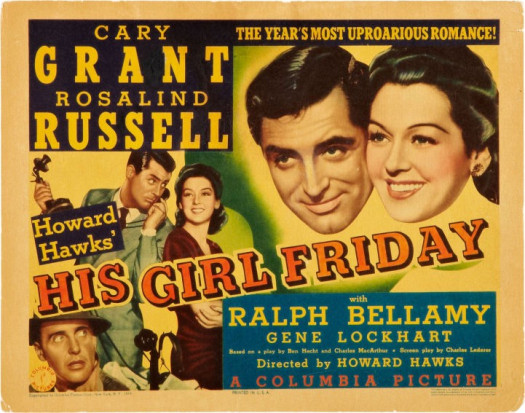
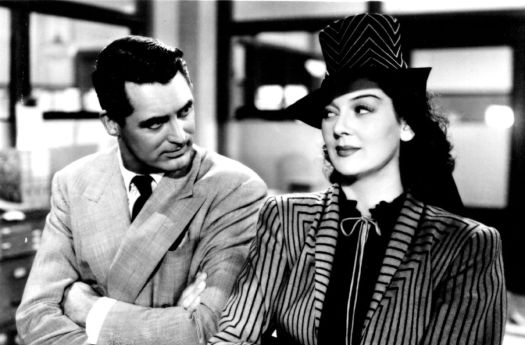
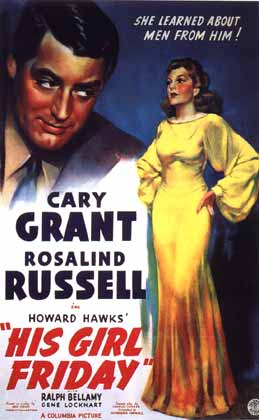
In my opinion, Howard Hawks’ HIS GIRL FRIDAY is one of the greatest screwball comedies ever made, a full speed ahead movie that’s pretty much got everything a film fan could want. A remake of the 1930 Lewis Milestone classic THE FRONT PAGE (itself an adaptation of Ben Hecht and Charles MacArthur’s Broadway smash), Hawks adds a delightful twist by turning ace reporter Hildy Johnson into editor Walter Burns’ ex-wife… and casting no less than Rosalind Russell and Cary Grant in the roles!
The two stars are in top form as the bickering ex-spouses, with their rapid fire banter nothing short of verbal dynamite. Grant in particular spouts off words quicker than a rapper (where did he get all that wind!) and his facial expressions and comic squeals (reminiscent of Curly Howard!) are simply priceless! Roz is more than his match as Hildy, with one lightning-fast zinger after another. Miss…
The 44th film in Mill Creek’s Fabulous Forties box set was the classic 1940 comedy, His Girl Friday.
Earlier this week, when I mentioned that Cary Grant’s Oscar-nominated work in Penny Serenade was not the equal of his work in comedies like The Awful Truth and The Philadelphia Story, quite a few people took the time to let me know that their favorite Cary Grant film remains His Girl Friday. And I can’t blame them. Not only does His Girl Friday feature Cary Grant at his best but it also features Rosalind Russell at her best too. Not only that but it’s also one of the best films to ever be directed by the great Howard Hawks. There are a lot of career bests to be found in His Girl Friday, and that’s not even counting a supporting cast that is full of some of the greatest character actors of the 1940s.
The film itself is a remake of The Front Page, that classic story of an editor trying to keep his star reporter from leaving the newspaper in order to get married. (Along the way, they not only manage to expose municipal corruption but also help to hide and exonerate a man who has escaped from death row.) The action moves fast, the dialogue is full of quips, and the whole thing is wonderfully cynical about … well, everything. The major difference between The Front Page and His Girl Friday is that the reporter is now a woman and she’s the ex-wife of the editor. When Cary Grant’s Walter Burns attempts to convince Rosalind Russell’s Hildy Johnson to cover just one last story, he’s not only trying to hold onto his star reporter. He’s also trying to keep the woman he loves from marrying the decent but boring Bruce Baldwin.
Bruce, incidentally, is played by Ralph Bellamy. Bellamy also played Grant’s romantic rival in The Awful Truth. To a certain extent, you really do have to feel bad for Ralph. He excelled at playing well-meaning but dull characters. As played by Bellamy, you can tell that Bruce would be a good husband in the most uninspiring of ways. That’s the problem. Hildy deserves more than just a life of boring conformity and Walter understands that. Not only do Walter and Hildy save the life of escaped convict Earl Williams but, in doing so, Hildy is also saved from a life of being conventional.
As we all know, it’s fashionable right now to attack the news media. Quite frankly, modern media often makes it very easy to do so. For that matter, so do a lot of a movies about the media. To take just two of the more acclaimed examples, there’s a smugness and a self-importance to both Good Night and Good Luck and Spotlightthat becomes more and more obvious with each subsequent viewing. (Admittedly, Edward R. Murrow was prominent way before my time but, if he was anything like the pompous windbag who was played by David Strathairn, I’m surprised that television news survived.) Far too often, it seems like well-intentioned filmmakers, in their attempt to defend the media, end up making movies that only serve to remind people why the can’t stand the old media in the first place.
Those filmmakers would do well to watch and learn from a film like His Girl Friday. His Girl Friday is a cheerfully dark film that is full of cynical journalists who drink too much and have little use for the type of self-congratulation that permeates through a film like Spotlight. Ironically, you end up loving the journalists in His Girl Friday because the film never demands that you so much as even appreciate them. There are no long speeches about the importance of journalism or long laments about how non-journalists just aren’t smart enough to appreciate their local newspaper. Instead, these journalists are portrayed as hard workers and driven individuals who do a good job because deliberately doing anything else is inconceivable. They don’t have time to pat themselves on the back because they’re too busy doing their job and hopefully getting results.
If you want to see a film that will truly make you appreciate journalism and understand why freedom of the press is important, watch this unpretentious comedy from Howard Hawks.
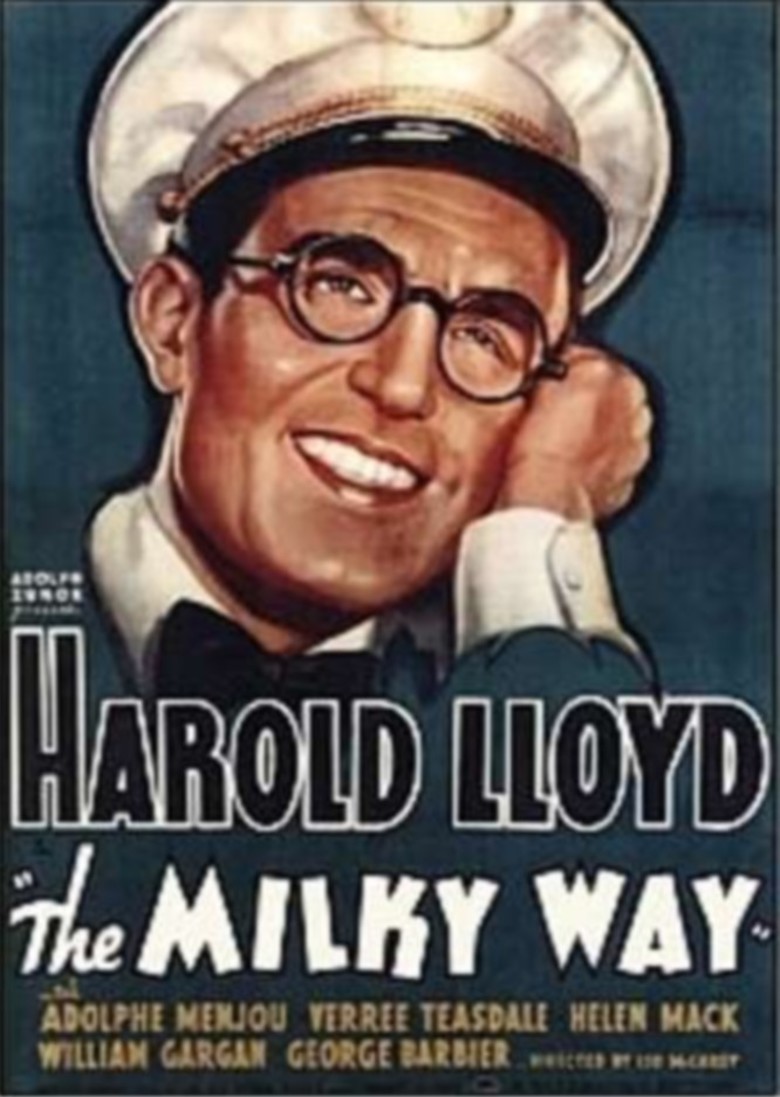
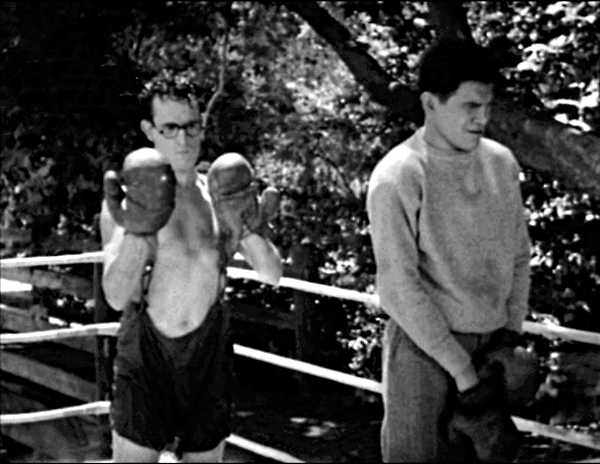
Harold Lloyd was one of the “Big 3” comedy stars of the Silent Era, right up there with Charlie Chaplin and Buster Keaton in popularity. I’ve viewed and enjoyed comic gems like SAFETY LAST and THE FRESHMAN, and some of his hilarious shorts. His bespectacled, energetic character was wildly popular in the Roaring Twenties, but with the advent of sound and The Great Depression, audiences turned away from Harold’s brand of comedy. Recently, I watched 1936’s THE MILKY WAY and wondered why they did, because Harold Lloyd was just as funny as ever in it, and the film is just as good as any screwball comedy of the era.
Harold plays Burleigh Sullivan, a milquetoast milkman constantly in hot water for failing to meet his quotas. When a pair of drunken ruffians try to hit on his sister, meek Burleigh is forced to come to her defense. A fight breaks out, and Burleigh emerges from the pile victorious. The…
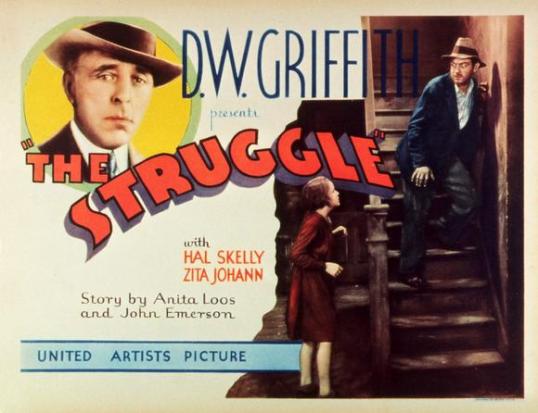
Like a lot of the films directed by cinematic pioneer D.W. Griffith, the 1931 film The Struggle is currently available on Netflix. As a result of his direction of the film Birth of the A Nation, Griffith is a controversial historical figure but it cannot be denied that he was one of the most ambitious, talented, and innovative of the silent filmmakers. Unfortunately, like a lot of the great figures of silent film, he did not survive the transition to sound. Griffith directed two sound films. Abraham Lincoln is overly theatrical while The Struggle … well, bleh.
The Struggle tells the story of a married couple whose marriage is threatened by the husband’s alcoholism. Florrie (Zita Johann) only agrees to marry Jimmie (Hal Skelly) on the condition that he stop drinking. And, for several years, Jimmie doesn’t touch a drop of liquor. But, under pressure at work and struggling to support his family, Jimmie finally breaks down, steps into a speakeasy (this film was made during prohibition), and has a drink. Soon, Jimmie is a full-blown alcoholic, wandering the streets of New York while little school children shout, “He’s a beggin’ bum!” at him. Will Jimmie’s life be turned around as the result of hearing a sermon the radio? Or will he just keep drinking himself to death?
This was the last film on which Griffith was credited as being director. (Reportedly, he was an uncredited co-director on San Francisco.) It’s obviously a heart-felt work but, outside of the harrowing shot-on-location scenes of the unshaven Jimmie stumbling down the streets of the Bronx, the film is too overly theatrical and the performances are too stiff and unconvincing to really work. Griffith was still a visual stylist but, watching The Struggle, it’s obvious that he never learned how to work with speaking actors. As well, dialogue that would have worked on a title card came across as being over-the-top and preachy when actually uttered aloud.
That said, The Struggle has some interesting historic value, especially for those of us who tend to take the Libertarian point of view when it comes to the war on drugs. The Struggle opens with a scene that is set at a garden party in 1911. We listen to various conversations being held at each table. Two people debate whether the Biograph Girl is named Mary Pickford or Mary Packard. A man declares that Woodrow Wilson will never be President because he’s a college professor. (This is all the 1931 equivalent of that scene in Titanic where Billy Zane says that a painting was done by “Somebody Picasso. I’m sure nothing will ever become of him….”) Suddenly, scandal hits the garden party as it’s discovered that a woman has had too much to drink and is now drunk. Everyone at the party, on their own, shuns the woman and she is properly shamed.
The film jumps forward to 1923. Prohibition is now the law of the land and we find ourselves in a speakeasy. The thing that we immediately notice is that there are a lot more people in the speakeasy than were at that garden party and every single one of them is drunk. And, since liquor in now illegal, it’s no longer being bought from safe and trustworthy sources. Instead, it’s now being brewed in a back room. One bootlegger holds up a bottle of prohibition liquor and announces it to be poison before then sending it out to be drunk by the Jimmies of the world.
The film’s point, of course, is that community is a lot better when it comes to policing itself than the government is. The Struggle may not be a great film but it certainly has the right message.

 Through the Shattered Lens