Writer Stephen Purcell comes out to the country to visit an old school friend, veterinarian Larry Hanrahan (Ronald Reagan). Larry is great at taking care of horses but a little clueless when it comes to women. Both rancher Rory Teller (Alexis Smith) and Rory’s neighbor, Daisy Otis (Peggy Knudsen), have a thing for Larry but Larry is kept pretty busy taking care of all the horses in the community. Stephen decides that he likes Rory but, deep down, he knows there’s no way he can compete with Larry. When Larry gets busy tending to an anthrax outbreak, Rory finds herself tempted to give Stephen a shot.
When Stallion Road originally went into production, Humphrey Bogart was cast as Stephen and Lauren Bacall was cast as Rory. Both of the stars refused to do the movie, feeling it was too lightweight. Audiences were cheated out of a chance to see Reagan and Bogart, who were friends despite their differing styles of acting, co-starring opposite each other. (They were both in Dark Victory but they didn’t share any scenes.) Speaking of Bogart and Reagan, it’s a Hollywood legend that Reagan was originally offered the role of Rick in Casablanca though I’ve also read that Reagan was actually offered the role of Victor Laszlo.
Bogart and Bacall were right. Stallion Road is the epitome of lightweight entertainment, with Reagan giving a pleasant but bland performance as Larry and the film never really allowing any doubt as to who Rory belongs with. It’s the type of movie that would be a Hallmark film today so if you’re actually looking for a realistic drama about ranching and taking care of horses, it’s best to look elsewhere. This film does show why Reagan was such a successful politician. Even though his character isn’t exactly exciting, he’s innately likable and, from the minute he first appears, he’s dependable. He’s someone who any rancher would trust to take care of their horses.
The Life of Emile Zola, the winner of the 1936 Oscar for Best Picture of the Year, opens with two French artists living in a drafty apartment.
Emile Zola (Paul Muni) is destined to become one of France’s most popular and important writers. Paul Cezanne (Vladimir Sokoloff) will eventually become one of the most important artists of the post-impressionist movement. But for now, they’re just two struggling artists who have sworn that they will never sell out their principles. They are poor but they’re happy. That changes for Zola after he meets a prostitute named Nana (Erin O’Brien-Moore) and he uses her life story as the inspiration for a novel. The book is controversial and its frank content scandalizes France. The public censor comes close to banning it. But it also becomes a best seller. It’s the book everyone secretly owns but claims to have never read.
Zola writes several more books, all about the conditions of the working class in France. Eventually, he becomes what he claimed he would never be, a wealthy man living in a mansion and having little contact with the poor and oppressed. Cezanne sees Zola one last time, calling him out for having sold his talent for money. Cezanne explains that, on general principle, he can no longer be Zola’s friend.
Meanwhile, a quiet and rather meek family man named Captain Alfred Dreyfus (Joseph Schildkraut) has been arrested and accused of being a spy for Germany. There’s little evidence that Dreyfus is a spy. Indeed, most of the evidence seems to point to a Major Walsin-Esterhazy (Robert Barrat). But, because Dreyfus is considered to be an outsider, he is convicted in a show trial and exiled to Devil’s Island.
(In real life, it’s generally agreed that Dreyfus was a victim of anti-Semitism. As the only Jewish member of the army’s General Staff, Dreyfus was viewed with suspicion by his colleagues even before anyone knew that there was a German spy. The Life of Emile Zola doesn’t specifically state that Dreyfus was a victim of anti-Semitism, with the exception of a brief moment when one of his accusers looks at his personnel file and says, “He’s not one of us,” while pointing at the word “Jew.” Otherwise, the fact that Dreyfuss was Jewish is never mentioned in the film. It’s as if the film is going out of its way to avoid offending the very people that the movie is criticizing.)
After speaking to Dreyfus’s wife (played by Gale Sondergaard, who would later become the victim of a show trial herself when she was blacklisted as a suspected communist), Zola decides to take up Dreyfus’s case. He publishes an open letter — J’Accuse — in which he states that Dreyfus was not given a fair trial and that Dreyfus is innocent of the charges against him. Zola finds himself in court, accused of libel. Zola uses his trial to give Dreyfus the hearing that he never received. While the army boos his every utterance, the people of France rally to his side.
The Life of Emile Zola is an early example of the type of prestige production that today is often referred to as being an “Oscar picture.” It tells a true story. As a film that condemns the treatment of Alfred Dreyfus but avoids stating the obvious reason why Dreyfus was targeted in the first place, it’s political without being radical. And it features a performance from the most acclaimed actor of the era, Paul Muni. Muni gives a powerful performance as Zola, holding the viewer’s attention even during the lengthy trial scenes that take up most the second half of the film. That said, the true star of the film is Joseph Schildkraut, who plays Dreyfus as being a kind and trusting soul who finds himself caught up in a Kafkaesque nightmare. At one point, Dreyfus is given a gun and told that there’s one way that he can avoid being put on trial for treason. Schildkraut played the scene so well that I wanted to cheer when he refused to surrender.
The Life of Emile Zola is a big and, at times, self-consciously important production. It was clearly designed to win a bunch of Oscars and it certainly managed to do that. Compared to some of the other films nominated that year — The Awful Truth,Dead End, A Star is Born, Lost Horizon, Stage Door, In Old Chicago — The Life of Emile Zola can seem a bit stodgy. However, the performances of Muni and Schildkraut continue to make the film worth watching.
I have to admit that One Foot In Heaven is a film that I probably never would have watched if not for the fact that it received an Oscar nomination for Best Picture.
This film from 1941 tells what I presume to be a true — or, at the very least, a true-ish — story. Fredric March plays William Spence. The film opens in 1904 with Spence explaining to his future in-laws that he’s spontaneously decided to drop out of medical school because he feels that he’s been called to become a Methodist minister. Though no one is happy or particularly encouraging about William’s decision to abandon the financial security of medicine to work as a minister, William feels that it’s what he was meant to do.
We follow William and his wife, Hope (Martha Scott), as they move from town to town, living in dingy parsonages and barely paying the bills by doing weddings. Though Hope is frustrated by the constant moving and the less-than-ideal living conditions, she remains supportive of William. They start a family and William goes from being a stern and somewhat judgmental man to becoming an inspiring minister. He even changes his opinion about the sinfulness of going to the movies. (All things considered, that’s probably for the best.) Eventually, William, Hope, and the family end up ministering to a congregation in Colorado. Determined to finally give his wife the home that she deserves, William tries to rebuild both the church and the parsonage. It turns out to be more difficult than he was expecting.
That’s pretty much the film. There’s not really much conflict to be found, until the final 30 minutes or so when William struggles to convince a bunch of snobs to help him achieve his dream of building a new church. The film opens with a title card thanking the Methodists for their help in the production of the film, which should tell you everything you need to know about the film’s attitude towards Protestantism. William does debate an agnostic at one point but it’s not much of a debate. William, after all, is played by the authoritative Fredric March while the agnostic’s name isn’t even listed in the credits. It’s a well-made film, in that sturdy way that many 1941 studio productions were, but — unless you’re just crazy about the history of Methodism — it’s not particularly interesting.
On the plus side, Fredric March gives a good performance as William Spence. March was one of the best actors of Hollywood’s Golden Age and he gives a sympathetic performance as a stern but well-meaning man who respects tradition but who is still willing to admit that he has much to learn. Probably the film’s most effective scene is when William reluctantly watches a movie with his son. March captures William’s transformation from being a disapproving father to an entertained filmgoer. It’s one of the few moments when the film really feels alive.
So, how did One Foot In Heaven receive a Best Picture nomination in the same year that saw nominations for films like Citizen Kane, The Little Foxes, Suspicion, and The Maltese Falcon? One Foot In Heaven is well-made and totally uncontroversial. It’s the type of film that, if it were made today, it would probably be directed by Ron Howard and it would star someone like James Marsden or Garrett Hedlund. One Foot In Heaven is not particularly memorable but there’s nothing particularly terrible about it either and it probably felt like a “safe’ film to nominate. Still, it’s probably significant that One Foot In Heaven didn’t receive any nominations other than one for Best Picture. It lost that Oscar to another film about family, How Green Was My Valley.
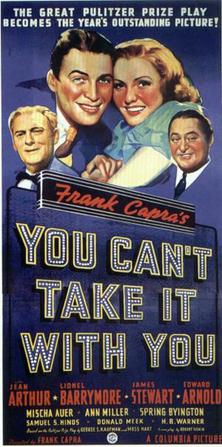
(With the Oscars scheduled to be awarded on March 4th, I have decided to review at least one Oscar-nominated film a day. These films could be nominees or they could be winners. They could be from this year’s Oscars or they could be a previous year’s nominee! We’ll see how things play out. Today, I take a look at the 1938 best picture winner, You Can’t Take It With You!)
“You can’t take it with you.”
If there’s any one belief that defines the worldview of Martin Vanderhof (Lionel Barrymore), it’s this. It doesn’t matter how much money you make in your life. It doesn’t matter how successful you are at business or anything else. The fact of the matter is that, when your time is up, you won’t be able to take any of that stuff with you. Instead, Grandpa Vanderhof (as he’s called by his large family) believes that the most important thing to do during your lifetime is to make friends and pursue what you’re truly interested in.
Vanderhof has another belief, one that particularly appealed to be me. He has never paid income tax. He doesn’t see the point of giving money to the government when he doesn’t feel that they’ll make good use of it. When an outraged IRS agent (Charles Lane) stops by Vanderhof’s sprawling house and demands that Vanderhof pay his taxes, Vanderhof refuses. When the IRS man argues that the income tax is necessary to pay for the Presidency, the Congress, and the Supreme Court, Vanderhof offers to give him five dollars. “Hell yeah!” I shouted at the TV. With an attitude like that, Vanderhof should have moved down here to Texas. We would have elected him governor.
Grandpa Vanderhof is the head of a large and cheerfully eccentric family, all of whom live together under the same roof. Penny (Spring Byington) writes novels because, years ago, a typewriter was accidentally delivered to the house. Her husband, Paul (Samuel S. Hinds), has a basement full of fireworks. Essie (Ann Miller) loves to dance and spends almost the entire movie twirling from room to room. Her husband, Ed (Dub Taylor), is a xylophone player.
Of course, it’s not just family living in the Vanderhof House. There’s also Potap Kolenkhov (Mischa Auer), a Russian who is “teaching” Essie how to dance. There’s Rheba the maid (Lillian Yarbo) and Donald (Eddie Anderson) the handyman. Actually, the house appears to be open to just about anyone who wants to stay.
And then there’s Penny’s daughter, Alice (Jean Arthur). Alice is the most “normal” member of the family. She has just become engaged to Tony Kirby (James Stewart) and she is still trying to figure out how to introduce Tony’s stuffy parents (Edward Arnold and Mary Forbes) to her eccentric family. What she and Tony don’t know is that Mr. Kirby is currently trying to buy up all the houses that are near a competitor’s factory. Only one homeowner has refused to sell. The name of that homeowner? Martin “Grandpa” Vanderhof.
It all leads, of course, to one chaotic dinner party, one lively night in jail, and a huge fireworks display. It also leads to true love, which is nice. Jimmy Stewart and Jean Arthur are even more adorable here than they were in Mr. Smith Goes To Washington.
Based on a Pulitzer-winning play by George S. Kaufman, You Can’t Take It With You was the second comedy to win the Oscar for Best Picture. The first comedy to win was 1934’s It Happened One Night. It’s probably not coincidence that both of these films were directed by Frank Capra.
Seen today, You Can’t Take It With You seems a bit slight for an Oscar winner. Grandpa Vanerhof is a lovable eccentric. Tony’s father is a stuffy businessman. Hmmm … I wonder whose philosophy is going to be victorious at the end of the movie? Still, predictability aside, it’s a delightfully enjoyable film. While it never quite escape its stage origins, it features wonderful performances from all the usual members of the Capra stock company. James Stewart and Jean Arthur are a charming couple while Lionel Barrymore gives a performance that is so warmly likable that it’s hard to imagine that, just 9 years later, he would be so perfectly cast as the heartless Mr. Potter in It’s A Wonderful Life. Of course, my favorite member of the member was Essie, mostly because I also like to dance from room to room. While it’s hard to justify awarding it Best Picture over The Adventures of Robin Hood and Grand Illusion, You Can’t Take It With You is still a wonderfully fun movie.
It’ll make you smile and laugh. Who can’t appreciate that?
(Lisa is currently in the process of trying to clean out her DVR by watching and reviewing all 40 of the movies that she recorded from the start of March to the end of June. She’s trying to get it all done by the end of July 11th! Will she make it!? Keep visiting the site to find out!)
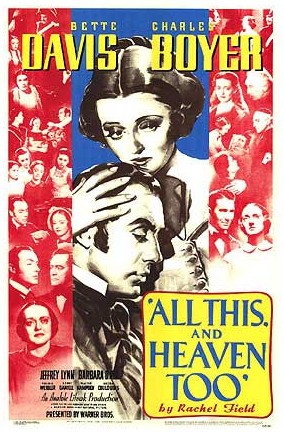
The 37th film on my DVR was the 1940 film, All This, And Heaven Too. It originally aired on June 21st on TCM.
All This, and Heaven Too is one of the many melodramatic historical romances in which Bette Davis appeared in the late 30s and early 40s. These films usually featured Bette as a strong-willed woman who was often condemned for not conforming to the rules of society. Typically, she would end up falling in love with a man who society said she could not have. Bette almost always seemed to end up alone, which I guess was the way women who thought for themselves were punished back then.
In this one, Bette plays Henriette Deluzy, a French woman who ends up in America in the 1850s. When she shows up to start teaching at a private, all-girls school, her students immediately start gossiping about her. It seems that Henriette was at the center of some sort of European scandal and everyone is speculating about what happened. Finally, at the start of class, Henriette tells her students that she’s going to tell them the true story of what happened back in France.
It turns out that Henriette was a governess. She took care of the four children of the Duc de Praslin (Charles Boyer) and his wife, the Duchesse (Barbara O’Neil). The Duchesse was mentally unstable and soon came to suspect that her husband had fallen in love with Henriette. Though she may have been insane, it turned out that the Duchesse was correct. When the Duchesse fired Henriette and then lied to her husband about it, the Duc flew into a rage and murdered his wife.
Under the laws of the time, the Duc could only be judged by his fellow noblemen. He was told that if he simply confessed and said that Henriette was the one who drove him to commit the murder, he would be set free. (As opposed to the characters that Bette Davis played in The Letter and The Little Foxes, Henriette was totally innocent.) Would the Duc confess and allow Henriette to be blamed or would he deny his love for her and sacrifice his life as a result?
All This, And Heaven Too is a rather slow movie and it’s hard not to be disappointed that Henriette is such a boring character. She’s so innocent and victimized that the role almost seems like a waste of Bette Davis’s talents. A big production that featured lavish (though black-and-white) recreations of 19th Century France, All This, And Heaven Too was probably a big deal for contemporary audiences and, if you’re a Bette Davis or Charles Boyer completist, you might enjoy it. But otherwise, it’s really nothing special.
All This, And Heaven Too was among the 10 films nominated for Best Picture of 1940. However, it lost to Rebecca.
The 35th film in Mill Creek’s Fabulous Forties box set was — wait a minute? I’m on my 35th Fabulous Forties review? Let’s see — there’s 50 films in the box set so that means that I only have 15 more of these to write and I’ll be done! And then I can move onto the Nifty Fifties, the Sensation Sixties, the Swinging Seventies, and the Excellent Eighties! YAY!
Anyway, where was I?
Oh yeah, the 35th film.
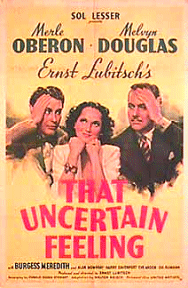
First released in 1941, That Uncertain Feeling is a movie about sophisticated people doing silly things. Socialite Jill Baker (Merle Oberon) gets the hiccups whenever she gets nervous or irritated. Her trendy friends suggest that she try the new big thing: seeing a psychoanalyst! At first, Jill is reluctant but eventually, she gives in to the pressures of high society and she goes to visit Dr. Vengard (Alan Mowbray). Dr. Vengard tells her that her hiccups are a result of her marriage to Larry (Melvyn Douglas) and suggests that the best way to cure them would be to get a divorce.
At first, Jill is horrified at the suggestion. Whatever will people think if she gets a divorce!? However, Larry is kind of a condescending jerk. (Or, at least, he comes across as being a jerk when viewed by 2016 standards. By 1941 standards, I imagine he’s supposed to be quite reasonable.) And Jill happens to meet another one of Vengard’s patients, an outspoken pianist named Alexander Sebastian (Burgess Meredith).
Soon, Jill is not only contemplating getting a divorce from Larry but perhaps marrying the eccentric Sebastian as well! When Larry realizes that Jill is dissatisfied with their marriage and that she is attracted to Sebastian, he gives her a divorce. He even pretends to be an abusive husband so that she can file for divorce on grounds of cruelty. (It’s funnier than it sounds.) Jill and Sebastian get engaged but, once Larry starts to date again, Jill realizes that she’s not quite over her ex…
I was really excited when I saw that The Uncertain Feeling was an Ernst Lubitsch film. Lubitsch directed some of my favorite Golden Age comedies, films like Ninotchka and Heaven Can Wait. But That Uncertain Feeling is not quite up to the standard of the other Lubitsch films that I’ve seen. As played by Burgess Meredith, Sebastian never comes across as being a realistic rival to Larry. The character is so cartoonishly eccentric that it becomes impossible to see what Jill sees in him. At the same time, Larry comes across as being such a chauvinist that it’s far easier to understand why Jill would divorce him than why she would ever want to take him back. The end result is a rare Lubitsch misfire.
However, as long as we’re talking about Lubitsch, make sure to see The Smiling Lieutenant if you get the chance. Now, that’s a good Lubitsch film…
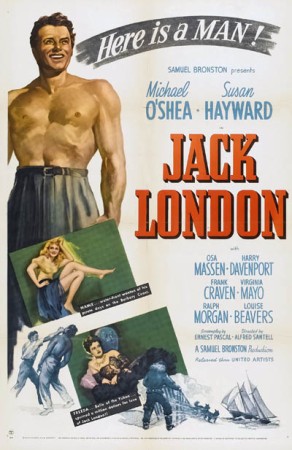
The 28th Film in Mill Creek’s Fabulous Forties box set was a 1943 biopic about the writer, Jack London. Not surprisingly, the title of the film was Jack London.
Now, I should start this review off by mentioning that I know very little about Jack London. I don’t think that I have ever read any of his short stories or his novels. I know that he wrote a novel called White Fang but that’s largely because there’s been so many different film versions of the book. (Long before directing Zombi 2, even Lucio Fulci made a version of White Fang.) Here’s what I do know about Jack London:
He was a prominent writer at the turn of the century.
He was reportedly an alcoholic.
He was a Socialist who even ran for mayor of Oakland, California on the party’s ticket.
He was an atheist.
In 1916, depending on the source, he either committed suicide, died of alcohol poisoning, or simply passed away as the result of 40 years of hard living.
Of those 5 facts, 4 are totally ignored in Jack London. The film does acknowledge that Jack London eventually became a prominent writer, even going so far as to open with stock footage of a U.S. warship being named after him.
As for his alcoholism, we never see London drunk. Indeed, the film’s version of Jack London is so earnest that it’s hard to believe he’s ever had a drink in his life.
As for his Socialism, we are shown that London grew up in a poor family. When, after serving at sea, he takes a writing class, he argues with a professor over London’s desire to write about the poor. However, we never hear London express any specific ideology. We certainly don’t see him running for mayor of Oakland.
As for his atheism — yeah right. This film was made in 1943! There’s no way that Jack London was going to be portrayed as talking about why he didn’t believe in God.
As for his death — well, Jack London ends with the writer very much alive. There’s not even a title card informing us that London eventually died.
Instead, Jack London is much more concerned with Jack (played by Michael O’Shea) dealing with the Japanese. Oh sure, we get some scenes of Jack London watching a shootout and breaking up a bar fight in Alaska. And Susan Hayward shows up as Jack London’s always supportive wife. (For that matter, Louise Beavers also shows up as Jack London’s always supportive house keeper.)
But, in the end, the majority of the film features Jack London as a war correspondent covering the turn of the 20th century war between Russia and Japan. When he’s captured by the Japanese, he observes the harsh way they treat prisoners and is shocked when he witnesses several prisoners being ruthlessly executed. When he talks to a Japanese commandant, he’s outraged as the commandant explains how the Empire of Japan is planning to take over the world. When Jack finally gets back to America, he’s less concerned with writing White Fang and more concerned with warning the American people to remain vigilant…
Jack London is basically wartime propaganda disguised as a biopic. The entire point of the film seems to be that if Jack London was still alive, he would want the men in the audience to enlist and the women to buy war bonds. None of it is subtle and, beyond its value as a time capsule of how Americans viewed the Japanese in 1943, none of it is particularly interesting as well.
In the end, Jack London plays out like one of those earnest but dull educational films that tend to show up on PBS when no one’s watching.
Before watching a film like 1940’s Foreign Correspondent, it helps to know a little something about history.
Nowadays, when we think about World War II, there’s a tendency to assume that, from the minute that Hitler came to power in Germany and started to invade the rest of Europe, the entire world united against the Nazis. The truth is actually far more complex. The world was still recovering from World War I and throughout the 1930s, even as the Axis powers were growing more and more aggressive, respected intellectual leaders and politicians continued to argue that peace must be maintained at all costs. Pacifism was such a popular concept that otherwise intelligent people were perfectly willing to make excuses for Hitler and Mussolini. For five years, the UK followed a policy of appeasement towards Nazi Germany. Even after war broke out between Britain and Germany, the U.S. remained officially neutral. In the 1940 presidential election, President Franklin D. Roosevelt — running on a platform of neutrality — was overwhelmingly reelected over internationalist Wendell Willkie.
Foreign Correspondent, an American film made by a British director, opens before the start of World War II. An American newspaper editor, Mr. Powers (Harry Davenport), is frustrated because none of his foreign correspondents seem to be able to understand the truth of the situation in Europe. They all claim that there is going to be no war in Europe but Mr. Powers feels differently. He also feels that the newspaper’s most celebrated and respected foreign correspondents are just a bunch of out-of-touch elitists. Instead of sending another upper class academic, Mr. Powers decides to send a hard-boiled crime reporter to cover the situation in Europe. Johnny Jones (Joel McCrea) has never been to Europe and that’s exactly why Mr. Powers decides to send him. In one of the film’s more clever moments, he does, however, insist that Johnny write under the more distinguished sounding name of “Huntley Haverstock.”
(Foreign Correspondent‘s pointed criticism of out-of-touch elitists repeating the establishment line remains just as relevant today as it was in 1940.)
From the minute the brash and tough Johnny arrives in Europe, he finds himself caught up in a huge conspiracy. He’s been assigned to report on a group known as the Universal Peace Party and, since this film was directed by Alfred Hitchcock, we automatically know that any organization with the word “Peace” in its name has to be up to something shady. The Universal Peace Party has been founded by Stephen Fisher (Herbert Marshall), who appears to sincere in his desire to avoid war. Johnny meets and falls in love with Fisher’s daughter, Carol (Laraine Day).
From the minute that Johnny witnesses the assassination of distinguished Dutch diplomat Von Meer (Albert Bassermann), he suspects that things are not how they seem. Working with Carol and a British journalist named Scott ffolliot* (delightfully played by the great George Sanders), Johnny discovers that Von Meer was not killed at all. Instead, a double was assassinated and Von Meer was kidnapped by a group of spies.
But who are the spies? After nearly getting killed by one of Fisher’s bodyguards, Johnny starts to suspect that Stephen Fisher might not be as into world peace as was originally assumed. Complicating matters, however, is the fact that Johnny is now engaged to marry Carol…
Foreign Correspondent is a wonderfully witty thriller, one that has a very serious message. While the film is distinguished by Hitchcock’s typically droll sense of humor (eccentric characters abound and the scene where Edmund Gwenn keeps getting interrupted before he can attempt to push Joel McCrea off of a tower is both funny and suspenseful), the film’s message was that America could not afford to stay neutral as war broke out across Europe. As the all-American Johnny Jones says at the end of the film:
“All that noise you hear isn’t static – it’s death, coming to London. Yes, they’re coming here now. You can hear the bombs falling on the streets and the homes. Don’t tune me out, hang on a while – this is a big story, and you’re part of it. It’s too late to do anything here now except stand in the dark and let them come… as if the lights were all out everywhere, except in America. Keep those lights burning, cover them with steel, ring them with guns, build a canopy of battleships and bombing planes around them. Hello, America, hang on to your lights: they’re the only lights left in the world!”
Foreign Correspondent was nominated for best picture of 1940 but it lost to another far different Hitchcock-directed film, Rebecca.
——
* Yes, that is how he spells his last name. As he explains, his family dropped the capital name in his surname after an ancestor was executed by Henry II. Since it was George Sanders doing the explaining, it somehow made perfect sense.
The title of the 1937 film They Won’t Forget works on many levels.
It describes the reaction of a small Southern town, following the brutal murder of teenager Mary Clay (played, in her film debut, by Lana Turner). The town won’t forget Mary and they won’t forget the terror caused by her murder. They also won’t forget that local teacher Robert Hale (Edward Norris) was accused of the crime.
The district attorney, Andrew Griffin (Claude Rains), hopes that the people of his state won’t forget his efforts to see Griffin convicted of that crime. Griffin wants to be elected to the U.S. Senate and he knows that the high profile case could be just what his career needs.
The Governor (Paul Everton) knows that, if he steps into the case and acts on his suspicion that Hale is innocent, the voters of his state will never forget. And they certainly won’t be willing to forgive.
And, on a larger level, the title lets us know that the South and the North will never forget the Civil War and the conflict between the two regions. The film opens with three elderly veterans of the Confederate Army, preparing to march in the town’s annual Confederate Memorial Day parade and admitting to each other that, after all these years, it’s difficult to remember much about the war other than the fact that they’re proud that they fought in it.
It’s while the rest of the town is busy watching Griffin and the governor ride in the parade that Mary Clay is murdered. It’s easy to assume that Hale was the murderer because Hale was one of the few townspeople not to go to the parade. You see, Hale is originally from New York City. When he’s accused of murder, it’s equally easy for Griffin and tabloid reporter William A. Brock (Allyn Joslyn) to convince the town people to blame this Northern intruder for both the murder of Mary Clay and, symbolically, for all of the post-Civil War struggles of the South itself.
Meanwhile, up North, Hale is seen as a victim of the South’s intolerance. A high-profile lawyer (Otto Kruger) is sent down to defend Hale but, as quickly becomes clear, everyone involved in the case is more interested in refighting the Civil War than determining the guilt or innocence of Andrew Hale.
They Won’t Forget is a hard-hitting and fascinating look at politics, justice, and paranoia. It’s all the more interesting because it’s based on a true story. In 1913, a 13 year-old girl named Mary Phagan was murdered in Atlanta. Leo Frank was accused and convicted of the murder. (In Frank’s case, he was born in Texas but was also Jewish and had previously lived in New York before moving to Atlanta, all of which made him suspicious in the eyes of many.) On the word of a night watchmen, who many believe was the actual murderer of Mary Phagan, Leo Frank was convicted and sentence to death. After spending days reviewing all of the evidence and growing convinced that Frank had been wrongly convicted, Georgia’s governor committed an act of political suicide by commuting Frank’s sentence to life imprisonment. Leo Frank was subsequently lynched and the man who had prosecuted the case against him was subsequently elected governor.
Well-acted and intelligently directed, They Won’t Forget is probably one of the best films of which few people have heard. Fortunately, it shows up fairly regularly on TCM and, the next time that it does, be sure to watch. It’s a great film that you won’t easily forget.
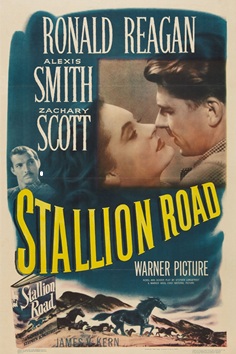 Writer Stephen Purcell comes out to the country to visit an old school friend, veterinarian Larry Hanrahan (Ronald Reagan). Larry is great at taking care of horses but a little clueless when it comes to women. Both rancher Rory Teller (Alexis Smith) and Rory’s neighbor, Daisy Otis (Peggy Knudsen), have a thing for Larry but Larry is kept pretty busy taking care of all the horses in the community. Stephen decides that he likes Rory but, deep down, he knows there’s no way he can compete with Larry. When Larry gets busy tending to an anthrax outbreak, Rory finds herself tempted to give Stephen a shot.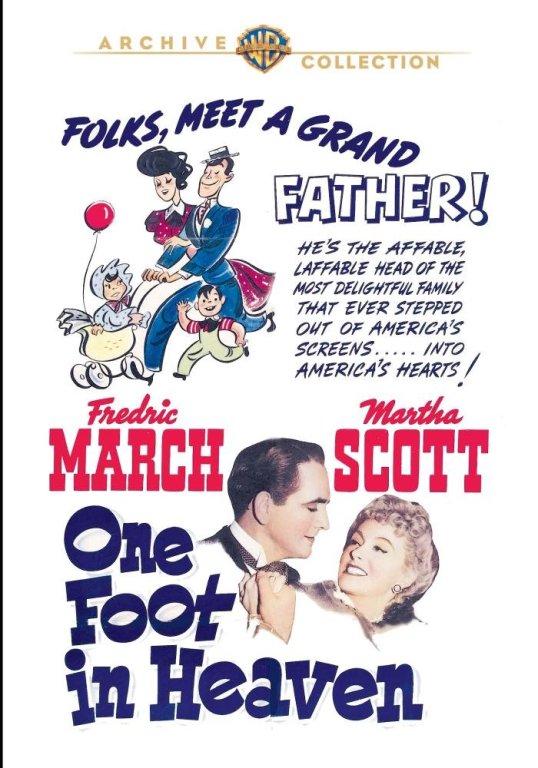


 Through the Shattered Lens