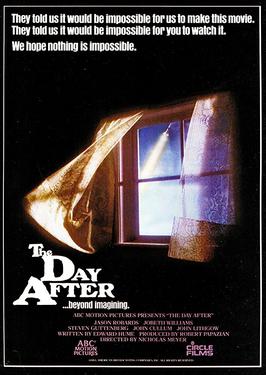
Film Review: The Day After (dir by Nicholas Meyer)


“This is Lawrence. This is Lawrence, Kansas. Is anybody there? Anybody at all?”

The words of Joe Huxley (John Lithgow) hang over the ending of The Day After, a 1983 film that imagines what the aftermath of a nuclear war would be like not on the East or the West Coasts but instead in the rural heartland of America.  Huxley is a professor at the University of Kansas and, as he explains early on in the film, Kansas would be an automatic target in any nuclear war because it houses a number of missile silos.  When he explains that, it’s in an almost joking tone, largely because the missiles haven’t been launched yet.  Instead, the only thing we’ve heard are a few barely noticed news stories about growing tensions between America and Russia.  About halfway through The Day After, the bombs go off and there are suddenly no more jokes to be made.

When the bombs drop over Kansas, we watch as cities and field and people burst into flames.  In a matter of minutes, several thousands are killed.  I’m almost ashamed to admit that I was probably more upset by the image of a horse being vaporized than I was by the death of poor Bruce Gallatin (Jeff East), the college student who was planning on marrying Denise Dahlberg (Lori Lethin).  I guess it’s because horses — really, all animals — have nothing to do with the conflicts between nations.  Humans are the ones who take the time to build bigger and better weapons and The Day After is one of the few films about war that’s willing to acknowledge that, when humans fight, it’s not just humans that die.

The bombing sequence is lengthy and I have to admit that I was a bit distracted by the fact that I recognized some of the footage from other movies.  A scene of panicked people running through a building was taken from Two-Minute Warning.  A scene of a building exploding and a construction worker being consumed by flames was lifted from Meteor.  As well, there’s some stock footage which should be familiar to anyone who has ever seen a documentary about the early days of the Cold War.  Still, despite that, it’s an effective sequence simply because it’s so relentless.  Some of the film’s most likable characters are vaporized before our eyes.  Steve Guttenberg, of all people, is seen ducking into a store.

Guttenberg plays Stephen Klein, a pre-med student who manages to survive the initial attack and takes shelter with the Dahlberg family at their ranch.  At first, it’s a bit distracting to see Steve Guttenberg in a very serious and very grim film about the nuclear apocalypse but he does a good job.  The sight of him losing both his teeth and his hair carries a punch precisely because he is reliably goofy Steve Guttenberg.

If the film has a star, it’s probably Jason Robards, the doctor who witnesses the initial blast from the safety of his car and then treats the dying in Lawrence, Kansas.  He does so, despite the fact that he doesn’t know if his wife, son, and daughter are even still alive.  He continues to do so until he also falls ill with radiation poisoning.  Knowing that he’s dying, he heads home just to discover that there is no home to return to.

Home is reccuring theme throughout The Day After.  Everyone wants to return to their home but everyone’s home has been wiped out.  “This is my home,” Jim Dahlberg (John Cullum) tries to explain before he’s attacked by a group of feral nomads.  Home no longer exists and trying to pretend like life can go back to the way it once was is an often fatal mistake.

Real happy film, right?  Yeah, this isn’t exactly a film that you watch for fun.  I have to admit that I made a joke about how I wouldn’t want to die while wearing the unfortunate blue jumpsuit that Jason Robards’s daughter chooses to wear on the day of the nuclear attack and I felt guilty immediately.  (Well, not that guilty.  Seriously, it was a terrible fashion choice.)  The Day After is a film that gives audiences zero hope by design.  It was made at a time when it was generally assumed that nuclear was inevitable and it was designed to scare the Hell out of everyone watching.  And while I can’t attest to how audience may have reacted in 1983, I can say that, in 2020, it’s still a powerful and disturbing film.

“Is anybody there? Anybody at all?” Joe Huxley asks and by the end of the film, the answer doesn’t matter.  The damage has already been done.
Back to School Part II #13: The Last American Virgin (dir by Boaz Davidson)


The_Last_American_Virgin_movie_poster

(SPOILERS BELOW!)

For the past week, I have been doing a chronological review of films about high school, college, and teenagers.  I started things off on Monday by taking a look at Teenage Devil Dolls, a film from the 1950s.  From there, I moved on to the 60s and then the 70s and now, finally, I am now ready to start in on the golden age of teen films — the 1980s!

I started things off by watching The Last American Virgin, a low-budget film from 1982 and oh my God!  Seriously, The Last American Virgin has got to be one of the strangest films that I’ve ever seen.  I can only imagine what teen audiences in 1982 must have thought when they went to see the latest sex comedy and discovered that it was actually one of the darkest and most depressing films ever made.

Actually, The Last American Virgin is two films in one.  The first film is pretty much a typical teen comedy.  Three friends — awkward but sweet Gary (Lawrence Monoson), handsome but shallow Rick (Steve Antin), and funny fat guy Dave (Joe Rubbo) — try to get laid and survive their senior year in high school.  They pick up three girls by pretending to have cocaine.  (They offer them sweet-n-low instead, which leads to a lengthy scene of the girls snorting the artificial sweetner and then saying stuff like, “This is the best Colombian that I’ve ever had.”)  They meet a lonely housewife who had sex with two of them before her husband arrives home.  (As usual, Gary misses out.)  They have sex with a crude hooker and all end up with crabs as a result.  It’s a typically crude teen comedy, distinguished only by the fact that Monoson, Antin, and Rubbo are a lot more believable as teenagers than the usual 25 year-old actors who often starred in these films.  (According to the imdb, Monoson was only 16 when The Last American Virgin first went into production.)

But, right there in the middle of the usual teen movie shenanigans, there’s this other movie taking place.  Gary is in love with Karen (Diane Franklin, who appeared in several teen films in the 80s, including Better Off Dead) but Karen is dating Rick.  When Gary finds out that Karen has lost her virginity to his best friend, he ends up sitting alone in a diner while Just Once (“I did my best … but I guess my best wasn’t good enough…”) plays on the soundtrack.  In fact, that song shows up several times during the movie.  Basically, whenever Gary tries to do anything, we suddenly hear: “I did my best … but I guess my best wasn’t good enough….”

I mean, seriously, poor Gary!  Even the soundtrack is implying that he’s a loser!

Eventually, Karen discovers that she’s pregnant.  Rick refuses to help out and promptly leaves on a ski trip.  Gary and Karen tell their parents but they’re going on the ski trip as well but instead, they go to an empty house that once belonged to Gary’s late grandmother.  Gary points out a huge, old-fashioned radio sitting in a corner and says that Karen can listen to it if she wants.  Karen starts to cry.  Gary starts to cry and swears that he’ll never abandon her.

Karen gets an abortion.  Shots of Karen at the clinic are mixed in with scenes of Gary desperately trying to raise the money to pay for her abortion.  He begs his boss for an advance on his salary.  He pawns his stereo.  All the while, U2’s I Will Follow plays on the soundtrack.

At this point, the film had gotten so serious that I was half-expecting for Gary to come to the clinic to pick up Karen, just to be told that she had died during the procedure.  But no, Karen survives.  They go back to grandma’s house.  Karen thanks Gary for all that he’s done for her.  Gary cries and says that he loves her.  Karen invites Gary to her birthday party.

Gary goes to the birthday party, bringing with him the gift of a ring.  But, as soon as Gary steps into the kitchen, what’s the first thing he sees?

Karen hugging Rick.  Both of them have tears in their eyes.  They look back at Gary.

Gary stumbles out of the party.  He gets in his car and drives away.  We get a close-up of Gary sobbing in the car…

I did my best …. but I guess my best wasn’t good enough…

AND THEN THE MOVIE ENDS!

I mean … MY GOD, HOW DEPRESSING CAN A MOVIE BE!?

And yet, that depressing ending is what sets The Last American Virgin apart.  I mean, it’s not a happy ending but it definitely elevates this low-budget and rather crude movie.  If nothing else, it feels more realistic than having Lawrence Monoson punch out Steve Antin and then live happily ever after.  Sometimes, stories don’t end with love and smiles.  Often times, they end with an awkward teenager sobbing as he drives home.

So, that’s The Last American Virgin.  It’s an odd little movie.  It was also a remake of a film that the same director had previously made in Israel and the film’s mix of low humor and high drama feels more European than American.  This is definitely a film made by an outsider, trying to imagine what American teenagers are like.  It makes for a movie that, though it may appear to be a typical teen sex comedy, is actually something else altogether.

Seriously, this is a weird one.  I’m as surprised as anyone to say that I recommend it.