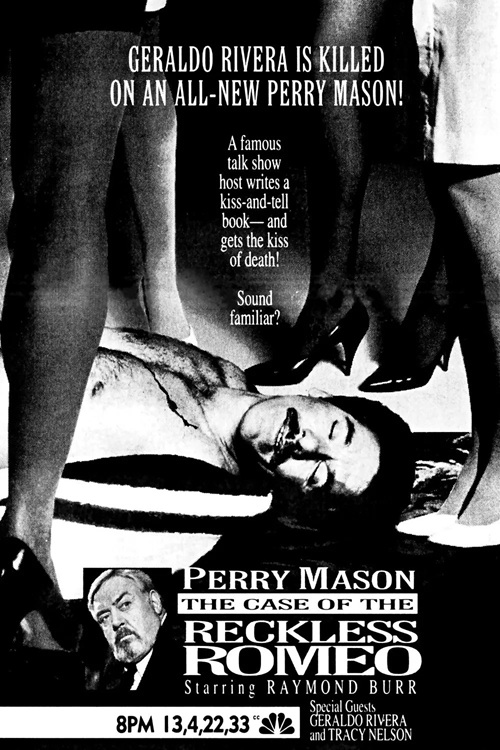
Sleazy talk show host Ted Mayne (Geraldo Rivera) writes a tell-all book about all of the famous women with whom he has had affairs. One of the women, Roxanne Shields (Amy Steel), is filmed threatening to kill him with a knife. When Ted is later found stabbed to death, Roxanne is arrested. Luckily, Perry Mason (Raymond Burr) is willing to take the case and reveal the true killer of the reckless Romeo.
This was one of the last of the Perry Mason movies. (Burr only did four more after this before he died.) The plot is okay, even if this is the third movie to feature Ken (William R. Moses) getting in trouble with the mob while investigating the the murder. It didn’t take me long to guess who the murderer was but the scene where Perry got his courtroom confession was still really well-done. Not surprisingly, the main pleasure of this film was seeing Geraldo Rivera as the victim. Geraldo may have been a terrible actor but he was still totally believable as a sleazy talk show host who went out of his way to embarrass every woman that he had ever had sex with. Geraldo is in the film long enough for you to get sick of him and then he goes away and isn’t seen again. That’s the way it should always be with Geraldo Rivera.
Perry does a few more courtroom tricks than usual in this movie. As the hapless district attorney, Kenneth Kimmins is no David Ogden Stiers. He’s not even Scott Baio. It’s really enjoyable to watch him get continually outsmarted by Perry. Raymond Burr was obviously not doing well physically when he made this movie but it’s still fun to watch him trick witness after witness into identifying the wrong woman.
The 1982 film Missing takes place in Chile, shortly after the American-backed military coup that took out that country’s democratically elected President, Salvador Allende.
Of course, the film itself never specifically states this. Instead, it opens with a narrator informing us that the story we’re about to see is true but that some names have been changed “to protect the innocent and the film.” The film takes place in an unnamed in South America, where the military has just taken over the government. Curfew is enforced by soldiers and the sound of gunfire is continually heard in the distance. Throughout the film, dead bodies pile up in the streets. Prisoners are held in the National Stadium, where they are tortured and eventually executed. Women wearing pants are pulled out of crowds and told that, from now on, women will wear skirts. The sky is full of helicopters and, when an earthquake hits, guests in a posh hotel are fired upon when they try to leave. About the only people who seem to be happy about the coup is the collection of brash CIA agents and military men who randomly pop up throughout the film.
Again, the location is never specifically identified as Chile. In fact, except for the picture of Richard Nixon hanging in the American embassy, the film never goes out of its way to point out that the film itself is taking place in the early 70s. If you know history, of course, it’s obviously meant to be Chile after Allende but the film itself is set up to suggest that the story its telling is not limited to one specific place or time.
Charlie Horman (John Shea) is an American who lives in the country with his wife, Beth (Sissy Spacek). Charlie is a writer who occasionally publishes articles in a local left-wing newspaper. In the aftermath of the coup, Charlie is one of the many people who go missing. All that’s known is that he was apparently arrested and then he vanished into the system. The authorities and the American ambassador insist that Charlie probably just got lost in the confusion of the coup and that he’ll turn up any day. Even though thousands have been executed, everyone assumes that Charlie’s status as an American would have kept him safe. As brutal as the new government may be, they surely wouldn’t execute an American….
Or, at least, that’s what Ed Horman (Jack Lemmon) believes. Ed is Charlie’s father, a businessman from New York who simply cannot understand what’s going on. He can’t understand why his son and his daughter-in-law went to South America in the first place. He can’t understand why his government is not doing more to find his son. And, when he eventually arrives in South America himself, Ed cannot understand the violence that he sees all around him.
Working with Beth, Ed investigates what happened to his son. At first, Ed blames Beth for Charlie’s disappearance and Beth can barely hide her annoyance with her conservative father-in-law. But, as their search progresses, Beth and Ed come to understand each other. Beth starts to see that, in his way, Ed is just as determined an idealist as Charlie. And Ed learns that Charlie and Beth had good reason to distrust the American government…
Costa-Gavras is not exactly a subtle director and it would be an understatement to say that Missing is a heavy-handed film. The Embassy staff is so villainous that you’re shocked they don’t all have mustaches to twirl while considering their evil plans. When, in a flashback, Charlie meets a shady American, it’s not enough for the man to be a CIA agent. Instead, he has to be a CIA agent from Texas who heartily laughs after everything he says and who brags on himself in the thickest accent imaginable. When Charlie talks to an American military officer, it’s not enough that the officer is happy about the coup. Instead, he has to start talking about how JFK sold everyone out during the Bay of Pigs.
As the same time, the film’s lack of subtlety also leads to its best moments. When Beth finds herself out after curfew, the city turns into a Hellish landscape of burning books and dead bodies. As Beth huddles in a corner, she watches as a magnificent white horse runs down a dark street, followed by a group of gun-toting soldiers in a jeep. When Ed and Beth explore a morgue, they walk through several rooms of the “identified” dead before they find themselves in a room containing the thousands of unidentified dead. It’s overwhelming and heavy-handed but it’s also crudely effective. While the film itself is a bit too heavy-handed to really be successful, those scenes do capture the horror of living under an authoritarian regime.
(Interestingly, Missing was a part of a mini-genre of films about Americans trapped in right-wing South American dictatorships. While you can’t deny the good intentions of these films, it’s hard not to notice the lack of films about life in Chavez’s Venezuela or the political dissidents who were lobotomized in Castro’s Cuba.)
Missing won the Palme d’Or at the 1982 Cannes Film Festival (an award that it shared, that year, with the Turkish film Yol) and it also received an Oscar nomination for best picture of the year. (It lost to Gandhi.)

 Through the Shattered Lens