Horror on the Lens: The Cabinet of Dr. Caligari (dir by Robert Wiene)


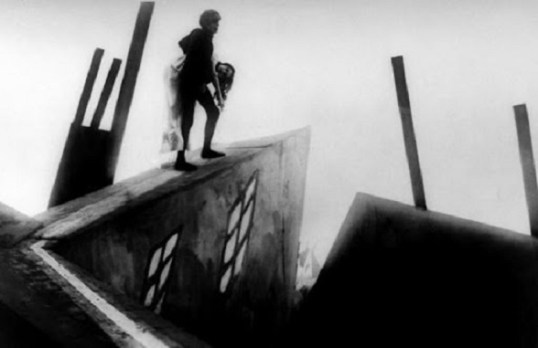
The Cabinet of Dr. Caligari (1920, dir by Robert Wiene, DP: Willy Hameister)

The Cabinet of Dr. Caligari is a film that I’ve shared many times previously on the Shattered Lens.  The first time was in 2011 and then I shared it again in 2014, 2015, 2016, 2017, 2018, 2019, 2020, 2021, and 2022!  Well, you know what?  I’m sharing it again because it’s a classic, it’s Halloween, and everyone should see it!  (And let’s face it — it’s entirely possible that some of the people reading this post right now didn’t even know this site existed in any of those previous years.  Why should they be deprived of Caligari just because they only now arrived?)

Released in 1920, the German film The Cabinet of Dr. Caligari is one of those films that we’ve all heard about but far too few of us have actually seen.  Like most silent films, it requires some patience and a willingess to adapt to the narrative convictions of an earlier time.  However, for those of us who love horror cinema, The Cabinet of Dr. Caligari remains required viewing.  Not only did it introduce the concept of the twist ending (M. Night Shyamalan owes his career to this film) but it also helped to introduce German expressionism to the cinematic world.

My initial reaction to The Cabinet of Dr. Caligari was that it simply wasn’t that scary.  It was certainly interesting to watch and I was happy that I was finally experiencing this film that I had previously only read about.  However, the film itself was obviously primitive and it was difficult for my mind (which takes CGI for granted) to adjust to watching a silent film.  I didn’t regret watching the film but I’d be lying (much like a first-year film student) if I said that I truly appreciated it after my first viewing.

But you know what?  Despite my dismissive initial reaction, the film stayed with me.  Whereas most modern films fade from the memory about 30 minutes after the end credits,The Cabinet of Dr. Caligari has stuck with me and the night after I watched it, I even had a nightmare in which Dr. Caligari was trying to break into my apartment.  Yes, Dr. Caligari looked a little bit silly staring through my bedroom window but it still caused me to wake up with my heart about to explode out of my chest.

In short, The Cabinet of Dr. Caligari passes the most important test that a horror film can pass.  It sticks with you even after it’s over.

For the curious with an open mind to watch with, here is Robert Wiene’s The Cabinet of Dr. Caligari!

Enjoy!

Film Review: Hitler — Beast of Berlin (dir by Sam Newfield)


1939’s Hitler — Beast of Berlin opens with a shot of Nazi stormtroopers marching down a Berlin street.  As they pass, every civilian stands and gives them the stiff-armed Nazi salute.  A couple sitting in a park does it.  A woman pushing a baby carriage does it.  A group of children do it.

Despite outward appearances, not everyone in Berlin is a supporter of Hitler or the Nazis.  Hans Memling (Roland Drew) is an intellectual and a veteran of World War I.  He knows that Germany’s economic policies are, in fact, making the country weaker.  He knows that Hitler is determined to provoke a war that Germany cannot win.  Prophetically, Hans speaks of the risk of German citizens being forced to fight in a war that is only being fought on behalf of Hitler’s ego.  He warns that Berlin and Germany will be destroyed if Hitler is not stopped.

Along with a group of other dissidents, Hans prints an underground newspaper, one that presents the truth about what is happening in Germany.  Working with him, among others, is his brother-in-law, Karl (Alan Ladd, in an early role) and a priest named Father Pommer (Frederick Giermann).  Their contact in the Gestapo is Alfred Stahlhelm (played by Hans Heinrich von Twardowski, a German actor who escaped Germany when Hitler came to power).  Stahlhelm is an alcoholic who fears that he will accidentally slip up when he’s drunk.  As he explains it, a member of the Gestapo is expected to drink and visit brothels when he is off-duty.  If he doesn’t, he will be immediately suspected of insubordination.

When the Gestapo does come for Hans’s operation, Hans finds himself separated from his wife (Steffi Duna) and imprisoned.  The only thing that keeps Hans alive is that the camp commandant is an old friend from World War I.  Hans can only watch as his allies are either executed or forced, after torture, to declare their loyalty to Hitler.  When Hans is finally given an opportunity to escape, he must decide whether to flee to Switzerland or to remain in Germany and continue to fight the Nazi regime.

The most interesting thing about this film is that it was made in 1939 and released into theaters a month after Germany invaded Poland.  The film was released at a time when America was still officially neutral and when isolationism was still a popular policy.  It was released at a time when many Americans were still dealing with the trauma of World War I and, as such, felt that Europe should be left alone to deal with its conflicts on its own.  As such, the film struggled with both the enforcers of the Motion Picture Production Code but also with local censors who felt that the film might offend the German communities within their towns.  James G. Stahlman, editor of the Nashville Banner, was moved to write an editorial calling for the film to be banned because it might inspire audiences to want to go to war with Germany.  Despite all that, Hitler — Beast of Berlin did well at the box office, though many theater owners chose to advertise it as being titled either Beast of Berlin or The Goose Steppers.

Seen today, parts of the film seem naive.  Despite the film being fervently and unapologetically anti-Nazi, it is still obviously a film made at a time when the full depravity of the Nazi regime had not yet been revealed.  The scenes in the concentration camp feel as if they could have been lifted from any 1930s prison film and they certainly come nowhere close to depicting what we now know was actually happening.  Indeed, the film barely acknowledges the anti-Semitism that lay at the heart of Nazi ideology.  But the film does do a good job of portraying life in a society where no one can be trusted and where simply saying the wrong word can lead to prison, torture, and even worse.  The film captures the fear and paranoia of living under a dictatorship and certainly, it deserves credit for calling out the Nazis and their leaders by name.  At a time when many people were living in denial about what was happening in Europe, this film took a clear and firm stand.  In 1939, the film may have been called “propaganda” but today, it feels like prophecy.  Everything that Hans predicts in this film would come to pass in reality.  The film was a warning that was heeded too late.