Happy Halloween From the Shattered Lens!
Tag Archives: Halloween
6 Trailers For Halloween, Part 1
With Halloween rapidly approaching, it’s time for another 3-part edition of Lisa Marie’s Favorite Grindhouse and Exploitation Film Trailers! Today, we start things off by revisiting 6 trailers from a very familiar franchise.
1) Halloween (1978)
2) Halloween 2 (1981)
3) Halloween 3: Season of the Witch (1982)
4) Halloween 4 (1988)
5) Halloween 5 (1989)
6) Halloween 6 (1995)
What do you think, Trailer Kitty?

Horror Music
I suppose if I asked most people what music they identified with horror, John Carpenter’s “Halloween Theme” and Mike Oldfield’s “Tubular Bells” (The Exorcist) would come up first. After that, you’d get a lot of Rob Zombie and Glenn Danzig. So right off the bat, you’re looking at an enormous variety of sounds and styles connected mainly by association. While John Carpenter’s work was intentionally composed for the film in which it appeared, “Tubular Bells” was originally a 50 minute progressive rock opus that was anything but sinister or foreboding in its full form. Misfits was a goth punk band that happened to favor horror themes. White Zombie’s horror imagery was more a matter of crudeness and vulgarity in the spirit of GWAR; their sound was a frontrunner in the emergence of industrial groove metal, and the greatest “horror” associated with Rob was the countless terrible nu metal spinoffs. A couple of “top ten horror songs” lists I stumbled upon even list Bobby Boris Pickett’s “Monster Mash” and Richard O’Brien’s “Time Warp”. I mean, “Monster Mash” is a fun Halloween song, sure, but horror? Really? And the Rocky Horror Picture Show does make me want to vomit, but we have to draw the line somewhere.
Suffice to say, “horror” music is not a genre at all. Simply associating a song with a scene or theme is enough to relate them; Huey Lewis and the News will probably make me smile and think of Christian Bale chopping people to bits in his apartment for the rest of my life. But there are definitely certain musical attributes that conjure in us a less glitzy feeling of dread than Hellbilly Deluxe. That skittering cockroach beat in the background of Halloween is completely unnerving; Carnival music is way creepier than Stephen King’s It; Black Sabbath’s appreciation for diabolus in musica virtually invented heavy metal; and it took a firm dose of the blues in 1988 for Danzig to capture a sense of the sinister that Misfits could never convey.
I don’t believe that any particular musical formula is the coalescence of evil. The music we find most haunting is derived from association too, but it connects in more subtle ways than say, the fact that a particular song appears in a horror film or mentions witches in the chorus. The real deal distorts what comforts us, denies our sense of order, and pries upon our innocence. Through a musical medium as through any other, horror focuses on shattering the lens through which we perceive reality as an ordered, logical construct. It reminds us of the real nightmares in life while nullifying our means to counteract them. It takes us to the world of the child, where emotional extremes enhance our senses of comfort and terror alike.
The carnival tune and music box are prime targets, conjuring in our minds a time when fear was more potent. The brief piano loop, the simple hum, the monotone drone–these bring us to solitude and isolation through minimalism. Effective horror themes offer no comforting symphony or rock ensemble to encase us in a nuanced world. They surround us with something singular and far from warm, or with nothing at all. The wind chimes warn of a storm; when none is coming, the darkness is all the more unnatural. The cathedral bell, a sign of fellowship on a Sunday morning, also tolls for death. A twitch, a buzz, a repeated knocking, a bit of static–things that would otherwise annoy us–exploit the close connection between discomfort and tension.
Or else we can completely overwhelm the senses with noise that strips away the familiarity which typically diminishes extreme music’s effect, leaving us a nervous wreck. When Blut Aus Nord chose to employ programmed, industrial blast beats in their 777 trilogy, they effectively eliminated the one element of the music that would have sounded too familiar to disturb. Instead, the epileptic guitar finds companionship in a persistent, unnatural clatter designed to place us permanently on edge.
Other bands have found other means to the same end. Peste Noire’s unique “black ‘n’ roll” sound enlivens a standard formula for “evil” music with a pep and a grin, giving the brutalizer a human face in the spirit of medieval sadism. Sunn O))) are inclined to drone on for ages, developing a false sense of comfort before infusing their deep buzz with a caterwaul of shrill pitches and clattering chimes. (I actually had a guy start freaking out on me at work one day when “Cry For The Weeper”, which he didn’t even notice playing, hit the 3:55 mark.)
And lastly, we can’t forget the power of lyrics to render a song gruesome. The stereotypical lines of a black metal song–nonsense about necromoonyetis and an appeal to Satanism far less disturbing than the average Christian commentator on Fox News–are pure cheese, and they entertain us in a manner similar to your typical zombie flick. But when you first heard Smashing Pumpkin’s “x.y.u.”, you probably got a feeling more akin to Henry: Portrait of a Serial Killer.
Horror in lyrics is something a bit the opposite of horror in sound; it strikes us most deeply when we can be convinced that there is absolutely nothing supernatural about it. There are certainly a few exceptions–Townes Van Zandt’s tall tale in “Our Mother the Mountain” chills me to the bone–but generally speaking, the real atrocities committed throughout human history far exceed the limits of our imaginations. Vlad Tepes was worse than any vampire, and from Elizabeth Bathory and Ariel Castro to Hernando Cortes and Adolf Hitler, we are flooded by examples of direct personal cruelty and dehumanized mass slaughter. When a song manages to make us think of these individuals and events beyond the safety blanket of historical narrative, an authentic feeling or horror is hard to deny.
October Music Series: Nokturnal Mortum – Lastivka
And so my month of folk and folk/pagan/black metal indulgence comes to an end. Of course they’re the styles I listen to the most throughout the year, but October always holds a somewhat special status for the genres. It marks the height of fall and the coming of winter, the commencement of the six months of the year I enjoy most, and also the start of the holiday season. Halloween is something of the anti-holiday–an all-encompassing celebration of everything that is not modern Christian/Muslim/Jewish culture. It’s that one break in year-round social norms where people can dress and act in ways that, despite representing the human experience for the vast majority of our species’ existence, are strictly taboo in the today’s world. Sure, plenty of pagan practices may have lurked their way into Christmas and Easter. Sure Thanksgiving, despite its name, remains a fairly uncompromised belated harvest festival. But on Halloween we sugar-coat nothing but the candy, sending our children down the streets as ghouls and ghosts and all sorts of counter-cultural guises, embracing primal human nature with no need for repentance. It might be highly consumer-centric, but a little unrestrained gluttony seems thoroughly appropriate for the occasion. From death and the old gods to vampires and zombies, everything falling beyond the accepted sphere of modern religion has its day on October 31st.
Lastivka, alternatively titled Swallow, is a rather ridiculous rendition of what I gather is a traditional Ukrainian folk song. It first appears on Nokturnal Mortum’s Marble Moon ep, released in 1997. Enjoy.
Happy Halloween Shattered Lens.
The Legend of Sleepy Hollow
Another October here at Through the Shattered Lens is coming to a close and I must say that everyone’s participation in this month’s horror/Halloween themed month has been an unqualified success. Here’s to waiting another year til we visit that most scary, terrifying, horrifying and darkly mysterious month of the year.
What better way to close off the month than sharing one of my favorite childhood Halloween rituals. Every Halloween during the 1980’s I would eagerly wait for the showing of Disney’s The Legend of Sleepy Hollow. Trick or treating wasn’t my thing at that age though I did do my share of dressing up and going door-to-door for sweets and snacks, but it was watching this classic Disney short film that made my Halloween.
I don’t know why I kept watching this year in and year out since after each session I would be scared out of my wits and could barely sleep a wink. This coming from a young lad who was already into watching slasher films and zombie gorefests. I think the genius of the film comes from how innocent the film is when it first begins but gradually shows it’s darker side until we get to the climactic appearance of the Headless Horseman himself. I wouldn’t be surprised if this film scarred for life some kids who saw it the first time. For a Disney film that was produced in 1949 it definitely had a high-level of scare when put in the context that it was advertised as a kid’s film.
If this film had been produced in this day and age I don’t think it would’ve made it out of the ratings board with a G-rating. They definitely don’t make animated films like this nowadays and that is a shame.
So, until next October sit down, relax and watch one of the things that helped shaped this site.
Happy Halloween From The Shattered Lens!!!
Happy Halloween to all of the readers and the visitors and the writers of The Shattered Lens!
October Music Series: Townes Van Zandt
Townes Van Zandt lived a troubled life, characterized by constant alcoholism, drug abuse, and failed relationships. He finally passed away of heart failure in a state of delirium tremens on January 1, 1997, at the age of 52, cryptically 44 years to the day after the death of perhaps his greatest influence, Hank Williams, under similar circumstances. As a song writer his music was inconsistent, but at his finest moments he tapped into his inner demons with an acute awareness that he was living more in dream than reality. He created his own folklore both in life and in song. The latter was quite deliberate, emerging sometimes from scratch and sometimes with attention to older legends. Narrated in the first person, always at night, bridging a gap between sleep and consciousness, he painted strikingly vivid images of personal confrontations with foul spirits and terrifying monsters physically imbued with emotional states which could never take on material form outside of a dream, or a song.
To call Spider Song a metaphor would do it a disservice. Of course it is about overcoming some inner demon, whatever that may be, and yes, through the battle against the spider we gain some insight into Van Zandt’s personal struggles, but that’s trivial. He’s not just beating that old dead horse again. The spider begins “in his dreams”, and at no point does it definitively leave them, yet the song is structured in such a way that Van Zandt’s dreams come to characterize more and more a real, physical monster encountered collectively by the narrator and the audience. What you get is a subtle transition from a nearly explicit metaphor (it’s in his dreams) to, by the end, momentary belief that a real, heroic, pitched battle against a giant spider is about to ensue. You don’t fully forget that the spider originated as a sort of representation of emotional states of fear, depression, or whatever you read into the first few stanzas of the song, but nevertheless here it stands, a menacing physical object. No, this song should not be regarded as a metaphor. Rather, our recognition of metaphor is employed to, over time, trick the senses into visualizing something supernatural.
Our Mother The Mountain is laden with hints at the supernatural from the outset: The woman’s esoteric claim to have come from her mother the mountain, her mysterious medallion, the refrain “singing tu-a-lu-ra-lai-o” with an emphasis on “lu-ra-lai”… “Lorelei”… The music feels like a dream, and the lyrics too, until the narrator stops observing the dream and tries to interact, reaching for her hand. The woman’s response is a manifest nightmare–a completely nonsensical appeal to pure foreboding terror captured in her physical actions. The narrator never sees her again, but he swears that it wasn’t just a dream, and as the listener you can’t help but believe him.
Spider Song
There is a spider in my dreams
Long and silent is his name
Cold as lightning is his smile
Final is his sting
His curse is deep as seven skies
Boys, I wouldn’t tell you lies
The legends say he never sleeps
and he’s never hungry long
He’s got us boys, I believe it’s true
But I’m fighting til he lays me down
Run his foul black body through
Cleave him all asunder
Think of your women, won’t you boys
Think of your mother growing old
Think about your darling son
Spit in the spider’s eye
Up at ease, against him ride
We’ll not take him by surprise
Give a scream down in your dreams
Let him know we’re coming
There is a spider in my dreams
Long and silent is his name
Cold as lightning is his smile
Final is his sting
Our Mother The Mountain
My lover comes to me with a rose on her bosom
The moon’s dancing purple all through her black hair
And her lady’s-in-waiting, she’ll stand ‘neath my window
And the sun will rise soon on the false and the fair
Singing tu-a-lu-ra-lai-o
She tells me she comes from My Mother The Mountain
And her skin fits her tightly, and her lips do not lie
She silently slips from her throat a medallion
Slowly she twirls it in front of my eyes
Singing tu-a-lu-ra-lai-o
I watch her, I love her, and I long for to touch her
The satin she’s wearing is shimmering blue
And outside my window her ladies are sleeping
My dogs are gone hunting; their howling is through
Singing tu-a-lu-ra-lai-o
So I reach for her hand, and her eyes turn to poison
And her hair turns to splinters, and her flesh turns to brine
She leaps ‘cross the room. She stands in the window
and screams that my first-born will surely be blind.
Singing tu-a-lu-ra-lai-o
Then she throws herself out to the black of the nightfall
She’s parted her lips, but she makes not a sound
I fly down the stairway and I run to the garden
No trace of my true love is there to be found
Singing tu-a-lu-ra-lai-o
So walk these hills lightly, and watch who you’re loving
By Mother The Mountain I swear that it’s true
And love not a woman with hair black as midnight
and a dress made of satin all shimmering blue
Singing tu-a-lu-ra-lai-o
My lover comes to me with a rose on her bosom
The moon’s dancing purple all through her black hair
And her lady’s-in-waiting, she’ll stand ‘neath my window
And the sun will rise soon on the false and the fair
Celebrate Halloween with Ms. 45!
Happy Halloween!
In honor of the holiday, here’s a Halloween-themed clip from one of the greatest films ever made — Ms. 45, the movie that proved that the Grindhouse is often more sincerely pro-woman than the mainstream.
(Big spoiler warning: This scene is actually the end of the film so if you’re the type of little toadsucker that’s always crying “You should have warned me boo hoo,” consider yourself warned.)
Song of the Day: Halloween Theme (by John Carpenter)
The penultimate choice for this week’s horror-themed “Song of the Day” feature brings one of the best theme songs ever composed and put on film. I am talking about the Main Title theme for John Carpenter’s classic horror film (also one of the best grindhouse films ever made) and one which launched a whole new horror subgenre with Halloween. This theme would become synonymous with the “slasher film” that when the many copies and imitators of the film came out in droves a year later they would try to replicate this keyboard synthesizer-based theme and fail miserably.
It’s actually a pretty simple theme. Carpenter composed the theme as a piano melody played in a 5/4 meter that even the most novice piano player could play with ease. This theme could be heard throughout the film whenever Michael Myers appears and/or in the vicinity. Some have even started calling it the Michael Myers theme and they wouldn’t be far off. It’s become the film’s leitmotif that Carpenter ends up relying on it to set the mood and tension in the film. Other kids of songs could be heard throughout the film but outside of the Blue Oyster Cult’s “Don’t Fear the Reaper” the rest of the score is forgettable until this theme kicks in.
This theme will be the final of the instrumental themes for the week. With one more day left in this special week-long horror-themed week for “Song of the Day” the last one will definitely usher in another awesome Halloween and help kick off the premiere of what will probably be the best thing to ever grace the tv screen past, present and future.
The Daily Grindhouse: Halloween (dir. by John Carpenter)
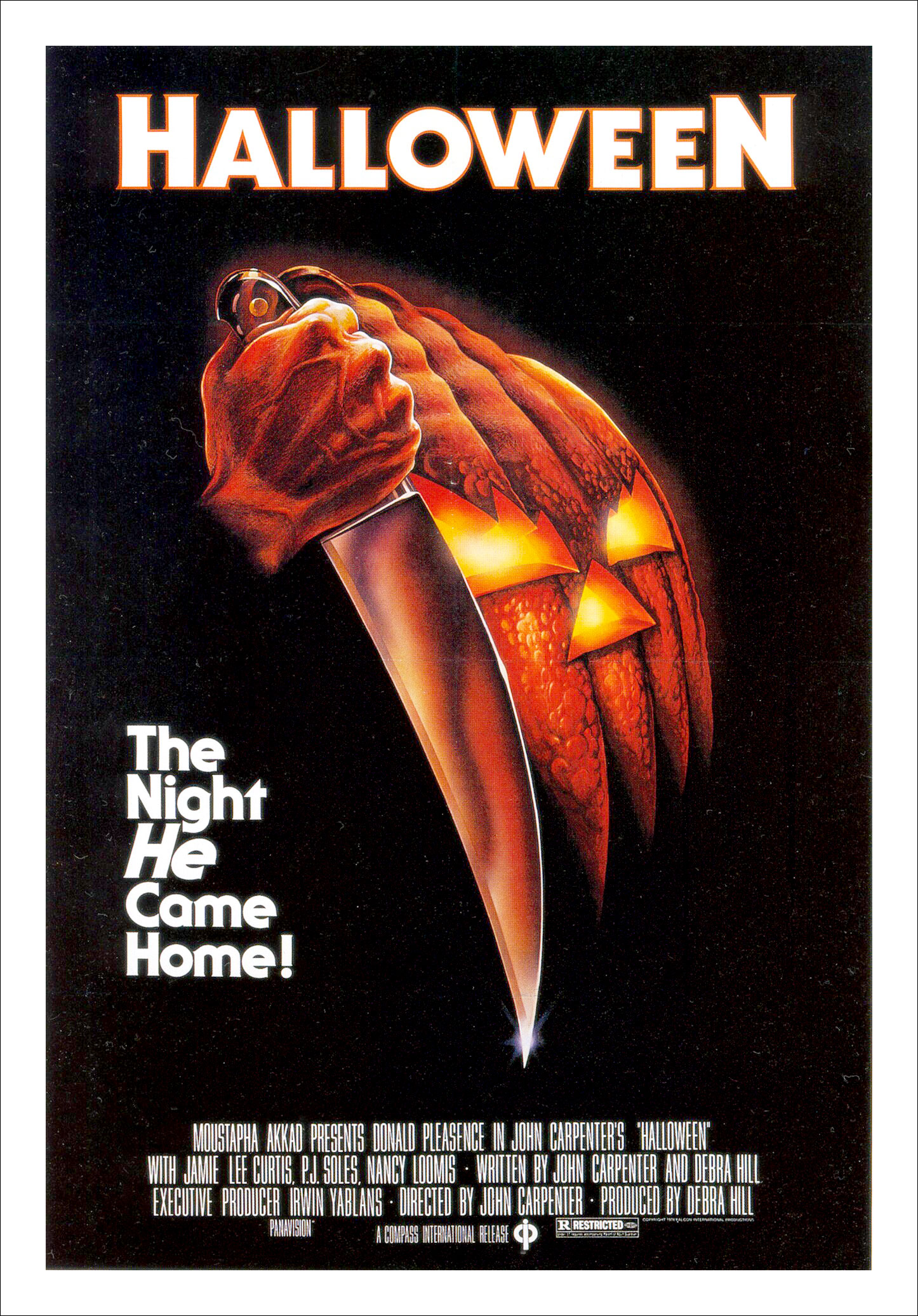
What better way to bring back a new daily grindhouse than the film which started the teen slasher genre. I speak of John Carpenter’s Halloween.
The film was truly a child of 1970’s independent filmmaking. With a budget of just $320,000 (even adjusting for inflation it’s still quite low) Carpenter made what’s considered one of horror’s defining films. Carpenter’s film was a smash hit when it was released in 1978. It played mostly in drive-in’s, grindhouse cinema houses before finally appearing in more mainstream venues. By then the film had become one of those must-see titles that many films both independent and mainstream try for but fail to do.
Some have commented that since Halloween was such a success in the box-office then it shouldn’t be considered grindhouse. I look at such thinking as quite narrow. Grindhouse was never synonymous with bad filmmaking. If one said the term meant cheap filmmaking then I would agree. Carpenter’s film has all the trappings of what makes a great grindhouse. It’s violent (though it really has less blood than what audience really remember) and uses sex as a storytelling tool (again the sex is quite chaste compared to later teen slashers).
While some film historians credit Hitchcock’s Psycho as the granddaddy of the slasher genre it wasn’t primogenitor of the teen slasher subgenre which has become an industry onto itself since Carpenter’s breakthrough hit. A hit that set many of the basic rules of teen slasher horror for decades to come. We get the nigh-unstoppable killer who seems more like a force of nature than human. The notion that teenage girls who have premarital sex will die horribly because of it while the chaste and virginal girl survives and inevitably stops the killer (until the subsequent sequel that is).
Halloween is grindhouse through and through. The fact that Carpenter’s obvious talent and skill as a director, editor, film composer and cinematographer shouldn’t DQ this film from being called grindhouse.
 Through the Shattered Lens