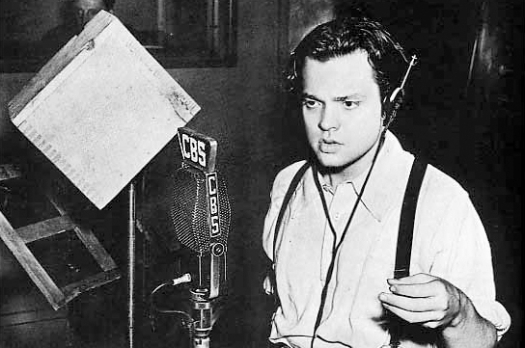
On October 30th, 1938, Orson Welles and the Mercury Theater On The Air broadcast an adaptation of H.G. Wells’s War of the Worlds and, legend has it, they scared the ever-loving heck out of America.
Actually, there’s some debate as to just how panicked America got when they heard the Mercury Theater On The Air’s adaptation of War of the Worlds. There was definitely some panic but there are differing reports on just how wide spread it was. For our purposes, let’s assume that the entire country was terrified at the same time and that everyone was loading up a shotgun and planning to go out and look for aliens. With his adaptation of War of the Worlds, Orson Welles managed to invent the whole found footage genre that would later come to dominate horror cinema in the late 90s and the aughts. Every found footage horror film owes a debt to what Orson Welles accomplished with War of the Worlds. Ultimately, it’s just another example of how far ahead of his time Orson Welles was.
H.G. Wells, the original author of War of the Worlds, and Orson Welles only met once, while they were both in San Antonio, Texas in 1940. (Orson Welles and H.G. Wells hanging out in San Antonio? To be honest, that sounds like it would make a good movie.) They were interviewed for a local radio station. H.G. Wells expressed some skepticism about the reports of Americans panicking while Welles compared the radio broadcast to someone dressing up like a ghost and shouting “Boo!” during Halloween. Both Wells and Welles then encouraged Americans to worry less about Martians and more about the growing threat of Hitler and the war in Europe.
I’ve shared this before but this just seems like the time to share it again. Here, for Halloween Eve, is the 1938 Mercury Theater On The Air production of The War of the Worlds!
On October 30th, 1938, Orson Welles and the Mercury Theater On The Air broadcast an adaptation of H.G. Wells’s War of the Worlds and, legend has it, they scared the ever-loving heck out of America.
Actually, there’s some debate as to just how panicked America got when they heard the Mercury Theater On The Air’s adaptation of War of the Worlds. There was definitely some panic but there are differing reports on just how wide spread it was. For our purposes, let’s assume that the entire country was terrified at the same time and that everyone was loading up a shotgun and planning to go out and look for aliens. One thing is for sure. With his adaptation of War of the Worlds, Orson Welles managed to invent the whole found footage genre that would later come to dominate horror cinema in the late 90s and the aughts. Every found footage horror film owes a debt to what Orson Welles accomplished with War of the Worlds. We won’t hold that against Orson. Instead, it’s just another example of how far ahead of his time Orson Welles was.
H.G. Wells, the original author of War of the Worlds, and Orson Welles only met once, while they were both in San Antonio, Texas in 1940. (Orson Welles and H.G. Wells hanging out in San Antonio? To be honest, that sounds like it would make a good movie.) They were interviewed for a local radio station. H.G. Wells expressed some skepticism about the reports of Americans panicking while Welles compared the radio broadcast to someone dressing up like a ghost and shouting “Boo!” during Halloween. Both Wells and Welles then encouraged Americans to worry less about Martians and more about the growing threat of Hitler and the war in Europe.
I’ve shared this before but this just seems like the time to share it again. Here, for Halloween Eve, is the 1938 Mercury Theater On The Air production of The War of the Worlds!
On October 30th, 1938, Orson Welles and the Mercury Theater On The Air broadcast an adaptation of H.G. Wells’s War of the Worlds and, legend has it, they scared the ever-loving heck out of America.
Actually, there’s some debate as to just how panicked America got when they heard the Mercury Theater On The Air’s adaptation of War of the Worlds. There was definitely some panic but there are differing reports on just how wide spread it was. For our purposes, let’s assume that the entire country was terrified at the same time and that everyone was loading up a shotgun and planning to go out and look for aliens. One thing is for sure. With his adaptation of War of the Worlds, Orson Welles managed to invent the whole found footage genre that would later come to dominate horror cinema in the late 90s and the aughts. Every found footage horror film owes a debt to what Orson Welles accomplished with War of the Worlds. We won’t hold that against Orson. Instead, it’s just another example of how far ahead of his time Orson Welles was.
H.G. Wells, the original author of War of the Worlds, and Orson Welles only met once, while they were both in San Antonio, Texas in 1940. (Orson Welles and H.G. Wells hanging out in San Antonio? To be honest, that sounds like it would make a good movie.) They were interviewed for a local radio station. H.G. Wells expressed some skepticism about the reports of Americans panicking while Welles compared the radio broadcast to someone dressing up like a ghost and shouting “Boo!” during Halloween. Both Wells and Welles then encouraged Americans to worry less about Martians and more about the growing threat of Hitler and the war in Europe.
I’ve shared this before but this just seems like the time to share it again. Here, for Halloween, is the 1938 Mercury Theater On The Air production of The War of the Worlds!
Today is the 156th anniversary of the birth of British author H.G. Wells!
It’s a bit of a tradition around these parts to celebrate H.G. Wells’s birthday with the help of another Welles, in this case Orson. Here is the infamous 1938 radio adaptation of H.G. Wells’s War of the Worlds. This is the program that became famous for terrorizing America. Of course, there’s always been some suggestions that the reports of panic were a bit exaggerated. That’s always possible. Orson Welles was, at heart, a showman and he knew how to tell and embellish a story. That said, it is also known for fact that enough people took the show seriously that the panic made the front page of the New York Times.
The first half of the show is an early example of what would become known as the found footage genre. It was the first mockumentary! The second half features Welles narrating the events after the invasion. During the second half, the news program angle is dropped and it becomes a traditional radio broadcast. One would hope that even panicked listeners would have taken the hint but who knows? They may have been too busy loading up their shotguns and heading outside to search for Martians to have been paying attention at that point.
We are rapidly reaching the halfway mark of our October horrorthon here at the Shattered Lens. By the time we reach the end of the first half at midnight on Saturday, we will have published over 200 posts. During the second half, we’ll publish …. well, let’s not speculate. You never know. The world could end tomorrow and, as a result, we might never post again. What’s important is that I’m proud of what we’ve accomplished so far and I look forward to seeing what we accomplish during the rest of the month!
(That said, I’m hoping for another 250 to 300 or so posts. 500 FOR OCTOBER! It seems like a reasonable go. We’ll see!)
Anyway, today seems like a good time for another edition of Lisa Marie’s Favorite Grindhouse Trailers! And, since today is Jack Arnold’s birthday, it only seems appropriate that today’s edition deals with giant creature features!
Q: The Winged Serpent (1982)
From director Larry Cohen, it’s Q The Winged Serpent! I’ve seen this movie and it’s undeniably entertaining. On the one hand, you’ve got the serpent flying around and looking all dangerous. Then you’ve got David Carradine and Richard Roundtree kind of sleepwalking through their roles. And then, suddenly, Michael Moriarty shows up and gives this brilliant, method-influenced performance. It’s an odd film but it’s hard not to like that Claymation flying serpent.
2. The Giant Spider Invasion (1975)
From Wisconsin’s own Bill Rebane, here’s the trailer for The Giant Spider Invasion! This is probably Rebane’s best film. If you’re trying to frighten your audience, you can’t go wrong with a giant spider.
3. Empire of the Ants (1977)
What’s the only thing scarier than a giant spider? A giant ant, of course! This film is from Bert I. Gordon, a director so obsessed with films about giant monsters that he was actually nicknamed Mr. BIG. (Of course, it also helped that those were his initials.)
4. Food of the Gods (1976)
Speaking of Bert I. Gordon, he was also responsible for this film, Food of the Gods. Like Empire of the Ants, it was based (however loosely) on a novel by H.G. Wells. Two old farmers feed the food of the Gods to the local animals and things do not go well. For some reason, a football player played by Marjoe Gortner decides to investigate. Shouldn’t he be practicing for the big game? Gordon missed an opportunity here by not having a giant-sized Marjoe Gortner.
5. Night of the Lepus (1972)
As frightening as those previous trailers were, can anything prepare you for the terror of killer rabbits!? This movie is proof positive that rabbits look cute no matter who they’re killing.
6. Village of the Giants (1965)
In the end, though, the greatest monster will always be man. By the way, this is another Bert I. Gordon film. Beau Bridges turns into a giant and plots to conquer the world. Only a young Ron Howard can stop him.
I hope you’re having a wonderful October! Never stop watching the shadows!
Since it’s Orson Welles’s birthday and everyone’s kind of nervous about going outside right now, why not experience the live radio broadcast that panicked America in 1938?
Actually, there’s some debate as to just how panicked America got when they heard the Mercury Theater On The Air’s adaptation of War of the Worlds. There was definitely some panic but there are differing reports on just how wide spread it was. For our purposes, let’s assume that the entire country was terrified at the same time and that everyone was loading up a shotgun and planning to go out and look for aliens. One thing is for sure. With his adaptation of War of the Worlds, Orson Welles managed to invent the whole found footage genre that would later come to dominate horror cinema in the late 90s and the aughts. Every Paranormal Activity film owes a debt to what Orson Welles accomplished with War of the Worlds. We won’t hold that against Orson.
H.G. Wells, the original author of War of the Worlds, and Orson Welles only met once. Interestingly enough, they were both in San Antonio, Texas in 1940. They were interviewed for a local radio station. H.G. Wells expressed some skepticism about the reports of Americans panicking while Welles compared the radio broadcast to someone dressing up like a ghost and shouting “Boo!” during Halloween. Both Wells and Welles then encouraged Americans to worry less about Martians and more about the growing threat of Hitler and the war in Europe.
I’ve shared this before but this just seems like the time to share it again. Here is the 1938 Mercury Theater On The Air production of The War of the Worlds!
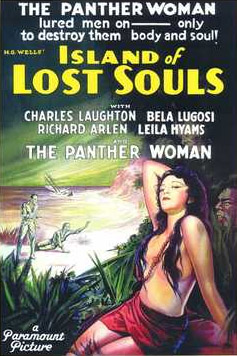
In the 1932 film Island of Lost Souls, Ruth Thomas (Leila Hyams) has reason to be concerned. She’s on the island of Samoa, awaiting the arrival of her fiancée, Edward Parker (Richard Arlen). When Parker’s boat doesn’t show up, it can only mean one thing. He’s been shipwrecked! Did he survive or was he lost at sea?
Well, Ruth need not worry. Parker did survive being shipwrecked. He was picked up by a freighter carrying a wide selection of animals to an isolated island. Unfortunately, when Parker complained about the way that Parker was abusing some of his admittedly odd-looking passengers, the captain responded by dumping Parker on that island as well.
On the island, Parker becomes the guest of Dr. Moreau (Charles Laughton) and his assistant, Montgomery (Arthur Hohl). Parker also meets and finds himself becoming attractive to the seemingly naive Lota (Kathleen Burke). Though Moreau seems to be a good host, Parker grows suspicious of him. It turns out that there’s a room in Moreau’s compound, a room that Lota calls “the house of pain.” At night, Parker can hear horrifying screams coming from the room.
Initially believing the Moreau is torturing the island’s natives, Parker soon discovers an even more disturbing truth. Moreau has been experimenting with trying to transform animals into humans. Lota, it turns out, was once a panther and the woods surrounding the compound are full of other Moreau creations. Though Moreau claims that his intentions are benevolent, he rules his island like a dictator. The animal-men are kept in line by the Sayer of the Law (Bela Lugosi) and any transgressions are punished in the House of Pain…
The Island of Lost Souls was the first cinematic adaptation of H.G. Wells’s The Island of Dr. Moreau. (Perhaps the most famous adaptation came out in 1996 and is the subject of Lost Souls, a fascinating documentary that, I believe, can still be found on Netflix.) I watched it last night on TCM and I have to admit that I had a mixed reaction to it. On the one hand, the film’s atmosphere of mystery and danger is palpable and Charles Laughton’s performance definitely set a standard for all misguided scientists to follow. The human-animals are fantastic creations and the film’s ending still has some power. Bela Lugosi’s performance of the Sayer of the Law was superior to his work as Dracula. (As shown by both this film and Ninotchka, Lugosi was an outstanding character actor.) Kathleen Burke also does a great job as Lota, which makes it all the more interesting that she was apparently cast as a result of winning a contest that was sponsored by Paramount Pictures.
(On a personal note, I always find it amusing that pre-code films always feature at least one scene of an actress removing her stockings, even if the scene itself has next to nothing to do with the rest of the film. In this case, the legs belong to Leila Hyams.)
On the negative side, Richard Arlen is not a particularly interesting hero and, from a contemporary point of view, Island of Lost Souls is a rather slow-moving film. Watching it today requires modern audiences to make a bit of an adjustment to their expectations.
With all that in mind, I still recommend Island of Lost Souls. Watch it for Charles Laughton and Bela Lugosi. Watch it as a valuable piece of cinematic history.
The 1933 Universal horror film, The Invisible Man, never seems to get as much attention as Frankenstein, Dracula,The Wolf Man, or The Mummy. Perhaps it’s because the invisible man really isn’t a supernatural monster. He’s just a scientist who has turned himself invisible and is now going mad as a result. Or maybe it’s because there have been so many crappy films that have used invisibility as a plot point that the reputation of the original Invisible Man suffers by association.
For whatever reason, The Invisible Man never seems to get spoken about in the same breathless, gleeful manner as some of the other Universal monsters. But I have to admit that, though I usually can’t stand movies about invisibility, I rather like The Invisible Man.
Based on a novel by H.G. Wells, The Invisible Man opens with a mysterious man (played by Claude Rains) arriving in a small English village. He checks into a small inn and soon, everyone in the village is scared of him. It’s not just his haughty attitude or his habit of ranting about his own superiority. There’s also the fact that he is literally covered, from head to toe, in bandages. He always wears gloves and dark glasses. He insists that he’s doing important research and demands to be left alone.
The inn keeper (Forrester Harvey) and his histrionic wife (Una O’Connor) put up with the mysterious man until he falls behind on his rent. However, once confronted, the mysterious man announces that he’s not going anywhere. When the police and a mob of villagers arrives, the man starts to laugh like a maniac. He unwraps the bandages around his head and…
THERE’S NOTHING UNDERNEATH!
Well, there is something there. It’s just that the man is invisible so no one can see what’s underneath. It turns out that the man is Dr. Jack Griffin, a chemist who has been missing for several days. He’s created an invisibility serum but he can’t figure out how to reverse the effects. Even worse, the serum is driving him insane. Griffin’s fiancée, Flora (Gloria Stuart), and her father, Dr. Cranley (Henry Travers), are searching for Jack but Jack doesn’t particularly want to be found. Jack is more interested in exploring how he might be able to use invisibility to conquer the world…
The Invisible Man is historically important because it was the film that brought Claude Rains to Hollywood. Rains has previously made films in the UK but this was his first American film. Think of how different film history would have turned out if The Invisible Man had, as originally planned, starred Boris Karloff. Without Claude Rains coming to America, who would have played Louis in Casablanca? Who would have played Sen. Paine in Mr. Smith Goes To Washington or Alex Sebastian in Notorious? Of course, we don’t really see Claude Rains’s face until the very end of The Invisible Man. Instead, we just hear his voice but what a voice Claude had! He delivers his dialogue with just the right amount of malicious sarcasm.
I like The Invisible Man. For modern audiences, it’s not particularly scary. (Though I do find the idea of being unknowingly followed by an invisible person to be a little unnerving…) However, unlike a lot of other old horror films, you can watch The Invisible Man and see why it would have been scary to an audience seeing it for the very first time. In 1933, a time when film was still a relatively new medium and audiences had yet to become jaded by special effects, here was a man unwrapping his bandages to reveal that there was nothing underneath! That had to have freaked people out!
The Invisible Man was directed by James Whale and the film features the same demented sense of humor that distinguished The Bride of Frankenstein. The villagers are portrayed as being so hysterical that you can’t help but think that maybe Griffin has a point about being surrounded by fools. By the time the local constable declares, “What’s all this then?,” you can’t help but start to sympathize with Jack Griffin.
There’s been a lot of bad invisibility movies made but The Invisible Man is not one of them. It may not be as well remembered as some of the other Universal horrors but it’s definitely one worth seeing.
This weekend, I’m busy getting ready to go on a road trip with Jeff. I’ll be away from home for two whole weeks! However, fear not! With the help of WordPress and my wonderful, beautiful older sister Erin, I will still be updating and posting even while we’re on the road. I might even be able to convince my fellow Shattered Lens writer to spend the next two weeks watching the Lifetime Movie Channel and posting “What Lisa Would Have Watched Last Night.” How about it, guys? *wink wink*
(And by the way, just because I’m going to be out of town next weekend won’t stop me from posting six more trailers next Saturday. Why? Because I love you, silly!)
In this infamous little film from the 1970s, Richard Burton, Lee Marvin, and O.J. Simpson fight the Ku Klux Klan in Alabama. Believe it or not, I’ve actually seen this movie though the copy I saw was one of those public domain DVDs that I think was actually a copy of the edited-for-TV version of this movie. (I say that because every time someone cursed, there was an awkward silence on the soundtrack.) Even more odd is the fact that I’ve actually read the old novel that this movie is based on. Anyway, this movie is pretty bad but the book is okay. The film was directed by the same guy who directed the first James Bond films.
Okay, so this is pretty obviously an Exorcist rip-off but wow, this trailer freaks me out. Needless to say this is an Italian film. My favorite part of the trailer, to be honest, is the use of the Ryder truck. It’s a moment that epitomizes Italian exploitation in that you can tell that the filmmakers really thought that displaying the one word — “Ryder” — would convince viewers that they were watching an American-made film.
Speaking of Italian exploitation cinema, here we have another example. I pretty much had to include this trailer because I live in Dallas and 2020 is just 9 years away. That said, I’m not sure what part of Texas this film is supposed to be taking place in. I’m guessing by all the shots of boots marching through grass that this is supposed to be up in North Texas but if you can find mountains like that around here then you’ve got far better eyesight than I do. Add to that, the sudden indian attack seems more like an Oklahoma thing. Not surprisingly, according to Amazon, this film was not only directed by Joe D’Amato but features both George Eastman and Al Cliver.
Apparently, it didn’t start in Texas. This is also an Italian film. It was directed by Enzo Castellari and, not surprisingly, George Eastman is in this one as well.
The is the trailer that dares to ask — who are you going to listen to? Common sense or H.G. Wells? I’ll tell you, nothing freaks me out more than when I see one of those ant lines carrying a dead cricket back to the anthill. Ants are one thing that I will not allow in the house. However, I kinda admire them. They’re so neat and organized. Plus, males in ant society know their place.
“20th Century Fox presents Mr. Billion …. starring Terence Hill, the 5th biggest star in the world…” I haven’t seen very many Terence Hill films but I always enjoy seeing him in trailers. I can’t really say whether he’s a good actor or not because every time I’ve seen him, he’s been dubbed. But he definitely had a very likable presence. You wanted him to be a good actor whether he was or wasn’t. That said, even if I had been alive at the height of Mr. Hill’s fame, it never would have worked out for us as I’m Southern Italian and Hill is quite clearly from the north. That’s just the way it is. Anyway, back to Mr. Billion — I’m including two trailers for this one. The first is the “Prestige” trailer. The second one is much shorter and features one of those odd little songs that gets stuck in your head.



 Through the Shattered Lens