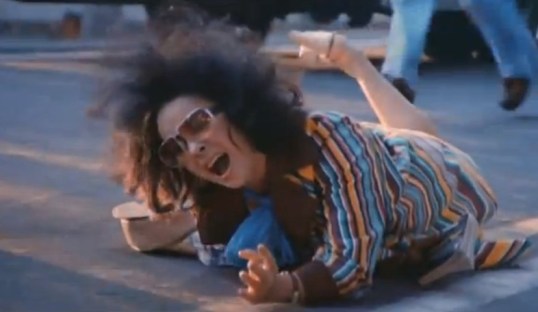
The TSL Grindhouse: Caligula: The Ultimate Cut (dir by Tinto Brass)


How many cuts do we need of a bad movie?

Caligula is a film with a long and storied history.  In the mid-1970s, Penthouse publisher Bob Guccione wanted to follow the lead of his rival, Hugh Hefner, and get into the movie business.  His plan was to make an explicit adult film with high production values, one that could be sold as a mainstream feature film.  He decided that the infamously decadent Roman Emperor Caligula would be the subject of his film.  In order to give the project some gravitas, he accepted scripts from both Lina Wertmuller and Gore Vidal.  Ultimately, he chose to go with Vidal’s script because Vidal’s name had more cultural cachet than Wertmuller’s.  It certainly wasn’t because he liked Vidal’s script, which Vidal later said featured a lot of gay sex but only one scene of heterosexual coupling.

With the promise that Caligula would be a classy production that would push the boundaries of cinematic sex without actually being pornographic, Guccione was able to bring together a truly impressive cast of actors.  Malcolm McDowell agreed to play Caligula.  Helen Mirren was cast as Caligula’s wife, Caesonia.  John Gielgud took on the role of Nerva the philosopher while Peter O’Toole was cast as the diseased Emperor Tiberius.  Guccione offered directing duties to John Huston and Lina Wertmuller.  In the end, no matter how much money he was willing to spend or how distinguished a cast he had assembled, Guccione could not find a prominent, mainstream director who was willing to work with him.  Guccione ended up hiring a director he knew little about, an Italian arthouse filmmaker named Tinto Brass.

Brass proceeded to rewrite Vidal’s script.  Brass’s version of the film featured more sex and less politics.  Guccione was happy about that until he discovered that Brass’s plan was to direct the sex scenes to be grotesque and disturbing.  To his horror, Guccione discovered that Brass was essentially parodying the type of film that Guccione wanted him to direct.  Even when Guccione insisted that the latest “Penthouse pets” be cast in the film, Brass tried to keep them in the background.  As Guccione’s demands grew, Brass responded by refusing to emphasize the ornate and very expensive sets that Guccione had paid to have created.  A working ship was built but Brass reportedly chose to put it in a small warehouse so that there would never be room to get a full shot of it.  Guccione responded by taking the film away in post-production and inserting several hardcore sex scenes, which upset the members of the cast who did not sign on to appear in a pornographic film.

As for the film itself, it must be said that Caligula is probably one of the most historically accurate portrayals of ancient Rome.  The city was said to be a mix of dirty streets and ornate palaces and Caligula certainly captured the mix of beauty and sordid decadence that was the Roman Empire.  The film’s plot actually sticks very closely to what was written about Caligula by Roman historians like Suetonius.  Helen Mirren and Malcolm McDowell both give strong performances, even if McDowell later claimed the film ruined his career by typecasting him as a perverse villain.  Peter O’Toole is memorably grotesque as Tiberius.  Exploitation vets John Steiner and Teresa Ann Savoy also make an impression in their roles and one gets the feeling that they both understood what type of film they were appearing in, even if the bigger names in the cast did not.  There are moments of shocking grandeur and visual beauty to be found in Caligula and also moments of such total ugliness that they are difficult to watch.  In many ways, Caligula is what Guccione wanted.  It’s a big, expensive film that tests boundaries and features explicit sex.

But, Good God, is it ever boring!  Seriously, the scene where Caligula visits Tiberius in Capri goes on forever.  Despite McDowell’s strong performance, Caligula is not a particularly compelling character.  He becomes emperor and then he goes mad.  For over two hours, Caligula does one terrible thing after another and there’s only so long that you can watch it before you just want someone to hurry up and kill him.  The film suggests that Caligula was rebelling against the Roman establishment but, in the end, who cares?  He kills his friends.  He has sex with his sister.  In the film’s most disturbing scene, he rapes a bride and then fists the groom.  It just goes on and on and it gets old pretty quickly.

Still, there’s always been a lot of debate over whether or not it would be possible to make Caligula into a good film.  Bob Guccione claimed that he saved the film.  Tinto Brass disagreed and his director’s cut, which takes out Guccione’s hardcore inserts, is considerably better-paced than the Guccione version but the nonstop ugliness still gets rather boring.

That brings us to the latest version of Caligula, the Ultimate Cut.  Assembled without the input of Tinto Brass or the deceased Bob Guccione, Caligula: The Ultimate Cut played at Cannes in 2023 and was given a limited release by Drafthouse Films in 2024.  It was largely assembled out of unused footage and alternate takes.  I’ve read that not a single fame from the original version of Caligula is in The Ultimate Cut but I don’t think that’s quite true.  (The scene with the giant beheading machine appears to be the same footage that appeared in the original version.)  Caligula: The Ultimate Cut removes all of Guccione’s hardcore footage but it also downplays a lot of Brass’s directorial flourishes as well.  Instead, The Ultimate Cut is said to much more closely follow Gore Vidal’s vision of the film.

Is the Ultimate Cut any good?  It definitely looks better than the previous version of Caligula.  The restoration makes Rome into a very colorful city.  There’s a bit more humor to McDowell’s performance in the Ultimate Cut.  While his version of Caligula still becomes a monster (and the wedding rape is still included in the film), he starts out as a clown whose mission is to humiliate the Roman establishment in much the same way that Tiberius used to humiliate him.  In The Ultimate Cut, Caligula is much more of an anarchist.  At the same time, the Ultimate Cut features a bit less of John Steiner as the duplicitous Longinus and that’s a shame because Steiner’s performance was one of the best in the original version.  As well, Helen Mirren’s performance is stronger in the original version than in The Ultimate Cut.  The alternate takes that were used in The Ultimate Cut often seem to favor McDowell over Mirren.

That said, The Ultimate Cut is still a bit of an endurance test.  Caligula’s meeting with Tiberius still goes on forever and the nonstop evil of his reign still gets a bit dull after a while.  It turns out that Caligula the Anarchist is no more compelling than Caligula the Madman.  Brass and even Guccione may have had a point with the original version of CaligulaCaligula is a film that requires a truly sordid and shameless sensibility to be interesting.

In the end, it’s hard not to feel that all of this could have been avoided if Gemellus had been named emperor.
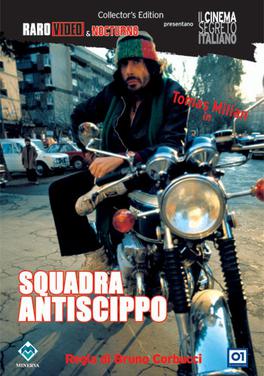
The Cop in Blue Jeans (1976, directed by Bruno Corbucci)


Nico Giraldi (Tomas Milian) was once one of Rome’s top thieves.  He stole handbags and briefcases and he sold them through a network of underground sellers.  Now that Nico has grown up, he’s turned over a new leaf.  Though he still bristles at authority and is just as quick to break the rules, Nico is now a member of the Rome police, assigned to the anti-mugging squad.  He’s a tough cop who has no problem beating the Hell out of a mugger after he captures him.  However, Nico knows that arresting the muggers is only half the job.  To Nico, the real enemies are the sellers who employ the muggers.  Nico wants the men at the top of the criminal food chain, men like the mysterious Baron (Guido Mannari) and the sadistic American crime boss, Richard Russo (Jack Palance).

It’s not just his background that’s unconventional.  Dressing like a slob and sporting an unkempt beard, Nico is a strong contrast to his more conventional co-workers.  Nico even carries a mouse named Captain Spaulding in his front shirt pocket.  The ladies, of course, love Nico.  His girlfriend (played by the beautiful Maria Rosaria Omaggio) is a literary agent who is hoping the publish a manuscript that is being smuggled out of Russia.  The Russians try to sabotage her efforts by switching a briefcase.  It’s a pretty good thing that Nico still remembers how to pull off the perfect mugging.

Though Nico is obviously based on Al Pacino’s performance in Serpico, The Cop in Blue Jeans has little in common with Sidney Lumet’s classic.  Instead, The Cop in Blue Jeans is a mix of action and comedy.  The action comes from Nico’s attempts to capture the members of Russo’s gangs and Russo killing anyone who displeases him.  (A scene in which Russo has a man suffocated in a car is far stronger than anything you would ever see in an American comedy.)  The comedy comes from Nico being such a slob that even his fellow police officers often attempt to arrest him.  Nico insults everyone and everyone insults Nico.  It’s actually not that funny but I liked how every fight turned into an elaborate brawl and Tomas Milian, who was always well-cast as scruffy iconoclasts, gives a good performance as Nico.  Add to that, it’s always entertaining to see Jack Palance play the bad guy, even if this was clearly just a film that he did to pick up a paycheck.

The Cop in Blue Jeans was a big hit in Italy and, coming out a time when Milian’s career was struggling after his early Spaghetti Western successes, it helped to revive his career.  Milian went on to play Nico in ten sequels before then establishing himself as a character actor.  (The role that most modern audiences know him from is as the corrupt Mexican general in Traffic.)  Milian died in 2017 and today would have been his 87th birthday.  The Cop in Blue Jeans features him at his best and shows why he was a star for such a long time.

Film Review: The Driver’s Seat (dir by Giuseppe Patroni Griffi)


The only reason that I watched the 1974 film, The Driver’s Seat, was because I had heard that Andy Warhol was in it and that he actually played a character other than Andy Warhol.

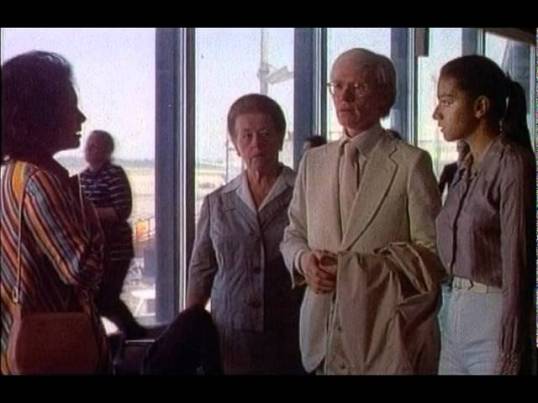
And that, it turns out, is true.  Andy Warhol does appear in The Driver’s Seat.  He plays a character known as “The English Lord” and he even attempts to speak with a posh British accent.  At the same time, though, it’s hard not to feel that Andy Warhol was still essentially playing himself.  Though not lacking in screen presence, Andy played the role with eccentric detachment.  It’s stunt casting, which Andy himself probably would have appreciated but, in the larger context of the film, his presence never quite makes sense.  Then again, the same can be said about just about every actor in The Driver’s Seat.  It’s not a film that’s overly concerned with making sense.

Andy is only in two scenes and they’re both rather short ones.  In his first scene, he approaches Lise (played by Elizabeth Taylor) in an airport and hands her a paperback book that she dropped earlier.  (The book is called The Walter Syndrome.)  As he and his entourage walk away from her, Lise says, “Why is everyone so afraid of me?”

Later on in the movie, Lise runs into the English Lord for a second time.  She approaches him and tries to talk to him but, just as before, he doesn’t have much to say to her.  He’s deep in conversation with some sort of government minister.  At one point, he says, “The King’s an idiot.”

And that’s pretty much the extent of Andy Warhol’s performance.

As for the rest of The Driver’s Seat, it’s one of the many oddly surreal films that Elizabeth Taylor made in the 1970s.  Taylor plays Lise, a middle-aged and overweight spinster who goes on an apparently spontaneous trip to Rome.  When she’s not trying to flirt with almost every man that she sees, she is obsessing on death.  (When she spots a police officer, he asks him if he has a gun and points out that, if he did, he could shoot her right that minute.)

Everyone seems to be scared of Lise, or I should say everyone but Bill (Ian Bannen).  Bill is, without a doubt, one of the most annoying characters of all time.  When Lise first sees him and his orange tan, she says, “You look like Little Red Riding Hood’s Grandmother.  Do you want to eat me?”

Bill laughs and happily replies, “I’d like to, I’d like to. Unfortunately, I’m on a macrobiotic diet and I can’t eat meat.”

Bill’s not joking either.  He is obsessed with his macrobiotic diet and won’t shut up about it.  He also tells Lise that, as a result of his diet, “I have to have an orgasm a day.”

When I diet, I diet,” Lise replies, “And when I orgasm, I orgasm!”  Lise also assures him, “I’m not interested in sex, I’m interested in other things!”

Meanwhile, while all this is going on, random people are getting blown up by terrorists and police officers are chasing young men down in airports.  The film is full of flash forwards in which the various characters who have met Lise are roughly interrogated by some sort of shadowy security agency.  Interpol, we’re told, is looking for Lise.  Everyone is looking for Lise!

Why?  Don’t expect an answer.  Why doesn’t matter in this film!  The Driver’s Seat is one of the most pretentious movies that I’ve ever watched.  Fortunately, I have a weakness for pretentious movies from the 1970s.  I’ve seen a lot of incoherent movies but I’ve rarely seen one that embraces and celebrates incoherence with quite the enthusiasm of The Driver’s Seat and it’s hard not to respect the film’s determination to be obscure.  The movie may make no sense but at least it’s weird enough to be watchable.  Elizabeth Taylor actually gives a pretty good performance as Lise, even if you never forget that you’re actually watching Elizabeth Taylor in one of her weird 1970s films.  Taylor plays the role with a conviction that sells even the most overwritten and/or obscure piece of dialogue.  Add to that, in the 70s, Elizabeth Taylor was probably one of the few people who truly could relate to the situation of having everyone in the world searching for her.

The Driver’s Seat is a pretentious mess and that’s just fine.