Two Americans meet up in Turkey in 1922. Josh Corey (Charles Bronson) is a cynical soldier-of-fortune who, along with his mercenary crew, is hoping to make money out of the ruins of the Ottoman Empire. Adam Dyer (Tony Curtis) is the heir to a shipping company and is hoping to get his last remaining boat out of the Turkish dock where it’s been interned since World War I. Osman Bey (Gregorie Aslan), one of the local powerbrokers who has risen to power since the Turkish Revolution, hires Josh and Adam to escort his daughters and their protector, Alia (Michele Mercier), to Mecca. Actually, the plan is for them to instead go to Cairo to recover a priceless treasure. The journey to Cairo is filled with action and betrayal as Josh and Adam try to navigate the upheaval of the post-war Middle East.
You Can’t Win ‘Em All is a mix of action and comedy, an adventure that owes more than a little to the other big budget heist films of the 60s and 70s. (Director Peter Collinson was hired due to his work on The Italian Job.) The film’s humor comes from the partnership of the stoic Bronson with the talkative Tony Curtis. In fact, the film’s main flaw is that Tony Curtis talks too much. Curtis simply will not shut up. After about fifteen minutes, I was tired of listening to him. Curtis’s acting limitations really come through the more that he talks and, as a result, Bronson walks away with the entire movie by saying next to nothing. Bronson keeps largely quiet because he doesn’t have to speak to make an impression. His stare says everything that needs to be said.
You Can’t Win ‘Em All is uneven but it has a few good action sequences and Bronson doing what Bronson did best. Watching this movie made me appreciate Charles Bronson all the more. Even when working with a less-than-great script and a miscast co-star, Bronson still had the undefinable quality that made him a star.
Johnny Bannion (Stanley Baker) is a career criminal, one who divides his time between long stretches in prison and short visits to the real world. He’s handsome, he’s charming, he’s clever, and he’s totally trapped. Baker moves through the film like a natural-born predator, waiting for the moment to strike. When he’s in prison, he’s as defiant as a caged tiger. When he’s out of prison, he’s always stalking the next prize.
Johnny has a hard time staying out of prison. When we first meet him, he’s in prison and it quickly becomes clear that he’s quite a respected figure behind bars. When he gets out, the first thing that he does is team up with his old associate, Mike Carter (Sam Wanamaker), and make plans to rob a racetrack. Mike and Johnny have an interesting relationship. On the one hand, Mike kept Johnny’s apartment for him while he was locked away and Johnny obviously has enough faith in Mike to work him. On the other hand, neither man seems to truly trust the other. That’s the world of criminals, I suppose. Never trust anyone.
Of course, it quickly turns out that there’s actually a good reason to never trust anyone when you’re living a life of crime. As soon as Johnny, Mike, and the gang pull of the racetrack robbery, Johnny’s betrayed. Johnny ends up locked away once again, all thanks to Mike. However, it turns out that Mike may have acted too soon because Johnny hid all the money before he was sent back to prison. Now, Mike has to figure out a way to pressure Johnny into revealing where the money’s buried while Johnny has to try to survive in a world of ruthless prisoners and guards who are ineffectual at best and crooked at worst. Mike’s not the only one who is interested in where Johnny put all that cash….
I have to admit that I’m probably a bit biased when it come to The Criminal because it’s a British crime film that I actually saw while in the UK. It’s one thing to watch a tough British crime film from the safety of Texas. It’s another thing to watch it at 2 in the morning while in a hotel room with a nice view of the Thames. As opposed to the watered down British-American co-productions that we tend to get used to here in the United States, The Criminal was British through-and-through, from the tough working class accents to the harsh urban landscape to the stylish suits that were worn even inside the prison.
It’s a dense movie. Though Stanley Baker is undoubtedly the star, director Joseph Losey is just as interested in the other people who come within Johnny’s orbit and, as a result, we get to know not just Mike but also the guards and the other prisoners. Partrick Magee, who was a favorite of Kubrick’s, makes a strong impression as Barrows, the prison guard who may be a manipulative sadist or who may just be a man who is doing what he has to do to maintain some sort of order in the prison. The film’s portrayal of Barrows is ambiguous but the same can be said for almost everyone in the movie. In classic noir fashion, there are no traditional heroes. Johnny’s bad but he’s a little bit less bad than the men who betrayed him and who are willing to go to extreme lengths to discover where Johnny hid that money.
Directed by Joseph Losey, The Criminal alternates between scenes of hard-edged reality and scenes that feel as if they could have been lifted from some sort of Boschian nightmare. The scenes outside the prison are harshly realistic while the inside of the prison feels almost like some sort of surrealistic dreamscape where demons take human form. The Criminal is an effective and violent British noir, one that will encourage you to keep your eyes on the shadows.
While watching the 1963 best picture nominee, Cleopatra, I had many thoughts. The film lasts over 4 hours so I had a lot of time to think.
For instance, I often found myself impressed by the sheer size of the production. I marveled at the recreation of ancient Greece and Rome. I loved looking at the ornate costumes. I loved feeling as if I was taking a look back at what Rome may have actually looked like at the height of the Roman Empire. Making it all the more impressive was that this film was made in the days before CGI. When the film’s Romans walked through the streets of Rome, they weren’t just actors standing in front of a green screen. They were walking down real streets and surrounded by real buildings. It reminded me of the awe and wonder that I felt when I was in Italy and I was visiting the ruins of ancient Rome.
(I don’t know if any of the cast accidentally flashed everyone like I did when I visited during Pompeii on a windy day but considering how short some of the skirts on the men were, it wouldn’t surprise me if they did!)
And, as I marveled at the recreation of Rome, I also thought to myself, “How long is this freaking movie?” Because, seriously, Cleopatra is an amazingly long movie. It’s not just the film is over four hours long. It’s that the film feels even longer. Gone With The Wind, The Godfathers Part One and Part Two, Once Upon A Time In America; these are all long films but, because they’re so great, you never find yourself checking the time while watching. Cleopatra is the opposite of that. Cleopatra is a film that, at its slowest, will make you very much aware of how many seconds are in a minute.
I found myself marveling at the lack of chemistry between Elizabeth Taylor and Richard Burton. If anything, this is the most shocking thing about Cleopatra. If Cleopatra is famous for anything, it’s famous for being the film where Elizabeth Taylor (cast in the role of Cleopatra) first met Richard Burton (who was playing Mark Antony). Their affair dominated the gossip headlines. (If TMZ and YouTube had been around back then, there would be daily videos of Richard Burton punching out paparazzi.) Cleopatra was the first of many big-budgeted, overproduced films that Taylor and Burton co-starred in.
(Then again, they also starred in Who’s Afraid of Virginia Woolf, a film that is almost the exact opposite of Cleopatra.)
In the role of Mark Antony, Burton spends most of the film looking absolutely miserable. Elizabeth Taylor, meanwhile, seems to be having a lot more fun. It’s almost as if she understood what Cleopatra was going to become so she went out of her way to give the type of over-the-top performance that the film deserved. The same can also be said about Rex Harrison, who plays Julius Caesar and who, perhaps because he appears to have shared her attitude, actually does have some chemistry with Taylor.
Actually, if anyone gives a truly great performance in Cleopatra, it’s Roddy McDowall. McDowall plays the future Emperor Augustus with a mesmerizing intensity. Again, McDowall’s performance is not exactly subtle but Cleopatra is not a film that demands subtlety.
As the film finally neared its end, I found myself wondering how Joseph L. Mankiewicz went from directing two close to perfect films, A Letter To Three Wives and All About Eve, to directing this. Even more amazing, Mankiewicz had previously directed one of the best Roman Empire films ever, 1953’s Julius Caesar. (When compared to Cleopatra, the low-key and thoughtful Julius Caesar appears to have been filmed on an entirely different planet.) Well, in Mankiewicz’s defense, he was not the original director. He was brought in to replace Rouben Mamoulian, who had previously attempted to make the film with Joan Collins, Ben-Hur‘s Stephen Boyd, and Peter Finch. When Mankiewicz was brought in, the cast was replaced with Taylor, Burton, and Harrison. Between the expensive stars, the troubled production, and all of the offscreen romantic melodrama, Mankiewicz probably did the best that he could.
Today, Cleopatra is mostly interesting as an example of a film from the “Only Gigantic Productions Will Save Us From Television!” era of Hollywood filmmaking. Cleopatra started out as a $2,000,000 production and ended up costing $31,000,000. It was the number one film at the 1963 box office and it still nearly bankrupted 20th Century Fox. While the film does have some kitsch appeal, the critics hated it and it’s easy to see why.
And yes, it was nominated for best picture of the year, a tribute to the size of the production and the determination of 20th Century Fox to get something — anything — in return for their money.
Cleopatra is a bit of a chore to sit through but it can be fun if you’re in a snarky mood. It’ll do until the inevitable Angelina Jolie remake comes along.
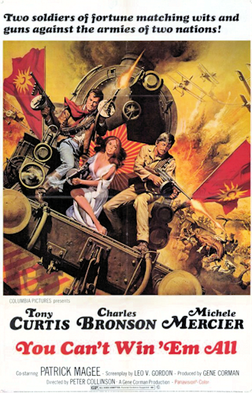 Two Americans meet up in Turkey in 1922. Josh Corey (Charles Bronson) is a cynical soldier-of-fortune who, along with his mercenary crew, is hoping to make money out of the ruins of the Ottoman Empire. Adam Dyer (Tony Curtis) is the heir to a shipping company and is hoping to get his last remaining boat out of the Turkish dock where it’s been interned since World War I. Osman Bey (Gregorie Aslan), one of the local powerbrokers who has risen to power since the Turkish Revolution, hires Josh and Adam to escort his daughters and their protector, Alia (Michele Mercier), to Mecca. Actually, the plan is for them to instead go to Cairo to recover a priceless treasure. The journey to Cairo is filled with action and betrayal as Josh and Adam try to navigate the upheaval of the post-war Middle East.

 Through the Shattered Lens