Grant Morrison Channels His Inner Philip K. Dick In “Annihilator”


4226786-a1

You’re never gonna believe me when I say this given how mercilessly I’ve been shilling for the guy’s recent work, but — I’m honestly not the world’s biggest Grant Morrison fan. As is the case with out esteemed fellow TTSL scribe Arleigh, his work has always been very much a “hit-or-miss” affair with me, and while I loved The InvsiblesThe Filth, and his now-legendary runs on Animal Man and Doom Patrol, a lot of his more-celebrated efforts — such as his runs on JLANew X-Men, and even Batman — were decidedly “meh” affairs in my book, that certainly never veered into actively bad territory but were, nevertheless, largely unmemorable. They had their moments, of that there’s no doubt,  but I felt that they were too few and far between to really stand out all that much.

And we won’t even mention his flat-out offensive analysis of the super-hero phenomenon in general,  Supergods, which dubiously posited that Jerry Siegel and Joe Shuster were not, in fact, the creators of Superman, but merely the human vessels through which this timeless ideal that was floating around in the ether decided to express itself. Guess DC doesn’t owe either of them a dime, then, do they, Grant?

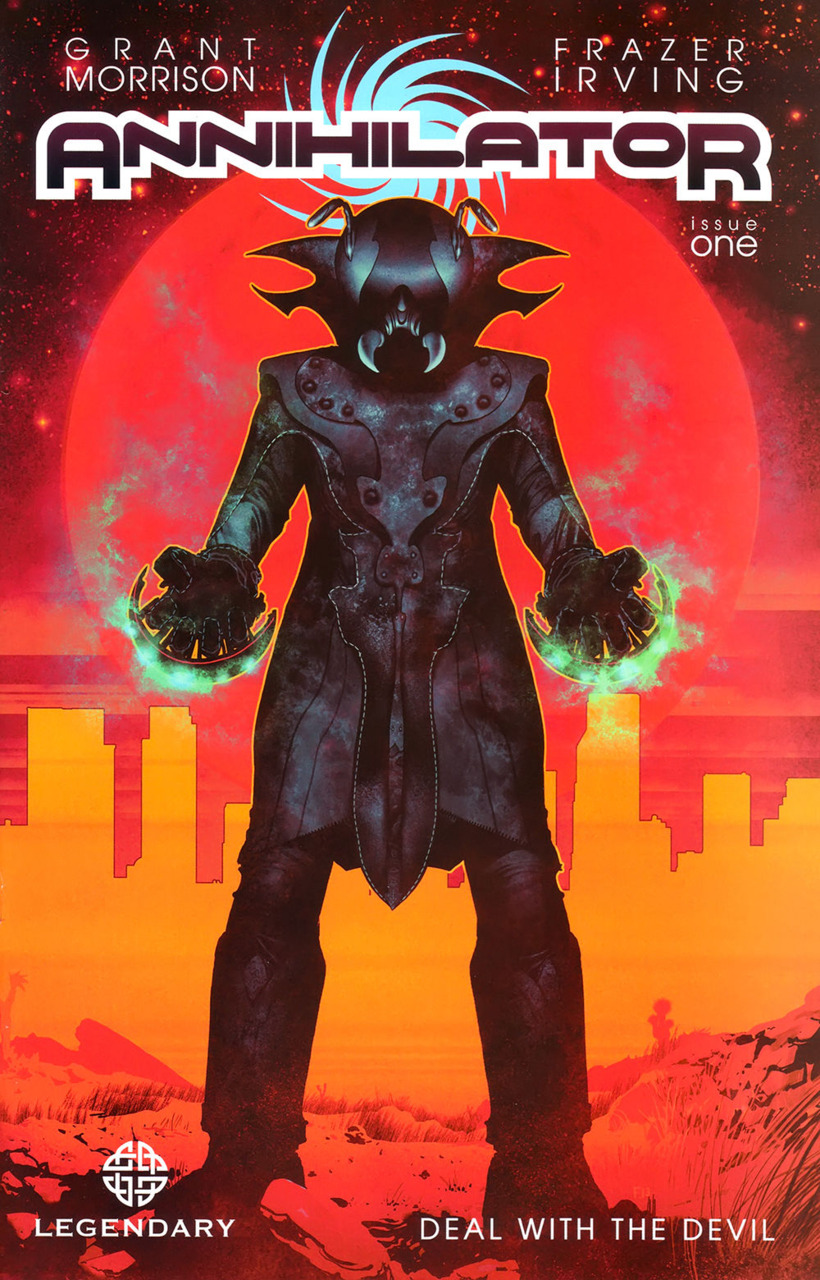
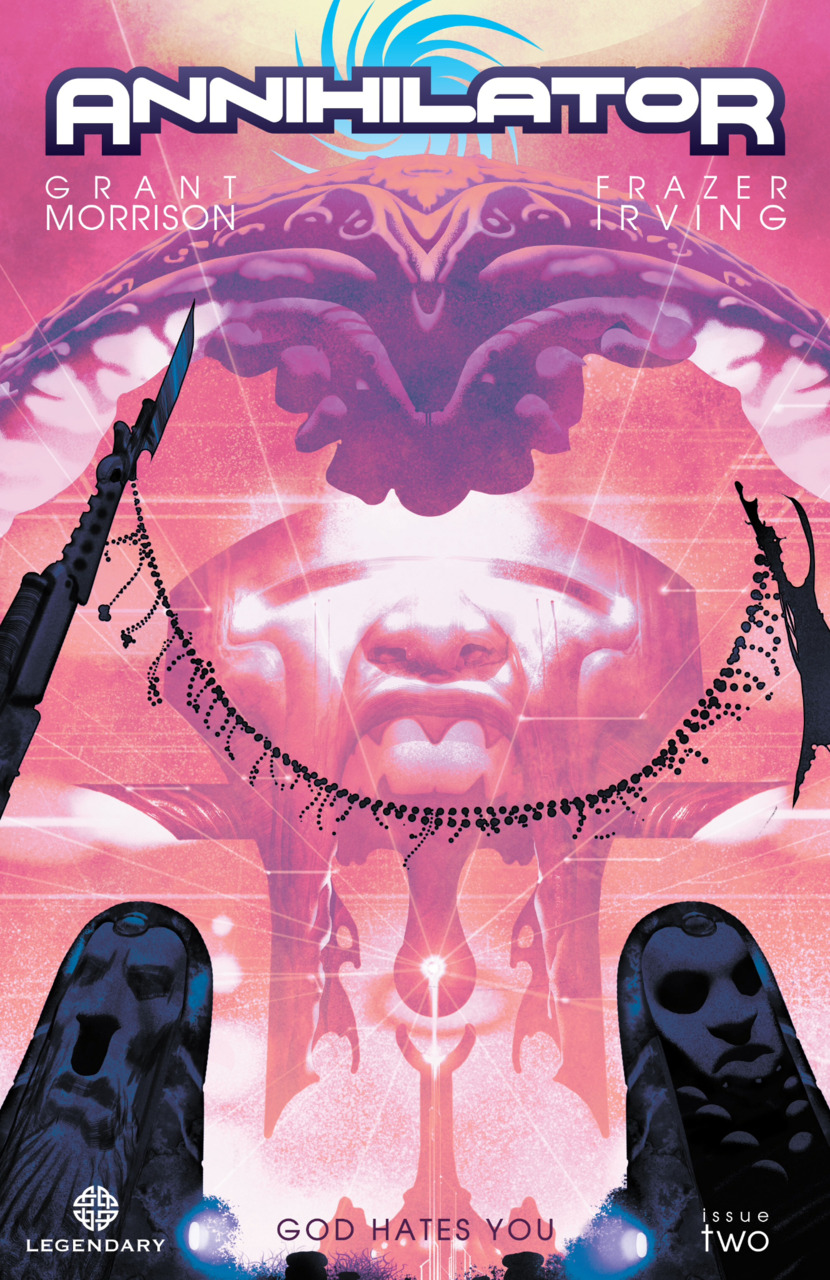
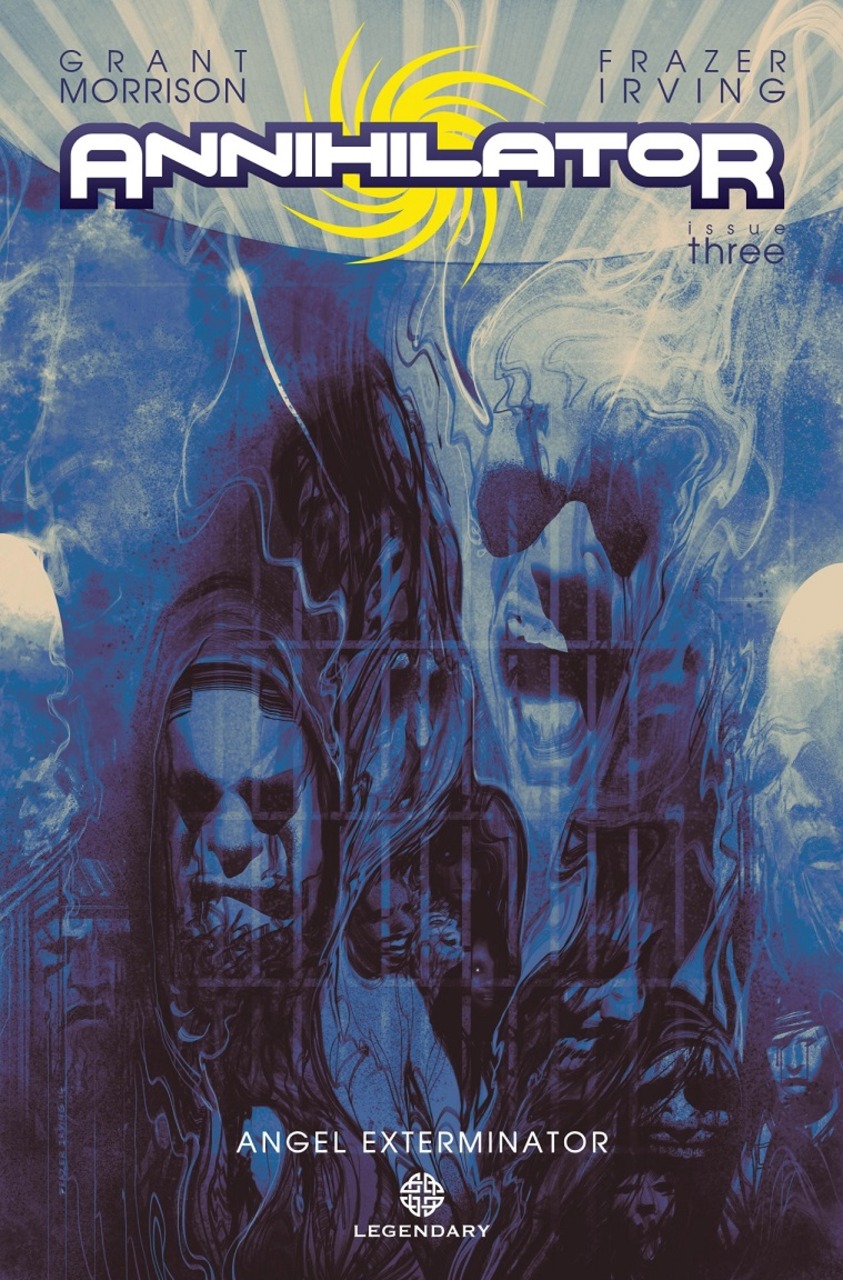
Still, I gotta call it like I see it, and despite the fact that I don’t have much reason to “root” for Morrison personally, it can’t be denied that he’s in the midst of arguably his strongest period as a creator right now, and I don’t say that simply because of the runaway artistic and commercial success that is The Multiversity (although that’s a big part of it, to be sure) — I also say it because, flying far underneath the the cover of hype generated by that blockbuster project (hype which I’m guilty of contributing to in my own small way with my glowing reviews for its last couple of issues),  there’s a little six-part series he’s doing with artist extraordinaire Frazer Irving for Legendary Comics called Annihilator that’s flat-out blowing the minds of the (apparently) few of us who are reading it.
4146792-img_0522

I’ve gotta be honest here — I have no idea why this book isn’t generating a more significant level of “buzz” than it’s managed to so far : maybe it’s because for all their Hollywood dollars and clout Legendary doesn’t seem to be putting much promotional muscle behind their comics line; maybe it’s because the subject matter of the series is too outre for all but the most hardened sci-fi fans to wrap their heads around; maybe it’s because neither of the main characters in the story are in any way “likable”; maybe it’s because The Multiversity is sucking all the oxygen out of the room when it comes to current Morrison work and there’s just not much energy left to heap praise on this title; or maybe it’s some combination of all those elements.

Whatever the case may be, though, it’s kind of a bummer, because four parts in it’s apparent that this is one of the most complex, challenging, interesting, and fun projects to come down the pipeline this year and would definitely be a shoo-in to be near the top of any “Top 10 Comics Of 2014” list I would cobble together if such rankings interested me in any way — which they don’t.
4226574-a+3

Think about it for a second : here we’ve got a veteran writer (ranked as the number two comics author of all time in the CBR poll that was just released earlier today — oh yeah, what was it I just said about not caring about “best of” lists again?) operating at the top of his game paired up with an up-and-coming “hot property” artist who’s doing career-defining work with this series and yet the whole thing seems to be going more or less unnoticed and is selling only a fraction of the number of copies each month of middling super-hero fare like, I dunno, Batwoman or Cyclops — both of which were recently cancelled by DC and Marvel, respectively, due to low sales. Something just ain’t right with this picture.

Well, never let it be said that I’m unwilling to get up on my soapbox and cheerlead for a comic that not enough people are paying attention to, because I’m here to tell you that if you like superbly-illustrated, high-concept, Philip K. Dick-style fuck-with-your-head science fiction, then you absolutely have to get caught up on Annihilator right now.

Here’s a brief rundown of the particulars just to whet your appetite : Ray Spass (pronounced “space”) is an asshole. A Hollwood screenwriter whose career trajectory is headed straight down, he hopes to get back on the “A List” with his new project, which is a script (called , you guessed it, “Annihilator”) about another asshole, a formerly-high-flying intergalatic criminal named Max Nomax who is imprisoned in orbit around the black hole ( named — wait for it — “The Annihilator”)  at the center of the Milky Way and is using his time there to try to bring the love of his life back from the dead.

You have to hand it to Max — he doesn’t think small. The problem is, he doesn’t know how his story ends, and in order to find out, he has to become real, and pay a visit to his writer.

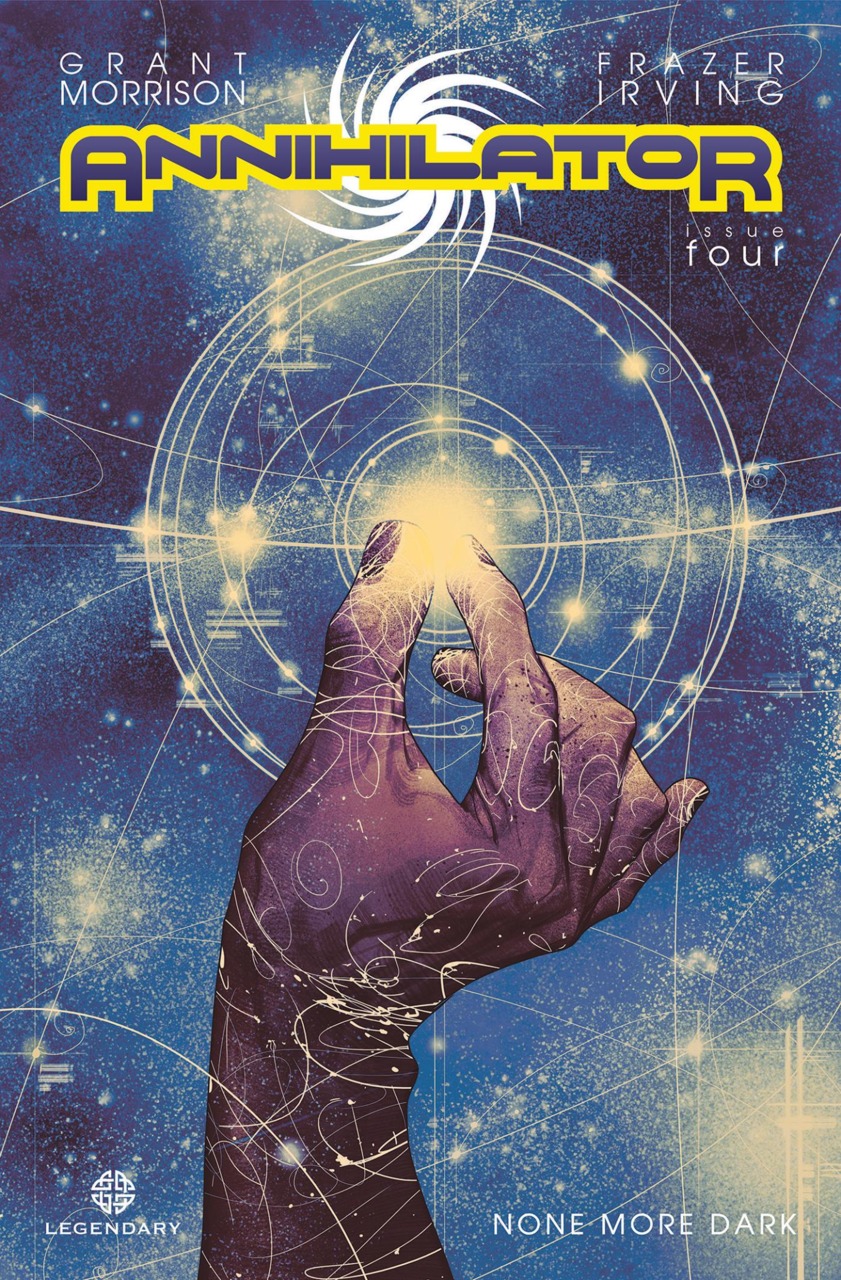
The first three issues really cause the reader to question how much of this is really happening and how much is the result of fevered hallucinations brought on by an inoperable brain tumor that’s afflicting Ray, and while the fourth chapter goes some way toward resolving that question, it raises plenty of new ones at the same time, chief among them — okay, if this is real, and Max needs Ray to keep working on his script in order to lay out the course of his life for him, then how is it happening — and why?
4279184-a+4

Intrigued yet? I can assure you that my brief synopsis only skims the surface of all that’s happening here, and that this is a book that certainly rewards multiple re-reads as it goes about laying its foundation of carefully-constructed twists and turns. It’s hard to say at this just-beyond-mid-way point how many seemingly disparate elements will be woven into the final pattern that Morrison is knitting here and how many will turn out to be throwaway “red herrings,” but my money is on “everything here matters in some way, shape, or form, and not even the smallest detail will go to waste once it’s all said and done,” as each successive installment to date has proven to be a further measured layer of intricacies built upon what’s gone before. A picture that began as convoluted is coming into view more clearly as events progress, even if it’s still largely obscured and even if, as just mentioned, every answer has a tendency to elicit about a dozen new questions.

And yet for all that story awesome-ness, I’m still not prepared  to say whether or not the (admittedly superb) writing is the real “star” of the show here, though, so polished and expressive is Irving’s art. I’d kill for an original page or two — any original page or two — from this series, as they’re all flat-out breathtaking and of “suitable for framing” quality. If you’re a big time “art geek” like I am, prepare to spend a lot of time “ooh”ing and “aah” ing to the — no exaggeration — unfolding series of wonders on display here. Irving has gone from being a “guy to watch” to a “guy to follow” to a “guy others will no doubt try to imitate” over the short space of four months (oh yeah, did I mention that each issue so far has even managed to come out on time?),  and you might as well get used to his name, because you’re bound to be hearing it a lot in the years to come.

I think I’ve pretty well exhausted my supply of compliments and superlatives at this point, so — yeah. Annihilator. Get it. Now.

Oh, and tell your friends, too — it”s not too late to build some genuine momentum for this book as it steamrolls headlong toward what’s sure to be a memorable conclusion.
“The Multiversity : Thunderworld Adventures” #1 — Grant Morrison’s Love Letter To C.C. Beck


4285249-01

If there’s one criticism that’s been leveled at Grant Morrison — and British comics writers in general — over the years, it’s that their work, while admittedly literate and intelligent, is often too “dark” or “cynical.” I guess sometimes it does apply — I mean, The Invisibles and The Filth , to name just a couple of standout Morrison projects, weren’t exactly light-hearted, happy-go-lucky affairs, were they?

And yet — even those two comics, bleak and nihilistic as they could often be, ultimately had optimistic endings, didn’t they? And books like Animal Man and All-Star Superman were flat-out celebrations of the type of comic book storytelling that the “British invasion” of the 1980s supposedly put an end to (as a side note, Alan Moore gets called out onto the carpet for the “darkness” of his work a lot, as well,  yet the same guy who gave us From Hell also gave us the most majestic tribute to the Superman of old ever conceived with his downright mythic run on Supreme and years earlier gave us arguably the single-greatest Superman story of all, “Whatever Happened To The Man Of Tomorrow? ” — hell, even Watchmen had a more optimistic conclusion than most folks give it credit for). All in all, then, when it comes to Morrison’s career arc, it’s probably more fair to say that even when things do get “dark” and/or “dystopian” (anybody reading Annihilator right now? You really should be), it’s usually only a matter of time until we get to the light.

That’s why I was a bit confused over some of the hand-wringing that was going on prior to his much-anticipated Captain Marvel (or Shazam!, if you must) story for The Multiversity. People were openly questioning whether or not his “style” would be the right fit for the character. Whether or not he could “do it justice.” Whether or not he could “bring back that 1950s-style magic and innocence.”

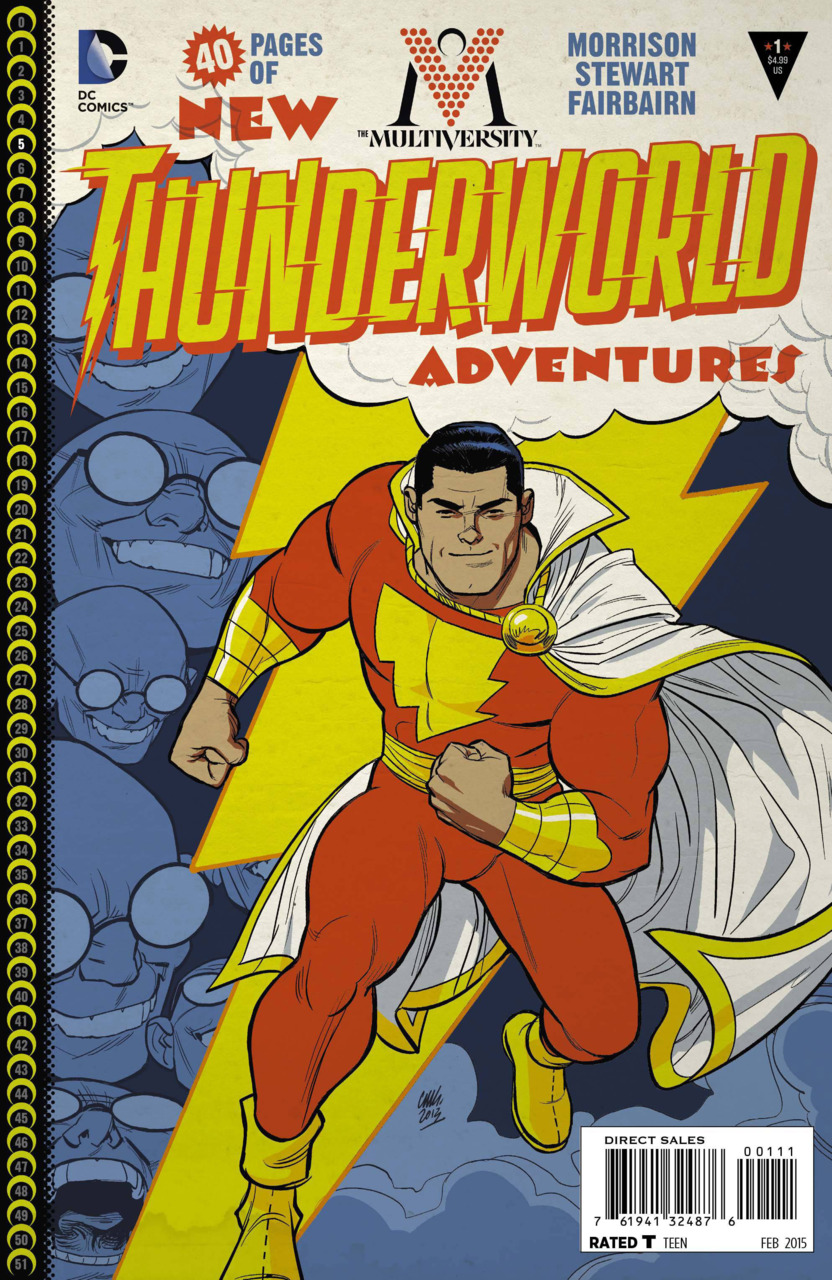
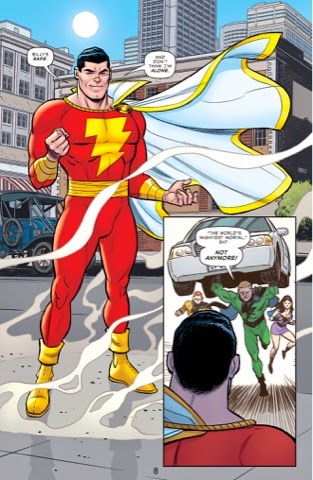
Well, The Multiversity : Thunderworld Adventures #1 came out last Wednesday, and it’s fair to say that all those concerns have been silenced in the days since, because this is probably the most heartfelt, endearing, spot-on adventure for The Big Red Cheese since C.C. Beck chronicled his exploits for Fawcett publications.  No hyperbole, no bullshit — everything you were hoping this issue would be, it is.

blogger-image-1390298821

Off we go, then, to Earth-5, which is apparently where Captain Marvel (and I bet we don’t see him referred to by that name anytime again too soon)  as he ought to be — instead of the angst-ridden, more “realistic” version of him we’ve been subjected to in the “New 52” universe — still exists, along with the rest of the Marvel family, and still does battle with the likes of Black Adam, Mr. Mind, The Monster Society Of Evil, and the villain of this story, Dr. Sivana, who has created a doppleganger “Sivana Family” and added an eighth day to the week, thanks to time and power siphoned away from other realities in the Multiverse.

That “cynicism” people were fretting about? It’s nowhere to be found here, as this is pure Beck-style storytelling all the way : imaginative, character-driven, idealistic, and action-packed. Heck, Morrison even gets the little touches right, such as when he gives us the first appearance in forever and a day of the non-super-powered Uncle Marvel, and continues the tradition of him pretending to have powers and everybody else knowing he doesn’t but humoring him anyway. There’s not a note missed, not a beat skipped. This is a majestic old-school comic book adventure that doesn’t even feel so much like an homage as it does a direct continuation of a story abandoned over 50 years ago (you know, when DC sued Fawcett right out of business for their flagship character’s “similarity” to Superman — then bought up his rights for a pittance).

It may flirt with overkill sometimes, I suppose, but even after two readings I remain more than happy to put that tiny concern aside, simply because there’s nothing in the least bit “post-ironic” — much less ironic — about what Morrison is doing here. Every page, every panel, every word bubble — it’s all coming from the heart, without any sort of “knowing wink at the audience” to be had. Much as I liked All-Star Superman, it still had elements of a 12-part funeral dirge to it, a “last story of this type that’s ever going to be told” vibe. There’s none of that on display here, even if we probably won’t see a comic quite like this one — at least from DC — again in our lifetimes.

BhmVPtcCMAAzdn-

It also represents a 180-degree turn from the more nihilistic — but every bit as well-executed — tone taken with this series’ last “one-shot” issue, the magnificently rich and complex Pax Americana, yet while  the two stories couldn’t be further apart in terms of style, this one is just  as compelling  that modern masterwork despite being infinitely “simpler” and more straightforward. The two issues coming out back-to-back as they have certainly highlights the diversity of Morrison’s writing ability, of course, but also the diversity inherent in The Multiversity project itself — a series where, truly, any story can be told in any given month. We hear that said — usually in hype generated by the publishers — about lots of comics, I suppose, but in this case, it’s proving to be absolutely true, and while Thunderworld Adventures does, in fact, make a few more concessions to the overall narrative connecting all of these disparate books than Pax Americana did, rest assured that it can still be read as a “stand-alone” story just fine.

About the only concession made here to the kind of “mind-fuckery” our guy Grant likes to engage in is a trippy double-page splash (one that’s so awesome to behold that I can’t bring myself to “spoil” it by including a preview image here, sorry) that doesn’t make much rational “sense” but certainly fits in with the overall tone of the proceedings very nicely indeed. Apart from that, though, all else in the world of Billy Batson and his magically-powered alter ego is more or less exactly as you remembered — maybe even better,

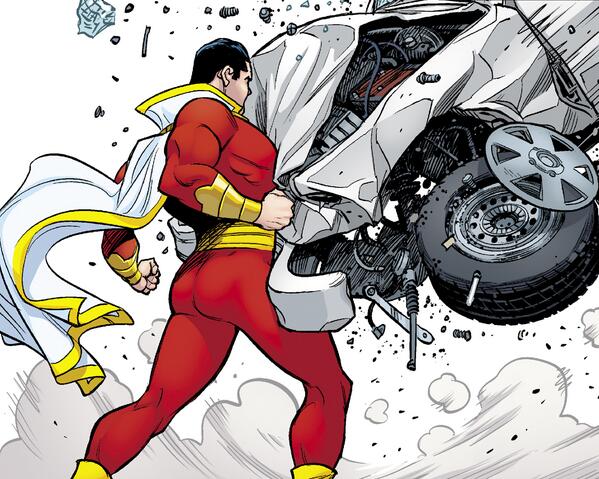
Speaking of the art — Cameron Stewart, who provides both pencils and inks for this issue, is a guy I’ve never considered to be anything other than a competent journeyman artist, providing good, but hardly memorable, work for a number of titles over the years, including several projects with Morrison like Seaguy and Batman And Robin (he’s currently the regular penciler on DC’s recently-revamped Batgirl monthly series), but damn if this isn’t the comic he was born to draw. Just look at that panel reproduced above showing a car smashing into Captain Marvel for a prime example of the dynamic and impactful sensibility he brings to the table here. I get the feeling that he spent several months working on this book, and if he didn’t — well, shit, then I guess I’m even more impressed, because none of the trademarks of a “rush job” are apparent here in any way. This is bold, breathtaking stuff that has me reconsidering his entire body of work in a whole new light. You might even say that he’s unleashed his inner super-hero here.

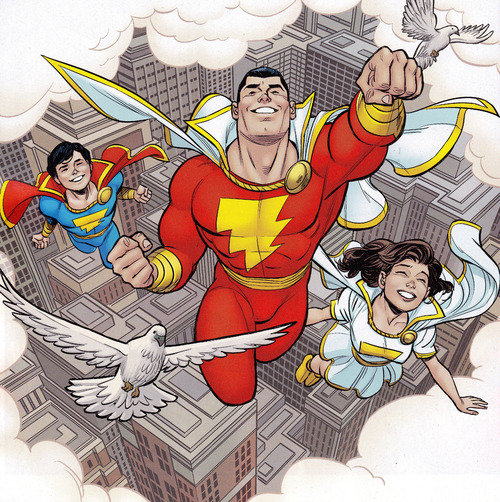
And the colors — man oh man, the colors! It’s hard to believe this is the same Nathan Fairbairn who gave us the more muted tones of Pax Americana as everything here is bright, vibrant, eye-catching, and just plain sunny. Earth-5 literally looks like a place where it never rains. Just have a look at the triumphant panel the story ends on here and you’ll see exactly what I mean —

tumblr_inline_ngqsxpiyfM1qaj97u

That, right there, is why most of us who fell in love with the comics medium as kids did so, isn’t it? Even if these characters were a bit “before our time” for most of us, it was the spirit of idealistic adventure that drew us in and that we all wish we’d see more of these days. In my headline for this review I called Thunderworld Adventures Morrison’s “love letter to C.C. Beck” (it’s worth noting that Alan Moore has pointed to Beck as being his primary storytelling influence on Supreme, as well), and while that’s undoubtedly true, there’s actually more to it than that — it’s a love letter to youth, optimism, idealism, and a kind of non-ironic goodness that’s in far too short a supply both in modern comics and , crucially, modern life. It’s a celebration of all that we can be, and sometimes are — when we’re willing to be the heroes of our own adventures.

“The Multiversity : Pax Americana” #1 Is The Comic Of The Year — No Question


MULTIVERSITY-Cv4-05

Understand — it’s not like me to make grandiose pronouncements like “such-and-such is the movie of the year,” “such-and-such is the comic of the year,” etc. It’s pretty damn hard to pinpoint something as being the best offering in any given medium when one person, obviously, can’t see or read everything that’s out there — and it’s probably doubly stupid to engage in such hyperbole before the year is even over.

And yet — that’s exactly what I’m doing right here, and with full confidence. That’s because the latest issue of Grant Morrison’s The Multiversity has no chance of being topped, barring a miracle of some sort. It’s just. That. Fucking. Good.

1-1

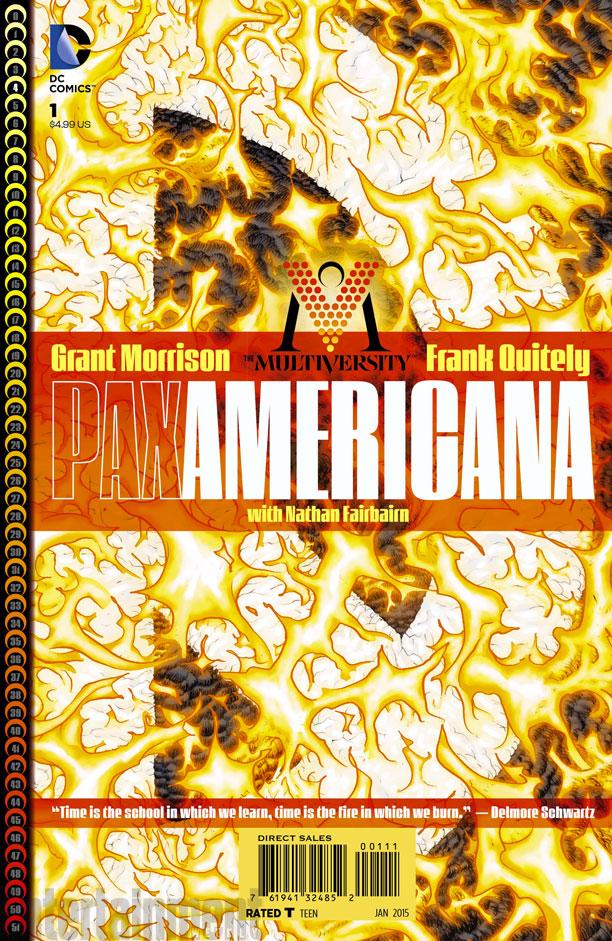
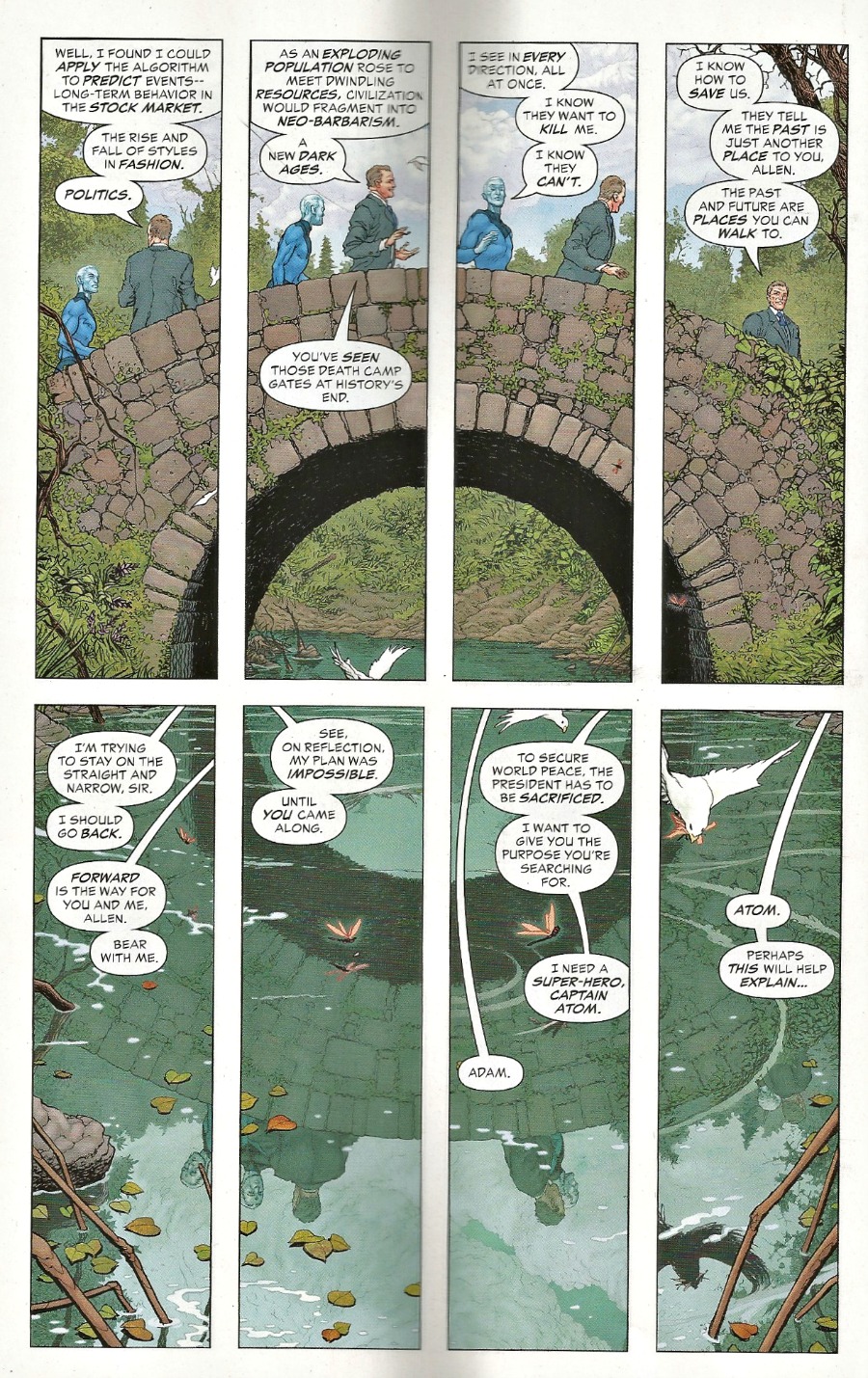
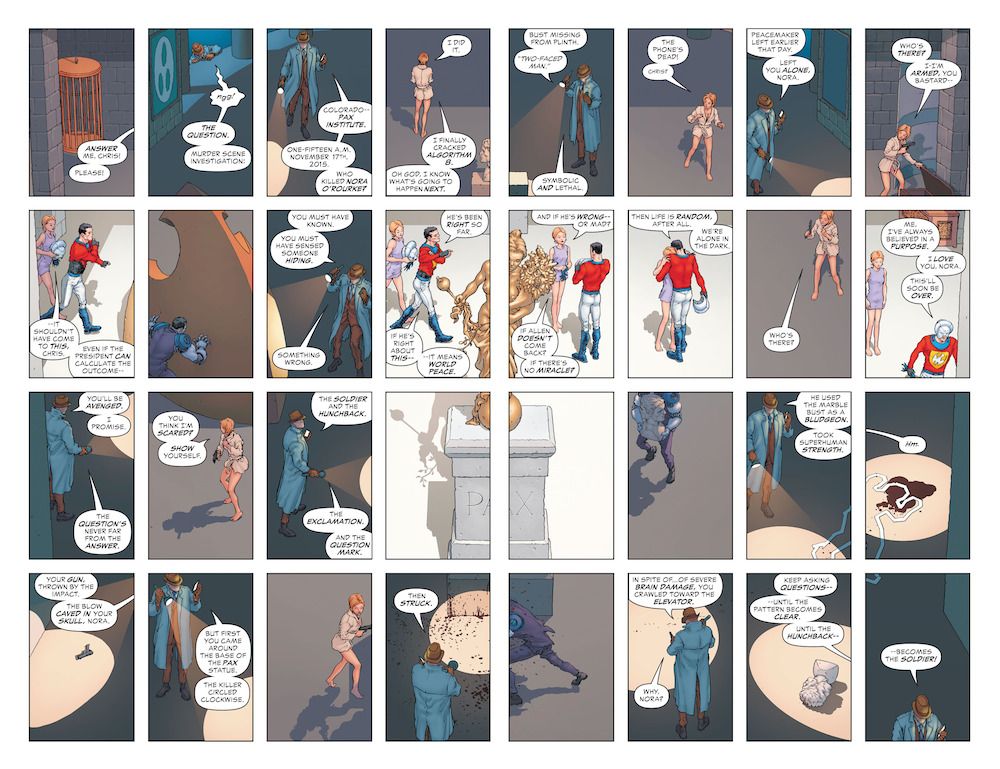
For those not familiar with the basic premise of what’s going on with The Multiversity, it’s an eight-issue mini-series from DC written by Morrison and illustrated by a bevy of the industry’s top talents — in this case,  his frequent collaborator Frank Quitely, who absolutely outdoes himself here. Yeah, okay, all his stuff’s awesome to behold, but his work  on Pax Americana leaves even his much-celebrated turns on Flex MentalloBatman And Robin, and All-Star Superman so far behind in the dust it’s not even funny. Just look at that spectacular page reproduced above and you’ll know that not only is Quitely rendering images here with amazing detail and care, he’s also pushing the boundaries of the comics page in terms of how narrative structure flows visually. I haven’t seen an artist on a “Big Two” project tell a story this hermetically sealed, with its own unique and perfectly logical, yet also expressive and evocative,  language since Dave Gibbons created the singular look and feel of the Watchmen “universe” nearly 30 years ago.

And hey, it’s no coincidence that we bring up Watchmen here since Pax Americana has been referred to, more than once, as “Morrison’s Watchmen,” and for good reason.  Each self-contained issue of The Multiveristy takes place on one of DC’s “parallel Earths,” with a slowly-unfolding, meta-fictional, ” comic within a comic” premise (nothing new for our guy Grant there, he’s been busting the fourth wall ever since his days on Animal Man) binding them all together in ways not fully understood yet given that we’re only halfway through the series, and this time out we’re on Earth-4, the Earth populated by the Charlton comics “Action Heroes” that DC acquired in the early ’80s and that Alan Moore famously first intended to utilize as his principal characters in he and Gibbons’ seminal work.  Morrison famously hates Watchmen, and takes every available opportunity to say so, and so the “intrigue factor” here is pretty high in terms of comics fans wanting to see how he’d handle essentially the same characters.

MCPAX-SMP-2

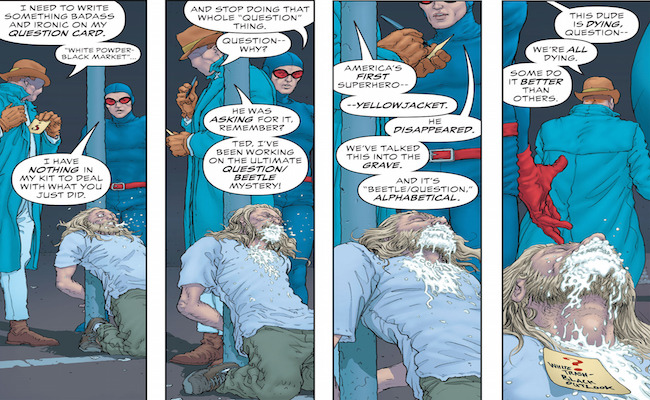
I say “essentially the same” because, of course, Moore and Gibbons weren’t allowed to use the Charlton characters in the end, and so quick stand-ins were devised — The Question became Rorschach, Blue Beetle became Nite Owl, Nightshade became Silk Spectre, Peter Cannon, Thunderbolt became Ozymandias, Peacemaker became The Comedian, and Captain Atom became Dr. Manhattan. DC had “other plans” (most of which amounted to a hill of beans) for the “real” characters at the time, but in the “New 52” universe they’ve all been shelved indefinitely and so Morrison is free to use the original versions here — with the exception of Peter Cannon, whose copyright has reverted back to his creator, Pete Morisi.

The Watchmen similarities don’t end with the principal characters the story is based around, though — Pax Americana also employs a tight, dense story structure that plays around freely with timelines and often employs mirror images of the same scene told from multiple perspectives, such as in the astonishing two-page spread above. Rest assured, it all makes perfect sense, but odds are you won’t catch it all on the first reading unless you’re, I dunno, Stephen Hawking or something.

1447_multiversity_pax_americana_1_splash

And that’s part of the joy of a book like this, isn’t it? Make no mistake — if you’re not willing to invest a few hours, at least, of your time (not to mention $4.99 of your hard-earned money) into what Morrison and Quitely (along with colorist supreme Nathan Fairbairn, who imbues the world of Earth-4 with a distinctive palette all its own) have created here, you’re short-changing yourself, because this is a story that reveals more and more about itself with each successive re-read. As you continue to peruse its contents you’ll be able to glean which instances are integral to a full understanding of the complex proceedings and which are just clever structural gimmicks employed by the author to impress you, but it wouldn’t be a good mystery story — and Pax Americana is, in fact, a great mystery story, centered around the most consequential murder any society can endure, that of its leader — without a few red herrings being thrown into the mix. Heck, Morrison even takes a fun, albeit admittedly cheap, shot at his arch-enemy, Mark Millar, by deftly deconstructing the most pivotal sequence of Wanted and essentially copying it note-for-note while turning it on its ear at the same time, and has a bit of fun at the expense of the scene with Sally and Laurie Jupiet/Juspeczyk in Watchmen #2, as well. Gratuitous? Sure, but it works.

The other ballsy move Morrison makes here is in asking the same fundamental question with his story that Moore and Gibbons did with Watchmen in terms of when is it right to sacrifice the few for the (supposed) good of the many, who “gets” to make that call, and how do they arrive at their decision? Granted, it’s a weighty theme that can’t be grappled with as comprehensively in one 40-page comic as it can in 12 separate 30-page comics, but I give him credit for essentially finding a way to tell multiple (hmmmm — a multiversity?) of stories here at once, given that there’s more going on in this one issue than most comics with a standard “A to Z” linear narrative manage to pack into a year’s worth of their pages, and by utilizing the same characters (again, essentially) that Watchmen used to deal with the same (again, essentially) themes and concepts, Morrison and Quitely aren’t so much aping Moore and Gibbons as they are answering them.

None of which is to say that Pax Americana is going to make people forget about Watchmen any time soon. Or even that it’s “as good” as Watchmen. Again, it’s much shorter, for one thing — but it’s certainly as intricate, arguably even moreso, certainly as demanding, and in the end, certainly as revelatory, at least for those with the patience to give it the detailed attention it both deserves and rewards (as an added plus, you needn’t even be invested in the other Multiversity comics to get on board with this one, it reads just fine on its own).

The comic of the year? Yeah, I can say that pretty easily — even though there’s a bunch of other stuff I haven’t read, and the year’s not over yet.

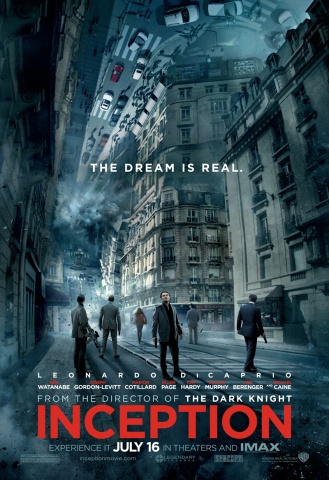
Inception: A Grant Morrison Level Mind Frack (spoiler free)


I don’t want to ruin the Inception experience for anyone so I will mention elements that were present in the trailer.

Reality vs Dream: The audience is presented with a scenarios where Oneiroinauts (like astronauts of the dream plane) are unable to differentiate between the waking world (reality) and dreams.  This caused me to recall Spike Spiegel’s samurai ideal (considering oneself as dead and the idea of death being an awakening from a dream) as well as Morrison’s discussion on reality, space and time) and its nature.

Viral Idea: Inception introduced the concept of infectious pathogen-like ideas that have the potential to enhance or corrupt the host.  This brought to mind a Grant Morrison creation: Weapon XII, a biological weapon with a viral consciousness that mentally degraded its victim and reshaped their minds into an extension of its own.

Limbo: Limbo is a netherworld spawned from the dreamer’s unconscious mind that an Onieroinaut could become trapped in. This was similar to the limbo featured in Final Crisis: Superman Beyond, a hell formed from the collective unconscious mind of comic book readers.

Grant Morrison speaking about reality, space/time and our perception of the three.

Images are courtesy of IGN.com and the videos are courtesy of Google Videos and YouTube.