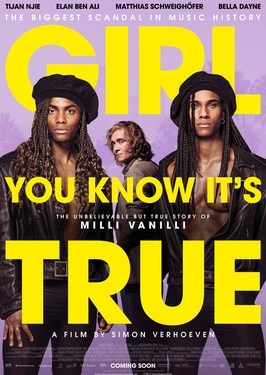
Girl You Know It’s True (2023, directed by Simon Verhoeven)


In 1988, a German music producer named Frank Farian (Matthias Schweighofer) has already recorded and produced a song called Girl You Know Its True.  He just needs to find two performers who are more photogenic than the middle-aged studio musicians who actually sang it.  Frank discovers Rob (Tijan Njie) and Fab (Elan Ben Ali), two friends who are trying to make it as dancers.  Rob is German and biracial.  Fab is French.  Frank tells them that all they have to do is lip-synch along with the record whenever they’re “performing” the song.  After Frank assures them that this type of thing is done all the time, they agree.  Frank also tells them that they will be known as Top Shelf.

The song becomes a hit and Rob and Fab become stars but they’re not known as Top Shelf, a name that is dismissed as being too German.  Instead, they find superstardom as Milli Vanilli.  With their popularity comes money, groupies, and drugs.  But when word gets out that neither Rob nor Fab actually sang on their record, everything collapses into one of the biggest entertainment scandals of the past 40 years.

I never would have guessed that a good movie could be made about the fall of Milli Vanilli but Girl You Know Its True is a surprisingly compelling and well-acted retelling of the familiar story.  The movie is as much as about the business of fame as it is about the band itself with Frank realizing and explaining that a band’s image is much more important than the music itself.  Rob and Fab are presented as being incredibly naive and trusting when it comes to Frank and his promises, with Rob also sabotaged by a need for acceptance that came out of his troubled childhood.  The villain in this story is not the band but instead a music industry that knowingly looked the other way on Frank’s deception and then scapegoated Rob and Fab when the truth came out.  Rob and Fab each deal with going from being superstars to being pariahs in their own individual way.  It leads to tragedy for one and regret for the other.

Even though I was familiar with the story, Girl You Know It’s True took me by surprise.  It’s a genuinely good film.

Cleaning Out The DVR Yet Again #18: Careful What You Wish For (dir by


(Lisa recently discovered that she only has about 8 hours of space left on her DVR!  It turns out that she’s been recording movies from July and she just hasn’t gotten around to watching and reviewing them yet.  So, once again, Lisa is cleaning out her DVR!  She is going to try to watch and review 52 movies by Wednesday, November 30th!  Will she make it?  Considering that she only has a day left, probably not.  But keep checking the site to find out!)

careful-what-you-wish-for-official-poster

I recorded Careful What You Wish For off of Starz on November 4th.  It’s one of two films in which Nick Jonas appeared in 2016.  (The other film was the underrated Goat, which I really should get around to reviewing some day.  Maybe if I ever finish cleaning out this damn DVR, I’ll finally get a chance to get caught up on reviewing all of the other movies that I’ve seen this year.)

Anyway, in Careful What You Wish For, Nick plays Doug.  Doug is kind of a dorky, creepy guy who spends the summer at his parent’s lakehouse.  His neighbors are the Harpers.  Elliott Harper is super rich banker and he’s played by Dermot Mulroney so you know he’s no good.  Lena Harper (played by Isabel Lucas) is blonde, young, and always seems to be in the process of removing her bikini top whenever Doug comes around.

Doug is soon lusting over Lena and Lena appears to feel the same way.  Soon, they’re having an affair that is probably about as torrid as anything involving Nick Jonas can be.  Lena tells Doug that Elliott abuses her.  Doug says that she needs to get away from her husband.  Lena says that Elliott would kill her if she ever tried to leave…

And then Walter Neff shows up and starts talking about insurance…

Okay, no, he doesn’t.  But he might as well because Careful What You Wish For is pretty much a by-the-numbers film noir.  It’s obvious to everyone what’s going to happen.  Or, I should say, it’s obvious to everyone but Doug.  Doug is such a goony dumbass that his whole reaction to everything that happens can be summed up as: “At least I got laid.”

Personally, I think the film made a huge mistake by not having Doug wear a purity ring that he could dramatically remove before having sex with Lena.  Seriously, this film could have used some moments of self-awareness like that.  (And I do feel a little bit guilty about making fun of Nick here because he actually gives a pretty good performance in Goat.)  But no, instead, we get a scene where a bare chested Nick eats an Oreo cookie and it’s kinda gross because he really gets into eating that cookie.  I mean, Nick really tries to show us every second of pleasure that Nick gets from that Oreo.  But the thing is, Oreo cookies are gross and overrated and to me, there’s nothing more disgusting than watching as someone dips an Oreo into milk and then gets milk all over their chin when they eat it.  UGH!

But, listen — if you’ve ever wanted to see Nick Jonas roll an Oreo cookie over his lover’s bare ass, Careful What You Wish For is definitely for you.

Playing Catch-Up: The End of the Tour (dir by James Ponsoldt) and Love & Mercy (dir by Bill Pohland)


Two of the best films released last year dealt with troubled artists.

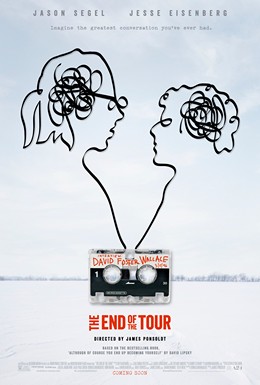
The_End_of_the_Tour

The End of the Tour opens in 2008, with a writer David Lipsky (Jesse Eisenberg) getting a call that the famous and acclaimed author, David Foster Wallace (Jason Segel), has committed suicide.  After learning of the tragedy, Lipsky remembers a few days that he spent interviewing Wallace 12 years earlier.  Wallace had just published his best known work, Infinite Jest.  At the time, Lipsky himself was a struggling writer and he approached Wallace with a combination of admiration and professional envy.  Lipsky hoped that, by interviewing Wallace, he could somehow discover the intangible quality that separates a great writer from a merely good one.

Almost the entire film is made up of Lipsky’s conversations with Wallace.  We watch as both the somewhat reclusive Wallace (who seems both bemused and, at times, annoyed with his sudden fame) warms up to Lipsky and as Lipsky forces himself to admit that Wallace might actually be a genius.  There are a few conflicts, mostly coming from the contrast between the withdrawn Wallace and the much more verbose Lipsky.  Lipsky’s editor (Ron Livingston) continually pressures him to ask Wallace about rumors that Wallace was once a drug addict.  But, for the most part, it’s a rather low-key film, one that’s more interested in exploring ideas than melodrama.  It’s also a perfect example of what can be accomplished by a great director and two actors who are totally committed to their roles.  Jason Segel, especially, gives the performance of his career so far.

The shadow of Wallace’s suicide hangs over the entire film.  Throughout their conversation, Wallace drops hints about his own history with depression.  Much as Lipsky must have done after Wallace’s suicide, we find ourselves looking for clues to explain his death.  But ultimately, Wallace remains a fascinating enigma in both life and death.

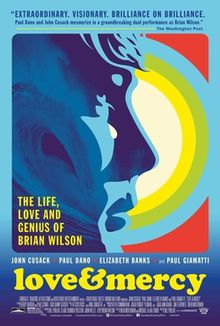
Love_&_Mercy_(poster)

Love & Mercy (dir by Bill Pohland)

Love & Mercy opens with Cadillac saleswoman Melinda Ledbetter (Elizabeth Banks) selling a car to a polite but nervous man (John Cusack).  The man sits in the car with her and rambles for a bit, mentioning that his brother has recently died.  Soon, the man’s doctor, Eugene Landy (Paul Giamatti), shows up and Melinda learns that the man is Brian Wilson, a musician and songwriter who is famous for co-founding The Beach Boys.  After having a nervous breakdown decades before, Brian is now a recluse.  He and Melinda start a tentative relationship and Melinda quickly discovers that Brian is literally being held prisoner by the manipulative Dr. Landy.

Throughout the film, we are presented with flashbacks to the 1960s and we watch as a young Brian (Paul Dano) deals with both the pressures of fame and his own relationship with his tyrannical father (who, in an interesting parallel to Brian’s later relationship with Landy, is also Brian’s manager).  As Brian struggles to maintain his grip on reality, he obsesses on creating “the greatest album ever.”

Love & Mercy is an enormously affecting story about both the isolation of genius and the redeeming power of love.  Whether he’s played by Cusack or Dano, Brian Wilson remains a fascinating and tragic figure.  It’s hard to say whether Cusack or Dano gives the better performance.  Indeed, they both seem to be so perfectly in sync with each other that you never doubt that the character played by Paul Dano will eventually grow up to become the character played by John Cusack.  Both of them do some of the best work of their careers in Love & Mercy.