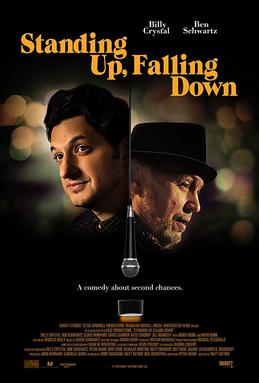
Having failed to achieve his dream of becoming a comedy superstar in Los Angeles, 34 year-old Scott (Ben Schwartz) returns home to Long Island. How bad are things for Scott? Consider this:
When he left for Los Angeles, he left behind Becky (Eloise Mumford), despite thinking that he was in love with her and despite her asking him to stay. While he was in L.A., he purposefully chose to not respond to her attempts to get in contact with him because he was determined to move on with his life. Now, he’s back and he’s wondering what could have been. As for Becky, she’s now an acclaimed photographer and she’s married to a surfer named Owen (John Behlman).
All of his old friends are now married and have families and don’t really have time to hang out with a 34 year-old who is still struggling with adulthood.
When Scott returns home, he moves back in with his parents. His mother (Debra Monk) spoils him while his father (Kevin Dunn) barely says a word to him. Scott announces that, even though he knows he needs a job, there’s no way that he’s going to go to work at his father’s lumberyard. His father says that’s not a problem because he wasn’t planning on offering Scott a job in the first place.
Scott’s sister (Grace Gummer) is also living at home and is stuck in a less than glamorous job but she’s dating Ruis (David Castaneda), an extremely charming security guard who is loved by everyone who meets him.
And, to top it all off, Scott has developed a rash of some sort in his arm!
In fact, the only positive development in Scott’s life is that he’s made a new friend. Marty (Billy Cyrstal) is a bit older and he’s an alcoholic but he also has the best weed and he’s full of good advice. On top of that, Marty’s also a dermatologist and is willing to just give Scott the medicine for his arm free of charge. Marty becomes a bit of a mentor to Scott. Of course, Marty has demons of his own. His first wife committed suicide and his second wife died of stomach cancer. His own son refuses to speak to him and won’t allow him to see his grandson. Marty’s drinking isn’t the quirky character trait that it first appears to be. Instead, it’s what he does to deal with the pain and the guilt that he carries around with him every day.
Standing Up, Falling Down is an occasionally effective and occasionally awkward mix of comedy and drama. As a character, Scott can occasionally be a bit hard too take. It’s one thing to have trouble accepting the fact that you’re getting older while it’s another thing to be in your mid-thirties with the maturity level of a 13 year-old. At times, Scott seems to be so helpless that you find yourself wondering how he survived in Los Angeles for as long as he did. Fortunately, Ben Schwartz is an appealing actor and the film doesn’t make the mistake of trying to idealize Scott’s lack of direction. You find yourself sincerely hoping that Scott will finally manage to get his life together, even though you know he probably won’t.
The big surprise of the film is Billy Crystal, who gives a genuinely good and complex performance as Marty. Like Crystal, Marty is a bit of an attention hog and occasionally seems a bit too satisfied with his jokes. However, the film also explores why someone like Marty always feels the need to be “on.” The best moments in the film are the ones where Marty quietly considers why his life has reached the point that it has. In the film’s quieter moments, there’s a lot of sadness in Crystal’s performance. The scene where he unsuccessfully tries to get his son to talk to him is absolutely heart-breaking, all the more so because Cyrstal downplays the scene’s potential for sentimentality. Right when you’re expecting schmaltz, Crystal instead holds back. With just the slightest change in his facial expression, Crystal immediately tells us everything that’s going on inside of Marty’s head. It’s a truly good performance.
Standing Up, Falling Down is a low-key, occasionally effective dramedy. Not all of it works (I could have done without Scott harassing his sister’s co-worker at the pretzel place) but it has a good heart and an unexpectedly great performance from Billy Crystal.
 Through the Shattered Lens