An Offer You Can’t Refuse #7: The Roaring Twenties (dir by Raoul Walsh)


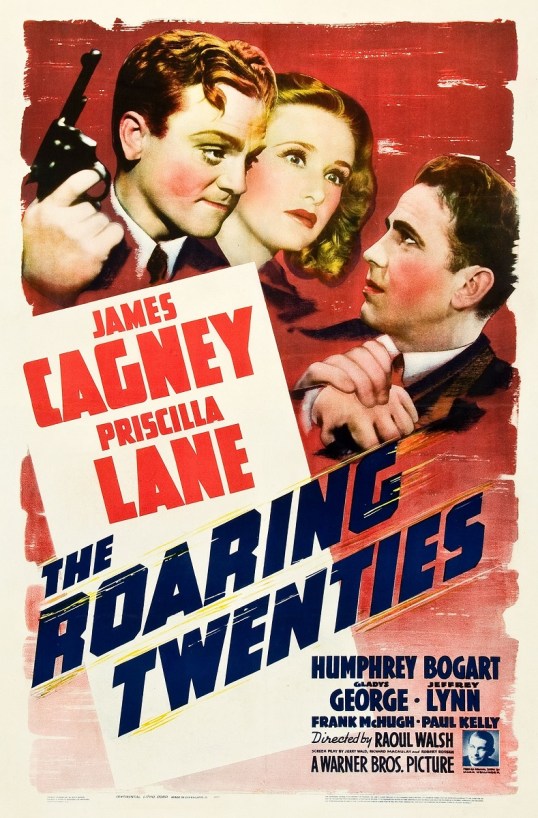
The 1939 gangster epic, The Roaring Twenties opens with newsreel footage of men like Franklin D. Roosevelt, Winston Churchill, and Adolf Hitler.  We watch as they give speeches and as armed soldiers march across Europe.  For those of us watching in the present, these are figures from the past.  For audiences in 1939, though, these were the men who were shaping both their present and their future.

A narrator informs us that the world has changed much over the past few years and that it’s on the verge of changing again.  The world is preparing for war and who knows what society is going to look like afterwards.  (Interestingly enough, at the time that The Roaring Twenties was released, the U.S. was officially neutral when it came to the war in Europe, with many politicians arguing that the U.S. should pursue an isolationist foreign policy.  Though the film seems to be speaking to a nation that was already committed to war but that was actually not the case.)  The narrator goes on to say that it’s easy to forget what America was like just 20 years ago.  World War I was ending.  Soldiers were returning home.  Prohibition has just become the law of the land and, as a result, there was now a whole new way to make illicit cash.  It was a different era, the narrator tells us, one that is running the risk of being forgotten.

With that narration, it’s made obvious that The Roaring Twenties is designed to be more than just a gangster film.  It’s also a history lesson.  With Americans aware that another war might be coming, perhaps they needed to be reminded of what happened during and after the previous one.  By that same token, with people across the world already dying in the fight for freedom, perhaps Americans needed to be reminded of what happened the last time they allowed the government to take those freedoms away.

The Roaring Twenties tells the story of three men who first met in 1918, while they were all hiding out in a foxhole while a bloody and violent war rages all around them.  (The narrator somewhat archly notes that the three men — like all the men who fought and died in World War I — had been told that they were making “the world safe for democracy.”)  The three of them become friend while under fire and they remain friends when they return home to a war-weary nation that refuses to take care of its veterans.  Unfortunately, that friendship doesn’t survive the roaring 20s.

George Holly (Humphrey Bogart) is a former saloon keeper who becomes a major bootlegger after the passage of prohibition.  George is the type who takes pleasure in gunning down a 15 year-old during World War I.  (“He’ll never make 16,” George says after pulling the trigger.)  He doesn’t improve once he returns home but he does find a lot of success as a bootlegger.  Soon, he’s got a mansion.  He’s got bodyguards.  He goes to the best clubs and owns the best clothes.  Prohibition may have been meant to put George Holly out-of-business but instead it’s made him a rich and influential man.

Lloyd Hart (Jeffrey Lynn) is a college-educated idealist, one who becomes a lawyer once he returns home.  Even the most successful of bootleggers needs a good lawyer but Lloyd refuses to compromise his belief in the law, even when it comes to helping out his friends.  Lloyd will eventually end up working out of the district attorney’s office, where he builds cases against men like George Holly.

And finally, there’s Eddie Bartlett (James Cagney).  Eddie is the film’s main character.  He’s a criminal but, unlike George, he’s not totally corrupt.  In many ways, he’s an idealist but he’s never as self-righteous as Lloyd.  While his friends worry about their place and their role in society, Eddie is just trying to survive.  Before he went off to war, Eddie was a mechanic but, once he returns, he discovers that his job has been filled.  With no other work available, Eddie is finally hired to drive a cab.  What is those cabs could be used to smuggle alcohol?  Eddie finds himself working with Panama Smith (Gladys George) while, at the same time, going to war with Nick Brown (Paul Kelly).  In between making and losing a fortune (due to both the end of prohibition and the 1929 stock market crash), Eddie falls in love with singer Jean Sherman (Priscilla Lane).  Because Eddie can’t leave the rackets, Jean ends up married to Lloyd instead.

The film follows these characters, from 1918 to 1933.  Along the way, it also provides a critique of prohibition.  Prohibition is presented as being a bad law, one that led to men like George Holly getting rich and which destroyed the lives of countless people.  By making liquor illegal, the film argues, it also made it appealing to people who would have otherwise never had a drink.  There’s a definite appeal to the forbidden.  Interestingly enough, Eddie never takes a drink while he’s getting rich smuggling the stuff.  It’s only after prohibition is repealed and Eddie finds himself once again reduced to driving a cab for a living that he becomes a drunk.  Rich George and educated Lloyd might survive the end of prohibition by Eddie — who was as much a foot soldier during prohibition as he was during World War I — against finds himself cast out by a society that wants to forget about the national trauma that it’s just gone through.  Eddie, however, isn’t going to go down without a fight.  He’s played by James Cagney, after all.

The Roaring Twenties is a true classic.  It works as a gangster movie, a historical epic, and a portrait of the side effects of out-of-control regulation.  It tells the story about what happens when society becomes more interested in governing people than in helping them.  Indeed, the film asks, what were men like Eddie Bartlett supposed to do when, after risking their lives for their country, they returned home to discover that their jobs were gone, rent had gone up, and the government wouldn’t even allow them to commiserate their sorrows over a cold beer?  Who can blame America for rebelling?  Who can blame the Eddie Barletts of the world for doing what they had to do to survive?

Finally, not only does The Roaring Twenties feature brilliant performances from genre veterans like Bogart and Cagney (in fact, this is a probably Cagney’s best gangster performance) but it also recreates the 20s with such skill that you can’t help but wish that you could have been a part of it.  It all ends with a brilliant final scene on the steps of a church.  “He used to be a big shot!”  Yes, he was.

This is definitely an offer not to refuse.
Previous Offers You Can’t (or Can) Refuse:

  1. The Public Enemy
  2. Scarface
  3. The Purple Gang
  4. The Gang That Could’t Shoot Straight
  5. The Happening
  6. King of the Roaring Twenties: The Story of Arnold Rothstein 

End of an Era: THE ROARING TWENTIES (Warner Brothers 1939)


gary loggins's avatarcracked rear viewer

Warner Brothers helped usher in the gangster movie era in the early 1930’s with Pre-Code hits like LITTLE CAESAR and THE PUBLIC ENEMY, and at the decade’s end they put the capper on the genre with THE ROARING TWENTIES, a rat-a-tat-tat rousing piece of filmmaking starring two of the studio’s top hoods, James Cagney and Humphrey Bogart , directed with the top down by eye-patch wearing macho man Raoul Walsh for maximum entertainment.

The film’s story was written by Mark Hellinger, a popular and colorful New York columnist in the Damon Runyon mold who based it on his encounters with some of the underworld figures he knew during that tumultuous era. Hellinger was later responsible for producing some of the toughest noirs of the late 40’s: THE KILLERS BRUTE FORCE , THE TWO MRS. CARROLLS, and THE NAKED CITY. Jerry Wald, Richard Macauley, and Robert Rossen adapted Hellinger’s story for the screen, and the film…

View original post 572 more words

Cleaning Out The DVR #25: The Maltese Falcon (dir by John Huston)


(For those following at home, Lisa is attempting to clean out her DVR by watching and reviewing 38 films by this Friday.  Will she make it?  Keep following the site to find out!)

220px-Falconm

I would love to see a remake of The Maltese Falcon with Bill Murray in the role of Sam Spade.  Well, maybe not the Bill Murray of today because he’s getting a little bit too old to play a hard-boiled private detective who is as good with his fists as his brain.  Instead, I’m thinking more of Lost In Translation era Bill Murray, when he was no longer young but could still probably beat up any sniveling punk who came at him with a gun.

Now, that may sound crazy to some but think about it.  Bill Murray is one of the great deadpan snarkers and so is Sam Spade.  Last night, when I watched the famous 1941 version of The Maltese Falcon (the story was filmed twice before, once with Bette Davis as the femme fatale), I was struck by how much of the film really was a comedy.  It may have been a murder mystery that featured death and betrayal and a lot of people getting beaten up but, ultimately, The Maltese Falcon is really about Sam Spade reacting to all of the crazy and strange people around him.  No matter how weird things get, Spade always responds with a smirk and a quip.  It’s a role that, at times, seems to be tailor-made for an actor like Bill Murray.

Bill Murray wasn’t around in 1941 but fortunately, Humphrey Bogart was.  Humphrey Bogart may have grown up wealthy and attended private schools but, on screen, nobody was tougher than Humphrey Bogart and nobody was better at delivering sarcastic, snark-filled dialogue.  After spending years as a villainous supporting actor, Humphrey Bogart got his first starring role when he played Sam Spade in The Maltese Falcon.  His performance, of course, would set the standard by which all future cinematic private eyes would be judged.

And, of course, Spade was tough and he was cynical and he has that wonderful moment at the end of the film where he explains that nobody’s going to make a “sap” out of him.  But for me, Bogart’s best moments come when Spade is alone and thinking.  It’s at those times that Spade suddenly becomes a human being.  A slight smirk comes to his lips, almost as if he’s sharing a private joke with the audience.  You can tell that he’s thinking to himself, “Can you believe how weird my life is?”

And it is indeed a weird life.  The film opens with Spade’s partner, Miles Archer (Jerome Cowan), being murdered.  The police believe that Archer was murdered by a man named Thursby and that Thursby was subsequently murdered by Spade.  Spade, however, suspects that both Archer and Thursby were killed by his latest client, a woman who introduced herself as Ruth Wonderly (Mary Astor).  Except, of course, that’s not her real name.  Her real name is Brigid O’Shaughnessy and, as she admits to Spade, Thursby was her partner.  She claims that Thursby must have murdered Archer but that she doesn’t know who could have possibly killed Thursby.

What’s particularly interesting about all this is that no one really seems to be that upset about Archer’s death.  Spade’s main motivation for investigating the murder is to clear his name and there are several lines of dialogue that reveal how little regard he had for Miles.  In fact, when Archer’s widow (Gladys George) suggests that Spade might be Archer’s killer, you can understand why she might think that.  But then again, that’s the world of The Maltese Falcon.  Only the tough survive.  Getting sentimental or allowing yourself to care is the biggest mistake you can make.

The murders are connected to the hunt for a valuable statue of a bird.  (This is the famous Maltese Falcon of the title.)  As Spade tries to clear his name in the two murders, he also finds himself getting caught up with a strange group of treasure hunters.  There’s the obsequious Joel Cairo (Peter Lorre).  There’s the ruthless “fat man,” Kasper Gutman (Sidney Greenstreet).  And then there’s Wilmer (Elisha Cook, Jr.), Gutman’s young henchman who spends the entire film trying to convince everyone that he’s tougher than he appears.  Wilmer is a born patsy.  Whenever Spade gets annoyed, he beats up Wilmer.  And he usually smiles afterward.

Along with being the directorial debut of John Huston, The Maltese Falcon was also one of the first great film noirs.  It’s one of the most influential films ever made and, even seen today, it’s a lot of fun.  You really can’t go wrong with Bogart, Astor, Greenstreet, Lorre, and Cook all in the same movie.  Bill Murray may never get a chance to play Sam Spade but that’s okay.  Humphrey Bogart’s the only Sam Spade we really need.

The Maltese Falcon was nominated for best picture.  However, it lost to How Green Was My Valley, a film that literally seems to take place in an entirely different universe from The Maltese Falcon.

Lisa Watches An Oscar Winner: The Best Years Of Our Lives (dir by William Wyler)


The_Best_Years_of_Our_Lives_film_poster

I’ve seen The Best Years Of Our Lives on TCM a few times.  There’s a part of me that always wishes that this film was dull, in the way that many best picture winners can be when watched through modern eyes, or in any other way overrated.  The Best Years Of Our Lives won the Academy Award for Best Picture of 1946 and in doing so, it defeated one of my favorite films of all time, It’s A Wonderful Life.  A part of me would love to be able to say that this was one of the greatest injustices of cinematic history but, honestly, I can’t.    The Best Years Of Our Lives is an excellent film, one that remains more than worthy of every award that it won.

Best_Years_of_Our_Lives_01_bar

The film deals with veterans returning home from World War II and struggling to adjust to life in peacetime.  That’s a topic that’s as relevant today as it was back in 1946.  If there’s anything that remains consistent about human history it’s that there is always a war being fought somewhere and the man and women who fight those wars are often forgotten and abandoned after the final shot has been fired.  The returning veterans in The Best Years Of Our Lives deal with the same issues that our soldiers have to deal with today as they return from serving in Iraq and Afghanistan.

The Best Years Of Our Lives follows three veterans as they return home to Boone City, Ohio.  As they try to adjust to civilian life, their loved ones struggle to adjust to them.

 Teresa Wright and Dana Andrews

Teresa Wright and Dana Andrews

Fred Derry (played by Dana Andrews) is a self-described former soda jerk.  (To be honest, I’m really not sure what a soda jerk was but it doesn’t sound like a very fun job.)  During the war, he was a captain in the air force.  He returns home with several decorations and few marketable skills.  During the war, he was good at bombing cities but there’s not much that can be done with that skill during peacetime.  Nearly penniless, Fred takes a job selling perfume at a department store.  He spends his days trying to control her temper and not give into his frustration.  At night, he’s haunted by nightmares of combat.

Teresa Wright and Virginia Mayo

Teresa Wright and Virginia Mayo

Meanwhile, his wife, Marie (Virginia Mayo), finds herself resenting the fact that Fred has come home.  She married him while he was in flight training and, as quickly becomes obvious, she’s less enamored of Fred now that he’s just another civilian with a low-paying job.  (She continually begs him to wear the uniform that he can’t wait to take off.)  The Best Years Of Our Lives is a film full of great performances but Virginia Mayo really stands out.  I have to admit that, whenever I watch this film, I find myself envious of her ability to both snarl and smile at the same time.

Teresa Wright, Myrna Loy, Fredric March, and Michael Hall

Teresa Wright, Myrna Loy, Fredric March, and Michael Hall

Al Stephenson (Fredric March) was a bank loan officer who served as an infantry sergeant.  (It’s interesting to note that the educated and successful Al was outranked by Fred during the war.)  Al returns home to his loving wife, Milly (Myrna Loy), his daughter Peggy (the beautiful Teresa Wright), and his son, Rob (Michael Hall).  At first, Al struggles to reconnect with his family and he deals with the tension by drinking too much.  Rehired by the bank, he approves a risky loan to a fellow veteran.  After the bank president (Ray Collins, a.k.a. Boss Jim Gettys from Citizen Kane) admonishes Al, Al gives a speech about what America owes to its returning veterans.

Meanwhile, Peggy has fallen in love with Fred.  When Milly and Al remind her that Fred is (unhappily) married, Peggy announces, “I am going to break that marriage up!”  It’s a wonderful line, brilliantly delivered by the great Teresa Wright.

Harold Russell

Harold Russell

Marriage is also on the mind of Homer Parrish (Harold Russell).  A former high school quarterback, Homer was planning on marrying Wilma (Cathy O’Donnell) as soon as he finished serving in the Navy.  During the war, he lost both his hands and now he’s returned home with metal hooks.  Homer locks himself away from the world.  When he finally does talk to Wilma, it’s to show her how difficult life with him will be.  Wilma doesn’t care but Homer does.

Harold Russell won an Academy Award for his performance here.  Russell was not a professional actor.  Instead he was a veteran and a real-life amputee.  Watching his performance today, it’s obvious that Russell was not an experienced actor but the natural charm that enchanted the Academy still shines through.

Harold Russell, Dana Andrews, and Fredric March

Harold Russell, Dana Andrews, and Fredric March

It’s been nearly 70 years since The Best Years Of Our Lives was first released but it remains a powerfully honest and surprisingly dark film.  All three of the veterans deal with very real issues and, somewhat surprisingly, the film refuses to provide any of them with the type of conventional happy ending that we tend to take for granted when it comes to movies made before 1967.  As the film concludes, Fred is still struggling financially.  Homer is still adjusting to life as an amputee.  Al is still drinking.   All three have a long road ahead of them but they’re all making progress.  None of them will ever be the same as they were before the war but, at the same time, they’re all working on making new lives for themselves.  They haven’t given up.  They haven’t surrendered to despair and, the film suggests, that is triumph enough.

The Best Years Of Our Lives is a great film and a great best picture winner.  It’s just a shame that it had to be released the same year as It’s A Wonderful Life.

http://www.youtube.com/watch?v=o_TJuLRjQCM