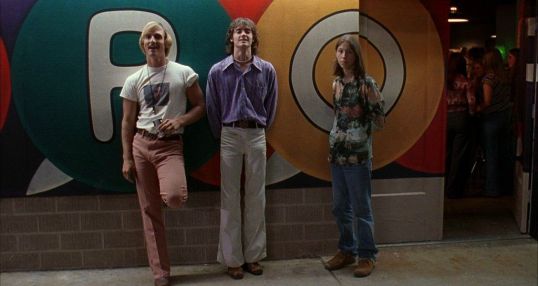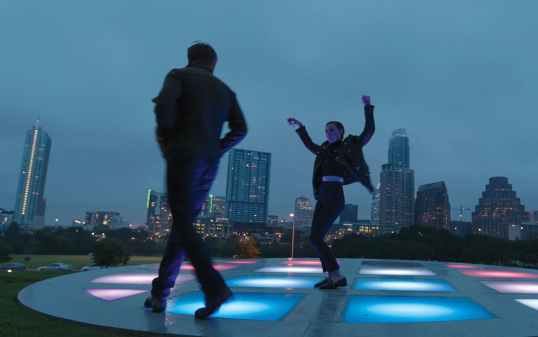
4 Or More Shots From 4 Or More Films is just what it says it is, 4 shots from 4 of our favorite films. As opposed to the reviews and recaps that we usually post, 4 Shots From 4 Films lets the visuals do the talking!
4 Shots From 4 Texas Films
4 Or More Shots From 4 Or More Films is just what it says it is, 4 shots from 4 of our favorite films. As opposed to the reviews and recaps that we usually post, 4 Shots From 4 Films lets the visuals do the talking!
4 Shots From 4 Texas Films
Wow, that Edna Ferber sure was a bitch.
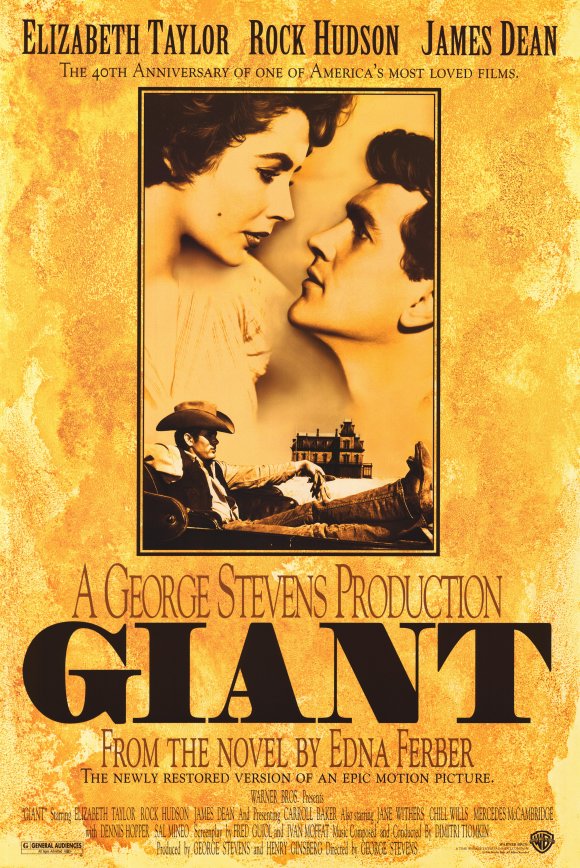
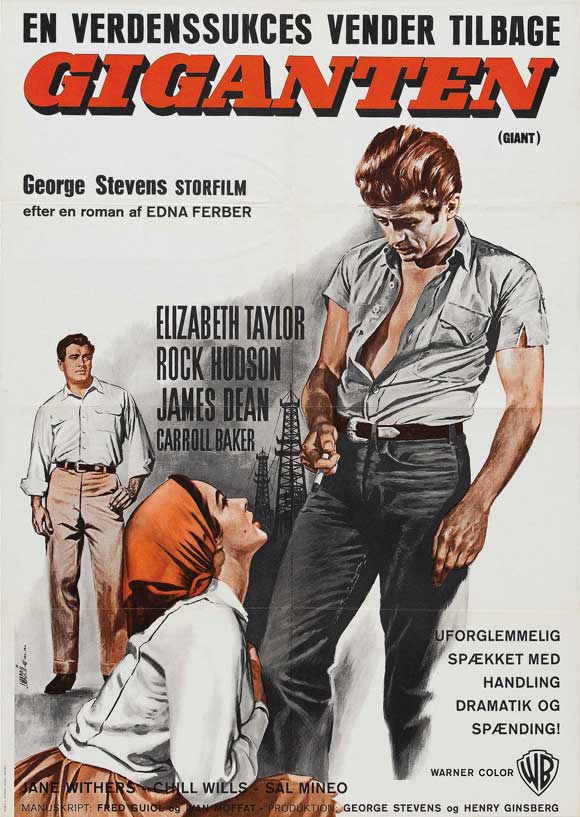
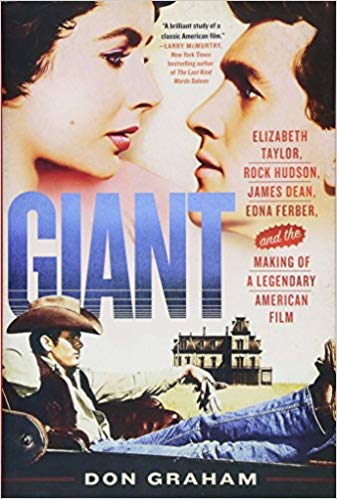
That was my first thought as I read Giant, Don Graham’s history about the making of the film of the same name. In the early 50s, Edna Ferber, a writer who was born in Michigan, raised in Wisconsin, and lived in New York, wrote a novel about Texas. The novel was called Giant and it told a story of ranchers, oilmen, and casual racists. It was meant to be an attack on Texas, a warning to the rest of the country to not allow itself to turn into Texas. Ferber presented Texas as being a land where everything was big and everyone owned a jet and an oil well and all the rest of the usual stereotypes. When Ferber’s novel was turned into a movie, she was apparently not happy to discover that the film was not the vehement denunciation of the state and its citizens that she wished it to be. In Don Graham’s book, Edna Feber often seems to be hovering in the background of every scene, throwing a fit about every detail of the movie. She comes across as a certain type of character that every Texan has had to deal with: the angry Northerner who can’t understand why we’re not as impressed with them as they are.
That’s not to say that Giant, as a film, was blindly pro-Texas. The film featured a subplot that deal with the prejudice that Mexicans faced in Texas. But the film also indicated that things could change and that people could grow and that was something that Ferber apparently did not agree with, at least as far as Texans are concerned.
If Graham’s entire book was just about Ferber’s displeasure with Giant, it would make for a fairly tedious read but, fortunately, Edna Ferber is just a minor part of the sprawling story that Graham tells. Instead of worrying too much about Ferber, Graham focuses on the filming of Giant and how it not only brought Hollywood to the citizens of Marfa, Texas but also what it meant to George Stevens, the film’s director and it’s three stars, Rock Hudson, Elizabeth Taylor, and James Dean. Giant was the film that proved that Elizabeth Taylor could act. It was also the film that brought Rock Hudson some rare critical acclaim. And, perhaps most importantly, it was the last film that James Dean made before his death.
Perhaps not surprisingly, the book is at its most interesting when it deals with James Dean. Graham does not make the mistake of blindly idolizing Dean. Indeed, Dean often comes across as a brat. Graham writes about Marlon Brando’s well-known dislike of Dean but he also shares anecdotes from the set that reveal that Dean was incredibly talented but also very self-destructive. Reading about Dean’s behavior and his frayed relationship with George Stevens, one gets the feeling that, even if he had survived the car accident, Dean’s acting career probably would never have survived his own self-destructive impulses. Graham celebrates Dean’s talent without idealizing his character.
Much as in the movie, Rock Hudson is frequently overshadowed by Dean. In the book, Hudson comes across as being …. well, he’s come across as being a bit of a jerk. Elizabeth Taylor, on the other hand, comes across as being driven, fragile, and committed to her stardom. She also comes across as possessing an unexpectedly sharp wit. If both Dean and Hudson were both a bit too self-impressed, Taylor possessed the knowledge of someone who had spent her entire life in the film industry.
Don Graham’s Giant is an entertaining book. Full of anecdotes and more than a little bit juicy speculation about what went on behind the scenes, Giant is a great read for Texans and film fans alike!
4 Shots From 4 Films is just what it says it is, 4 shots from 4 of our favorite films. As opposed to the reviews and recaps that we usually post, 4 Shots From 4 Films lets the visuals do the talking.
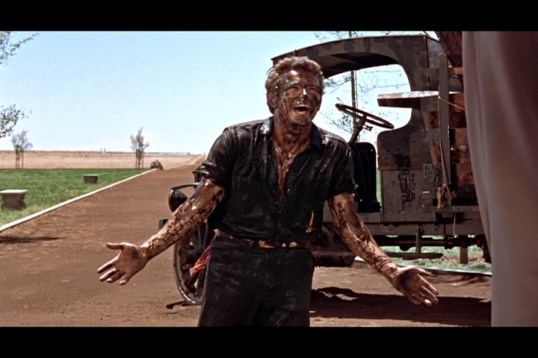
On this date, 64 years ago, James Dean was killed in a tragic car accident. At the time of his death, he had already filmed East of Eden, Rebel Without A Cause, and Giant. East of Eden would be the only one of his starring roles that Dean would live to see. Dean went on to be nominated for two posthumous academy awards and, in death, he became an icon that will live forever.
If James Dean were still alive today, he would be 88 years old. Would he still be acting? It’s hard to say, of course. Some actors retire and some don’t. (Robert Duvall, for instance, is 88 and still doing films. For that matter, Norman Lloyd is 104 and apparently still reading scripts.) If Dean were alive today, he wouldn’t be that much older than the stars of The Irishman.
In honor of James Dean’s career and his legacy, here are….
4 Shots From 4 James Dean Films
Let’s continue to embrace the melodrama by taking a look at the 1956 best picture nominee, Giant.
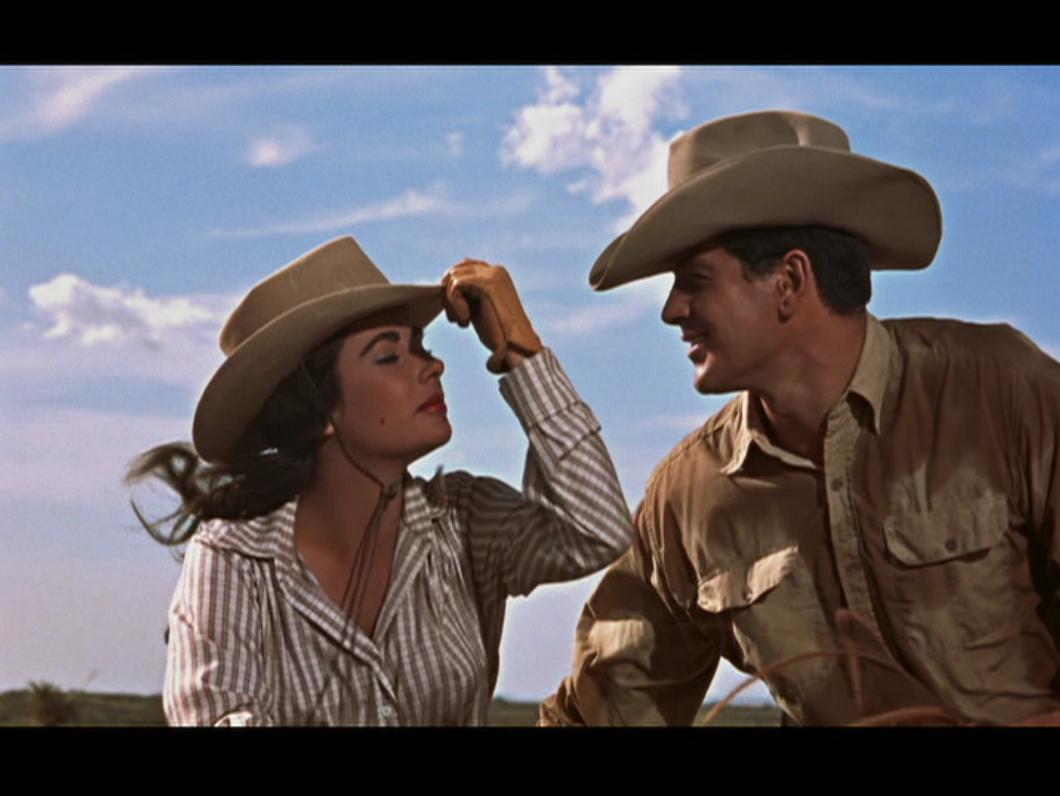
Giant is a film about my home state of Texas. Texas rancher Bick Benedict (Rock Hudson) goes to Maryland to buy a horse and ends up returning to Texas with a bride, socialite Lesley Lynnton (Elizabeth Taylor). At first, Lesley struggles to adapt to the harsh and hot Texas landscape. Bick’s sister, Luz (Mercedes McCambridge) takes an instant dislike to Lesley and Bick is annoyed by Lesley’s concern over the living conditions of the Mexicans that work on Bick’s ranch. It sometimes seems like the only person who appreciates Lesley is Jett Rink (James Dean), an ambitious ranch hand who secretly loves her and who is planning on becoming a rich man. That’s exactly what happens when oil is found on the land around Bick’s ranch. While Bick stubbornly clings to the past, oilman Jett represents both the future of Texas and the nation. Meanwhile, Bick and Lesley’s son (played by a very young Dennis Hopper) challenges his father’s casual bigotry when he falls in love with a Mexican girl.
Giant is appropriately named because it is a huge film. Clocking in at 201 minutes, Giant tells a story that spans several decades and features a big cast that is full of familiar faces, all struggling for their chance to somehow stand out from everyone else around them. Even the film’s wonderful panoramic shots of the empty Texas landscape only serve to remind us of how big the entire film is. To a certain extent, the size of Giant‘s production is to be understood. In the 1950s, Hollywood was having to compete with television and they did this by trying to make every film into a major event. You watch a movie like Giant and you practically hear the old Hollywood moguls shouting at America, “See!? You can’t get that on your precious TV, can you!?”
For those of us watching Giant today, the length is both a blessing and a curse. It’s a curse because the movie really is too damn long. The opening scenes drag and many of them really do feel superfluous. It’s hard not to feel that the real story doesn’t really start until about 90 minutes into the movie. And once the story really does get started, there’s still way too much of it for it all to be crammed into one sitting. Oddly enough, you end up feeling as if this extremely long film is still not telling you everything that you need to know. If Giant were made today, it would probably be a two-part movie on either HBO or Lifetime and it would definitely feature a lot more sex.
However, to be honest, one of the reasons that I did enjoy Giant was because it was as big as it was. I mean, the film is about Texas so of course it should be a little excessive! Everything’s bigger in Texas and that includes our movies. Add to that, Giant may be too long but it uses that length to deals with issues that are still relevant today — oil, immigration, and racial prejudice. Rock Hudson may not have been a great actor but he is at least convincing as he transitions from bigotry to tolerance.
But really, when it comes to Giant, most people are only interested in James Dean. And they definitely should be because Dean gives a great and compelling performance here. Dean brings all of the emotional intensity of the method to material that one would not naturally associate with method acting and the end result is amazing to watch. Giant was released after Dean had been killed in that infamous car wreck. I can only imagine what it must have been like to be sitting in a theater in 1956 and to see this compelling and charismatic actor towering above the world on the big screen while aware, all the time, that his life had already been cut short and he would never been seen in another film.
Even better, Dean’s new style of acting clashes perfectly with Hudson’s old style of acting, making the conflict between Bick and Jett feel all the more real and intense. Much as Bick represents old Texas and Jett represents the new Texas, Hudon and Dean represented the two sides of Hollywood: the celebrity and the artist. Needless to say, Dean wins the battle but, surprisingly, Hudson occasionally manages to hold his own.
I can’t necessarily say that Giant is an essential film. A lot of people are going to be bored by the excessive length. But if you’re a fan of James Dean or if you’re from Texas, Giant is a film that you need to see at least once.
I was at work this afternoon when my boss — who had just gotten to the office after spending the day in court — approached my desk and said, “Lisa, you like old movies, don’t you?”
“Kinda sorta,” I replied and I tried to say that with just a hint of a coy little smile to let him know that I absolutely love movies — new and old — but I’m not sure if he noticed.
“Did you know Elizabeth Taylor died today?” he asked. I guess I didn’t answer quickly enough because he then added, “She was a movie star, might have been a little bit before your time.”
Well, just for the record, I do know who Elizabeth Taylor was. And even though she pretty much retired from acting before I was even born, she was hardly before my time because — whether it was by appearing in classic films like A Place in the Sun and Giant or films like Cleopatra and Reflections in a Golden Eye that were so bad that they somehow became good — she became one of those timeless icons.
I think there’s probably a tendency to be dismissive of Elizabeth Taylor as an actress because her private life, in so many ways, seemed to epitomize every cliché of old school Hollywood scandal and glamorous excess. However, you only have to watch her films from the 50s to see that Elizabeth Taylor actually was a very talented actress who, even more importantly, had the type of charisma that could dominate the screen.
I think that’s why it was so strange to hear that Elizabeth Taylor had died. It was a reminder that, as opposed to just being an image stored on DVDs that can be viewed as often or as little as one might choose, she was actually a human being just like the rest of us.