October True Crime: The Chase (dir by Paul Wendkos)


When he died in 1988, Phillip Hutchinson was only 24 years old.

Born in Virginia, Phillip Hutchinson served in the U.S. Marines before he was discharged for desertion.  He went on to become a career criminal and a violent one at that.  By the time he was 24, he already had a long criminal record.  In Texas, he was convicted of aggravated assault and ended up with a life sentence.  He escaped from prison by stealing a truck.  (It was his third escape attempt.)  Fleeing Texas, he eventually ended up in Denver.  He is alleged to have robbed four banks in Denver before holding up the Rio Grande Operating Credit Union.  The 18 year-old teller was able to set off a silent alarm and Hutchinson ended up leading police on a chase through Denver.  Following Hutchinson in the air was a news helicopter.  At one point, Hutchinson crashed into an unmarked police car, killing Detective Bob Wallis.

After crashing his own car, Hutchinson continued to run on foot.  Eventually, he reached a trailer park.  He took John Laurienti as a hostage and forced the 73 year-old man to drive him past the police in his pick-up truck.  When the men in the news helicopter realized that the police didn’t realize that Hutchinson was in the truck, they dived down and blocked the truck from moving forward.  The cops, realizing their mistake, surrounded the truck and opened fire, killing Hutchinson while the cameraman in the helicopter continued to film.  John Laurienti escaped from the truck, uninjured.

Phillip Hutchinson really had no one but himself to be blame.  If he hadn’t robbed the credit union, he would have had the cops chasing him to begin with.  If he hadn’t rammed into the unmarked car and killed Bob Wallis, it’s possible that the police would have been more willing to negotiate before opening fire on him.  You can wonder what led to someone, by the age of 24, becoming a hardened criminal and that is something that should always be investigated.  In the end, actions do have consequences.

Phillip Hutchinson is one of those criminals who would probably be forgotten today if not for the fact that his death was not only captured on camera but also broadcast across the television airwaves.  Hutchinson has gone on to have a significant afterlife in various “documentaries.”  Remember World’s Wildest Police Videos?  (I’ve also read that the shoot-out is a popular video on various “forbidden” and “dark” websites but I’m not going to look to find out.)

1991’s The Chase was a made-for-television movie about Phillip Hutchinson and his final ride.  Casey Siemaszko plays Phillip Hutchinson as being a psycho redneck, which is probably not the far from the truth.  Siemaszko gives a good performance as Hutchinson but the majority of the film deals with the people who came into contact with Hutchinson on the final day of his life.  Ricki Lake plays the teller who set off the silent alarm.  Ben Johnson gives a moving performance as the old man who Hutchinson took hostage.  Barry Corbin plays Bob Wallis.  Megan Follows plays a drug addict who narrowly escapes Hutchinson.  Robert Beltran plays the man in the helicopter.  They all give good performances.  At the same time, for a film called The Chase, the Chase itself doesn’t actually start until we’re 70 minutes into the movie and it’s over pretty quickly.  If you’re watching this film for the action, you’ll probably be disappointed.

This film was written by Guerdon Trueblood, who also directed one of my favorite grindhouse films, The Candy Snatchers.  Trueblood’s script follows the standard disaster formula, in that there are a lot of subplots and filler leading up to the big event.  In other words, The Chase isn’t a film for everyone.  I’ll admit, though, that I teared up a little at the end.  Phillip Hutchinson may have been a violent criminal but his death brought a community together.
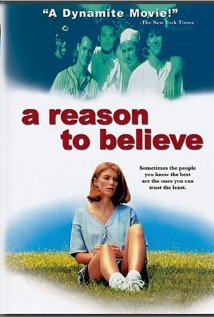
Embracing the Melodrama Part II #91: A Reason to Believe (dir by Douglas Triola)


A Reason to BelieveThroughout the late 90s, a rather obscure film from 1995 called A Reason To Believe used to show up on Cinemax fairly frequently. I was 11 when I first saw it.  At the time, I was indulging in my rebellious streak by secretly staying up past my bed time and sneaking into the living room, where I would watch whatever forbidden sordidness what being aired.  Because I didn’t want to wake anyone up, I would watch with the volume turned almost all the way down.  Hence, when I first saw A Reason To Believe, I literally had to sit less than an inch away from the TV just so I could hear the dialogue.

And I remember that, at the age of 11, A Reason To Believe really blew me away.  I thought it was one of the greatest films that I had ever seen.  The fact that the film involved college students made me feel like I was both watching a movie for adults and getting a preview of what life would be like when I was older.  All of the sex and the language made me feel like I was getting away with something while I was watching it.  At one point, there was a shot of Sharon (played by Holly Marie Combs) putting a condom on Wesley’s (Danny Quinn) erect penis and I found myself glancing over my shoulder, convinced that at any minute a responsible adult was going to enter the living room and say, “WHAT ARE YOU WATCHING!?”

So, when I recently rewatched A Reason To Believe, I did so wondering how the film would hold up now that I’m an adult.  Not surprisingly, a good deal of the film now seemed to be heavy-handed.  For every good line in the script, there was a line that was way too obvious.  Characters who were funny when I was 11 — like dorky stoner Potto (Keith Coogan) — now seemed to be annoying.  And, of course, my more experienced eyes immediately realized that Holly Marie Combs was putting that condom on a prosthetic penis.

And yet, A Reason To Believe is still fairly effective and probably deserves to be better known than it actually is.  Usually, I refuse to give extra credit for good intentions but I’m willing to make an exception for A Reason To Believe because the film deals with a subject that, now more than ever, needs to be dealt with.

Charlotte (Allison Smith) is a student at an unnamed generic university.  When her boyfriend, Wesley (Danny Quinn), has to go away for the weekend, he asks Allison not to go to Viking, an annual party thrown by his fraternity.  Charlotte promises that she won’t but then goes anyway.  At Viking, she hangs out with Wesley’s best friend, Jim (Jay Underwood).  Jim is also dating Allison’s friend, Judith (Kim Walker).  Realizing that she’s had too much to drink, Allison attempts to leave the party but instead, Jim leads her into his bedrom.  He kisses her.  She says no but Jim forces himself on her.  Repeating all the old bullshit excuses (i.e., Charlotte was flirting with him, all girls say no when they mean yes, and all the rest) Jim seems to truly believe that the sex was consensual.  Charlotte knows it was rape.

At first, Charlotte doesn’t want to face what happened.  When she finally does go to the university administration and reports what happened, the frat — including her boyfriend — comes together to protect Jim.  Charlotte’s friends — like Judith — abandon her.  Her only supporter is Linda (Georgia Emelin), an anti-fraternity campus activist who is more interested in Charlotte as a means to an end than as a human being.

A Reason To Believe held up fairly well.  Yes, it’s heavy-handed and a lot of the dialogue is too spot-on and literal.  I could have done without the scenes featuring Obba Babatunde as a bombastic professor.  However, Allison Smith and Jay Underwood both gave excellent performances in the two lead roles and the film deserves a lot of credit for not shying away from just how misogynistic the fraternity/sorority culture can truly be.  Ultimately, flaws and all, it’s a valuable, realistic, and angry portrayal of rape culture and it deserves to be seen for that reason.

It can currently be viewed on YouTube.