18 Days of Paranoia #18: Nineteen Eighty-Four (dir by Rudolph Cartier)


Well, here we are at the end of both March and the 18 days of paranoia.  We started things off with a review of The Flight That Disappeared and now, we end things with a look at the 1954 BBC production of Nineteen Eighty-Four.
“Orewllian” is a term that gets tossed around a lot nowadays, largely by people who the real George Orwell probably would have viewed rather dismissively.  Ever since the election of Donald Trump, for instance, it’s become rather common for certain people of twitter to say that “Orwell was right” or that we’re living in an “Orwellian nightmare.”  I remember after Trump’s press secretary blatantly lied about the size of the crowd at the inauguration, there was even a commercial that featured Zachary Quinto giving a hilariously overwrought reading of the final passage of George Orwell’s 1984.  “He …. LOVED …. BIG …. BROTHER!” Quinto declared while staring grimly at the camera.

Interestingly enough, many of the same people who complain about Trump’s lies being Orwellian never used the term during the previous 8 years, when we were being constantly told that a permanent recession was actually a sign of a strong economy and that if people liked their doctor, they could keep them.  The fact of the matter is that, for a lot of people, “Orwellian” is just a term that they use whenever a politician from the other side does something that they dislike.  It makes you wonder how many of them have actually read 1984 because, if they had, they would surely know that — if we truly were living in the world depicted in Orwell’s novel — no one would be allowed to acknowledge it and, in fact, Orwell and his books would have vanished down the memory hole.  Just the act of saying that we’re living in 1984 without getting sent to a reeducation camp is proof that we’re not (or, at least, we’re not just yet).

That’s not to say that 1984 isn’t an important work of literature.  In fact, it’s probably one of the most important books ever written, which is why it does it such a disservice to glibly toss around the term Orwellian.  Even if we aren’t living in Orwell’s world right now, it’s probably easier than ever to imagine a scenario where we eventually could.  The Coronavirus pandemic, for example, is just the sort of thing that could lead to the people accepting the idea that the government is meant to be a Big Brother and that those who disagree deserve to be reported for the good of the people.  It’s easy to imagine a future where people believe that history started with the Coranavirus and that everything that happened before the pandemic was just a hazy rumor, like Europe before the Renaissance.  As such, even if the term Orwellian is overused, 1984 is still a book that needs to be read and understood.

There have been several film adaptations of 1984, some of which are better than others.  My personal favorite is the 1985 film, which was directed by Michael Radford and which starred John Hurt and Richard Burton.  Running a close second, however, would be the version that was made for the BBC in 1954.

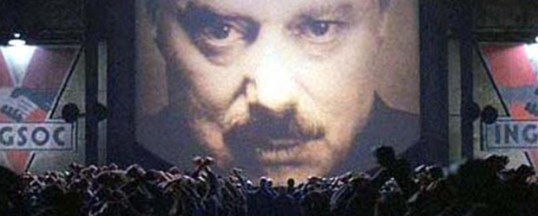
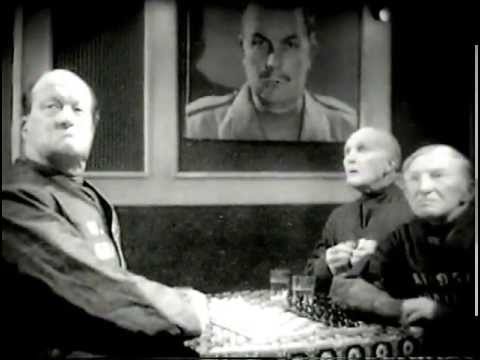
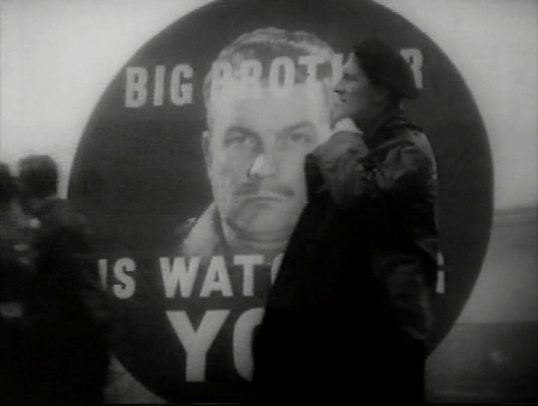
This version sticks closely to Orwell’s novel, though it downplays the book’s sexual themes.  (This is not surprising considering that this version was made for 1950s television.)  Though it condensed Orwell’s story, it hits all of the important points.  Winston Smith (Peter Cushing) is a member of the Outer Party who works at the Ministry of Truth and who lives a rather drab existence in London, “the chief city of Airstrip One.”  He is a citizen of Oceania, which has always been at war with Eurasia.  Winston lives under a system of government called Ingsoc and every day, he spends two minutes hating a mysterious figure named Goldstein.  All around him are posters of Big Brother, watching him and judging.

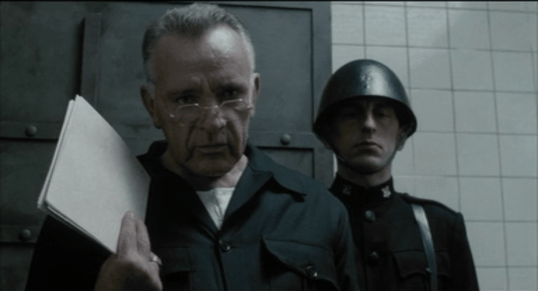
On the outside, Winston is a loyal party man but on the inside, he has questions and doubts.  How can he not when he works for the Ministry of Truth?  His job is to change history to reflect whatever the current version of it may be.  Some of his co-workers, like Symes (Donald Pleaseance), are openly cynical about what they do.  Others, like O’Brien (an imposing Andre Morell), seem as if they might be sympathetic to Winston’s doubts but Winston cannot be sure.  Meanwhile, Winston has found himself obsessed with Julia (Yvonne Mitchell), who is a member of the Anti-Sex League but who might have doubts of her own.  (Then again, she could also be a member of the Thought Police.)

When Winston is finally arrested for being a thoughtcriminal, it leads to a harrowing interrogation where he learns that truth doesn’t matter, the numbers add up to whatever the party says that they add up to, and that no one is strong enough to survive the ordeal of Room 101.

The BBC adaptation of Nineteen Eighty-Four was, for the most part, a live performance with a few filmed scenes inserted into the action.  Still, the fact that the majority of the actors were delivering their lines lives brings a certain immediacy to the film.  Everyone seem nervous and edgy.  In real life, that could have been due to the fear that they would miss a line but it also feels appropriate for people who spend every day of their life being watched and judged by Big Brother.  The entire production does an excellent job of creating a world where every minute is suffused in an atmosphere of dread and fear.  From the minute we first see him, Winston seems to know that he’s doomed.  The fact that Big Brother would rather torture and brainwash him rather than just make him disappear just makes things worse.

The production is full of actors — like Cushing, Morrell, and Pleasence — who would go on to become leading figures in the British horror industry and all of them do an excellent job bringing Orwell’s horror to life.  Peter Cushing, with his mix of intelligent features and neurotic screen presence, makes for the perfect Winston Smith and Andre Morrell is just as perfectly cast as the fearsome O’Brien.  The scene in which Winston is forced to confront Room 101 is still a harrowing one and this film perfectly nails the novel’s famous ending, doing so in a low-key manner that’s far more effective than the overwrought approach that other adaptations have brought to the final scene.

Nineteen Eighty-Four can currently be viewed on Prime.  The print is a bit grainy but that only adds to the film’s power.  It comes to us like a hazy vision of the future.
Other Entries In The 18 Days Of Paranoia:

  1. The Flight That Disappeared
  2. The Humanity Bureau
  3. The Private Files of J. Edgar Hoover
  4. The Falcon and the Snowman
  5. New World Order
  6. Scandal Sheet
  7. Cuban Rebel Girls
  8. The French Connection II
  9. Blunt: The Fourth Man 
  10. The Quiller Memorandum
  11. Betrayed
  12. Best Seller
  13. They Call Me Mister Tibbs
  14. The Organization
  15. Marie: A True Story
  16. Lost Girls
  17. Walk East On Beacon!

Film Review: Nineteen Eighty-Four (dir by Michael Radford)


Nineteen-Eighty-Four

Yesterday, as I was flipping through the channels, I came across a documentary that was being shown on This TV.  The documentary was called Nineteen Eighty-Four and it told the story of a low-level British bureaucrat named Winston Smith (who bore a strong resemblance to a youngish John Hurt)  who, after having a secret affair with a free-spirited woman, was charged with committing “thought crimes” against the state.  As a result, he was tortured by a man named O’Brien (who looked a lot like Richard Burton) until Winston finally came to love the government above all else…

What’s that?

Okay, you caught me.

This movie was not a documentary.  Instead, it was an adaptation of George Orwell’s famous novel about a dystopian future Britain (quite cleverly renamed Airstrip One in both the book and the film) where the citizens spend their time giving thanks to Big Brother, a leader who may or may not actually be a fictional creation of the ruling party.  It’s a world where everyone knows that “Big Brother is watching you” and every day is scheduled around the “two-minute hates” that are directed towards Big Brother’s enemy, Emmanuel Goldstein (who, much like Big Brother, may or may not actually exist).  It’s a world dominated by three separate superstates that are in a state of perpetual war, though we’re also given reason to suspect that the war is just as fictional as Big Brother and Goldstein might be.  It’s a world where order is kept by the Thought Police and history is regularly changed for the benefit of the ruling party.  It’s a world where people can become unpersons and cease to exist and where all good citizens understand that one plus one equals three if the government says that it does.

So, no, it’s not a documentary.

It just feels like one.

Richard Burton 1984

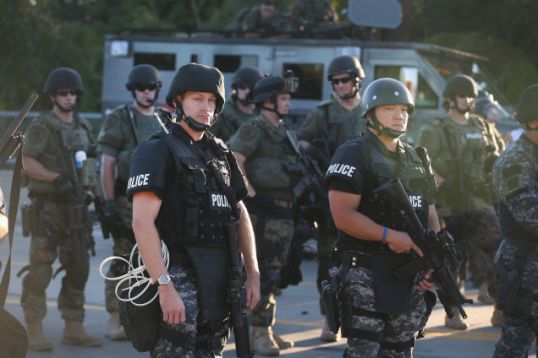
As I watched Nineteen Eight-Four, it was impossible for me not to compare Orwell’s vision of the future (which is faithfully visualized in the film) with our present world.  Even though the book was written in 1948 and this film was shot and released in 1984, it was hard not to feel as if Nineteen Eighty-Four could have just as easily been made yesterday.  Beyond the obvious NSA-as-Big-Brother comparisons that everyone makes, it was hard not to compare the brainwashed citizens waiting to hear from Big Brother with the people today who slavishly repeat whatever talking points they hear on MSNBC or Fox News.  How different, I wondered, was Big Brother railing against Goldstein from our President continually telling us that we’re at war with the “forces of cynicism” and that anyone who disagrees with him is not just expressing an opinion but instead is being unpatriotic?  When O’Brien explained how the Party stayed in power by keeping the people perpetually angry at unseen enemies, he might as well have been talking about our own elected officials.  And, when the Thought Police finally arrested Winston and Julia, it brought to mind the images of the militarized police force of Ferguson, Missouri.

And that, I think, is why Nineteen Eighty-Four remains so powerful as both a book and a film.  We live in a world where we are told more and more often that, regardless of what it does, the government is in charge and must be obeyed.  We live in a world where we are currently told that good citizens must obey the law simply because it is the law.  We’re told not to question why a police force needs to resemble an invading army.  We’re told not to question why a member of the police force might happen to shoot an unarmed black teenager multiple times.  We’re told not to question the official history.  Instead, we’re just supposed to live in a state of blind obedience and accept, on faith alone, that those in charge are always right.  We’re supposed to “respect authority” and not think about the specifics.

Thought Police or the Ferguson PD?

Thought Police or the Ferguson PD?

In short, we’re living in the world of Nineteen Eight-Four whether we realize it or not.

As for the film itself, it’s a powerful and surprisingly faithful adaptation of Orwell’s novel.  John Hurt is perfectly cast as Winston Smith and Suzanna Hamilton is sympathetic as Julia.  The two of them have a very real chemistry in this film and it makes the inevitable final scenes all the more disturbing and tragic.  This was also Richard Burton’s final film.  After years of alcoholism, Burton died shortly after filming ended and he looks ill throughout Nineteen Eighty-Four.  But his obvious ill-health actually works to the role’s advantage.  As played by Burton, O’Brien becomes the perfect embodiment of the morally corrupt ruling Party.  The scenes where O’Brien tortures Hurt as difficult to watch, as they should be.  But both Hurt and Burton give such committed performances that you can’t look away even when you want to.  Finally, Nineteen Eighty-Four was an early job for the great cinematographer Roger Deakins and the film has a memorably bleak look to it.  The drabness of Air Strip One perfectly mirrors the empty life of its citizens and it serves as a perfect contrast to the lushness of Winston’s fantasies.

Nineteen Eighty-Four is not an easy film to watch but it’s one that everyone should track down and see.  Watch it and ask yourself how different 1984 is from 2014.

1984-john-hurt

The Worst Freakin’ Commercial Of All Time


So, about a month and a half ago, Arleigh and I had a little disagreement on which commercial deserved the title of Best Freakin’ Commercial Of All Time.  I argued for the cute little Kia commercials featuring the Sockmonkey and the Freaky Red Thing in Vegas.  Arleigh, however, claimed that the title actually belonged to a series of ads featuring a scary football player destroying stuff and selling deodorant.  Okay, that’s fine.  Friends can disagree.  In the end all that matters is that I love Sockmonkey and Sockmonkey loves me and we don’t care what you think.  So there.

However, all throughout that debate, neither one of us mentioned any possible contenders for the worst commercial of all time.  To be honest, there’s probably too many contenders to really pick just one.  However, I definitely have a least favorite and here it is…

Okay, maybe this isn’t the worst commercial of all time.  In fact, in many ways, it’s oddly effective.  However, if it’s not the worst, it’s certainly the most insulting. 

What are my specific objections to this commercial?   Thank you for asking.

1) I don’t care how effective the freaking 3-D was, the story still sucked!  Oh, wait a minute.  That’s my specific objection to Avatar.  Sorry, it’s been a long week.

Okay, let’s try this again.

1) First off, do I really need a car company to tell me what it means to be an American?  Ever since they got their asses bailed out in ’09, American car companies have been producing the most pompous, condescending commercials possible.  Whereas once we just saw footage of people driving too fast, car commercials today just feel like propaganda.  Now, car commercials are narrated somber men going, “You know what America needs?  America needs a comeback.”  No, America doesn’t need a comeback.  You guys just need to get your shit together.  This commercial continues the new tradition of condescending car commercials. 

2) “We have always been a nation of builders…”  Actually, we’ve also been a nation of poets, artists, freethinkers, farmers, atheists, politicians, libertines, and just about every other category under the sun.  I kinda thought that was the whole point.  I mean, is this a car commercial or is it an educational video? 

3) If you’re going to brag about how America is responsible for the Colt Revolver then at least have the balls to actually show a Colt Revolver while you’re doing it.  A bunch of horses races at the Kentucky Downs while a bunch of rich people sit in the stands and cheer has absolutely nothing to do with the Colt Revolver.  The Colt Revolver was not named after a horse, it was named after the man who invented it.  For the most part, horses were imported to America from Asia by way of Europe.  So, just because whoever made this commercial was scared to show a gun, they instead show an image that totally negates the commercial’s message.

4) What’s up with the weird little guy in that radiation suit?  I mean, does he not look like a villainous doctor from some horrific science fiction movie from the early 80s?  Do we really want someone like that working with radioactive material?

5) Yes, I understand the background music is taken from Johnny Cash song and who doesn’t love Johnny Cash?  But the music is still annoyingly repetitive, like the sort of thing that they play to dull your brian during a brainwashing session.

6) “As a people, we tend to do well…”  You know what, Mr. Smug Narrator Man?  As a person, I do well when I’m not building anything at all.  Don’t insult me with all that “as a people…” BS.

7) “The Things We Make, Make Us.”  Seriously, this is the type of empty, collectivist statement that would make George Orwell throw a fit.  Animal Farm much?