The 26th film in Mill Creek’s Fabulous Forties box set was the 1944 British film, The Way Ahead (or, as it was retitled when it was released in America, The Immortal Battalion).
Directed by Carol Reed (who was five years away from directing the great The Third Man), The Way Ahead is a British propaganda film that was made to boost the morale of both a weary British public and the army during the final days of World War II. Usually, when we call something propaganda, it’s meant as a term of disparagement but The Way Ahead is propaganda in the best possible way.
The film follows a group of British soldiers, from the moment that they are conscripted through their training to their first battle. (In many ways, it’s like a more refined — which is another way of saying “more British” — version of Gung Ho!) As usually happens in films like this, the newly conscripted soldiers come from all sections of society. Some of them are poor. Some of them are rich. Some of them are married. Some of them are single. In fact, when the film first begins, the only thing that they all have in common is that they don’t want to be in the army.
As they begin their training, they resent their tough sergeant, Fletcher (William Hartnell), and are upset that Lt. Jim Perry (David Niven, giving a very likable performance) always seems to take Fletcher’s side in any dispute. However, as time passes by, the soldiers start to realize that Fletcher is looking out for them and molding them into a cohesive unit. Under his training, they go from being a group of disorganized and somewhat resentful individuals to being a tough and well-organized battalion.
Though they’re originally skeptical that they’ll ever see combat, the battalion is eventually sent to North Africa. However, their ship is torpedoed and, in a scene that remains genuinely impressive even when viewed today, the men are forced to abandon ship while explosions and flames light up the night sky. By the time that they do finally reach North Africa, they are more than ready to fight…
The Way Ahead plays out in a semi-documentary fashion (it even features a narrator who, at the end of the film, exhorts the audience to stay firm in their commitment) and it’s a fairly predictable film. If you’ve ever seen a war film, you’ll probably be able to predict everything that happens in The Way Ahead. That said, The Way Ahead is a remarkable well-made and well-acted film. The cast is well-selected (and features a lot of familiar British characters actors, some making their film debut) and David Niven is the perfect choice for the mild-mannered but firm Lt. Perry. Even though I’m not a huge fan of war films in general, I was still impressed with The Way Ahead.
Of all the monsters who have appeared in horror cinema, Count Dracula is perhaps the most iconic. Reportedly, Dracula first appeared on film in 1920, in a silent Russian film that is now considered to be lost. In 1921, he would appear in a Hungarian film called Dracula’s Death and in 1922, he would be renamed Count Orlok for the German masterpiece Nosferatu. Indeed, by the time Bela Lugosi gave his famous performance in Tod Browning’s Dracula, the count had been appearing in films for at least 11 years. In nearly 100 years of filmmaking, a countless number of actors have brought Dracula to life.
We could spend hours debating who was the best Dracula and certainly, there are some worthy contenders. Bela Lugosi brought a continental sophistication to the role, while John Carradine was properly intimidating and theatrical. Udo Kier, Gary Oldman, Thomas Kretschmann, Leslie Neilsen, Zandor Vorkov, and Frank Langella have all played the prince of darkness, to varying degrees of success.
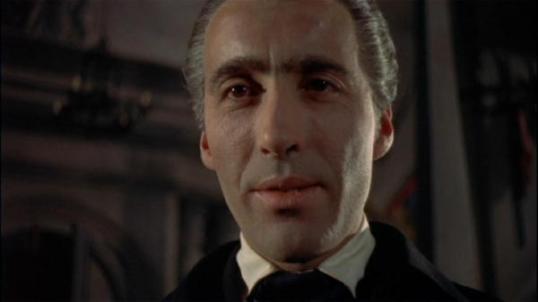
Yet for me, as worthy as any of those actors may be, there is only one true Dracula and he was played by Christopher Lee.
Lee famously played Dracula in seven movies for Hammer Films and, though he has often complained about the quality of these films (especially the later ones, which tended to mix Dracula with hippies), they were largely responsible for making Christopher Lee into the iconic figure that he remains today. It’s also largely due to Lee’s performance that horror fans like me continue to discover and appreciate the films of Hammer today.
As played by Christopher Lee, Dracula was pure evil. Lee’s Dracula had no use for self-pity and one can only imagine what his reaction would have been if he had ever run into the self-torturing vampires of Twilight. Lee’s Dracula had no use for doubt or regret. Instead, he was a determined animal who was driven by a singular lust for blood.
And yet, at the same time, Lee brought an intelligence to the role that was often lacking in previous performances. Lee’s Dracula may have been an animal but he was a cunning animal. Whereas it’s easy for me to imagine escaping from the clutches of Bela Lugosi, I know that if Lee’s Dracula wanted me then he would have me. There’s no escape from Lee’s Dracula. He’s too quick, determined, and intelligent.
His animal nature made Lee’s Dracula frightening but it was his cunning and determination that made him dangerous and, ultimately, even sexy. (While I’ve read that audiences in 1931 swooned over Bela Lugosi, whatever sex appeal he may have had is lost on modern viewers like me.) It has often been argued that Bram Stoker meant for Dracula to be a symbol of all the desires that were repressed by Victorian society. That’s certainly true when it comes to Christopher Lee’s carnal and viscous portrayal of the character.
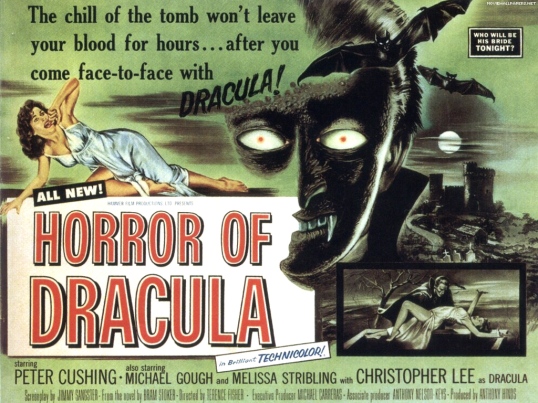
Of the seven Dracula films that Christopher Lee made for Hammer Films, the first remains the best. Released in 1958 and known as Dracula in the UK and the Horror of Dracula in the US, it revitalized the horror genre and helped to make stars of both Christopher Lee and Peter Cushing. Especially when compared to some of the sequels that Hammer subsequently produced, it remains one of the best Dracula films ever made.
The film is a very loose adaptation of Stoker’s original novel. Jonathan Harker comes to Dracula’s castle in Romania. Though posing as a librarian, Harker has actually come to the castle to drive a stake through the heart of both Dracula and his vampire bride. However, no sooner has Harker staked the bride than he’s overpowered and bitten by Dracula. Significantly, all of this occurs within the first 10 minutes of the film. As opposed to certain other Dracula films, Horror of Dracula gets straight to the point. And why shouldn’t it? After all, anyone watching the film already knows that Dracula’s a vampire so why waste time trying to convince us otherwise? We don’t watch Dracula for the familiar story as much as we watch to discover how different filmmakers will choose to tell that story.
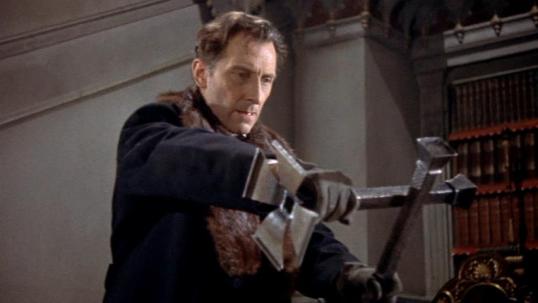
When Harker’s colleague, Prof. Van Helsing (played with the perfect amount of intensity by Peter Cushing) shows up at the castle, he discovers that Harker is now a vampire and that Dracula is nowhere to be found.
Dracula, needless to say, is out for revenge. He stalks Harker’s fiancee Lucy, as well as Lucy’s brother Arthur Holmwood (Michael Gough) and his wife Mina (Melissa Stribling). Much as in Stoker’s original novel, Lucy is eventually turned into a vampire and it’s up to Van Helsing and Arthur to stop both her and her new master.
(Of course, in Stoker’s original novel, Harker is not turned into a vampire and instead marries Mina while the aristocratic Arthur is one of Lucy’s three suitors. However, I have to say that I always thought the literary Harker was a bit on the dull side and that Arthur was always my favorite character so I’m happy that he gets to be the hero here.)
If I had to pick one film to epitomize everything that I love about the Hammer brand of horror, it would be Horror of Dracula. As directed by Terrence Fisher, the film moves at an exciting, non-stop pace while the traditionally lush cinematography is almost bombastically colorful. Cushing and Lee, who were the best of friends off screen, make for formidable opponents, with Cushing embodying good just as effective as Lee embodied evil. Though it’s been over 50 years since Horror of Dracula was originally released, the film remains effective and, not coincidentally, a lot of fun.
Quite simply put, this is a film that, for so many reasons, remains a true pleasure to watch.
One final note — I often find myself lamenting that I was born several decades too late and I realize just how true that is whenever I watch a film like Horror of Dracula. Seriously, I would have loved to have been a Hammer girl, showing off my cleavage and getting hypnotized by Christopher Lee.


 Through the Shattered Lens