The Lucky Texan (1934, directed by Robert N. Bradbury)


After graduating from college, Jerry (John Wayne) travels down to the ranch owned by his uncle, Grandy (George “Gabby” Hayes).  Jerry wants to look after the cattle but it turns out that Grandy doesn’t have any more cattle.  They’ve all been stolen by rustlers.  What Grandy does have is a dog, some horses, and a granddaughter named Betty (Barbara Sheldon) who Jerry is eager to marry even though the two of them are related.  Things start to look up when Grandy and Jerry discover gold in a nearby creek.  When a crooked assayer named Mr. Harris (Lloyd Whitlock) and a rustler named Joe Cole (Yakima Canutt) find out about the creek, they scheme to steal both it and the ranch from Grandy.  It’s up to Jerry to save the ranch and to expose the bad guys, even after they attempt to frame him for murder.  Fortunately, both Jerry and Grandy have a few tricks up their sleeves.

This was one of the many B-westerns that John Wayne did for the poverty row studios in the years before Stagecoach made him a star.  (Though the film is a western with its ranches and its search for gold, the climax features Gabby Hayes driving a car so it’s hard to say for sure when it’s supposed to be taking place.)  Though he seems too old to be playing a recent college graduate (John Wayne was 27 when he starred in The Lucky Texan but he looked closer to 40), Wayne gives a relaxed and likable performance as Jerry.  Watching him in this film, it’s possible to see hints of the screen presence that led to John Ford casting him as the Ringo Kid in Stagecoach.  As always, Yakima Canutt is on hand to do some impressive stuntwork during the film’s many chase scenes and Gabby Hayes provides the comic relief.  Like most of the poverty row productions, the film can seem more than a little creaky by today’s standards but fans of John Wayne will not be disappointed with either his performance or the film’s action.

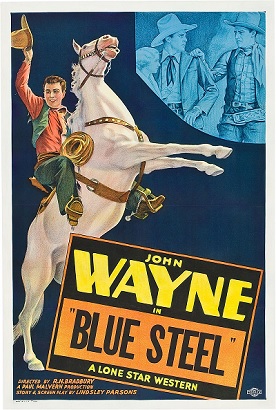
Blue Steel (1934, directed by Robert N. Bradbury)


On a stormy night, frontier Sheriff Jake Withers (George “Gabby” Hayes) and undercover U.S. Marshal Carruthers (John Wayne) both check into the same inn.  They are both searching for the infamous Polka Dot Bandit (Yakima Canutt), who has been burglarizing homes and businesses all over California.  They both figure that, on a rainy night like this, there’s no way that the Bandit is going to be out.  It turns out they are both wrong.  The Bandit breaks into the inn and robs the safe but also leaves behind one of his spurs.  The sheriff comes across Carruthers investigating the safe and mistakenly believes that Carruthers is the bandit.

Later, when Sheriff Winters goes out to Carruthers’s cabin, he’s planning on arresting Carruthers.  Before he can do so, they both hear gun shots.  Outside, another group of bandits is chasing Betty (Eleanor Hunt) and her father.  The Sherriff and Carruthers manage to save Betty but her father is killed.  The grieving Betty is taken in by a local rancher named Malgrove (Edward Peil, Jr.) but it turns out that Malgrove is the head of the Polka Dot Gang and he is planning on killing Betty in order to keep a shipment of supplies from coming to the town!  Carruthers and the sheriff have to work together to thwart Malgrove’s plan and bring the Polka Dot Bandit to justice.

This 54-minute programmer was one of the many B-westerns that John Wayne made for Monogram Pictures in the days before John Ford made him a star by casting him in Stagecoach.  Though Wayne was still learning how to act on camera, the screen presence that would make him a star can be seen in Blue Steel and he and Hayes make a good team.  The story is simple enough but there’s enough horse riding and fistfights to keep most B-western fans entertained.  It’s still hard not to imagine how much different the movie would have been if the sheriff had arrested Carruthers at the scene of the crime instead of letting him ride out to his cabin.  It’s a good thing these old programmers never had to make too much sense.

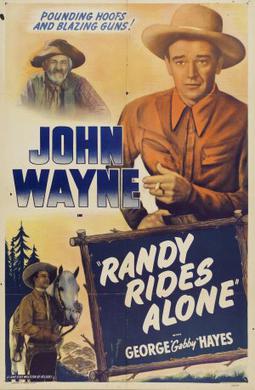
Randy Rides Alone (1934, directed by Harry L. Fraser)


Randy (John Wayne) rides his horse into a frontier town.  He is planning to pay a visit to his old friend, saloon owner Ed Rogers.  But when Randy enters the saloon, he discovers that everyone, including Ed, has been shot dead and a hand-written note has been left by the perpetrator, warning the sheriff not to come after him.

The sheriff and a posse of citizens arrive at the saloon and refuse to believe Randy when he says that he didn’t commit the crime.  Matt the Mute (George Hayes, before he became known as Gabby) hands the sheriff a note in which he suggests arresting Randy and hanging him for the crime.  Matt’s note is written in the same handwriting as the note that was left at the saloon but no one notices because Matt has a reputation for being a fine, upstanding citizen.

With the help of Ed’s niece, Sally (Alberta Vaughn), Randy escapes from the posse and makes his way to a cave, which he discovers is the hideout for a gang of thieves led by Matt the Mute, who isn’t even a mute!  When the gang kidnaps Sally, Randy has to rescue her and clear his name.

A 56-minute programmer, Randy Rides Alone is one of the many B-westerns that John Wayne made before Stagecoach made him a star.  In the 30s, every poverty row studio was churning out short westerns that would play as double features and which would entertain audiences looking for an escape from the present day.  Randy Rides Alone is one of the better examples of the genre, due to John Wayne’s authoritative presence and a better-than-average plot.  The opening, with a smiling John Wayne entering the saloon just to discover that all of his friends have been murdered, establishes the stakes early on and the movie is as much about revenge as it is about Randy clearing his name.  George Hayes, who became best known for playing comedic relief sidekicks, is an effective villain.  The film’s target audience was probably bored with Sally and Randy falling in love but they also probably enjoyed Randy climbing a mountain to rescue her.  The movie ends with Sally announcing that Randy won’t be riding alone much longer.  Randy may have settled down but John Wayne had 150 more films ahead of him.