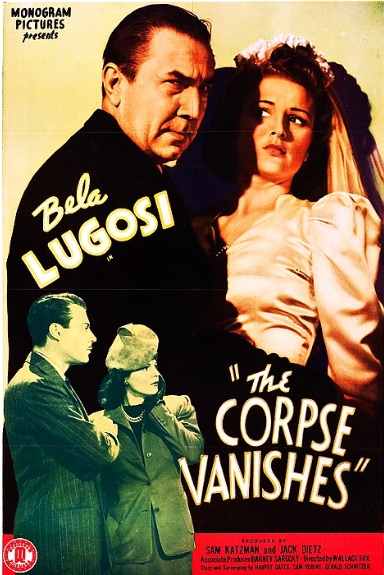
Horror Film Review: The Corpse Vanishes (dir by Wallace Fox)


1942’s The Corpse Vanishes opens with a young bride collapsing at her wedding.  A doctor runs over to her and says that she’s died.  A hearse — or a “stiff wagon,” as one witness puts it — pulls up and takes the body.  However, the body never reaches the morgue!

It turns out that this is not the first time this has happened.  In fact, there’s an epidemic of brides dying on their wedding day and their bodies disappearing.  One would think that this would cause a citywide panic or, at the very least, it would cause some people to maybe get married out-of-town.  Considering that the most recent victim was the daughter of one of the richest families in the community, you would think solving this mystery would be the police’s number one priority.

However, the police are useless.  And when the police can’t get the job done, it falls to journalists.  At least, that’s the way it worked in movies from the 1930s and the 40s.  While the cops were busy saying, “Scram!” and “Beat it, buster!,” it fell to the cynical and quick-witted journalist to find out what was going on.  In this case, Patricia Hunter (Luana Walters) investigates and discovers that all of the brides received an orchid on their wedding day.  (How the police didn’t notice this, I don’t know.)  Patricia tracks down the eccentric Dr. Lorenz (Bela Lugosi), who was once quite renowned for his orchids.

Dr. Lorenz now lives in a secluded mansion.  He’s polite when Patricia comes to speak to him but it’s obvious that he’s hiding something.  A sudden thunderstorm leads to Patricia and Dr. Foster (Tristram Coffin) getting stranded at Lorenz’s mansion.  Foster was visiting the mansion to examine Lorenz’s wife, the Countess (Elizabeth Russell).

Lorenz, as you probably already guessed, is behind the corpse abductions.  Except, of course, the brides aren’t dead.  Instead, the orchid has put them into a state of suspended animation.  Lorenz is extracting their blood and using it to keep his wife young.  Helping him out are his servants, a dwarf named Toby (Angelo Rossitto), Toby’s hulking half-brother, Angel (Frank Moran), and their mother, Fagah (Minerva Urecal).  Patricia figures out what is going on but will she be able to convince anyone else!?

From what I read about the film online, it would appear that The Corpse Vanishes has got a terrible reputation but, when I watched it, I actually found it to be entertaining when taken on its own Poverty Row terms.  No, the plot doesn’t make any sense.  But Bela Lugosi’s smile manages to be both sinister and inviting and Toby and Angel make for good henchmen.  The movie only has a 64-minute runtime and, as a result, the plot has to keep moving fairly quickly.  The film also features a lot of snappy “newsroom” dialogue between Patricia and her easily-annoyed editor (Kenneth Harlan), all delivered at a fast pace and with the the casually cynical outlook that makes 1940s newspaper movies so entertaining.  The Corpse Vanishes is a thoroughly ludicrous film that epitomizes an era and, as such, it’s far more diverting than one might otherwise expect.

GANG WAR (1958) – a young Charles Bronson testifies against the mob!


Charles Bronson starred in four movies and one TV show in 1958. Two of those movies were produced by Harold Knox, written by Louis Vittes, and directed by Gene Fowler, Jr. The first of the two films was SHOWDOWN AT BOOT HILL, an excellent low budget western that featured Bronson as a bounty hunter with a chip on his shoulder and love in his heart. The second film was GANG WAR. 

In GANG WAR, Charles Bronson plays Alan Avery, a high school teacher in Los Angeles who’s walking home one night and happens to witness a gangland killing. He calls the police to report the murder, but he doesn’t want to get any further involved so he doesn’t give them his name. Avery was on his way home from a trip to the pharmacy where he had picked up a prescription for his pregnant wife (Gloria Henry) who is suffering from migraines. In the stress of the moment, he left the pharmacy sack in the phone booth and the police are able to track him down to his home. After being pressed by the police, Avery reluctantly agrees to testify. He’s a great witness as he’s able to give the police a description of the car and its license plate number. His information leads to the arrest of Joe Reno, the second in command to mobster Maxie Meadows (John Doucette). Maxie sends his attorney Bryce Barker (Kent Taylor) over to the police station to see Captain Finch. Finch happens to be on Maxie’s payroll, and he immediately tells Barker about the witness. He even leaks it to the press so they can run a story revealing Avery’s name and address. Maxie would prefer to buy Avery’s silence, but he also wants a little insurance, so he sends his punch drunk henchman Chester over to slap around Avery’s wife. This order is akin to asking Lennie Small from OF MICE AND MEN to go play with some puppies. Simple-minded Chester proceeds to kill Mrs. Avery. When Avery comes home and finds his wife dead, he heads directly to Maxie’s house to kill him. The cab driver who took Avery to Maxie’s place just happened to see his gun, so he called the cops. Just before Avery can squeeze off a kill shot, the police show up and arrest him. Pissed that Avery was able to get so close to killing him, Meadows puts an actual hit out on him this time. Will the high school teacher be able to survive his battle against the mob?!!

(Note: The analysis below ventures into spoiler territory for both GANG WAR and SHOWDOWN AT BOOT HILL. You may want to watch these films prior to reading the rest of the review.)

As a lifelong fan of Charles Bronson, I really appreciate his work with director Gene Fowler, Jr. in 1958. Fowler recognized Bronson’s charismatic screen presence, but he also recognized something deeper in the legendary icon… his heart. SHOWDOWN AT BOOT HILL seemed to be giving us Bronson as a typical western hero, only to reverse course and turn Bronson into a romantic lead who would choose to throw down his guns so he could establish roots in a community and spend his life with the woman he loves. In a similar way, GANG WAR seems to be setting Bronson up to be a vigilante, not much different than the type of character he would be portraying throughout the 70’s and 80’s. But when 70’s and 80’s Bronson would be pulling his trigger, Fowler presents a more thoughtful Bronson who recognizes that the best revenge can sometimes be in letting someone live with the consequences of their own decisions. This allows him to lower his gun, walk away and continue his life free of the guilt and the legal consequences that would undoubtedly come with taking another person’s life. This decision honors his wife’s legacy much more than murder and a lifetime in jail ever would. 

There are many good performances in this little gem. Bronson may not have been a “star” when this film was made, but there is no doubt that he was ready. He simply commands every frame that he appears in from the beginning to the end. John Doucette and Kent Taylor are also memorable as the gangster and his paid off lawyer, respectively. Doucette’s Maxie Meadows is certainly a stereotype of the gangsters in TV’s and movies at the time, but he plays the part well, saving his very best for his last moments of the film. Kent Taylor has the movie’s best story arc. When we meet him, he’s an alcoholic who can’t stand what he’s allowed himself to become, yet he continues to run every time Maxie calls. It’s a strong moment when he decides he won’t do it anymore. And Jennifer Holden is simply gorgeous as Marie, Maxie’s woman. Speaking of nice scenery, it was also fun seeing a Los Angeles that included landmarks like the Capitol Records Building and the old Nickodell Restaurant. So much of the action in GANG WAR takes place against these iconic backdrops, and for a guy who’s never been to LA, seeing these places again almost makes me feel like a resident.

Overall, while GANG WAR does feel like an old fashioned 50’s movie, it has plenty of things to recommend it, not the least of which is an excellent performance from a young Charles Bronson. At a 75 minute run time, it’s definitely worth a viewing.

The trailer for GANG WAR is presented below: