In a magical land of dragons and fierce warriors, the evil sorcerer Kadar (Richard Lynch) attacks a peaceful group of traveling entertainers, slaughtering the majority of them and kidnapping their queen, Canary (Virginia Bryant). Canary has a magical ruby that Kadar hopes will increase his power. Canary also has two sons who are each sold separately into slavery. Years later, these muscle-bound twins, Kutchek (Peter Paul) and Gore (David Paul), will be reunited and will team up to save their mother, fight a dragon, and free the kingdom from Kadar.
An Italian-American co-production that was directed by Ruggero Deodato and distributed by Cannon, TheBarbarians was a starring vehicle for the so-called Barbarian Brothers. Peter and David Paul were twin bodybuilders who appeared in a handful of films and who are today best-known for getting cut out of Oliver Stone’s Natural Born Killers. (In his director’s commentary, when explaining why their scene didn’t work, Stone said, “It was my fault.”) Peter and David Paul were not natural-born actors. They’re both pretty stiff in TheBarbarians but their natural chemistry as brothers made up for a lot. They spend most of their screentime in The Barbarians bickering and yelling at each other and you get the feeling that was something they had a lot of experience with.
TheBarbarians starts slow. It takes a while to get going and the plot has the ramshackle feel of many Cannon productions. Richard Lynch, as always, is a great villain and familiar faces like Michael Berryman and George Eastman have small roles. Trying to keep track of who is betraying who can require keeping a scorecard while watching the movie but The Barbarians does a good job of creating its fantasy world (and it looks really good for a film that was probably not made for much money) and once the action finally does get started, there’s enough of it to keep things entertaining. The Barbarians battle not only Kadar’s sorcery but a dragon as well and they do it all while trash talking each other. The film feels like a cross between Dungeons and Dragons and a regional wrestling production. It’s entertainingly dumb.
A film about David, the young shepherd and musician who eventually became the second king of Israel?
That sounds like a great idea!
After all, David is one of the most compelling figures in history. Whether it’s the slaying of Goliath or his ill-fated friendship with Jonathan or his uneasy relationship with Saul, every detail about David’s youth feels perfect for cinematic drama. And then, once David become king of Israel, the drama doesn’t end. David finds himself dealing with both politics and temptation. He falls in lust with Bathsheba and, in a moment of terrible weakness, he arranges for her husband to be killed in battle. His own son, Absalom, turns against him and then, despite David’s very clear orders to the contrary, Absalom is executed while he helplessly hangs from a tree. For every triumph in David’s life (like the time he used a slingshot to take down Goliath), there’s a tragedy. For all of David’s attempts to be a good and wise king, he still struggles with his own weaknesses. Every detail of David’s life seems like it belongs on the big screen.
So, now that we’ve agreed that the life of David would be perfect for a movie, consider this: A film about David, a master of both poetry and politics who was known for his deep emotions, starring Richard Gere?
Uhmmmm….
The 1985 film, King David, has all the potential to be a great film but it’s pretty much doomed by the fact that David is played by Richard Gere. Today, of course, Richard Gere is an above average character actor who is well-cast as older, seemingly successful men who have never quite conquered their own self-doubt. That’s not the Richard Gere who shows up in King David. The Richard Gere who shows up in King David is the blank-faced, youngish Richard Gere who was best-known for films like An Officer and a Gentleman and American Gigolo. Richard Gere is so miscast as David that just the sight of him takes you out of the film’s reality. While the film plays out, you find yourself saying, “Richard Gere just killed Goliath. Richard Gere just spied on Bathsheba. Richard Gere is dancing through the streets of Jerusalem.”
There are a few good things about King David. Edward Woodward gives a good performance as Saul, who has always been overshadowed David but who was, in his own way, almost as compelling a character. The film does a credible-enough job recreating the ancient world and it’s entertaining to see the iconic Italian actor George Eastman show up as Goliath. Far too often, though, King David becomes one of those films where every big action scene is shown in slow motion and there’s too many close-ups of swords being tossed into the air.
According to Wikipedia (that’s right, I did some “serious” research for this review), King David was actually made because it was felt that the film would be able to draw in the same audience that loved Star Wars. That turned out to not be true as the film was a huge flop and apparently damaged a lot of careers. But, flop or not, it was still on TV last night, which just proves that movies are forever.
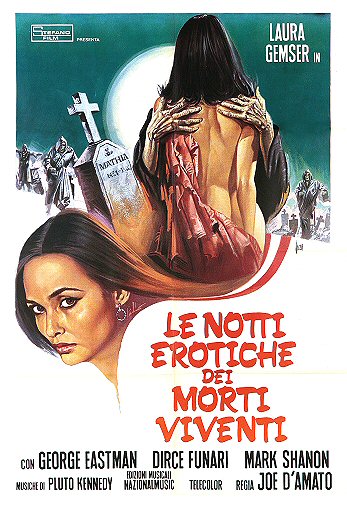
Yes, I know that The Erotic Nights of the Living Dead sounds like something that someone made up but the movie totally exists and you probably won’t be surprised to know that it really doesn’t live up to the brilliance of the name. There is a lot sex but most of it involves a really unattractive guy with a mustache and a perm that makes him look like he should be a part of Anchorman‘s Channel 5 Action News Team so it’s debatable how erotic it is. The living dead do show up and, let’s give credit where credit is due, the zombie effects are undeniably well done. They really do look like the dead come back to life. However, none of the zombies are particularly sexual. There is a ghost who, in close-up, castrates a man while giving him a blow job but, since she’s a ghost, it’s debatable whether or not she can truly be considered one of the living dead. Finally, the title promises us “nights of the living dead” but it’s really more of an evening of the living dead.
Details matter.
Released in 1980, The Erotic Nights of the Living Dead was directed by Aristide Massaccesi, a filmmaker who was better known by the name Joe D’Amato. D’Amato had a deserved reputation for directing some of the sleaziest Italian exploitation flicks of all time, though he also directed one of my personal favorites, Beyond the Darkness. (For the record, Joe D’Amato was not the only alias used by Massaccesi. Over the course of his long career, he was credited under at least 43 different names. Also, for the record, I’ve read several interviews from people who worked with Massaccesi and, without fail, all of them have reported that he was one of the nicest and most generous people that one could hope to work with during the Italian horror boom of the 1980s.)
The Erotic Nights of the Living Dead is really two bad films in one. The first film features a land developer named John Wilson (Mark Shannon). Wilson has purchased an island and wants to build a luxury hotel on the island. However, he’s having some trouble convincing anyone with a boat to give him a ride out to his property. It seems that the location has a bad reputation. John finally convinces local boat captain and adventurer, Larry O’Hara (George Eastman), to take him to the island. Accompanying them is Fiona (Dirce Funari) who is either John’s girlfriend or just didn’t have anything better to do. (To be honest, it was kind of hard to follow.) Before heading out for the island, John takes a long shower with two prostitutes and Larry languidly watches as a stripper does a dance that involves popping a champagne cork without using her hands.
The second movie involves the trip to the island. It turns out that the island isn’t as deserted as Mark assumed. There’s an old man with a massive bump on his head. There’s also the man’s mysterious daughter, played by Laura Gemser who also starred in D’Amato’s Black Emanuelle films. The old man and his daughter warn everyone that they should leave the island but, of course, people are stupid.
Anyway, there are two good things about The Erotic Nights of the Living Dead. First off, the great George Eastman gets a lengthy scene in which he giggles like a madman and it’s fun to watch because Eastman truly throw himself into the performance. Secondly, the arrival of the zombies is heralded by a mysterious black cat. The cat has the most Hellish meow that you’ll ever hear but he’s a black cat so he’s cute.
In the end, though, the best thing about The Erotic Nights of the Living Dead is the title.
— Big Ape (George Eastman), asking the question that everyone’s wondering in
2019: After The Fall Of New York (1983)
“Giara, if love had any meaning in the world, you would be the one I love.”
— Parsifal (Michael Sopkiw) in 2019: After The Fall of New York (1983)
New York City was a frequent location for Italian exploitation films and why not? Seeing as how most of the Italian exploitation films of the 70s and 80s were specifically designed to pass for an American product (with the actors and directors often credited under Americanized pseudonyms), it would only make sense to use America’s best-known city. Interestingly enough, these films rarely portrayed New York as being a very pleasant place. There was always either a mob war or a zombie invasion or police corruption or a madman with a knife to deal with. This portrayal of New York as Hell-on-Earth reached its logical conclusion with Lucio Fulci’s The New York Ripperbut even films less extreme than Fulci’s still presented New York as representing every negative thing that has ever been thought about Americans.
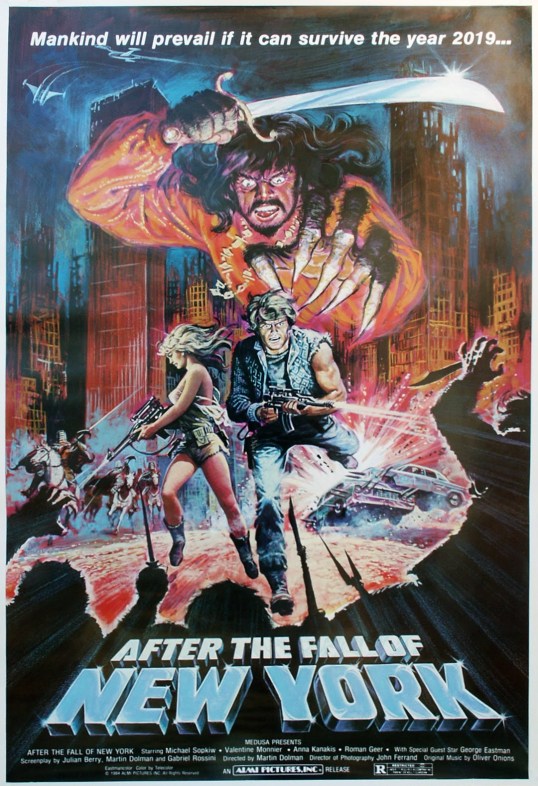
After the international success of the first two Mad Max films and John Carpenter’s Escape From New York, there was a handful of Italian films that were meant to portray what life would be like in New York after a nuclear apocalypse. (In most cases, life would not be pleasant.) Of the films that made up this odd, yet undeniably energetic genre, 1983’s 2019: After The Fall of New York is one of the best.
Every post-apocalyptic film opened with the task of explaining who went to war with who. In this case, the war was started 19 years earlier by the European-Asian Alliance. After reducing America to atomic rubble, the Euracs (as they’re called) set up their headquarters in New York. When 2019: After the Fall of New York opens, the few radiation-scarred survivors have been reduced to living in the sewers and eating rats. The Eurac army rides through the streets atop white horses, capturing survivors and subjecting them to terrible medical experiments. Consider this: 2019: After The Fall of New York was an Italian-made film about evil Europeans (including, presumably, soldiers recruited from Italy) invading America. If you ever had any doubt about how determined the Italian film industry was to appeal to American audiences, 2019: After The Fall of New York should erase them.
Despite losing the war, there is still an American government. The President of the Pan-American Confederacy (played by Edmund Purdom, who regularly showed in strange movies like this one and Don’t Open Til Christmas) is determined to savage what he can of American society before relocating to either Alaska or the moon. Just in case you had any doubt that this movie was made a long time ago, the supporters of the Pan-American Confederacy are called the Confederates. And they’re the heroes of the film…
It turns out that there is only one fertile woman left on Earth. And the Confederate President is determined to take her to the moon to harvest her eggs and use in vitro fertilization to restart the human race. However, she is currently in a state of hibernation in New York (which, we are told, protects her from the radiation. That doesn’t really sound quite right but we’ll just go with it). President Purdom wants her rescued before the Euracs track her down!
Meanwhile, Parsifal (Michael Sopkiw) is in Nevada, where he makes his living by winning violent car races. After his latest race, he is rewarded with a sex slave but, because he’s a good guy, he lets the slave go free. (Before leaving, the slave does tell Parsifal about the existence of cyborgs, which is information that comes in useful later on.) No sooner has Parsifal done his good dead then he’s grabbed by some Confederate soldiers and taken to see President Purdom. Purdom doesn’t quite say, “I heard you were dead,” but he might as well.
Working with the one-eyed Ratchet (Roman Geer) and a bitter former academic named Bronx (Vincent Scalondro), Parsifal enters New York and tries to find the woman while staying on step ahead of the Eurac commander (Serge Feuillard). Along the way, Parsifal gains allies like a little person named Shorty (Louis Ecclesia), a kickass warrior named Giara (Valentine Monnier), and former circus performer turned gang leader, Big Ape (George Eastman).
That’s right, George Eastman is in this movie. If you know the least bit about Italian exploitation cinema, you will not be surprised when George Eastman shows up. You also won’t be disappointed. Eastman (whose real name is Luigi Montefiori) was a regular presence in everything from Spaghetti Westerns to grisly thrillers like Anthropophagus to flamboyant gialli like Deliriumto post-apocalyptic thrillers like Raiders of Atlantis and this one. As always, Eastman is a lot of fun to watch in the role of Big Ape. Nobody played hulking menace with quite the flair of George Eastman at his best.
Along with Eastman, 2019: After the Fall of New York also some cult appeal because it starred Michael Sopkiw. The handsome Sopkiw had a short film career, starring in four Italian films and working with directors like Lamberto Bava and Sergio Martino, before retiring from acting. The briefness of his career and his backstory as a former sailor-turned-marijuana smuggler-turned-model have given Sopkiw a certain enigmatic mystique among fans of Italian exploitation. 2019: After the Fall of New York was Sopkiw’s first role and he brings a lot of enthusiasm to the role.
As directed by Sergio Martino, 2019: After The Fall of New York is full of interesting oddities that set it apart from your typical Italian post-apocalyptic thriller. For instance, a radiation-scarred man is occasionally seen wandering through the rubble, playing a trumpet and, at one point, serving as a chorus to the action. Another character, in a scene reminiscent of a Fulci film, has his eyes graphically ripped from their sockets and spends the rest of the film preparing for an eye transplant. Two of Big Ape’s followers are dressed up as gorillas and Big Apes even gets a chance to show off his skills with a scimitar. Perhaps my favorite random detail is that the Euracs do their evil plotting in front of a reproduction of Picasso’s Guernica. It’s just so wonderfully weird.
In fact, the whole movie is wonderfully weird. 2019: After The Fall of New York is Italian exploitation at its best!
“I warn you, the hate of a woman can be very bad!”
— Dialogue from Delirium (1987
The 1987 Italian film Delirium is an odd combination of soapy melodrama and giallo horror. Someone is murdering models and taking pictures of their corpses. Some other people are plotting to take over a magazine. Obscene phone calls are received. Recorded taunts are heard. Oh, and one unlucky model is attacked by a swarm of bees.
That’s right — Delirium is the first and probably the only giallo to feature bees used as a deadly weapon.
Gioia (Serena Grande) is a former prostitute-turned-model-turned-men’s-magazine-publisher. When we first meet Gioia, she’s sitting out at her pool and watching a photo shoot. Her neighbor — a teenage boy who is confined to a wheel chair — calls her.
“You make my member hard with desire!” he tells her, “It wants to penetrate your flower and explode!”
Gioia calmly tells him to stop bothering her and then hangs up on him. And really, this scene pretty much establishes everything that we need to know about Gioia. She is a successful businesswoman who is just as comfortable dealing with the pervert next door as she is making high power deals. You think Donald Trump’s ruthless? Well, he’s got nothing on Gioia!
The other thing that you notice about Gioia is that she has an extremely voluptuous figure. There’s not a single scene that isn’t shot to emphasize that fact and yet, the unapologetic pride that Gioia (and actress Serena Grande) took in her body was actually very empowering and one of the better aspects of the film. Far too often, movies associate being busty with either being stupid or slutty and women are told that they have to hide their figure to be taken seriously. (Traditionally, in horror films, it seems like the bigger an actress’s cup size, the less likely she is to survive until the end of the film.) Speaking as someone who shares Gioia’s struggle, I was happy to see a woman with big boobs being portrayed as both an intelligent businesswoman and a tough, strong survivor.
Gioia has more than just the pervert next door to deal with. There’s also the fact that her models are being murdered and she’s receiving photos of their dead bodies in the mail. Who is killing Gioia’s employees? Could it be a rival publisher (played by Capucine)? Could it be Gioia’s neurotic assistant (played by Daria Nicolodi)? Could it be George Eastman, who plays Gioia’s former lover? Actually, it’s made pretty clear that it’s not George Eastman, which is odd when you consider how many movies have featured Eastman as a killer. (Eastman and Grandi also co-starred in the infamous cannibal epic Anthropophagus, in which Eastman was the killer and Grandi was the center of one of the most infamous scenes in the history of Italian horror.) Or could the killer by the pervert next door?
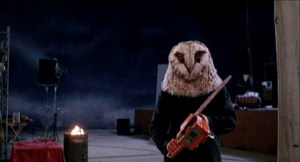
As is typical of films in the giallo genre, most of the murders are filmed from the killer’s point of view. What’s interesting is that, when the killer looks at his victims, he literally sees them as twisted monsters. It’s a neat little technique that leads to scenes like this:
Delirium was directed by Lamberto Bava, who has never quite gotten the attention that he deserves. Despite the fact that he directed such classics as the two Demons films and A Blade In the Dark,I’ve always felt that Lamberto is often overshadowed by the achievements of his father, Mario Bava. However, Lamberto Bava’s films are almost always entertaining when taken on their own terms. Delirium may not reach the heights of A Blade In The Dark or even Demons but it’s still an entertaining giallo. It’s perhaps not the film to use to introduce a newcomer to the genre but, those of us who are familiar with giallo, Delirium is an enjoyably crazed offering.
This weekend, I’m busy getting ready to go on a road trip with Jeff. I’ll be away from home for two whole weeks! However, fear not! With the help of WordPress and my wonderful, beautiful older sister Erin, I will still be updating and posting even while we’re on the road. I might even be able to convince my fellow Shattered Lens writer to spend the next two weeks watching the Lifetime Movie Channel and posting “What Lisa Would Have Watched Last Night.” How about it, guys? *wink wink*
(And by the way, just because I’m going to be out of town next weekend won’t stop me from posting six more trailers next Saturday. Why? Because I love you, silly!)
In this infamous little film from the 1970s, Richard Burton, Lee Marvin, and O.J. Simpson fight the Ku Klux Klan in Alabama. Believe it or not, I’ve actually seen this movie though the copy I saw was one of those public domain DVDs that I think was actually a copy of the edited-for-TV version of this movie. (I say that because every time someone cursed, there was an awkward silence on the soundtrack.) Even more odd is the fact that I’ve actually read the old novel that this movie is based on. Anyway, this movie is pretty bad but the book is okay. The film was directed by the same guy who directed the first James Bond films.
Okay, so this is pretty obviously an Exorcist rip-off but wow, this trailer freaks me out. Needless to say this is an Italian film. My favorite part of the trailer, to be honest, is the use of the Ryder truck. It’s a moment that epitomizes Italian exploitation in that you can tell that the filmmakers really thought that displaying the one word — “Ryder” — would convince viewers that they were watching an American-made film.
Speaking of Italian exploitation cinema, here we have another example. I pretty much had to include this trailer because I live in Dallas and 2020 is just 9 years away. That said, I’m not sure what part of Texas this film is supposed to be taking place in. I’m guessing by all the shots of boots marching through grass that this is supposed to be up in North Texas but if you can find mountains like that around here then you’ve got far better eyesight than I do. Add to that, the sudden indian attack seems more like an Oklahoma thing. Not surprisingly, according to Amazon, this film was not only directed by Joe D’Amato but features both George Eastman and Al Cliver.
Apparently, it didn’t start in Texas. This is also an Italian film. It was directed by Enzo Castellari and, not surprisingly, George Eastman is in this one as well.
The is the trailer that dares to ask — who are you going to listen to? Common sense or H.G. Wells? I’ll tell you, nothing freaks me out more than when I see one of those ant lines carrying a dead cricket back to the anthill. Ants are one thing that I will not allow in the house. However, I kinda admire them. They’re so neat and organized. Plus, males in ant society know their place.
“20th Century Fox presents Mr. Billion …. starring Terence Hill, the 5th biggest star in the world…” I haven’t seen very many Terence Hill films but I always enjoy seeing him in trailers. I can’t really say whether he’s a good actor or not because every time I’ve seen him, he’s been dubbed. But he definitely had a very likable presence. You wanted him to be a good actor whether he was or wasn’t. That said, even if I had been alive at the height of Mr. Hill’s fame, it never would have worked out for us as I’m Southern Italian and Hill is quite clearly from the north. That’s just the way it is. Anyway, back to Mr. Billion — I’m including two trailers for this one. The first is the “Prestige” trailer. The second one is much shorter and features one of those odd little songs that gets stuck in your head.
So, here I am. It’s May 1st, I’m suffering from a mighty terrible case of insomnia, my asthma is bothering me so much that I’d scream if I had the lung capacity, and let’s just say that whatever it is that I’m watching on LMN right now is not memorable enough to rate a What Lisa Watched Last Night post.
And yet, I’m excited. Why?
Because we have a title!
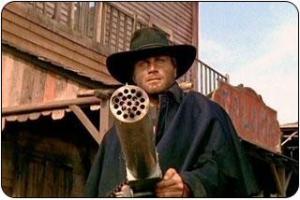
In this case, we have the title to Quentin Tarantino’s upcoming Spaghetti Western (or “Spaghetti Southern” as Tarantino has suggested it should be called). The title is Django Unchained. When I first heard that title, along with the rumor the Franco Nero would have a cameo in the film, I was hopeful that maybe Tarantino was looking to restart the original Django series. Back during the heyday of the Spaghetti Western, there were a countless number of Italian-made westerns that detailed the adventures of a ruthless bounty hunter named Django. Franco Nero first played Django in a film entitled, not surprisingly, Django. However, after the success of the first Django, Django was played by everyone from Tomas Milian to Ivan Rassimov to Jeff Cameron to George Eastman.
However, it appears that the name of Tarantino’s Django is not evidence of a reboot but just of an homage. Tarantino’s Django is a former slave who, along with an older German bounty hunter (presumably to be played by Christoph Waltz, who could use another good role), returns to the South to rescue his wife from an evil plantation owner.
If you read the story over on Comingsoon.net, you can read a review of the script from someone who claims to have read a copy. I’m not going to quote from that review because, quite frankly, it’s obvious just from the tone of it that the reviewer is busier trying to come across like a film geek badass than actually reviewing the script. (Seriously, there’s nothing I hate more than people who think they’re more interesting than they actually are.)
Still, I will always look forward to anything Tarantino does. Add Franco Nero into the mix and we have got a lot to look forward to.
Director Michele Soavi is probably best known for directing the last great Italian horror film, Dellamorte Dellamore. However, his word in that film has been so praised that, to a certain extent, Soavi’s earlier horror films have been overshadowed. This is a shame because Soavi was (and is) a great director and — before he temporarily retired from films in the mid-1990s — he directed four of the greatest Italian horror films ever made. The first of these films (and Soavi’s directorial debut) was the 1987 slasher film Stagefright.
As written by Luigi Montefiore (who, as an actor, was better known as George Eastman), Stagefright’s basic story function almost as a parody of a stereotypical 80s slasher film. On a dark and stormy night, an eg0-crazed, cocaine-addicted theatrical director (played by David Brandon) is running a rehearsal for his latest show, a campy musical about a fictional serial killer. However, even as his cast performs fictional mayhem on stage, a real killer escapes from a nearby mental hospital and makes his way to the theater. After the real killer murders the production’s wardrobe mistress, the director decides it would be a brilliant idea to rewrite his show to make it about the real killer. Not realizing that the real killer has snuck into the building, the director secretly locks his cast inside the theater and forces them to rehearse his new show. As you can probably guess, mayhem ensues and blood (a lot of blood) is spilled.
That the film worked (and continues to work over 20 years later) is a tribute to the talent of Michele Soavi. Obviously understanding that he was working with a genre piece, Soavi embraced the expectations of the slasher film and then pushed those expectations as far as he could. The end result is a film that works as both an old school slasher film and as a commentary, of sorts, on the genre as a whole. Soavi’s camera prowls every corner of the film’s theater, creating an atmosphere of truly claustrophobic dread. To me, the most effective thing about the film is that, for once, our victims actually do the smart thing. They stick together and try to fight off the killer as a group. And they end up failing miserably in a scene of horrific choas that shows Soavi at his best.
Soavi started his career as an actor and appeared in a countless number of Italian horror films in the late 70s and early 80s. (For whatever reason, Soavi always seemed to be getting killed in some awful way…) Perhaps that’s why, of all the great Italian horror directors, Soavi always seemed to have the best instincts when it came to casting. For a slasher film, Stagefright is well-acted by a cast made up of horror regulars. Barbara Cupisti is a properly likable protagonist in the role of “final girl” while the great Giovanni Lombardo Radice does good work in the small role of Brett, a flamboyantly gay actor. However, the film is dominated by David Brandon who snorts cocaine and barks out orders as if the fate of the world depended upon it.
(Soavi, himself, appears in a small role as an ineffectual policeman who, while people are dying all around, is more concerned with whether or not anyone else agrees that he looks like James Dean. And, it should be noted, there was a resemblance.)
As opposed to a lot of other directors involved with the Italian horror genre, Soavi had (and, I hope, still has) a genuine love of film and that love is obvious in his stylish direction here. There’s something truly exhilarating about seeing a movie made by someone who is truly in love with the possibilities of film and, because of that love, has no fear of pushing genre “rules” to their extreme.
 In a magical land of dragons and fierce warriors, the evil sorcerer Kadar (Richard Lynch) attacks a peaceful group of traveling entertainers, slaughtering the majority of them and kidnapping their queen, Canary (Virginia Bryant). Canary has a magical ruby that Kadar hopes will increase his power. Canary also has two sons who are each sold separately into slavery. Years later, these muscle-bound twins, Kutchek (Peter Paul) and Gore (David Paul), will be reunited and will team up to save their mother, fight a dragon, and free the kingdom from Kadar.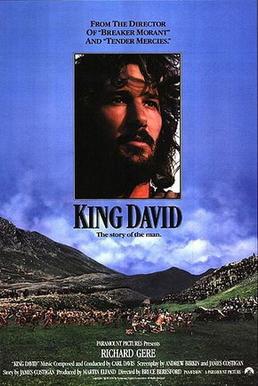



 Through the Shattered Lens