Did you know that in 1938, the same year that they horrified America with their production ofThe War Of The Worlds, Orson Welles and the Mercury Theater did a radio version of Dracula?
Check out this amazing cast list:
Orson Welles – Dracula/Dr. Arthur Seward
George Coulouris- Jonathan Harker
Ray Collins – Russian Captain
Karl Swenson – The Mate
Elizabeth Fuller – Lucy Westenra
Martin Gabel – Professor Van Helsing
Agnes Moorehead – Mina Harker
Coulouris, Collins, and Moorehead would, of course, all go one to appear with Orson Welles in Citizen Kane.
And now, we are proud to present, for your listening pleasure …. DRACULA!
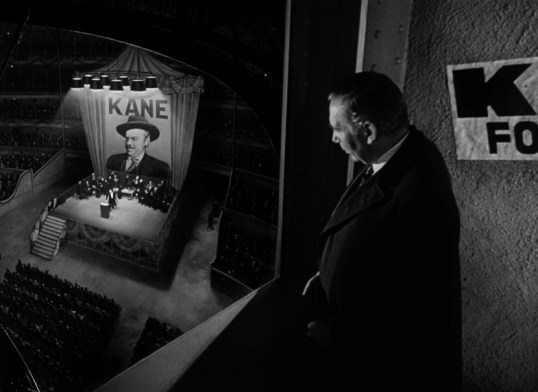
For some reason, certain people seem to feel the need to try to reduce what Orson Welles accomplished with 1941’s CitizenKane.
In 1971, the famous film critic Pauline Kael published an essay called RaisingKane, in which she argued that screenwriter Herman J. Mankiewicz deserved the majority of the credit for CitizenKane. This was Kael’s shot at rival Andrew Sarris and his embrace of the auteur theory. (1971 was the same year that Kael described DirtyHarry as being a “fascist work of art” so I guess even the best film critics can have a bad year.) David Fincher’s father, after reading Kael’s essay, wrote the screenplay for Mank, which not only made the case that Mankiewicz deserved the credit but which portrayed Orson Welles in such a negative fashion that you really did have to wonder if maybe Orson had owed old Jack Fincher money or something. Herman J. Mankiewicz himself always claimed that he deserved the majority of the credit for CitizenKane but then he would, wouldn’t he?
The truth of the matter is that Mankiewicz did write the screenplay for CitizenKane and he did base the character of Charles Foster Kane on William Randolph Hearst and the character of Kane’s second wife on Hearst’s mistress, Marion Davies. There’s some debate over how much of the film’s narrative structure belongs to Mankiewicz and how much of it was a result of Welles rewriting the script. Mankiewicz played his part in the making of CitizenKane but he played that part largely because Orson Welles allowed him to. Like all great directors, Welles surrounded himself with people who could help to bring his vision to life. (That’s something that would think David Fincher, of all people, would understand. Aaron Sorkin may have written The Social Network but the reason why the film touched so many is because it was a David Fincher film.)
Make no mistake about it. CitizenKane is Orson Welles’s vision and Welles is the one who deserves the majority of the credit for the film. The themes of Citizen Kane are ones to which Welles would frequently return and the cast, all of whom bring their characters to vivid life, is made up of largely of the members of Welles’s Mercury Theatre. The tracking camera shots, the dark cinematography, and the satiric moments are all pure Welles. As the Fincher film argues, Mankiewicz may have very well meant to use the film to attack Hearst for his personal hypocrisy and for opposing the political ambitions of Upton Sinclair. If so, let us be thankful that Orson Welles, as a director, was smart enough to realize that such didacticism is often deadly dull.
And there’s nothing dull about Citizen Kane. It’s a great film but it’s also an undeniably fun film, full of unforgettable imagery and scenes that play like their coming to us in a dream. It’s a film that grabs your interest and proves itself to be worthy of every minute that it takes to watch it. I was lucky enough to first see Citizen Kane at a repertory theater and on the big screen and really, that’s the best way to watch it. It’s a big film that’s full of bigger-than-life characters who are ultimately revealed to be full of the same human longings and regrets as all of us. As a young man, the fabulously wealthy Charles Foster Kane thinks that it would be “fun” to run a newspaper. Later, he thinks that he’s found love by marrying the niece of the President. He runs for governor of New York and, watching Welles in these scenes, you can see why FDR tried to recruit him to run for the Senate. Welles has the charisma of a born politician. When Welles first meets Susan Alexander (Dorothy Comingore) it’s easy to laugh. The great man has just been splashed by a taxi. Susan laughs but then winces in pain due to a tooth ache. Later, Kane insists on trying to turn her into an opera star. He runs a negative review written by his friend (Joseph Cotten) and then he promptly fires him. As in all of Welles’s films, it’s all about personal loyalty. Kane may betray his wife and the voters but he’s ultimately just as betrayed by those around him. In the end, you get the feeling that Kane was desperately trying to not be alone and yet, that’s how he ended up.
There are so many stand-out moments in CitizenKane that it’s hard to list them all. The opening — MIGHTY XANADU! — comes to mind. The satirically overdramatic newsreel is another. (CitizenKane can be a very funny film.) Joseph Cotten’s performance continues to charm. Orson Welles’s performance continues to amaze. Who can forget Agnes Moorehead as Kane’s mother or Everett Sloane as Mr. Bernstein, haunted by that one woman he once saw on a street corner? Myself, I’ve always liked the performances of Ray Collins (as the sleazy but strangely reasonable Boss Gettys), Paul Stewart (as the subtly menacing butler), and Ruth Warrick (as Kane’s first wife). Mankiewicz may have put the characters on paper but Welles is the one who selected the amazing cast that brought them to life.
CitizenKane was nominated for nine Oscars and it won one, for the screenplay written by Welles and Mankiewicz. Best Picture went to How Green Was My Valley. When was the last time anyone debated who should be given credit for that movie?
This radio production of A Christmas Carol was originally broadcast on Christmas Eve, 1939. It’s not really Christmas unless you experience at least one version of Charles Dickens’s classic holiday tale and this version features not only Orson Welles providing the narration but Lionel Barrymore playing the role of Scrooge!
Other members of the cast included such well-known Welles’s associates as Everett Sloane (Marley’s ghost), Frank Readick (Bob Cratchit), Erskine Sanford (Fezziwig) and George Coulouris (Ghost of Christmas Present). Two years after this broadcast, Welles, Sloane, Sanford, and Coulouris would all appear in Citizen Kane.
For your listening pleasure, we offer up this journey to the past….
Did you know that in 1938, the same year that they horrified America with their production of The War Of The Worlds, Orson Welles and the Mercury Theater did a radio version of Dracula?
Check out this amazing cast list:
Orson Welles – Dracula/Dr. Arthur Seward
George Coulouris- Jonathan Harker
Ray Collins – Russian Captain
Karl Swenson – The Mate
Elizabeth Fuller – Lucy Westenra
Martin Gabel – Professor Van Helsing
Agnes Moorehead – Mina Harker
Coulouris, Collins, and Moorehead would, of course, all go one to appear with Orson Welles in Citizen Kane.
And now, we are proud to present, for your listening pleasure …. DRACULA!
Before he revolutionized cinema, Orson Welles revolutionized both theater and radio. As the host and mastermind behind the Mercury Theatre On The Air, Welles was heard on a weekly basis as the show broadcast adaptations of literary classics into American homes. In 1938, both Welles and Mercury Theatre On The Air achieved a certain immortality with their broadcast of War of the Worlds. What is often forgotten is that, one week after terrifying America, the Mercury Theatre presented an adaptation of Joseph Conrad’s Heart of Darkness, one which featured Welles in the role of Kurtz and his future Citizen Kane co-star, Ray Collins, as Marlow.
This broadcast was significant in that, when Welles first went to Hollywood, it was with an eye towards turning Heart of Darkness into a film. Welles planned to shoot the film strictly from the point-of-view of Marlow, with the camera serving as Marlow’s eyes. Welles not only planned to play Kurtz in the film but he also intended to provide the voice of Marlow. Unfortunately, the film was never made. With the outbreak of war in Europe, it was felt that the audience most likely to embrace Welles’s experiment would no longer be going to the movies. Welles would instead make his cinematic debut with Citizen Kane, a film that fully embodies Welles’s artistic vision regardless of what Mank tried to sell everyone last year. As for Heart of Darkness, it would later be adapted for television, appearing in greatly altered form as an episode of Playhouse 90 in 1958. Boris Karloff played Kurtz and Roddy McDowall played Marlow and someone decided that it would be a good idea to add a subplot in which Kurtz is revealed to by Marlow’s long lost father. There would be many attempts to turn Conrad’s novella into a feature film but it was not until 1979, with Francis Ford Coppola’s Apocalypse Now, that Conrad’s story would appear on the big screen, albeit in massively altered form. Nicolas Roeg would later direct his own version of Heart of Darkness, one that featured Tim Roth as Marlow and John Malkovich as Kurtz. (I haven’t seen it but that just sounds like perfect casting.)
Today, in honor of the 106th anniversary of the birth of Orson Welles, here is the Mercury Theatre On The Air’s production of Heart of Darkness. This broadcast also features an adaptation of the play, Life With Father. The casts are as follows:
Heart of Darkness: Orson Welles (Author, Ernest Kurtz), Ray Collins (Marlow), Alfred Shirley (Accountant), George Coulouris (Assistant Manager), Edgar Barrier (Second Manager), William Alland (Agent), Virginia Welles (Kurtz’s Intended Bride), Frank Readick (Tchiatosov)
(For those keeping track, Welles, Collins, Coulouris, and Alland would all have key roles in Citizen Kane. Alland played the reporter who is assigned to discover the meaning of Rosebud. Ray Collins played Boss Jim Gettys, the political boss who prevents Kane from being elected governor. Coulouris played Kane’s guardian, Walter Parkes Thatcher. And Welles, of course, was Charles Foster Kane, American. )
Life With Father: Orson Welles (Father), Mildred Natwick (Mother), Mary Wickes (Employment Office Manager), Alice Frost (Margaret), Arthur Anderson (young Clarence Day).
This program was originally aired on November 6th, 1938. Welles was 22 years old at the time of this broadcast. So, sit back and enjoy Orson Welles and the Mercury Theatre.
Did you know that in 1938, the same year that they horrified America with their production of The War Of The Worlds, Orson Welles and the Mercury Theater did a radio version of Dracula?
Check out this amazing cast list:
Orson Welles – Dracula/Dr. Arthur Seward
George Coulouris- Jonathan Harker
Ray Collins – Russian Captain
Karl Swenson – The Mate
Elizabeth Fuller – Lucy Westenra
Martin Gabel – Professor Van Helsing
Agnes Moorehead – Mina Harker
Coulouris, Collins, and Moorehead would, of course, all go one to appear with Orson Welles in Citizen Kane.
And now, we are proud to present, for your listening pleasure …. DRACULA!
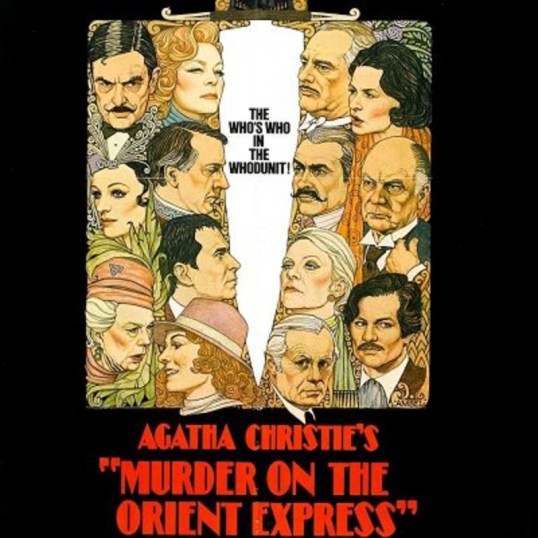
In the middle of the night, a shady American businessman (Richard Widmark) was stabbed to death. Now, with the train momentarily stalled due to a blizzard, its up to the world’s greatest detective, Hercule Poirot (Albert Finney), to solve the crime. With only hours to go before the snow is cleared off the tracks and the case is handed over to the local authorities, Hercule must work with Bianchi (Martin Balsam) and Dr. Constantine (George Coulouris) to figure out who among the all-star cast is a murderer.
Is it the neurotic missionary played by Ingrid Bergman? Is it the diplomat played by Michael York or his wife, played by Jacqueline Bisset? Is it the military man played by Sean Connery? How about Anthony Perkins or John Gielgud? Maybe it’s Lauren Bacall or could it be Wendy Hiller or Rachel Roberts or even Vanessa Redgrave? Who could it be and how are they linked to a previous kidnapping, one that led to the murder of an infant and the subsequent death of everyone else in the household?
Well, the obvious answer, of course, is that it had to be Sean Connery, right? I mean, we’ve all seen From Russia With Love. We know what that man is capable of doing on a train. Or what about Dr. No? Connery shot a man in cold blood in that one and then he smirked about it. Now, obviously, Connery was playing James Bond in those films but still, from the minute we see him in Murder on the Orient Express, we know that he’s a potential killer. At the height of his career, Connery had the look of a killer. A sexy killer, but a killer nonetheless….
Actually, the solution to the mystery is a bit more complicated but you already knew that. One of the more challenging things about watching the 1974 version of Murder on the Orient Express is that, in all probability, the viewer will already know how the victim came to be dead. As convoluted as the plot may be, the solution is also famous enough that even those who haven’t seen the 1974 film, the remake, or read Agatha Christie’s original novel will probably already know what Poirot is going to discover.
That was something that director Sidney Lumet obviously understood. Hence, instead of focusing on the mystery, he focuses on the performers. His version of Murder on the Orient Express is full of character actors who, along with being talented, were also theatrical in the best possible way. The film is essentially a series of monologues, with each actor getting a few minutes to show off before Poirot stepped up to explain what had happened. None of the performances are exactly subtle but it doesn’t matter because everyone appears to be having a good time. (Finney, in particular, seems to fall in love with his occasionally indecipherable accent.) Any film that has Anthony Perkins, John Gielgud, Lauren Bacall, Sean Connery, Ingrid Bergman, and Albert Finney all acting up a storm is going to be entertaining to watch.
Though it’s been a bit overshadowed by the Kenneth Branagh version, the original Murder on the Orient Express holds up well. I have to admit that Sidney Lumet always seems like he would have been a bit of an odd choice to direct this film. I mean, just consider that he made this film in-between directing Serpico and Dog Day Afternoon. However, Lumet pulls it off, largely by staying out of the way of his amazing cast and letting them act up a storm. It looks like it was a fun movie to shoot. It’s certainly a fun movie to watch, even if we do already know the solution.
This radio production of A Christmas Carol was originally broadcast on Christmas Eve, 1939. It’s not really Christmas unless you experience at least one version of Charles Dickens’s classic holiday tale and this version features not only Orson Welles providing the narration but Lionel Barrymore playing the role of Scrooge!
Other members of the cast included such well-known Welles’s associates as Everett Sloane (Marley’s ghost), Frank Readick (Bob Cratchit), Erskine Sanford (Fezziwig) and George Coulouris (Ghost of Christmas Present). Two years after this broadcast, Welles, Sloane, Sanford, and Coulouris would all appear in Citizen Kane.
For your listening pleasure, we offer up this journey to the past….
Deanna Durbin was the best Christmas present Universal Studios ever received. The 15-year-old singing sensation made her feature debut in 1936’s THREE SMART GIRLS, released five days before Christmas. The smash hit helped save cash-strapped Universal from bankruptcy, and Miss Durbin signed a long-term contract, appearing in a string of musical successes: ONE HUNDRED MEN AND A GIRL, THAT CERTAIN AGE, SPRING PARADE, NICE GIRL?, IT STARTED WITH EVE. One of her best is the Christmas themed comedy/murder mystery LADY ON A TRAIN, one of only two films directed by Charles David, who married the star in 1950, the couple then retiring to his native France.
Our story begins with young Nikki Collins travelling by train from San Francisco to New York City to visit her Aunt Martha, reading a murder mystery to pass the time. Nikki witnesses a real-life murder committed through a window, and after ditching her wealthy…
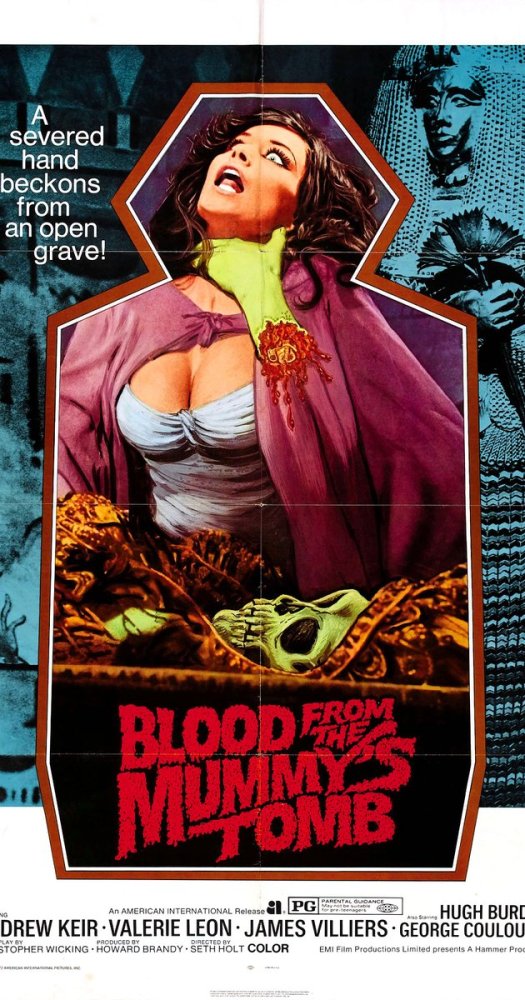
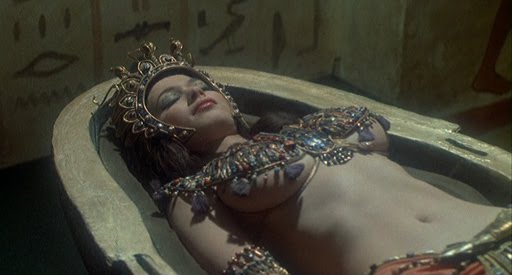
Hammer’s ‘Mummy’ movies never really did it for me, but BLOOD FROM THE MUMMY’S TOMB is a shroud of a different colour. Adapted from Bram Stoker’s novel “The Jewel of the Seven Stars”, the movie suffered some behind the scenes setbacks, which contribute to its choppy nature. The backstage chaos began when original star Peter Cushing’s wife passed away after only a day’s filming. He was replaced by Andrew Keir (QUARTERMASS AND THE PIT). Then before shooting was complete, director Seth Holt (TASTE OF FEAR, THE NANNY) died of a heart attack, and Hammer veteran Michael Carreras had to step in to finish the film. Despite all this, BLOOD FROM THE MUMMY’S TOMB is one of the better latter-day Hammers, picking up steam as it goes along, with a great performance by sexy star Valerie Leon.
Leon plays Margaret Fuchs, who was born the same day her father Professor Julian Fuchs…




 Through the Shattered Lens